Irene MacDougall

1984

27/10/26

The Royal Lyceum Theatre, Edinburgh

George Orwell’s 1949 novel is embedded into our cultural landscape, its ideas spreading far beyond the confines of the page. In the seven decades since it was published, its terminology has become ubiquitous: thought police, doublethink, Room 101 – and, most famously, Big Brother, who always knows what we’re up to, thanks to surveillance devices installed in our homes.

What time did you get in last night? Your doorbell knows. Hey, Siri. Alexa! Are you listening?

Of course, this means that it is endlessly adaptable (and endlessly adapted), horribly applicable to almost every political regime. So what’s a theatre-maker to do if they want to offer a fresh perspective? In this instance, playwright Chris Hannan has opted for a framing device highlighting 1984‘s Scottish origins, as Orwell builds his dystopia from a bed in Glasgow’s Hairmyres Hospital, where he’s being treated for TB. It works well, binding the fictional world to the real one, reminding us how easily Oceania could become our actuality.

The first act is impressive. Jack Tarlton convinces as both Orwell and his protagonist, the world-weary Winston Smith. It’s a demanding job (the actor is in every scene) and he handles it with aplomb, engaging us in the two men’s inner struggles: Orwell coming to terms with his physical decline, and Winston trying to retain his sense of self in the face of ruthless authoritarianism.

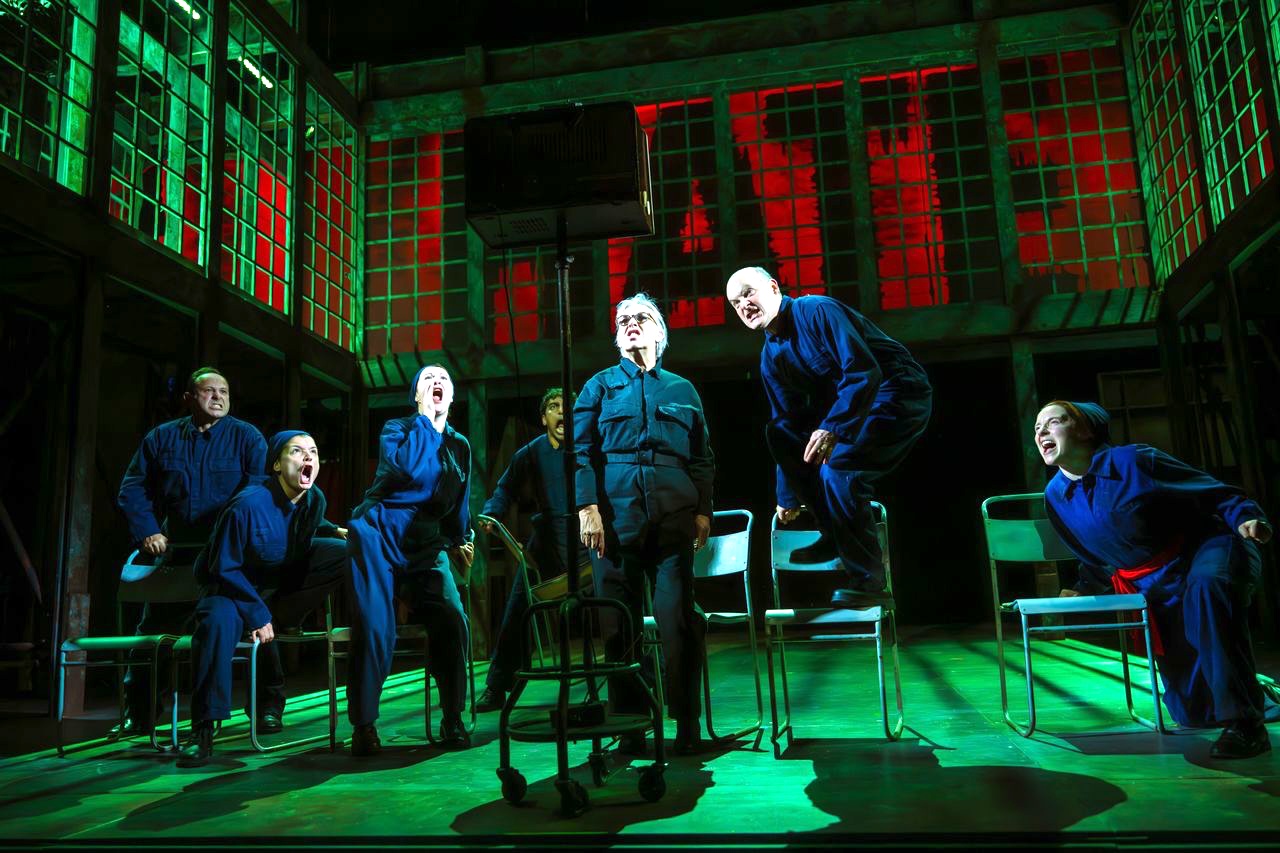
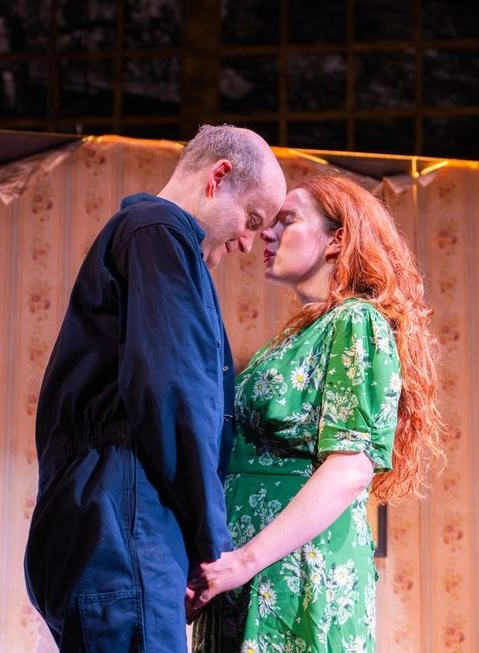
Tom Piper’s imposing design creates an immediate sense of oppression, with metal bars and grating dominating the prison-like set, where silent guards patrol an upper mezzanine. When Winston and his co-conspirator, Julia (Jessica Hardwick), venture out into the forbidden countryside for a tryst, the naif-style roll-on scenery is over-bright and fake looking, accentuating the couple’s wilful delusion. They’re not fooling anyone except themselves; Big Brother is just biding his time.

Unfortunately, the second act is not as successful as the first. Once Winston and Julia have been apprehended for their transgressions, the storytelling becomes more fragmented and we are afforded less insight into their characters. Winston’s torture is shown in a series of vignettes which, although visually arresting, are punctuated by long blackouts, which soon become tiresome. What’s more, although I like the idea of gender-swapping O’Brien, I can’t help thinking Irene MacDougall has been miscast here, exuding neither menace nor authority.

Perhaps the most disappointing element is the Room 101 sequence. I share Winston’s phobia of rats and yet I’m not at all moved. The box on Winston’s face means that we can’t see his reactions, while Heather Scott’s video design – a strength of the production up to this point – is too understated here, the images of the rodents too dark and close-up to really make out.

The hospital scenes ameliorate things somewhat, with Robert Jack and Irene Allan convincing as Dr Dick and Nurse Rankine respectively. Director Dominic Hill creates a palpable sense of Orwell’s desperate situation in these moments, illuminating both subtle and not-so subtle links to the novel.

All in all, this co-production between Glasgow’s Citizens’ Theatre, Dundee Rep and Edinburgh’s Royal Lyceum offers an interesting and uniquely Scottish take on a modern classic. Despite some mis-steps, it’s nonetheless well worth seeing, especially in these post-truth times.

3.6 stars

Susan Singfield

Oor Wullie: The Musical

28/01/20

King’s Theatre, Edinburgh

Jings and crivvens!

Wullie and I are old acquaintances. He appeared every week in the comics I read as a child back in the 1960s, but he first saw the light of day in 1936 and has endured over the decades, recently clocking up his eightieth anniversary. Last year, his image made millions for charity with the Big Bucket Trail, which featured individually decorated statues of the iconic kid from Auchenshoogle in various locations around Scotland.

This musical, by the same team who brought The Broons to the stage, features  a sprightly and raucous collection of songs in a wide range of styles. The simplicity of the storyline would seem to make it a good fit for a younger audience. Indeed, the kids in the auditorium tonight are clearly enjoying the proceedings (especially when Wullie’s pet mouse, Jeemy, makes an appearance), but the majority of the audience are older people, here to reconnect with something fondly remembered from their childhoods.

Wahid (Eklovey Kashyap) is a teenage boy, born in Scotland to Pakistani parents. He’s having a hard time fitting in, forever being asked if he ‘likes his new home.’ Well-meaning neighbours ask him where he’s really from, while the school bullies enjoy making fun of him at every opportunity. Wahid is Scottish, but somehow, ‘not-Scottish,’ and he’s beginning to struggle with his own identity.

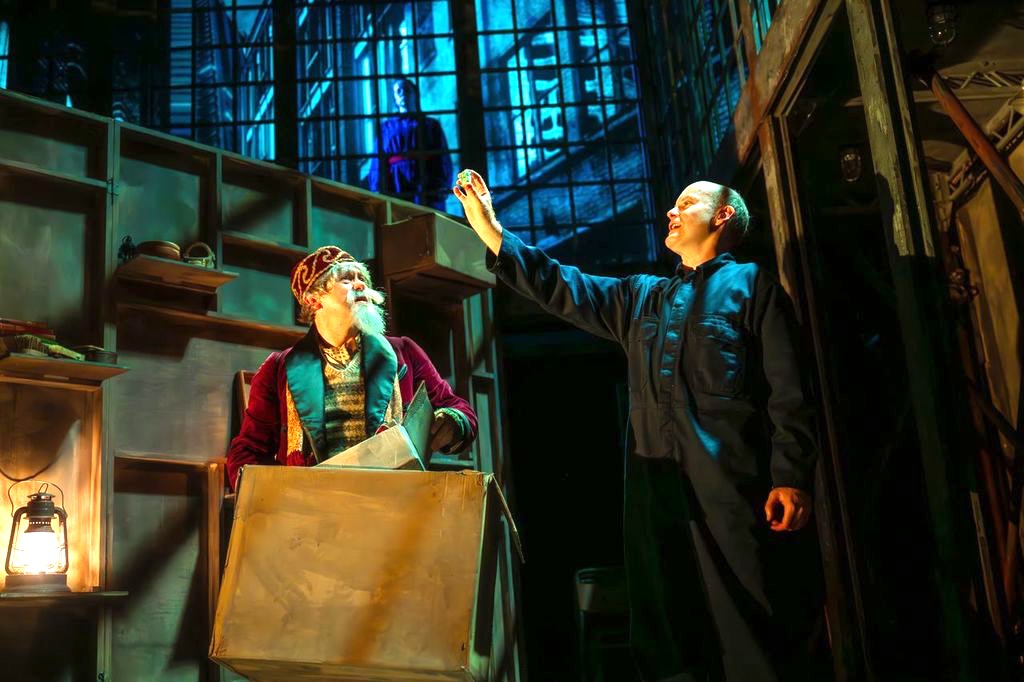
In the school library, he meets up with the mysterious librarian (George Brennan), who gives him an Oor Wullie annual to read, telling him it’s the perfect introduction to ‘being Scottish.’ Wahid is somewhat taken aback when Wullie (Martin Quinn) appears in his bedroom, claiming to be in search of his famous bucket, which has unexpectedly gone missing. Wahid remembers that he saw just such a bucket in the school library, so the two of them set off in search of it.

It isn’t long before Wullie is joined by his gang – Bob (Dan Buckley), Wee Eck (Grant McIntyre), Soapy Soutar (Bailey Newsome) and Primrose (Leah Byrne). They are not surprised to discover that the bucket has been purloined by arch enemy, Basher McKenzie (Leanne Traynor), and the kids enlist their old adversary PC Murdoch (Ann Louise Ross) to help them retrieve it. In the second half, the comic book characters take Wahid into the fictional world of Auchenshoogle, where their clothes transform from black and white into full colour.

Valiant attempts are made to make Wullie more relevant to a modern day audience. There’s a song that features him performing a duet with Alexa, for instance and there’s a nice bit of inclusivity where the cast put on saris and leap about to a bhangra-style tune. PC Murdoch gets an opportunity to strut his stuff to a rock song and there’s some funny interplay between him and an amorous teacher (Irene MacDougall).

If there’s an over-riding problem, however, it’s that the drama fails to generate any genuine sense of peril. Wullie wants his bucket back, but we’re never entirely sure why its so important to him, nor indeed what will happen if he doesn’t get it. The result is never less than knockabout fun, but here’s a musical that doesn’t seem entirely sure about what kind of audience it’s trying to appeal to.

To my mind, it’s surely one for the kids, assuming you can get them away from their phones and tablets for a couple of hours. Wullie has been an enduring character over the decades and there’s no reason why a new generation of youngsters shouldn’t fall for his charms, given half a chance.

3.5 stars

Philip Caveney