Robert Jack

1984

27/10/26

The Royal Lyceum Theatre, Edinburgh

George Orwell’s 1949 novel is embedded into our cultural landscape, its ideas spreading far beyond the confines of the page. In the seven decades since it was published, its terminology has become ubiquitous: thought police, doublethink, Room 101 – and, most famously, Big Brother, who always knows what we’re up to, thanks to surveillance devices installed in our homes.

What time did you get in last night? Your doorbell knows. Hey, Siri. Alexa! Are you listening?

Of course, this means that it is endlessly adaptable (and endlessly adapted), horribly applicable to almost every political regime. So what’s a theatre-maker to do if they want to offer a fresh perspective? In this instance, playwright Chris Hannan has opted for a framing device highlighting 1984‘s Scottish origins, as Orwell builds his dystopia from a bed in Glasgow’s Hairmyres Hospital, where he’s being treated for TB. It works well, binding the fictional world to the real one, reminding us how easily Oceania could become our actuality.

The first act is impressive. Jack Tarlton convinces as both Orwell and his protagonist, the world-weary Winston Smith. It’s a demanding job (the actor is in every scene) and he handles it with aplomb, engaging us in the two men’s inner struggles: Orwell coming to terms with his physical decline, and Winston trying to retain his sense of self in the face of ruthless authoritarianism.

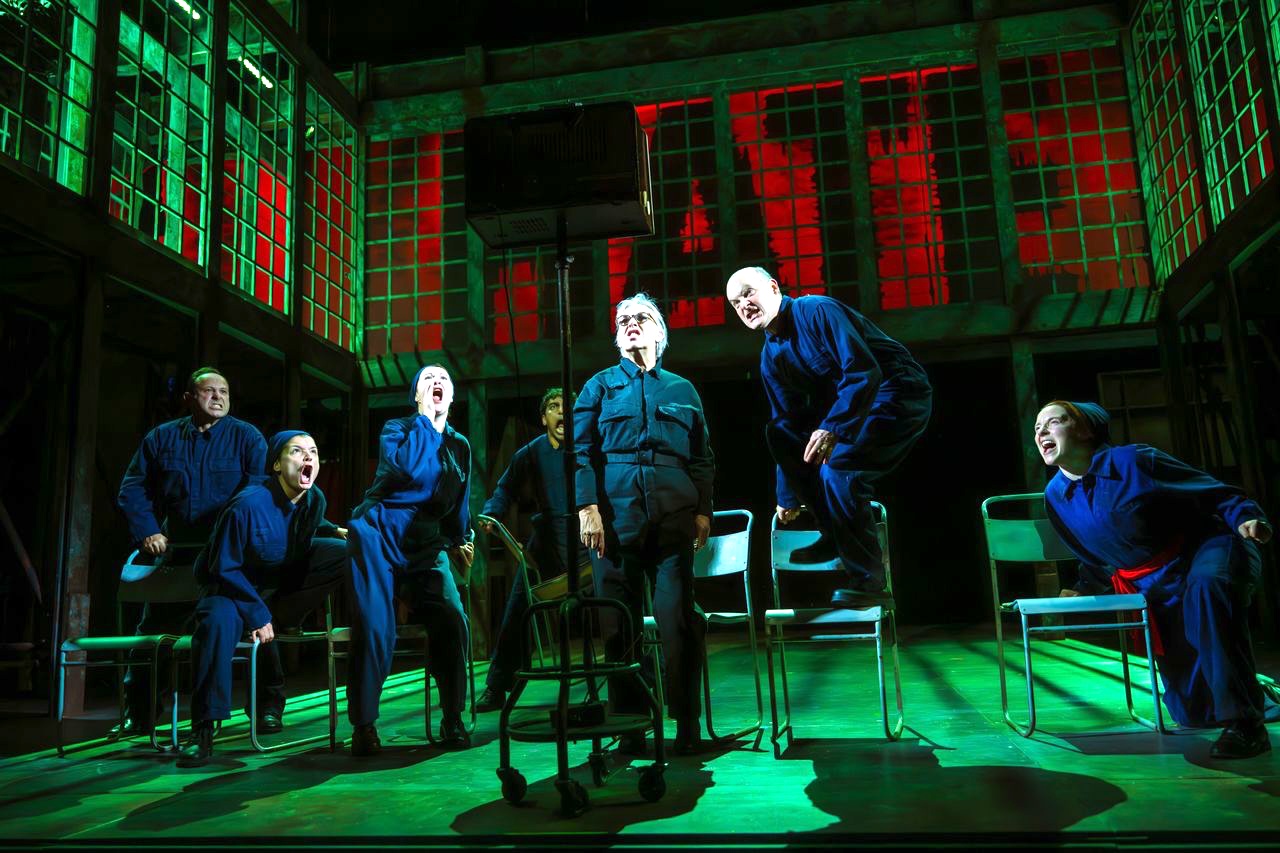
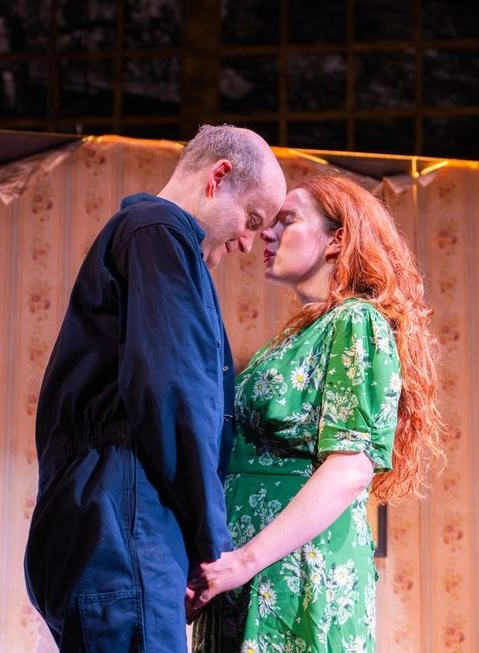
Tom Piper’s imposing design creates an immediate sense of oppression, with metal bars and grating dominating the prison-like set, where silent guards patrol an upper mezzanine. When Winston and his co-conspirator, Julia (Jessica Hardwick), venture out into the forbidden countryside for a tryst, the naif-style roll-on scenery is over-bright and fake looking, accentuating the couple’s wilful delusion. They’re not fooling anyone except themselves; Big Brother is just biding his time.

Unfortunately, the second act is not as successful as the first. Once Winston and Julia have been apprehended for their transgressions, the storytelling becomes more fragmented and we are afforded less insight into their characters. Winston’s torture is shown in a series of vignettes which, although visually arresting, are punctuated by long blackouts, which soon become tiresome. What’s more, although I like the idea of gender-swapping O’Brien, I can’t help thinking Irene MacDougall has been miscast here, exuding neither menace nor authority.

Perhaps the most disappointing element is the Room 101 sequence. I share Winston’s phobia of rats and yet I’m not at all moved. The box on Winston’s face means that we can’t see his reactions, while Heather Scott’s video design – a strength of the production up to this point – is too understated here, the images of the rodents too dark and close-up to really make out.

The hospital scenes ameliorate things somewhat, with Robert Jack and Irene Allan convincing as Dr Dick and Nurse Rankine respectively. Director Dominic Hill creates a palpable sense of Orwell’s desperate situation in these moments, illuminating both subtle and not-so subtle links to the novel.

All in all, this co-production between Glasgow’s Citizens’ Theatre, Dundee Rep and Edinburgh’s Royal Lyceum offers an interesting and uniquely Scottish take on a modern classic. Despite some mis-steps, it’s nonetheless well worth seeing, especially in these post-truth times.

3.6 stars

Susan Singfield

Ulster American

21/02/19

Traverse Theatre, Edinburgh

We missed Ulster American at the Fringe last year, but we couldn’t miss the buzz surrounding David Ireland’s latest play: the high praise and the damning criticism, the controversy, the hype. So we’re delighted that it’s back at the Traverse for a ten-day run. Now we can see for ourselves precisely what the fuss was all about.

Right from the start. we know we’re in the ‘high praise’ camp. Darrell D’Silva swaggers into action as Jay, an alpha-male Hollywood star, expecting deference and devotion, used to being fêted but in denial about his privilege. He’s visiting Leigh (Robert Jack), a mild-mannered London theatre director, who’s clearly desperate to please the celebrity who’ll ensure his latest project is a sell-out. As they await the arrival of Ruth (Lucianne McEvoy), the Northern Irish playwright in whose drama Jay will take the lead, the two men make conversation, with Jay predictably dominating proceedings. His intense, naval-gazing prattle discomfits Leigh, and the scene is genuinely hilarious – as well as shocking.

The humour here derives mainly from Jay’s lack of self-awareness, and from Leigh’s awkward attempts to disagree without offending him. Jay’s a self-proclaimed nice guy; he loves women. He refuses to see how reductive his hypothetical rape questions might be, and Leigh is no better, colluding as he eventually does. I find myself perplexed by critics who’ve condemned the piece for joking about rape. I’m a feminist; I’m primed to bristle. But the joke is never about rape. It’s about two deluded men and their blind spots, about their tone-deaf ignorance. Jay’s forcefulness juxtaposed with Leigh’s nervy twitching is a fascinating dynamic, and the performances heighten these characteristics to great effect.

When Ruth arrives, their hubris is further exposed. Her play – which both men claim to love – is about the Troubles in Northern Ireland, and its protagonist is a Unionist terrorist. American Jay, despite identifying as an Irish-Catholic, has never actually been to Ireland, and is having trouble grasping the basic details. What does Ulster mean, exactly? And what’s a Fenian? It soon becomes clear that he has accepted the part without understanding it, and that he’s not at all happy about the themes that Ruth reveals.

From here, mayhem ensues, as the three pursue their own disparate agenda. Ruth and Jay are at loggerheads, while Leigh is stuck in the middle, tying himself in knots to appease them both, and failing miserably. He claims he’s a feminist, that women’s voices need to be heard, but misses the disconnect between these assertions and his constant interruptions and shushing of Ruth; his mansplaining, “What she really means is…”; his rebuttal of her declaration that she’s British (“She’s not.”).

Still, neither man is wholly repugnant: Jay, despite his bombast and bluster, is well-meaning really; Leigh is weak and obsequious, but he’s not unlikeable. Nor is Ruth a stainless heroine; she’s more than capable of using the situation to further her own ends. But she is the only one with a clear sense of who she is – and it’s she who drives the play to its shocking conclusion. McEvoy portrays her as a force to be reckoned with, all jaw-clenched determination and self-assurance. It’s a remarkable performance.

This is a visceral, explosive piece of drama, reminiscent of early Martin McDonagh with its bloody violence and dark humour, and the direction (by Gareth Nicholls) is flawless. The fights (choreographed by EmmaClaire Brightlyn) are the most horribly convincing I’ve ever seen, forcing me to watch through my fingers, and gasp in revulsion. (I see this as a positive.) All three actors are compelling in their roles; the tension between them is palpable.

We leave the theatre talking about the issues raised, and we’re still discussing them  hours later. This is riveting stuff and an important addition to the #metoo dialogue.

5 stars

Susan Singfield


Rhinoceros

25/03/18

Lyceum Theatre, Edinburgh

There are, I’m told, people who “don’t like” theatre. And, of course, those people are absolutely entitled to their opinion. But, oh, how I wish I could take them by the hand and guide them to the Royal Lyceum, where Edinburgh’s International Festival and Istanbul’s Dot Theatre have joined forces to create something I’m sure would change their minds.

I’ve read Eugene Ionesco’s Rhinoceros, but I’ve never seen it performed. And, in Turkish director Murat Daltaban’s hands, something magical happens in that leap from page to stage. This is inspirational theatre: at once lively, accessible, thought-provoking and funny. It’s clever, clever stuff – and, judging by the excited, enthusiastic buzz in the theatre bar, it’s crowd-pleasing as well.

Speaking of crowds, that’s pretty much what this play’s about; more specifically, to quote the Lyceum’s artistic director, David Grieg, it’s about “the fragility of the individual in a time of crowds.” Ionesco witnessed the rise of fascism in 1930s Romania, and this play – with bewildered everyman, Berenger (Robert Jack), at its core – highlights the unsettling horror he must have felt at watching his world change. And, of course, the timing of this production is no accident, with the rise of the ‘alt-right’ and the increasing polarisation of political debate.

As the play opens, all seems well. The sleepy French village comes to life like an animated postcard, all bright hues and exaggerated dimensions. Characters and relationships are quickly established, and there is humour and energy in the exchanges, even when they become heated. But the sight of a rhinoceros (or are there two?) rampaging through the town results in the first real tension, the first real rift.

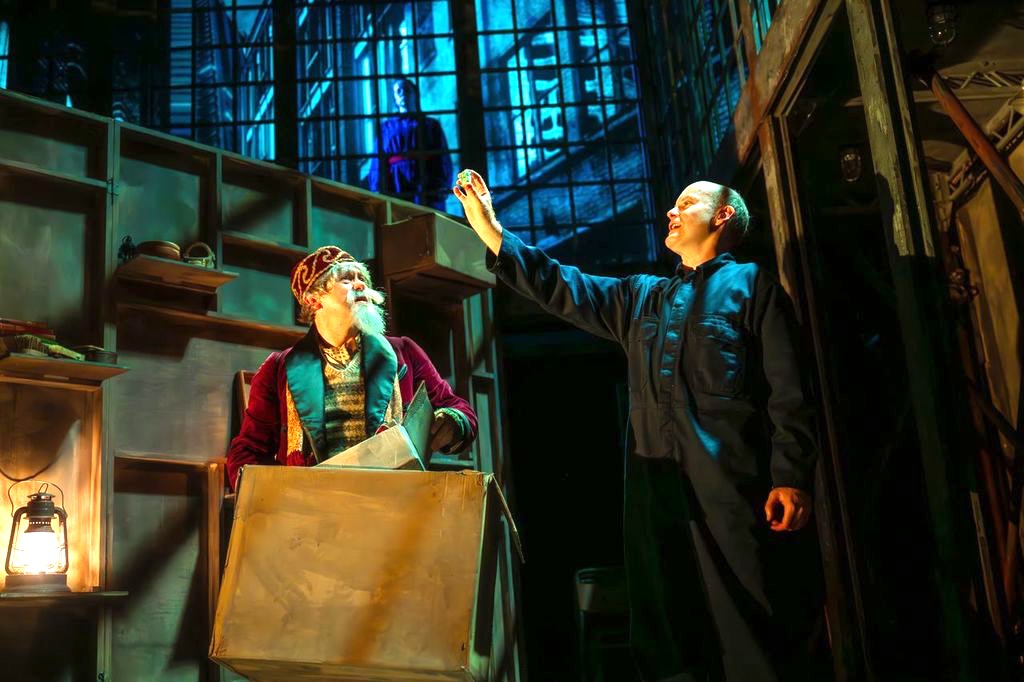
As growing numbers of rhinoceroses appear, Berenger – a drifter with a drink problem – is horrified to learn that they are his friends and neighbours, that the townsfolk are literally turning into these braying beasts. As more and more of them join the herd, Berenger becomes ever more isolated, a predicament that is illustrated beautifully by the ingenious set, reminiscent of a Chinese puzzle box, shrinking his ‘safe place’ until it’s perilous and unworkable.

This is a truly glorious production, as witty and vivacious as it is prescient. There are some great comic turns, most notably from Myra McFadyen as Papillon and Steven McNicoll as Jean. It’s visually stunning, and the sensual, Middle Eastern-inflected music adds to the mood of transformation, with musician Oguz Kaplangi onstage throughout.

Seriously, grab a reluctant theatre-goer and head along to the Royal Lyceum tonight. You’ll be changing hearts and minds.

5 stars

Susan Singfield

Charlie Sonata

02/05/17

Lyceum Theatre, Edinburgh

Some playwrights tell their stories in straightforward terms – others prefer to take a more mysterious route, leaving you with several unanswered questions – and Douglas Maxwell’s Charlie Sonata falls very definitely into the latter category. And it’s all the more intriguing for it – if more difficult to pin down in a review. The play, brilliantly directed by Matthew Lenton, is an enchanting, magical tale that flirts with seemingly unconnected ideas: the concept of time travel, a famous fairy story and the era of Britpop.

Chick (Sandy Grierson), a hard drinking but immensely affable drifter, returns from London to his Scottish hometown when he hears that the teenage daughter of his old pal, Gary (Kevin Lennon), is in a coma following an accident. Chick hopes to reconnect with Gary –  and with his other best friend, Jackson (Robert Jack), but events keep getting in his way and he continually finds his thoughts shunted unexpectedly back to earlier, happier days at Stirling University, when the three young lads had no responsibilities. Jackson is fond of expounding his “non-negotiable” theories about time-travel. Chick is about to discover how negotiable they really are.

Pretty soon, Chick is back in the present day, hanging around the hospital, where he encounters mysterious ‘bad fairy’ Meredith (Meg Fraser), who is struggling with her own issues. Can she and Chick work together to release Gary’s daughter, Audrey (Lauren Grace), from her ‘Sleeping Beauty’ coma?

Nothing here is ever quite what it seems and, as the narrative switches effortlessly backwards and forwards in time, the scenes are linked by a commentary by The Narrator (Robbie Gordon), which adds to the story’s mythical feel. Grierson plays Chick with just the right mixture of vulnerability and intoxication – I’ve rarely been so convinced by an onstage ‘drunk’ – while the inventive production design by Ana Inés Jabares-Pita and the ethereal lighting by Kai Fischer, keep creating moments of real wonder that help to reinforce that all-important sense of magic.

This is a challenging but ultimately rewarding piece of theatre, based around – in Douglas Maxwell’s own words – ‘a fairy tale wish for another chance to make everything right.’ The audience’s enthusiastic response seems to confirm that this production has achieved its aims.

4.2 stars

Philip Caveney