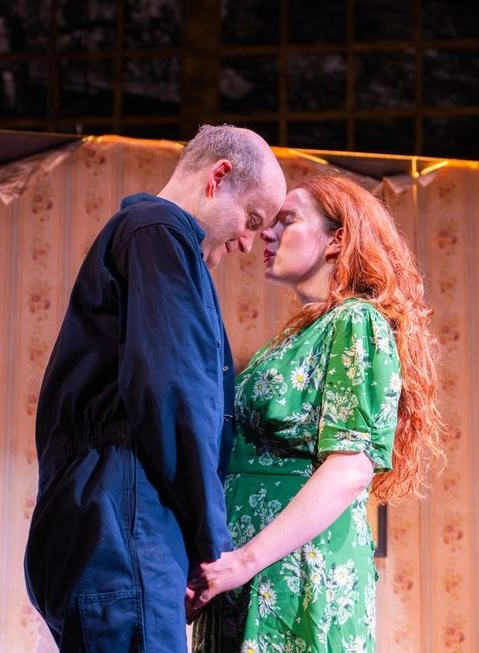
Jessica Hardwick

1984

27/10/26

The Royal Lyceum Theatre, Edinburgh

George Orwell’s 1949 novel is embedded into our cultural landscape, its ideas spreading far beyond the confines of the page. In the seven decades since it was published, its terminology has become ubiquitous: thought police, doublethink, Room 101 – and, most famously, Big Brother, who always knows what we’re up to, thanks to surveillance devices installed in our homes.

What time did you get in last night? Your doorbell knows. Hey, Siri. Alexa! Are you listening?

Of course, this means that it is endlessly adaptable (and endlessly adapted), horribly applicable to almost every political regime. So what’s a theatre-maker to do if they want to offer a fresh perspective? In this instance, playwright Chris Hannan has opted for a framing device highlighting 1984‘s Scottish origins, as Orwell builds his dystopia from a bed in Glasgow’s Hairmyres Hospital, where he’s being treated for TB. It works well, binding the fictional world to the real one, reminding us how easily Oceania could become our actuality.

The first act is impressive. Jack Tarlton convinces as both Orwell and his protagonist, the world-weary Winston Smith. It’s a demanding job (the actor is in every scene) and he handles it with aplomb, engaging us in the two men’s inner struggles: Orwell coming to terms with his physical decline, and Winston trying to retain his sense of self in the face of ruthless authoritarianism.

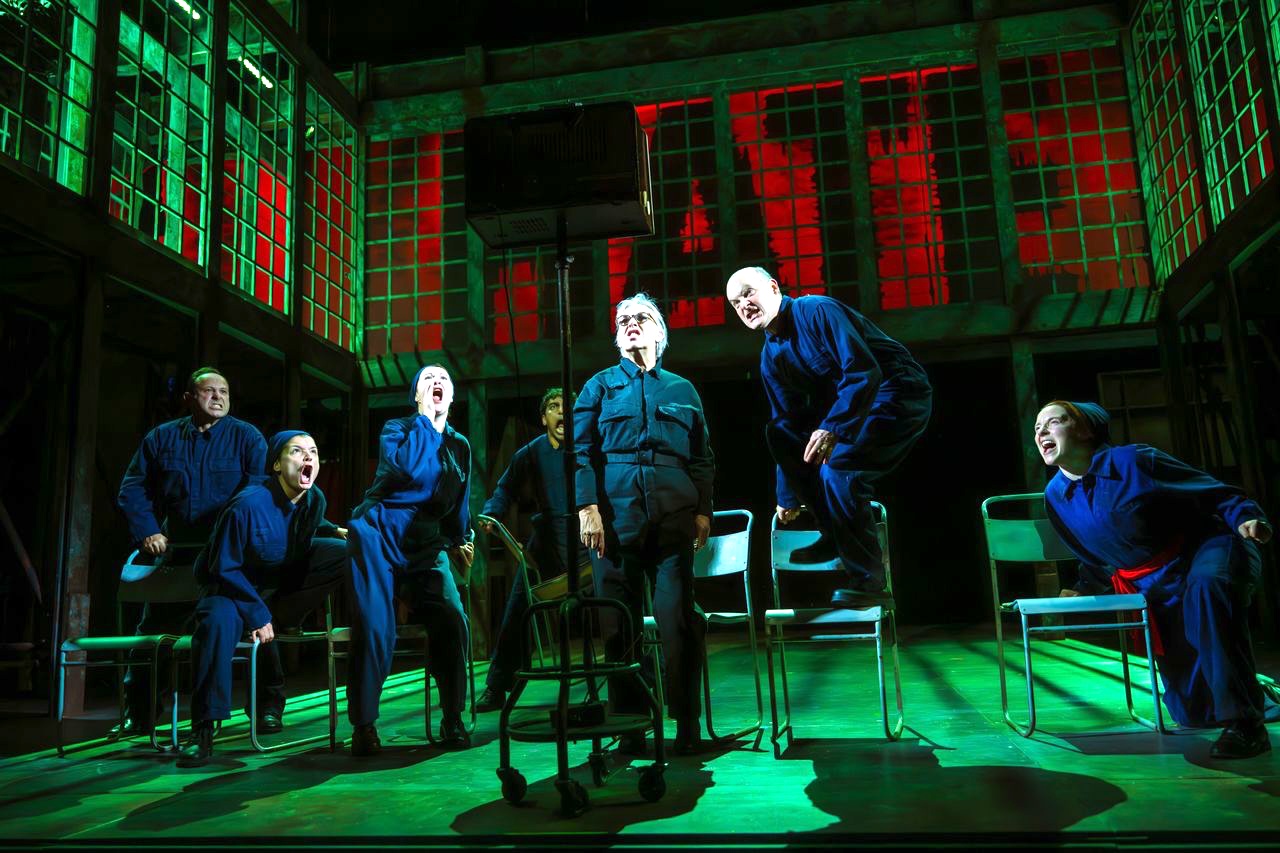
Tom Piper’s imposing design creates an immediate sense of oppression, with metal bars and grating dominating the prison-like set, where silent guards patrol an upper mezzanine. When Winston and his co-conspirator, Julia (Jessica Hardwick), venture out into the forbidden countryside for a tryst, the naif-style roll-on scenery is over-bright and fake looking, accentuating the couple’s wilful delusion. They’re not fooling anyone except themselves; Big Brother is just biding his time.

Unfortunately, the second act is not as successful as the first. Once Winston and Julia have been apprehended for their transgressions, the storytelling becomes more fragmented and we are afforded less insight into their characters. Winston’s torture is shown in a series of vignettes which, although visually arresting, are punctuated by long blackouts, which soon become tiresome. What’s more, although I like the idea of gender-swapping O’Brien, I can’t help thinking Irene MacDougall has been miscast here, exuding neither menace nor authority.

Perhaps the most disappointing element is the Room 101 sequence. I share Winston’s phobia of rats and yet I’m not at all moved. The box on Winston’s face means that we can’t see his reactions, while Heather Scott’s video design – a strength of the production up to this point – is too understated here, the images of the rodents too dark and close-up to really make out.

The hospital scenes ameliorate things somewhat, with Robert Jack and Irene Allan convincing as Dr Dick and Nurse Rankine respectively. Director Dominic Hill creates a palpable sense of Orwell’s desperate situation in these moments, illuminating both subtle and not-so subtle links to the novel.

All in all, this co-production between Glasgow’s Citizens’ Theatre, Dundee Rep and Edinburgh’s Royal Lyceum offers an interesting and uniquely Scottish take on a modern classic. Despite some mis-steps, it’s nonetheless well worth seeing, especially in these post-truth times.

3.6 stars

Susan Singfield
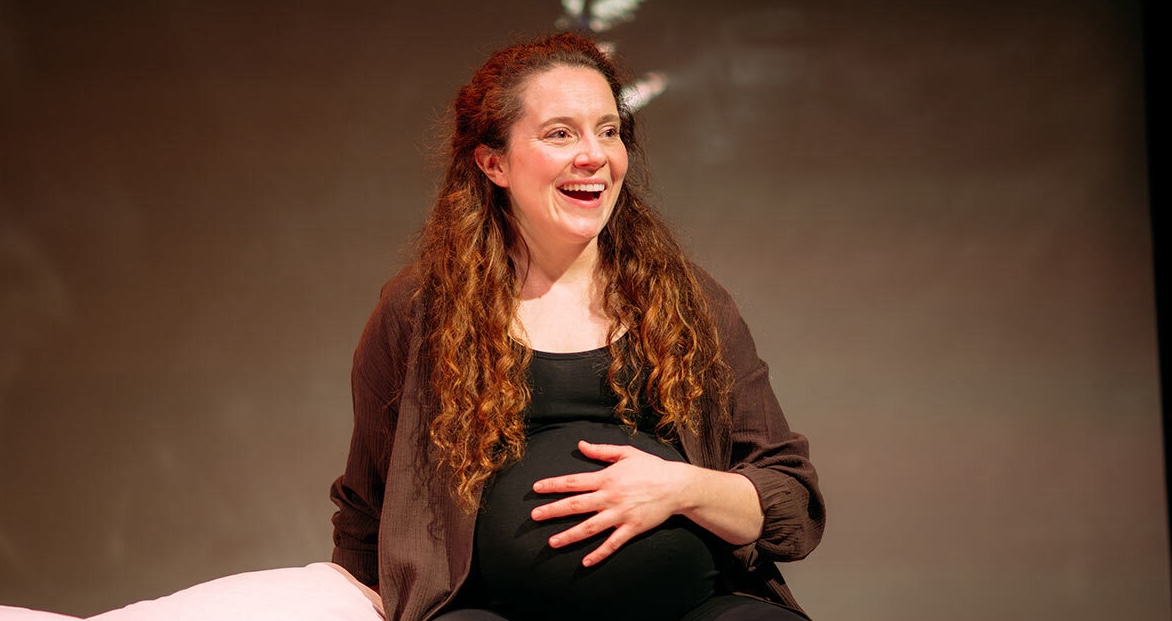
Gush

23/04/26

Traverse Theatre, Edinburgh

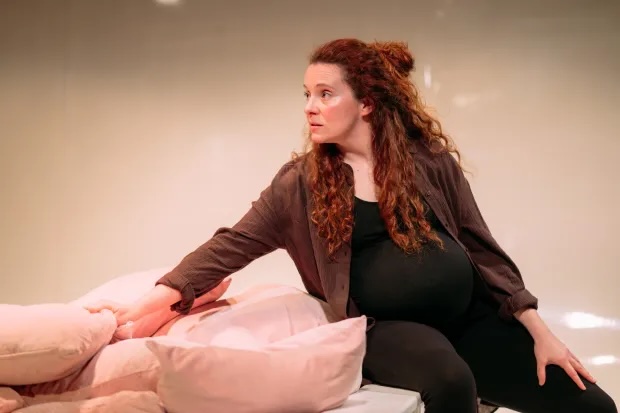
Ally (Jessica Hardwick) is expecting her first baby. She’s looking forward to becoming a mum, but she’s also scared of losing her own identity. Already, before ‘Bug’ has put in an appearance, she’s ceded some of her autonomy to Kevin, her loving but anxious husband, who asks her to drink rooibos tea instead of her preferred English Breakfast, and keeps imploring her to ‘relax.’ Her world seems to be shrinking and she’s desperate to claw back her sense of self…

Especially that one particular aspect of herself she’s never had the courage to explore.

In a few short weeks she’ll be too busy, too tired, too focused on looking after her child, so it’s now or never, she reasons. And never isn’t an option. Ally’s always known she’s bisexual but she’s only ever been with men. She needs to try sex with a woman, just once, before she settles down for good. She deserves this last hurrah, doesn’t she?

Hardwick’s ebullient performance anchors the monologue effectively: she’s funny and appealing, so that we want her to find fulfilment, despite the moral ambiguity of her plan (namely, cheating on her husband with a sex worker). Jess Brodie’s script is witty and well-paced, the cringe-comedy elements perfectly judged, so that I often find myself laughing from behind my hands, my toes literally curled, as Ally’s quest leads her from one awkward moment to the next.

Becky Minto’s design is deceptive. At first, the set appears to be all clinical white surfaces, a perspex-coated cyclorama morphing into a hard-edged bed, softened only by a few cushions. But as the play develops and the lighting (courtesy of Renny Robertson) becomes more subdued, we notice that the bed’s walls are clad in intricately knitted wool, reminiscent of a baby’s blanket, and there’s a pleated cotton valance around the raised platform.

Under Becky Hope-Palmer’s direction, this is a lively, kinetic piece of drama, and there are some lovely creative touches. I like the way the audience is manipulated into vicarious embarrassment and, more specifically, the simplicity of Ally’s bump becoming her baby.

If you’re in the mood for a highly-original take on impending parenthood, Gush might just be the play for you. There are only two nights left to see it in Edinburgh though, so you’ll need to get your skates on.

4 stars

Susan Singfield

The Play of Light upon the Earth: A Reading

05/09/19

Traverse Theatre, Edinburgh

The Play of Light upon the Earth by Sally Hobson is an unusual piece of writing: a play structured into twenty-seven chapters, representing the psychological fragmentation that follows trauma. For the protagonist, Innocence (Jessica Hardwick), Bloody Friday is the trigger. The shock of this childhood experience, long-repressed, explodes into her adult life, forcing her to confront its impact.

It feels like a genuine privilege to be here at this stage of the creative process: the play is still being developed, still seeking its perfect form. In this rehearsed reading, directed by Muriel Romanes, we get a sense of what it could become. Because there is little movement (the actors are seated behind a trestle table), the focus is inevitably on the language, which is dense and lyrical, packed with literary references, Joycean in its verbal inventiveness.

Maureen Beattie’s reading (as narrator and Mother) is particularly engaging, delivered with intensity and vigour. Benny Young (narrator and Father) is good too: very funny, despite the gravity of what’s being said. There is, in fact, a lot of humour in this play: the light that shows the shade for what it really is.

This is a thought-provoking, intellectually-demanding piece, and I’m fascinated to see how it turns out. Post-show discussion about staging throws up various options, from a grand, large-scale production with a cast of hundreds, to a more minimalist notion, with a few key characters inhabiting a huge stage. I’m struck by the idea of a multi-media approach, which I think might suit this spoken-word/performance-art/play hybrid.

Whatever. I’ll certainly be keeping an eye out to see where this goes.

Susan Singfield

Cyrano de Bergerac

13/10/18

Lyceum Theatre, Edinburgh

Since its debut in 1897, Edmond Rostand’s most celebrated play has seen many reboots, reimaginings and reinterpretations – perhaps most unusually in Steve Martin’s 1980s movie, Roxanne, which pitched the American comedian as the head of a fire station, opposite cinematic newcomer Darryl Hannah – and of course, many will remember a more traditional movie version of the tale starring a never-better Gerard Depardieu.

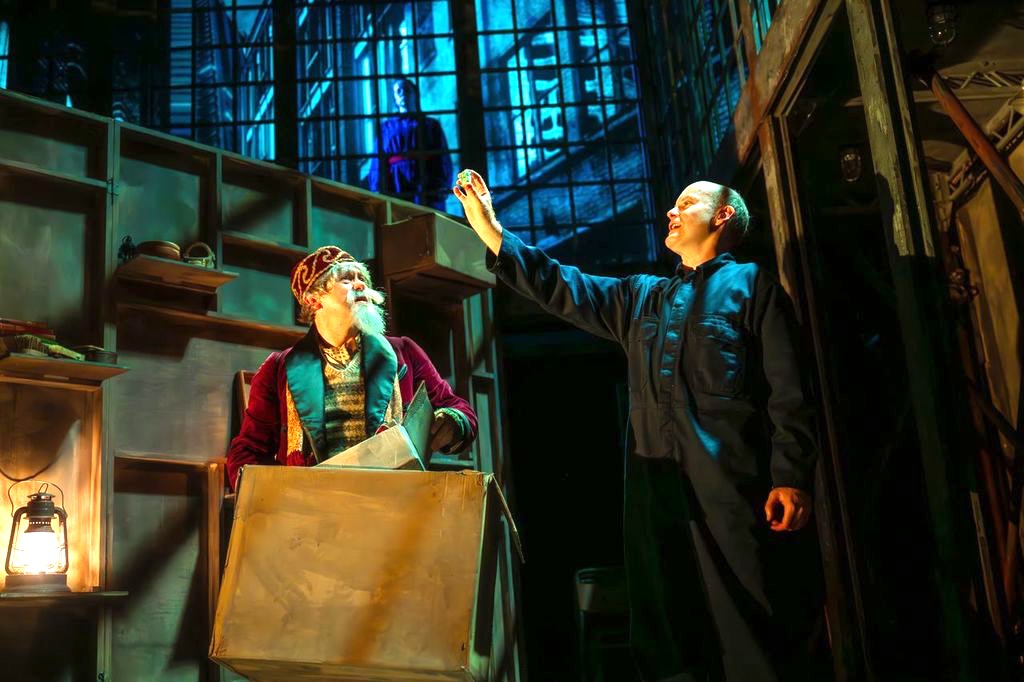
This co-production with The National Theatre of Scotland and Glasgow’s Citizens Theatre, directed by Dominic Hill, is a revival of Edwin Morgan’s 1992 translation, which envisions Rostand’s celebrated hero as a Glaswegian, complete with unflinchingly authentic dialect. Why? Well, Morgan felt the character of swashbuckling soldier-poet Cyrano was perfectly suited for such a transformation, and who am I to argue with him? Ihave to confess though, that it takes me a little while to adjust to this particular aspect. Despite living in Scotland for over two years, some of Brian Ferguson’s earlier utterances in the leading role are initially hard for me to decipher, something that isn’t helped by the huge false nose he’s obliged to wear. However, as I gradually adjust to that undiluted accent, so I begin to warm to the character and there’s no denying that Ferguson’s performance here is a veritable tour de force, as Cyrano jokes, swaggers and bellows his way through the proceedings, barely offstage for more than a few moments at a time. One can only wonder if his voice will hold up to such a battering.

Of course, the central premise of this story is one of unrequited love. Cyrano is madly in love with his cousin, Roxane (Jessica Hardwick), but she has eyes only for the handsome Christian (Scott Mackie), the new recruit to Cyrano’s regiment. She begs Cyrano to help her win the newcomer’s heart. So besotted is Cyrano that he is powerless to resist her entreaties and so pledges to do his level best to help her achieve her aims. Christian, of course, is a plain speaking sort of fellow, so Cyrano uses his poet’s intellect to open a series of heartfelt letters to Roxane, passing off his own devotion as Christian’s. The deceit works like a charm, but of course, tragedy is always waiting in the wings to throw a well-timed spanner into the works.

This rumbustious production has much to recommend it, not least the spectacular set designs of Tom Piper and Pam Hogg’s eye-catching costumes, which combine traditional elements with an irreverent dash of punk rock. There are live musicians onstage throughout the proceedings, that infamous ‘nose-insults’ routine is delivered into a microphone in standup style and there’s a beautifully executed sword fight to help to keep the action flowing.

But there’s no denying that this is a long play, a full three hours in the telling – and, with most of the most memorable scenes occurring in the first half, it feels as though a little judicious editing in the second would make this feel a wee bit more fleet-footed. See this for Ferguson’s barnstorming performance and for those audacious costume designs. And whatever you do, don’t mention the size of Cyrano’s nose. He’s touchy about that kind of thing.

3.8 stars

Philip Caveney

The Venetian Twins

Unknown

02/05/15

Lyceum Theatre, Edinburgh

Carlo Goldoni is, of course, the playwright whose earlier work, A Servant of Two Masters was so fruitfully adapted by the National Theatre to create One Man, Two Guvnors. The Venetian Twins is cut from the same bolt of gaudy cloth (indeed, can it really be a coincidence that lead actor Grant O Rourke is a dead ringer for James Corden?) At any rate, it matters not. This is a farce majeure, beautifully played, timed to precision and rib ticklingly funny from start to finish.

The action takes place in Verona. Rich and somewhat dim country boy, Zanetto (O Rourke) comes in search of a bride, specifically the nice but equally dim Columbina (Angela Darcy) whose gold-digging father, The Provost senses an opportunity to refill the family’s depleted coffers. But Zanetto has an identical twin brother, Tonino (also played by O Rourke) from whom he was separated as a child. When Tonino flees his native Venice for Verona along with his sweetheart, prototype feminist Beatrice (Jessica Hardwick), the scene is set for a bewildering series of ‘mistaken identity’ disasters. It’s a cliche to say that much hilarity ensues but in this case, that’s exactly right.

In the wrong hands, farce can be toe-curling, but there’s not a foot put wrong here (unless you count the hilariously drunken old landlady who falls repeatedly through an open trapdoor.) This owes much to Commedia Dell Arte, but this is no ‘off-the-peg plot. Much of the wittily updated script by Tony Cownie is delivered in broad Scots accents, which work brilliantly, and there’s a wonderfully foppish performance by John Kielty as the effete (and inevitably English-accented) Florindo. There’s some wonderfully fruity innuendo, a fistful of malapropisms from Columbina and a stomach-churning scene involving a blocked toilet that modesty forbids me to describe in detail. Meanwhile, O Rourke slips effortlessly between the two roles simply by doing up the top button on his jacket and adopting a different expression. The two acts galloped by while the audience, myself included, were convulsed with laughter from start to finish. If laughter is something you relish, then you really should see this before it moves on. It’s a Venetian blinder.

5 stars

Philip Caveney