Irene Allan

1984

27/10/26

The Royal Lyceum Theatre, Edinburgh

George Orwell’s 1949 novel is embedded into our cultural landscape, its ideas spreading far beyond the confines of the page. In the seven decades since it was published, its terminology has become ubiquitous: thought police, doublethink, Room 101 – and, most famously, Big Brother, who always knows what we’re up to, thanks to surveillance devices installed in our homes.

What time did you get in last night? Your doorbell knows. Hey, Siri. Alexa! Are you listening?

Of course, this means that it is endlessly adaptable (and endlessly adapted), horribly applicable to almost every political regime. So what’s a theatre-maker to do if they want to offer a fresh perspective? In this instance, playwright Chris Hannan has opted for a framing device highlighting 1984‘s Scottish origins, as Orwell builds his dystopia from a bed in Glasgow’s Hairmyres Hospital, where he’s being treated for TB. It works well, binding the fictional world to the real one, reminding us how easily Oceania could become our actuality.

The first act is impressive. Jack Tarlton convinces as both Orwell and his protagonist, the world-weary Winston Smith. It’s a demanding job (the actor is in every scene) and he handles it with aplomb, engaging us in the two men’s inner struggles: Orwell coming to terms with his physical decline, and Winston trying to retain his sense of self in the face of ruthless authoritarianism.

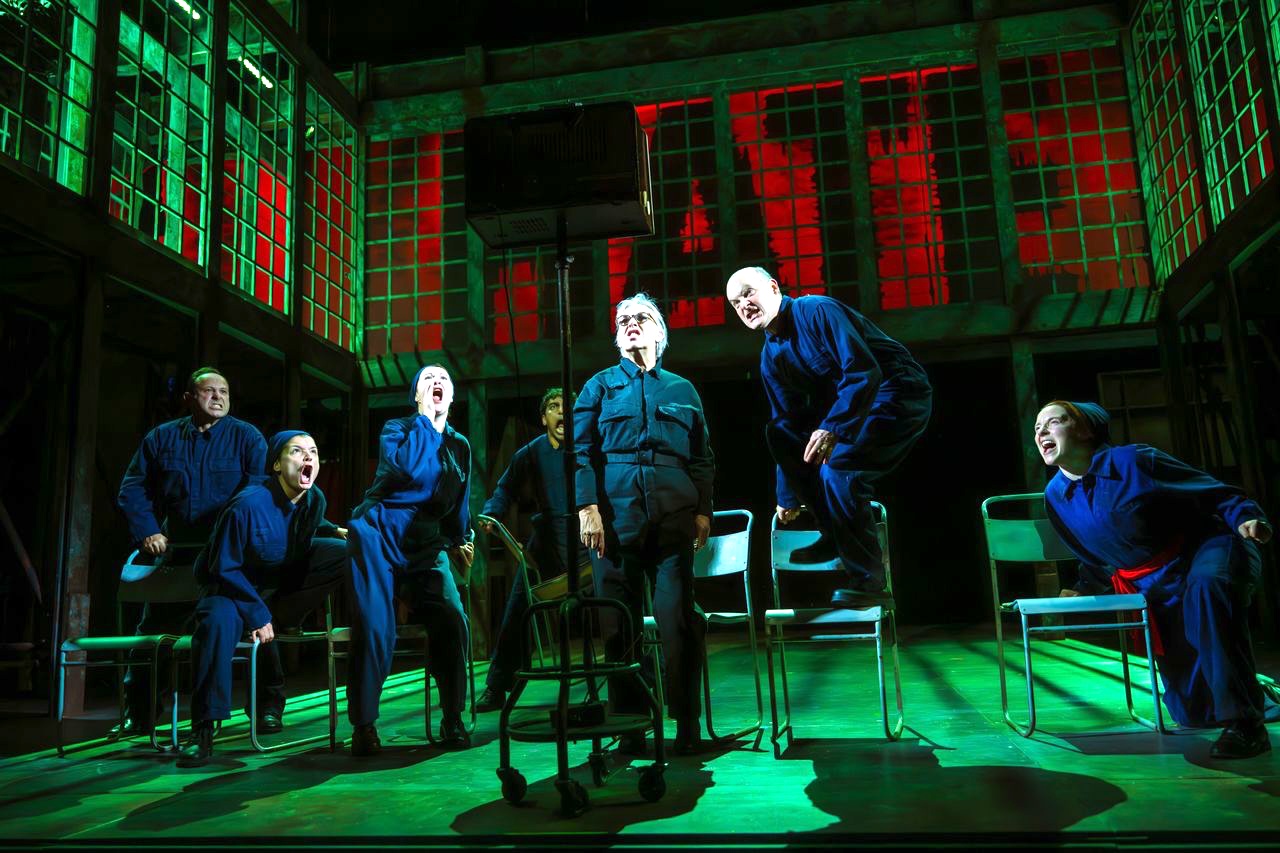
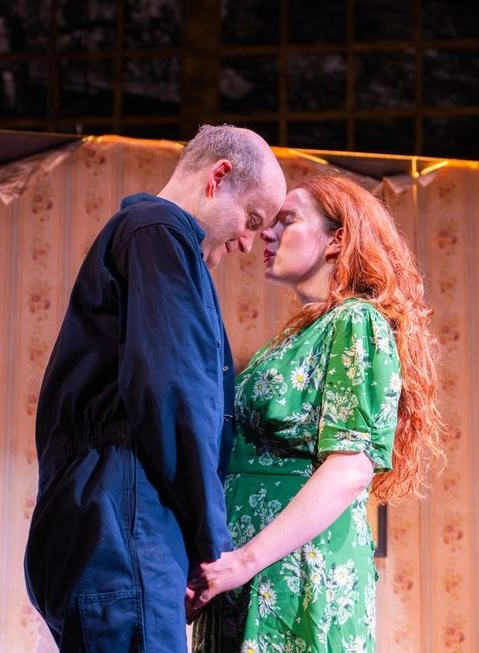
Tom Piper’s imposing design creates an immediate sense of oppression, with metal bars and grating dominating the prison-like set, where silent guards patrol an upper mezzanine. When Winston and his co-conspirator, Julia (Jessica Hardwick), venture out into the forbidden countryside for a tryst, the naif-style roll-on scenery is over-bright and fake looking, accentuating the couple’s wilful delusion. They’re not fooling anyone except themselves; Big Brother is just biding his time.

Unfortunately, the second act is not as successful as the first. Once Winston and Julia have been apprehended for their transgressions, the storytelling becomes more fragmented and we are afforded less insight into their characters. Winston’s torture is shown in a series of vignettes which, although visually arresting, are punctuated by long blackouts, which soon become tiresome. What’s more, although I like the idea of gender-swapping O’Brien, I can’t help thinking Irene MacDougall has been miscast here, exuding neither menace nor authority.

Perhaps the most disappointing element is the Room 101 sequence. I share Winston’s phobia of rats and yet I’m not at all moved. The box on Winston’s face means that we can’t see his reactions, while Heather Scott’s video design – a strength of the production up to this point – is too understated here, the images of the rodents too dark and close-up to really make out.

The hospital scenes ameliorate things somewhat, with Robert Jack and Irene Allan convincing as Dr Dick and Nurse Rankine respectively. Director Dominic Hill creates a palpable sense of Orwell’s desperate situation in these moments, illuminating both subtle and not-so subtle links to the novel.

All in all, this co-production between Glasgow’s Citizens’ Theatre, Dundee Rep and Edinburgh’s Royal Lyceum offers an interesting and uniquely Scottish take on a modern classic. Despite some mis-steps, it’s nonetheless well worth seeing, especially in these post-truth times.

3.6 stars

Susan Singfield

Armour: A Herstory of the Scottish Bard

01/10/24

Traverse Theatre, Edinburgh

Today’s A Play, A Pie and A Pint production is a welcome revival of Shonagh Murray’s Armour: A Herstory of the Scottish Bard. Unwieldy title notwithstanding, this is a taut, well-scripted piece of theatre, the music deftly evoking the lyrical poetry at its heart.

It’s thirty years since the death of Scotland’s beloved poet, Robert Burns, and his widow, Jean (Irene Allan), still misses him. But she has plenty to occupy her time, not least her headstrong young granddaughter, Sarah (Karen Fishwick), who’s been sent to live with her in Dumfries, while her dad’s away in India. And then there’s Nancy Maclehose (Hilary Maclean), Burns’ erstwhile mistress, who seems very keen to talk to Jean. There’s something important she needs to say…

Tom Cooper’s direction and Heather Grace Currie’s set design both serve to highlight Murray’s clever structure, ensuring that Burns’ absence forms the centre of the play, a model of his mausoleum gleaming from the mantlepiece, white against the dark furniture. Armour is a feminist piece but it doesn’t shy away from the fact that we only know these women in relation to a man, that they are destined to remain almost unknown, circling the ghost of a famous heavyweight, as small as the dolls that Sarah plays with.

Murray’s script breathes life into the women, imagining their responses to the scant details we have of their real circumstances. Allan imbues Jean with a sharp dignity, a refusal to be shamed or diminished by her husband’s infidelities. What’s more, Maclean’s Nancy defies the image of a paramour: she admits to feeling guilt for not thinking about Jean, but there’s no room here for any moral outrage. She loved Rab. He loved her. He loved Jean too. People are complicated and you can’t change that. What you can do, as Jean explains to Sarah, is choose whether to be “a sitter or a do-er”. And being a do-er is infinitely more admirable.

Fishwick shines as the motherless young child, fascinated by her granny’s stories and determined to follow in her grandad’s footsteps and become a bard herself. Her wistful demeanour – as she remembers India and her dad – contrasts beautifully with the irrepressible spirit she shows as she sings and dances around her granny’s house. Jean and Nancy might have been consigned to a life in the shadows, but Sarah believes she can have much more. Especially with those great women behind her.

Armour is a deceptively melodic piece, which smoulders gently before bursting into full flame.

4.1 stars

Susan Singfield

Wilf

10/12/21

Traverse Theatre, Edinburgh

James Ley’s latest offering is about as far away from a ‘Christmas play’ as it could be. In fact, there’s only one nod towards the festive season: a decorated tree in the corner of the stage. Tree aside, this is more of an antidote to Yuletide than an evocation of it. And that’s fine, because there’s plenty of the traditional stuff on offer at other venues in the city. Wilf is a December play for those who want something… else.

And it really is something else. Where to start? Calvin (Michael Dylan) is struggling. He’s bipolar – in the midst of a manic episode – and everything is going wrong. He knows he needs to leave his abusive boyfriend, Seth, but there’s no one who can help. Not his mum: she’s left for a new life in the American bible belt, and has cut him out of her life. Not his driving instructor, Thelma (Irene Allan), because – after a mere 104 lessons – Calvin has passed his test, and the ex-psychotherapist is pleased to be rid of him. So where can he turn?

The answer soon presents itself: Wilf. Wilf is an unlikely saviour, not least because he is a car. Specifically, Wilf is a beaten up old Volkswagen, so there’s more than a hint of Herbie about him – although Wilf’s antics are more colourful than his predecessor’s. And by colourful, I mean sexual. Calvin and Wilf’s relationship is intense.

To be fair, Calvin’s pretty intense all round. With his shiny new driving license and his battered old car, he finally finds the courage to break away from Seth, but he’s a long way from feeling okay. A road trip around Scotland, staying in Airbnbs and cruising graveyards for anonymous sex, seems appropriate. And, with Wilf’s help, Calvin might just make it.

This tight three-hander, directed by Gareth Nicholls, is equal parts quirky and charming. Dylan is immensely likeable as Calvin, and treads the line between comedy and tragedy with absolute precision. The soundtrack is banging – who doesn’t love a bit of Bonnie Tyler? – and the simple set (by Becky Minto) makes us feel like we’re with Calvin all the way: inside the car; inside his head.

Allan brings a powerful energy to the role of Thelma, while Neil John Gibson, as everyone else, represents a gentler, more nurturing humanity, especially in the form of Frank.

All in all, Wilf is a gloriously weird concoction, and a most welcome addition to the winter theatre scene.

4 stars

Susan Singfield

Lyceum Christmas Tales

17/12/20

Lyceum Online

God, how we’ve missed The Lyceum! We’ve seen so many wonderful productions here over the years and it really doesn’t help that we live just around the corner, and so see it standing forlorn and empty on an almost daily basis. The production team for Christmas Tales had hoped to be able to admit socially distanced audiences to these live performances, had even gone to the lengths of adapting the stage to accommodate them, but it was not to be. So, in the end, Christmas Tales is a streaming-only affair.

Designed as a kind of family-friendly advent calendar, eight short plays are available to watch for free on the Lyceum’s website – and this pay-for-view special features four longer tales, streamed live direct from the theatre’s stage. The pieces vary in tone and are linked by some truly spellbinding folk tunes. We are treated to The Christmas Ghost by Louise Ironside, the story of a young boy (Ryan Hunter) discovering an unexpected presence in his house. Jackie Kay’s Christmas with Angela Davis is the evocative memoir of a young Glaswegian girl (Helen Katamba) falling under the spell of the imprisoned activist after seeing her face on that famous poster.

There’s an interval at the midway point (though of course, we miss the chattering crowd in the bar) and then we’re back for the second half.

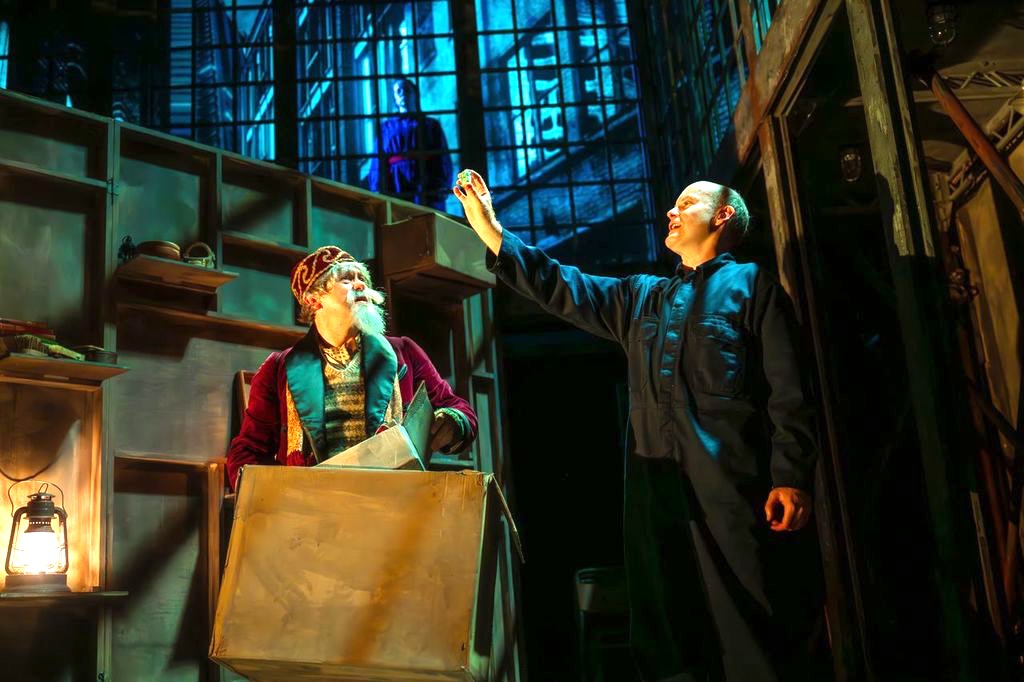
The Returning of the Light by Lynda Radley is the stirring saga of a young girl (Kirsty Findlay)’s quest to bring the sunlight back to her winter-ravaged village. Finally, my favourite of the quartet, A Cold Snap by Shona Reppe is the story of Carole (Irene Allan), a contemporary suburban Scrooge, who finds herself forced to ‘celebrate’ the festive season by a mischievous Norwegian sprite.

There’s a genuine air of magic throughout the show, with the cast utilising the full depth of the Lyceum’s extended stage to great effect. A Cold Snap in particular uses the format of film to canny effect, with ever more elaborate festive decorations seeming to appear out of nowhere.

Afterwards, we head out for our nightly walk around the empty city and, quite by chance, bump into Ryan Hunter, on his way back to his lodgings, guitar across his back. We’re able to congratulate him, which is, I suppose, the closest that any of the cast of this charming show can hope to get to the hearty round of applause they deserve.

But this is 2020 and we must be realistic. Until we can safely return to the theatre, shows like this serve as a timely reminder of how truly enchanting the theatre can be – and of how profoundly we are missing it.

4 stars

Philip Caveney