George Orwell

1984

27/10/26

The Royal Lyceum Theatre, Edinburgh

George Orwell’s 1949 novel is embedded into our cultural landscape, its ideas spreading far beyond the confines of the page. In the seven decades since it was published, its terminology has become ubiquitous: thought police, doublethink, Room 101 – and, most famously, Big Brother, who always knows what we’re up to, thanks to surveillance devices installed in our homes.

What time did you get in last night? Your doorbell knows. Hey, Siri. Alexa! Are you listening?

Of course, this means that it is endlessly adaptable (and endlessly adapted), horribly applicable to almost every political regime. So what’s a theatre-maker to do if they want to offer a fresh perspective? In this instance, playwright Chris Hannan has opted for a framing device highlighting 1984‘s Scottish origins, as Orwell builds his dystopia from a bed in Glasgow’s Hairmyres Hospital, where he’s being treated for TB. It works well, binding the fictional world to the real one, reminding us how easily Oceania could become our actuality.

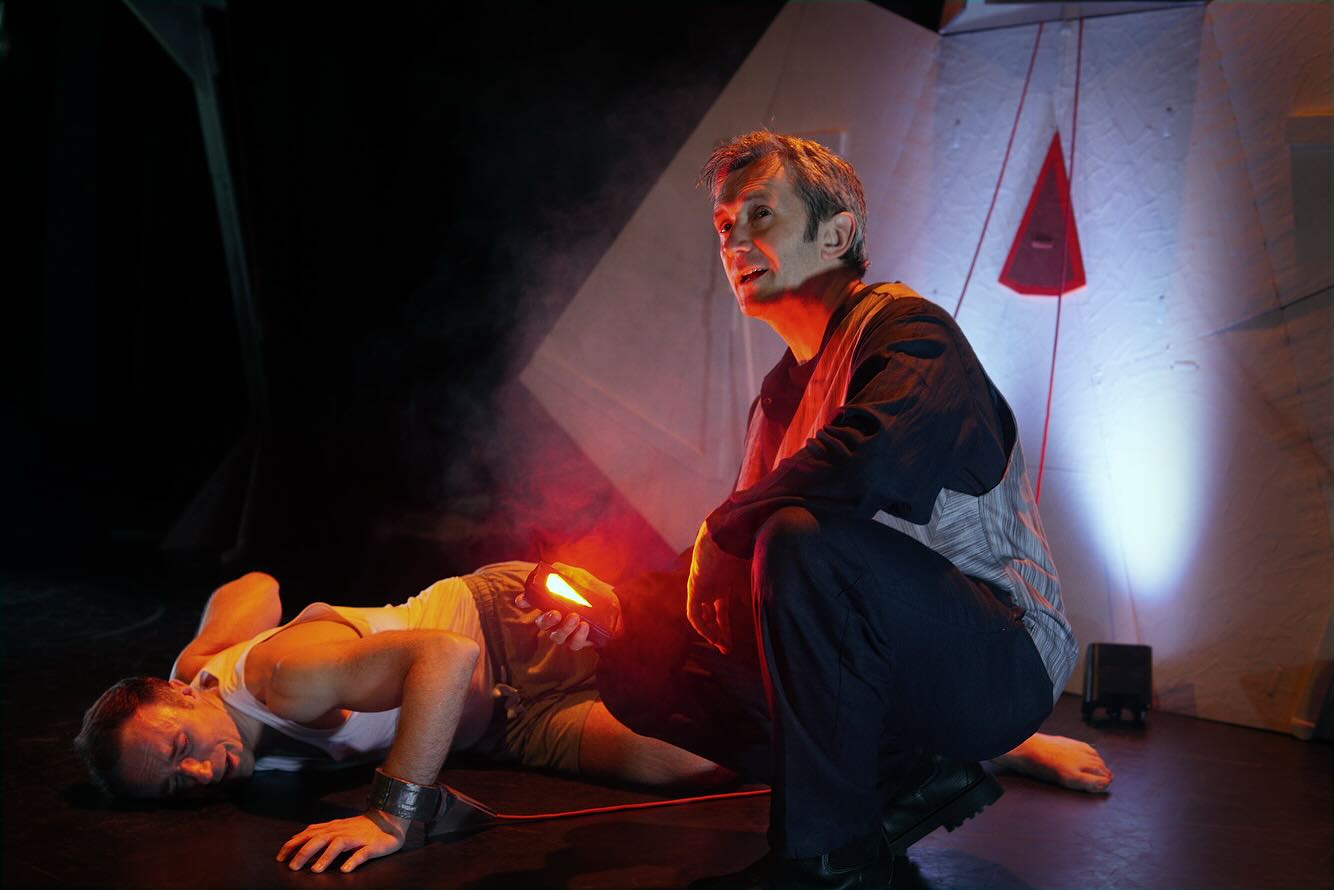
The first act is impressive. Jack Tarlton convinces as both Orwell and his protagonist, the world-weary Winston Smith. It’s a demanding job (the actor is in every scene) and he handles it with aplomb, engaging us in the two men’s inner struggles: Orwell coming to terms with his physical decline, and Winston trying to retain his sense of self in the face of ruthless authoritarianism.

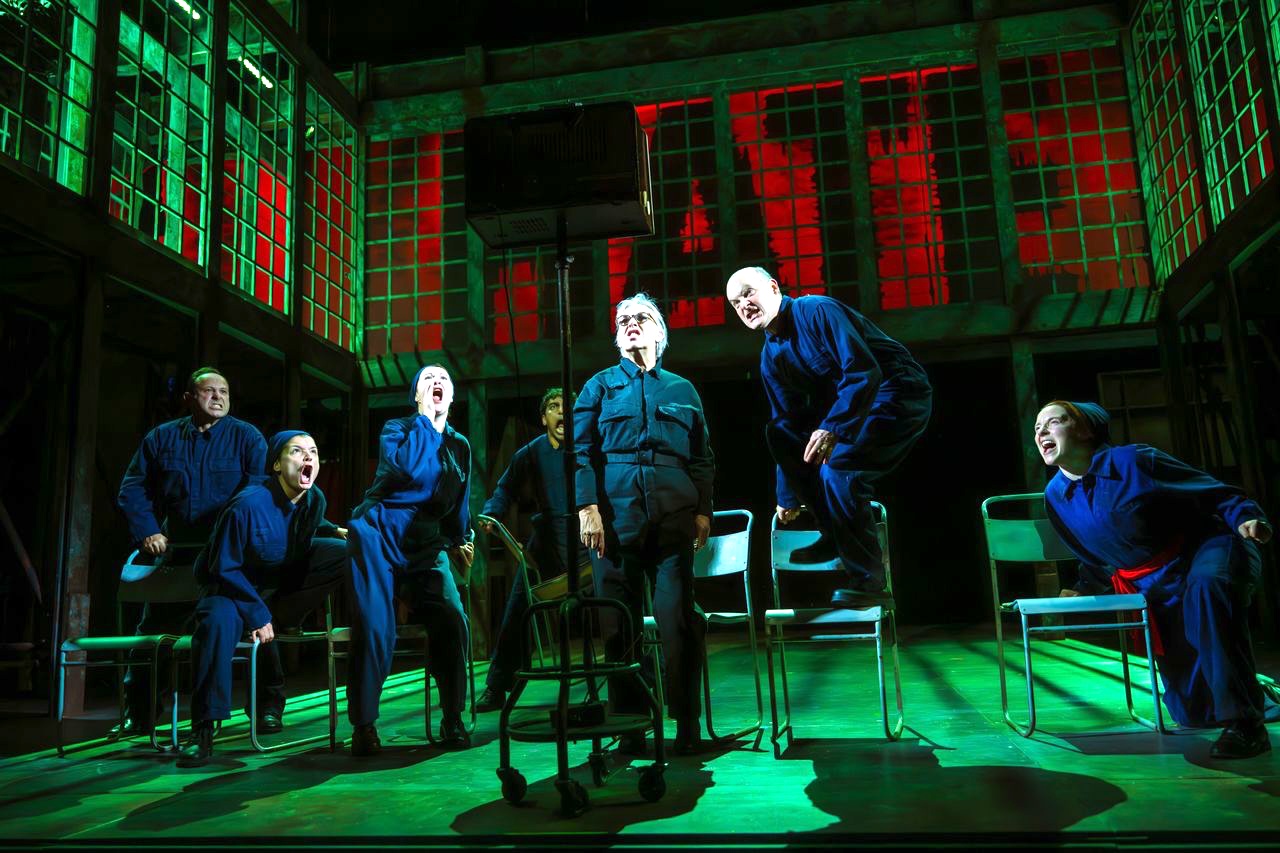
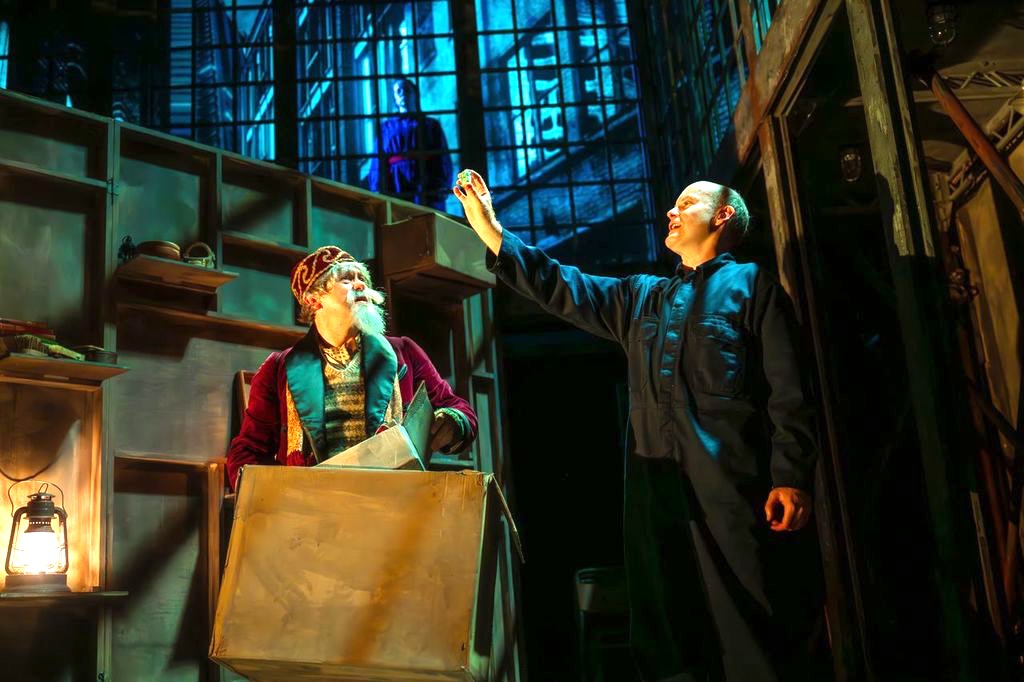
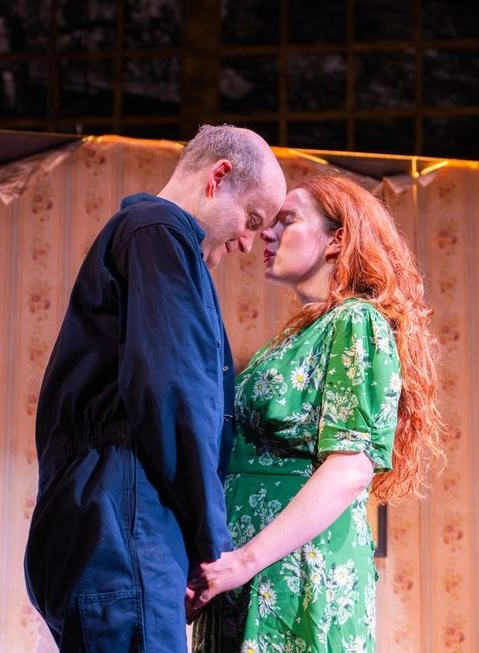
Tom Piper’s imposing design creates an immediate sense of oppression, with metal bars and grating dominating the prison-like set, where silent guards patrol an upper mezzanine. When Winston and his co-conspirator, Julia (Jessica Hardwick), venture out into the forbidden countryside for a tryst, the naif-style roll-on scenery is over-bright and fake looking, accentuating the couple’s wilful delusion. They’re not fooling anyone except themselves; Big Brother is just biding his time.

Unfortunately, the second act is not as successful as the first. Once Winston and Julia have been apprehended for their transgressions, the storytelling becomes more fragmented and we are afforded less insight into their characters. Winston’s torture is shown in a series of vignettes which, although visually arresting, are punctuated by long blackouts, which soon become tiresome. What’s more, although I like the idea of gender-swapping O’Brien, I can’t help thinking Irene MacDougall has been miscast here, exuding neither menace nor authority.

Perhaps the most disappointing element is the Room 101 sequence. I share Winston’s phobia of rats and yet I’m not at all moved. The box on Winston’s face means that we can’t see his reactions, while Heather Scott’s video design – a strength of the production up to this point – is too understated here, the images of the rodents too dark and close-up to really make out.

The hospital scenes ameliorate things somewhat, with Robert Jack and Irene Allan convincing as Dr Dick and Nurse Rankine respectively. Director Dominic Hill creates a palpable sense of Orwell’s desperate situation in these moments, illuminating both subtle and not-so subtle links to the novel.

All in all, this co-production between Glasgow’s Citizens’ Theatre, Dundee Rep and Edinburgh’s Royal Lyceum offers an interesting and uniquely Scottish take on a modern classic. Despite some mis-steps, it’s nonetheless well worth seeing, especially in these post-truth times.

3.6 stars

Susan Singfield
1984

17/08/25

Pleasance Courtyard (Above), Edinburgh

We first chanced upon the work of theatre company Box Tale Soup at 2023’s Fringe, where we were impressed by their intriguing adaptation of MR James’ Casting the Runes. If 1984 seems like an ambitious step-up in scale, we needn’t worry. All of the company’s impressive tricks are deployed to great effect to bring George Orwell’s dystopian masterpiece to the stage.

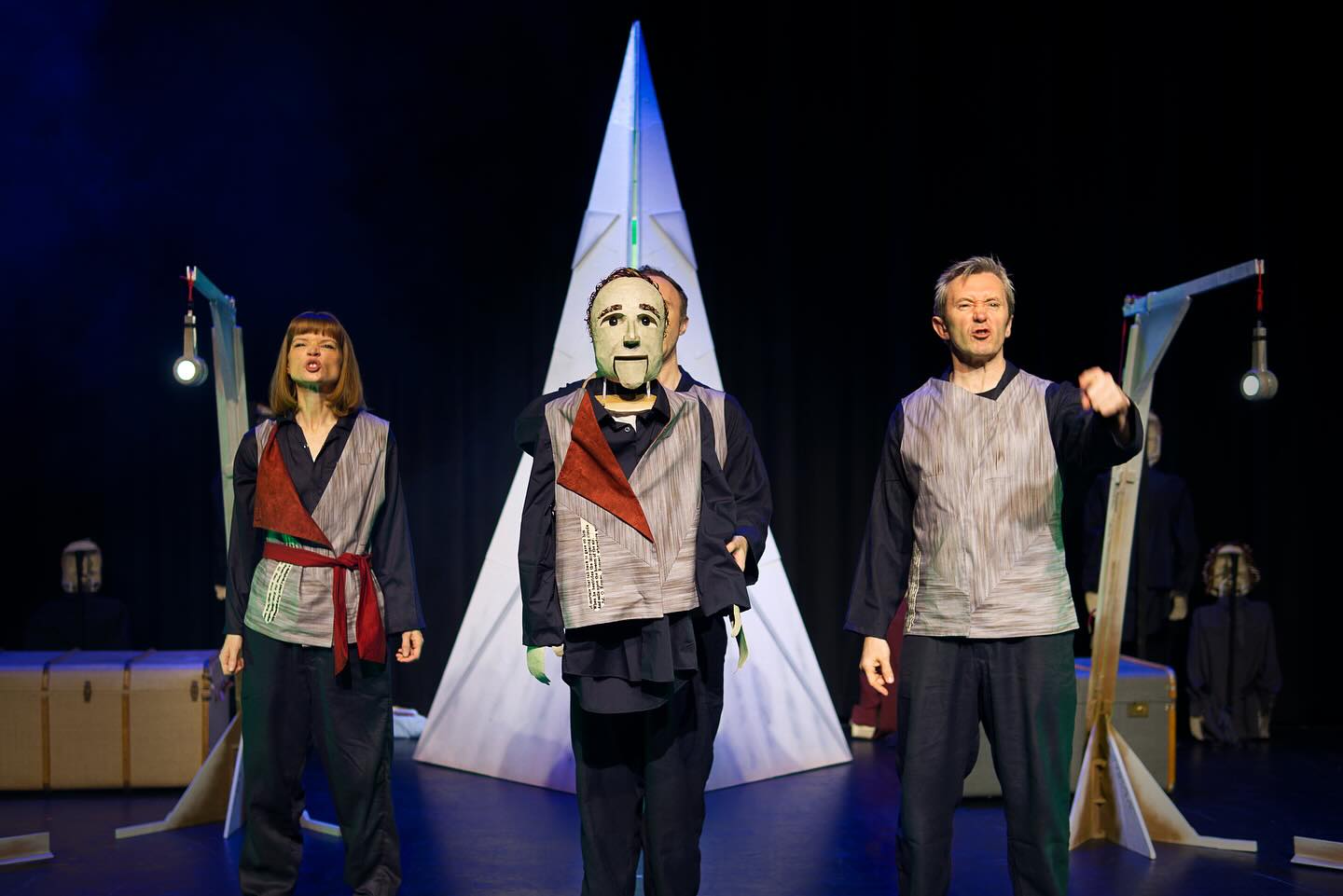
For starters, there are those distinctive-looking puppets, sometimes external representations of the people who carry them – which makes me think of the masks we so often choose to display to the world – and in other instances, they are characters in their own right.

The story of Winston Smith (Mark Collier), his forbidden romance with Julia (Antonia Christophers), and his ultimate torture at the hands of O’Brien (Noel Byrne), is so universally known, it seems pointless to say too much about the storyline; suffice to say, this adaptation leaves nothing out – and it’s also chilling to acknowledge that in today’s turbulent world, Orwell’s warnings about totalitarianism seem more relevant than ever.

The inventive ways in which this familiar story is told are so intriguing and immersive that I never suffer from the common problem of knowing what happens next – each successive scene has some new detail to marvel at. The performances from all three actors are compelling and the complex set in which the drama unfolds is so skilfully manipulated and rearranged as the story progresses that the pace is never allowed to flag.

From the very beginning I’ve been aware of a set of closed doors at the back of the stage – and when the doors of Room 101 are finally opened, this powerful adaptation exerts an even more chilling grip on its spellbound audience.

Before I go, one question. How many fingers am I holding up?

4.6 stars

Philip Caveney

1984

11/10/24

Bedlam Theatre, Edinburgh

George Orwell’s dystopian masterpiece has loomed large over 2024 for us. In April, we listened to Audible’s star-studded ‘immersive’ audio adaptation, where Andrew Garfield, Cynthia Erivo, Tom Hardy and Andrew Scott brought Oceania memorably to life. Immediately afterwards, we both read Sandra Newman’s Julia, a reworking of the novel from the lead female’s point of view. And today we’re here at Bedlam Theatre, ready to see EUTC’s interpretation of the cautionary tale.

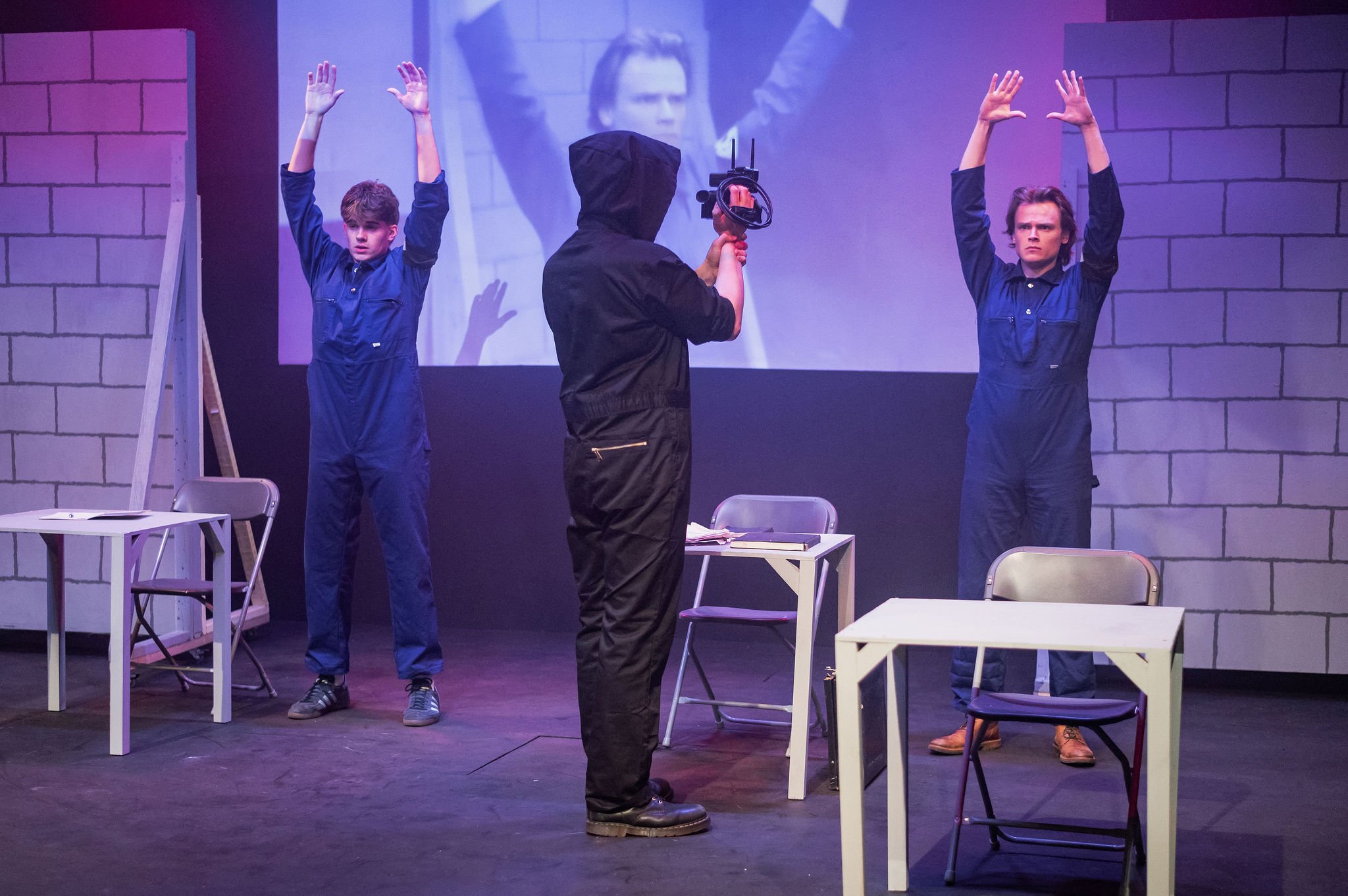
The use of screens projecting both pre-records (Lewis Eggeling) and live video (Tom Beazley) is inspired: there can’t be many stories more suited to a multi-media approach. The scene is set as soon as we enter the theatre: Big Brother (Thaddeus Buttrey) is watching us, a close-shot of his eyes filling the back drop. Instead of ushers, there are guards (Molly Gilbert, Rose Sarafilovic, Dylan Kaeuper and Fergus White), forbidding in their black uniforms, scarfs covering their lower faces. “All hand-held telescreens must be switched off,” one intones; “Silence!” bellows another. Predictably, we all comply.

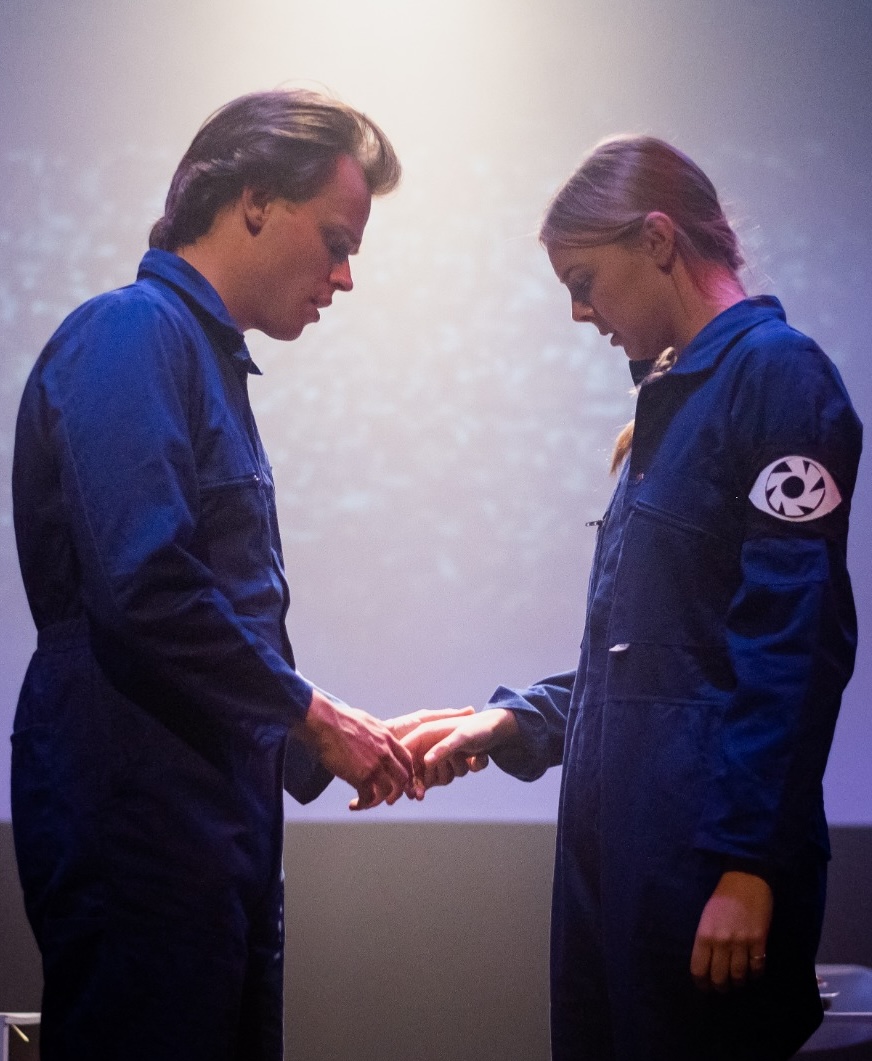
This adaptation (by Robert Owens, Wilton E Hall Jr, and William A Miles Jr) generally works well, plunging us immediately into the middle of the story. What used to be Britain is now part of Oceania, a sprawling dictatorship led by Big Brother, its impoverished citizens ruled with an iron rod by the unforgiving Party. By falling in love, Ministry of Truth workers Winston (Harry Foyle) and Julia (Francesca Carter) have broken the law and, having crossed that line, find themselves increasingly unable to swallow the propaganda they are fed. But what chance do they stand against the all-seeing apparatus of the State?

Director Hunter King does a great job of establishing a sense of threat, as well as highlighting the fragile humanity that endures, despite Big Brother’s best efforts to quash it. “They can make us say things,” as Julia acknowledges, “But they can’t make us think them.” As the central duo, Foyle and Carter both deliver flawless performances: Winston and Julia are convincingly reckless, persuading themselves that they are less vulnerable than they really are, caught up in the excitement of their affair. The story is so well known that there is a dramatic irony not present in the original plot, and King exploits this effectively, so that we find ourselves grieving for the couple even as their relationship blooms.

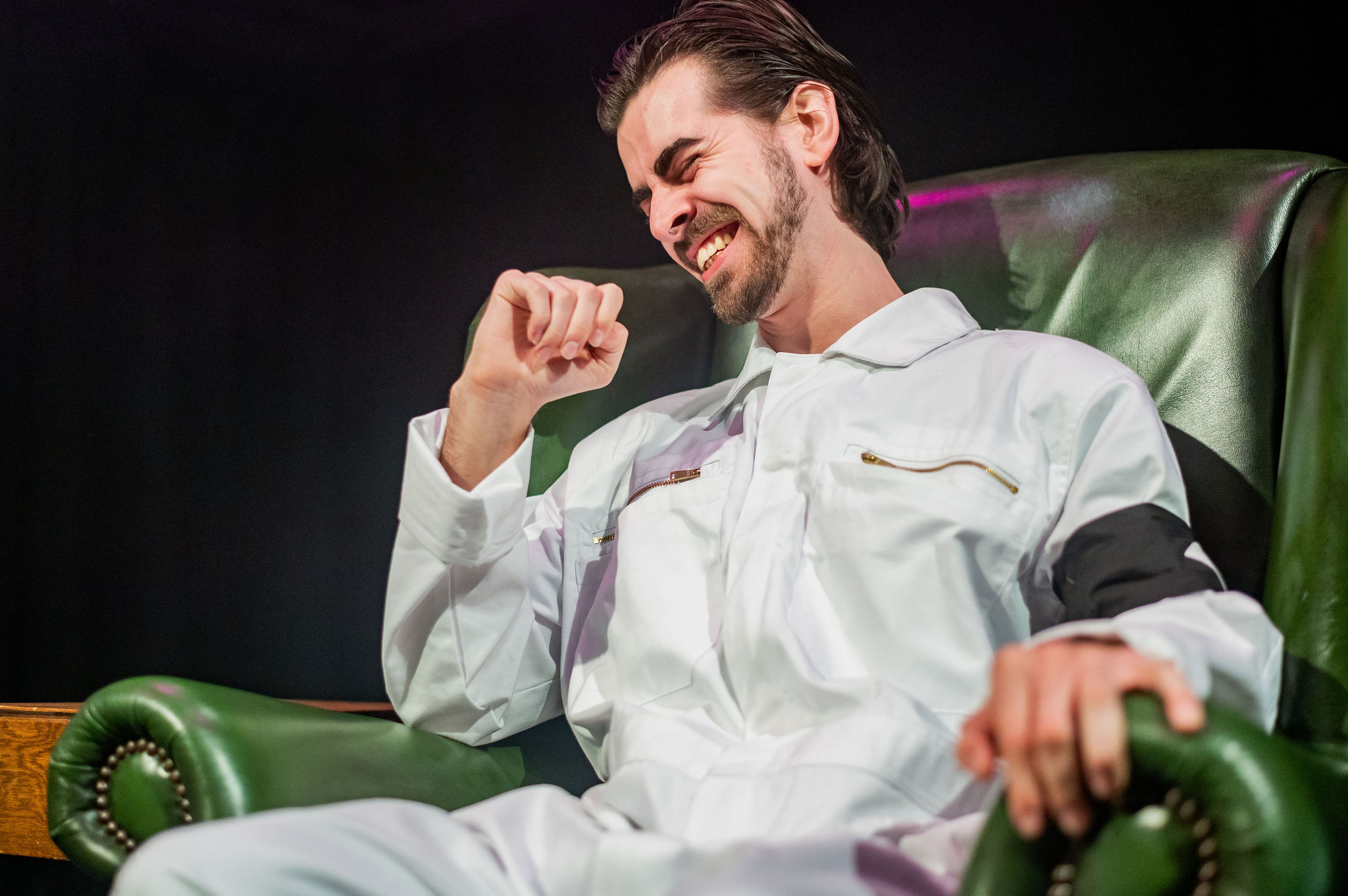
Robbie Morris is clearly having a whale of a time as smarmy backstabber, O’Brien, member of the Inner Party and chief snarer of the unwary. He plays the role as a kind of archetypal villain, complete with maniacal laugh, which makes for an interesting counterpoint, highlighting the freedom that comes with privilege: this is not a man who has ever felt the need to hide or even mute his feelings, unlike even the most loyal Party members. The only other character who seems uncowed is the landlady (Raphaella Hawkins), who owns the apartment Winston and Julia rent for their illicit lovemaking. As a Prole, she has a certain kind of liberty, born of being so poor and lowly that she’s considered unworthy of attention. It’s a dubious advantage.

As we’ve come to expect from Edinburgh University’s student shows, this is an impressive piece of theatre. I especially enjoy the fight sequences, directed by Rebecca Mahar, which are horribly credible and more brutal than I’m used to seeing on stage, ramping up the horror of this too-close-for-comfort imagined world. If I have a criticism, it’s more about the script than this production – there are a lot of actors without much to do, and I think more could be made of the ensemble. I’m also not sure why Winston and Julia get married – that’s not in the book and it doesn’t seem like there’s any dramatic purpose for the change.

That aside, EUTC’s 1984 is remarkable from start to finish, with even the final bows making a statement. It’s double-plus good.

4.4 stars

Susan Singfield