Author: Bouquets & Brickbats

The Garden Party

GP 1

23/07/20

Big Mind Theatre

Creators gonna create, right? 

Until March 2020, I’d only ever associated the phrase ‘the theatres were closed’ with Shakespeare-lore: fascinating to read about, but as relevant to me as a ruffed collar or a Stratford cottage. 

And then along came the coronavirus – and suddenly we were living right in the middle of history, experiencing the kind of ‘interesting times’ that make it into school syllabi. 

It affected us all. As a drama teacher and a reviewer, I was left with a void. My day job and my night job, both vanished in one fell swoop. 

But we pick ourselves up, don’t we? The company I work with started offering drama workshops on Zoom. The National Theatre beamed its extensive back catalogue into our living rooms. We muddled through, made do.

But oh, I have missed live theatre. And, even now, as other industries begin to open up, there’s little sign that our playhouses will be able to follow suit. 

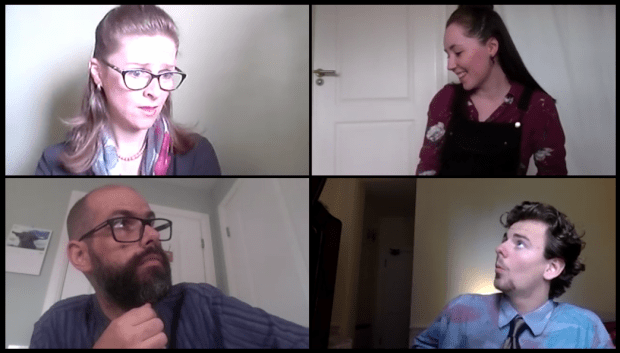
So thank goodness for the inventive minds that populate the performance industry, for the brainwave that saw somebody realise that certain classic plays are perfectly suited to the Zoom platform. Thank goodness for Big Mind Theatre, and their cleverly staged production of Václav Havel’s 1963 play, The Garden Party. 

It’s live, properly live, and I love it. We sign in, then mute ourselves and make ourselves invisible. 

The play is an allegory, skewering the behaviour of those who conformed to the Communist regime in Czechoslovakia. Language becomes meaningless as the characters parrot the same phrases in an endless loop, all struggling to adapt to a nebulous set of ideals.

Not quite all: Hugo Pludek (Ben Fleming) is, it transpires, marvellously adaptable. We first meet him talking to his parents (Ross Bailie and Mick Rowe) whilst listlessly playing chess against himself, winning and losing every game. They’re worried about him, so they’ve arranged a meeting with the influential Mr Kalabis. 

They wait, fruitlessly repeating the same inane questions; there are definitely echoes of Godot here. And then, when Kalabis reneges, citing the need to attend a Garden Party as an excuse, Hugo is dispatched to the same party, in order to ingratiate himself.

It all works out rather too well, as Hugo coldly observes and plans his moves, before assimilating – and then annihilating. 

It’s a bleak tale, and chillingly directed by Katrina Woolley. The textual changes required to make it believable as an online world are only slight, and it feels unpleasantly prescient. The performances are uniformly good, with Lucy Wilson creating an especially nightmarish vision of ruthlessness hidden by a big bright smile.

I have just one criticism, and that’s the length. It’s an intense piece of writing, and the Zoom format really amps up that intensity. It all gets a bit much, and I can’t help thinking some judicious pruning would be beneficial here.

All in all though, this is a bright spot in a world of dark theatres. Don’t miss the chance to see it. You have until 25th July and you can find tickets on Eventbrite or by following this link. https://www.facebook.com/events/228638011488957/?active_tab=about

4 stars

Susan Singfield


The Old Guard

22/07/20

Netflix

Charlize Theron’s steady advance into the realms of the action hero continues apace with this Netflix Original, directed by Gina Prince-Bythewood and based – unsurprisingly – on a comic book by Greg Rucka. Theron plays ‘Andy’ (or Andromadache of Scythia, if you want to be more formal about it), a centuries-old warrior princess. She’s the leader of a group of immortals who spend their spare time as mercenaries, jetting off to the world’s war zones to offer help to those who need it – kicking much ass as they do so.

The team also features Booker (Matthias Schoenarts), Joe (Marwan Kenzari) and Nicky (Luca Marinelli), characters Andy has encountered at various points across the world’s turbulent history, none of whom has much of a backstory – or at least not that the writer has bothered to share with us. When the team’s latest mission turns out to be a double cross, they quickly realise that somebody wants to capture them, and it becomes clear that CIA operative, Copley (Chiwetel  Ejiofor in a rather thankless role), is a key player in this operation.

Meanwhile, young GI, Nile (Kiki Layne), is wondering why a supposedly fatal injury she’s recently acquired in the line of duty hasn’t finished her off. Could it be that she’s the next new recruit for Andy’s team? Sure enough, Andy is soon showing her the ropes…

To be fair, The Old Guard isn’t the total debacle that many reviews have labelled it. It’s hokum, for sure, but it’s niftily directed hokum, which features several developments you don’t often see in a mainstream punch ’em up. Women are placed at the forefront of the action, for instance, while Joe and Nicky are lovers and proud to declare the fact to anyone who’ll listen.

But the story doesn’t always convince. We’re told that members of the team are immortal until ‘it’s time to die,’ which seems to be a case of having your cake and eating it – while Copley’s actions are frankly incomprehensible, lauding Andy and her crew in one breath and ratting them out in the next. His involvement with ruthless scientist and all-round bad egg, Merrick (Harry Melling), is unconvincing to say the least. What exactly are his motives?

Still, this is sprightly enough to pass a couple of hours with ease –  even if the obvious attempt to set this up as the first in a series is a tad optimistic.

3.4 stars

Philip Caveney


Clemency

19/07/20

Curzon Home Cinema

Anybody who still believes that the death penalty is a defensible punishment should sit down and take a long, hard look at this film. Chinonye Chukwu’s bleak, slow burn of a movie ably demonstrates the ways in which capital punishment brutalises and destroys all who come into contact with it – including those who have to implement its chilling procedures.

Bernadine Williams (Alfre Woodward) is the warden of an American prison, a place mostly populated by inmates awaiting death by lethal injection. In a blistering opening sequence, we see one such execution being carried out in unflinching detail. It’s horribly botched, which makes it all the more affecting.

Also waiting on death row is Anthony Woods (Aldis Hodge), a taciturn young man accused of murdering a police officer. He’s been imprisoned for seven years and  insists that he’s innocent, but what makes Clemency different from Just Mercy – a film with which it will inevitably be compared  – is that we’re really never sure whether he has committed the crime or not. In a way, it’s irrelevant, because it’s the very system of capital punishment that’s on trial here and not its victims.

Bernadine is struggling with her duties as warden – the daily grind of dealing with the fear, the hope, the demonstrators, the relatives of those imprisoned and, of course, the inmates themselves. She takes solace in drink and realises that a wedge is developing between her and her husband, Jonathan (Wendell Pierce), but feels unable to do anything about it. Around her, other people are quitting. Defence attorney Marty Lumetta (Richard Schiff), who has spent his life fighting for death row prisoners, tells Bernardine that Woods’ case will be his last – he just can’t take any more campaigns for clemency that never yield results. Even the dead policeman’s parents feel that justice has already been served and want Woods to be pardoned. And he, meanwhile, has pinned all his his hopes on meeting his young son for the first time.

Both Woodward and Hedges submit powerhouse performances here; neither of them isafforded much opportunity to talk, but their fears and hopes are writ large in every move, in every despairing look they direct towards the camera. This will not be the happiest screen experience you’ve ever had, but it’s nonetheless a stirring and emotional story, and a passionate plea for change.

4 stars

Philip Caveney

Amadeus

16/07/20

National Theatre Live

Peter Schaffer’s Amadeus is that rarest of creatures, a celebrated play that went on to become an equally celebrated film. 

This 2016 production by the National Theatre, streaming live on YouTube for a limited period, is well worth catching. Lively, vivacious and compelling, it offers a thrilling blend of theatre and music – indeed, I’ve rarely seen an orchestra so perfectly integrated into a performance. They move around the stage with their instruments, performing brilliant renditions of Mozart’s best known work, and are as much a part of the production as the characters in costume, ‘players’ in every sense of the word.

This is, of course, the ‘based-on-fact’ tale of the bitter rivalry between successful-but-mediocre musician Antonio Salieri (Lucian Msamati) and youthful musical prodigy Wolfgang Amadeus Mozart (Adam Gillen). Mozart has newly arrived at the court of Joseph II in Vienna, expecting to be feted by all he meets, but he unwittingly ignites Salieri’s jealousy and enmity by being too talented for comfort. Some historians have questioned the authenticity of Schaffer’s story, but it really doesn’t matter. It’s quite simply a great idea, beautifully realised.

At first, I have some doubts about this particular adaptation. In the opening scenes, Msamati’s grandiloquent and declamatory delivery is a little hard to take but, thankfully, he soon switches to a more naturalistic approach and, from the moment we are introduced to Gillen’s Mozart, the play finds its wings and soars. 

Gillen plays the upstart visitor as a hypercharged, twitching bundle of neuroses, coming across as a weird mixture of Rick Mayall and Thing 1(or 2?), seemingly unable to stand still for a moment as he spouts strings of inventive obscenities. He’s an absolute joy to watch, and the calm, still performance of Msamati provides a perfect foil for his talents.

Of course, this is much more than a two-man show. The large cast offer faultless support, as they speed the story headlong from each scene to the next.

Under Michael Longhurst’s direction, this production is both playful and inventive, veering expertly between slapstick comedy and moments of pure poignancy. It’s easy to see why the play has achieved such success and the opportunity to reappraise its considerable charms is surely not to be missed.

4.4 stars

Philip Caveney


The Deep Blue Sea

15/07/20

National Theatre Live

Terence Rattigan’s 1952 play seems remarkably contemporary, despite the period details that flood both the script and director Carrie Cracknell’s interpretation of it. Boarding houses are prevalent; Freddie has turned to alcohol because of his awful experiences as a second world war pilot; suicide is illegal; Dr Miller (Nick Fletcher), the doctor-turned-bookie, has a German accent that makes him an outsider. But its central themes – of love, loss and alienation – endure, even if the specific context does not.

Helen McRory is an inspired choice for the lead role, imbuing Hester Collyer with an oxymoronic fierce fragility. She’s at once desperate and sprightly, confident and lost.

Hester too is an outsider: a vicar’s daughter, she has left a respectable marriage (to the paternalistic Sir William, a judge, played with eminent likeability by Peter Sullivan) in favour of a love affair with the dashing Freddie Page (Tom Burke). It’s to the play’s credit that neither of these men is easily dismissed: Sir William is kindly, but Hester wants more than the pleasant companionship he offers; Freddie is unreliable and unromantic, but he is no cad. Both men offer Hester what they have to give, but neither has enough.

And, unable to envisage a future without Freddie’s love, Hester attempts to kill herself.

It’s undoubtedly a tragic tale, brutal in its exposure of human sadness. Tom Scutt’s design, with its eerie reflectiveness and skeletal outlines of other apartments – other sorrows – underscores the universality of Hester’s unhappiness.

But there is hope here, and redemption. And a fried egg sandwich too!

4 stars

Susan Singfield


Fanny Lye Deliver’d

14/07/20

Curzon Home Cinema

Thomas Clay’s oddly titled film has clearly been a labour of love. Ten years in the making and set shortly after the end of the English Civil War, it’s been well reviewed elsewhere – and it stars Maxine Peake, surely the closest thing to a guarantee of quality that film lovers could reasonably ask for. So finally viewing the finished product comes as a crushing disappointment.

There are, of course, some good things to say about Fanny Lye Deliver’d. The look of the film is ravishing and the authenticity of the period setting sings out from just about every frame, putting me in mind of Michael Reeves’ wonderful Witchfinder General. A pity then that the authenticity doesn’t seem to extend to teaching the actors how to convincingly ride horses; they all look like they’ve never sat on a horse before, let alone ridden one. The musical score (composed by Clay and played on period instruments) is also rather good. But then there’s the story…

Fanny (Maxine Peake) is the hard-working wife of the much older John (Charles Dance), a former soldier and a hard taskmaster. It’s clear from the outset that Fanny is led a dog’s life, toiling from sunup to sundown, as she cares for her husband and her young son, Arthur (Zak Adams). The family’s routine is rudely disrupted by the arrival of Thomas Ashbury (Freddie Fox) and Rebecca Henshaw (Tanya Reynolds). The couple arrive stark naked and steal clothes from the Lye’s wardrobe but, when they explain that they have been set upon and rubbed of everything they own, the Lyes take them in, feed them, and tolerate their strange behaviour.

But a visit from the High Sheriff (Peter McDonald), who is in pursuit of two ‘heretics,’ changes everything, unleashing a whole series of violent events…

This might work if the visitors were charming enough to convince an audience that they really could fool a family like the Lyes into accepting their story, but, as played by Fox and Reynolds, they are about as likeable as a cockroach infestation. Quite why young Arthur would trust them – when their only interaction with him involves bullying him mercilessly – is therefore baffling.

We’re told that the two visitors represent a new sexual freedom, one that challenges the strictures of Puritanism,  but – when this supposed freedom seems to be demonstrated by its followers acting just as brutally as the people they supposedly oppose  – it doesn’t really cut the mustard. Furthermore, since the cathartic effect on Mrs Lye is the whole raison d’être for this story (narrated by Henshaw, years after the event) it’s frustrating to see how little opportunity Peake is given to shine, mostly having to convey Fanny’s inner turmoil with sidelong glances and occasional shrugs.

As if the nasty, spiteful storyline isn’t enough to put me off, the film has a slow, lumpen middle section, which drags remorselessly.  I find myself listening to Thomas Ashbury’s heavily accented drivel and vainly wish that Curzon Cinema would get around to offering subtitles for their films.

Fanny Lye Deliver’d feels like something of a missed opportunity, its good points totally swamped by an unpleasant and rather unconvincing storyline.

2.8 stars

Philip Caveney


A Midsummer Night’s Dream

27/06/20

National Theatre Live

Watching immersive theatre via a screen, especially a small screen, is always going to be oxymoronic. My first thought, as Egeus (Kevin McMonagle) drags his errant daughter, Hermia (Isis Hainsworth), through the Bridge Theatre’s standing audience to face the judgement of Theseus (Oliver Chris) is, ‘Oh, this isn’t going to work…’ By which I mean, this isn’t going to work for me. Because sometimes you really do have to be there.

This production, directed by Nicholas Hytner and Ross MacGibbon, is all about the live experience. I can only imagine how exhilarating it must have been in that auditorium, at once spectator and spectacle. Instead I’m at home (for the millionth night running), sitting on my sofa, watching via a computer.

It’s still very good, and I soon get over feeling distanced. I suppose we’ve all had to get over a lot stranger things in recent times. The chilling opening scene – where father-of-the-year Egeus seeks permission to put his daughter to death if she refuses to marry a man she doesn’t love – highlights the importance of the midsummer madness in the woods. Away from the strict patriarchal rule of Athens, the characters are free to explore their deepest desires, able to give rein to their true selves.

The story – for those who need reminding – is of four young lovers who run away into the forest. Also present is a group of amateur actors, seeking a quiet place to rehearse their latest play, and – of course – the resident fairies, who view these human interlopers as playthings, to be teased and manipulated just for fun. In this version, Oberon (Chris) and Titania (Gwendoline Christie)’s roles are switched, with Titania orchestrating the action.

Bunny Christie’s design is bold and daring, all flying beds and shifting green floors. The audience is called upon to move with the action, to pass a parachute above their heads, to dance; they become the forest’s shadows, the Athenian court. I’ve seen a lot of immersive theatre, but rarely anything as well-integrated as this, where the audience action feels purposeful and not just grafted on. The beds are especially clever, highlighting the dual themes of sex and dreaming; it’s not subtle, but why should it be? This is not a subtle play.

There’s not a bum note here, but there are some standout performances, not least from Hammed Animashaun, who plays Bottom as a wide-eyed enthusiast rather than a bumptious fool. He’s utterly endearing, so I’m delighted with Hytner’s decision to make his drug-fuelled tryst with Oberon a tender one, ill-advised but not risible. David Moorst’s Puck is also a delight, all twisty movements and Mancunian patter.

In short, I wish I’d been there; a show like this reminds me exactly why I love live theatre. But seeing it like this is much, much better than not seeing it at all.

4.6 stars

Susan Singfield

L’alba D’oro

l-alba-d-oro

27/06/20

 Henderson Row, Edinburgh

It should be simple enough, right?  We haven’t eaten fish and chips since well before lockdown began, three months ago, and we really, really fancy some. But good fish and chips, you understand, not the greasy lukewarm sludge that sometimes masquerades under that description around Britain’s fair cities. We certainly don’t want to repeat the experience we once had, when, fuelled by a few drinks at The Cameo, we called at a high street chippy (which shall remain nameless), waited ages for some ‘freshly prepared’ nosh, took one bite each and promptly threw the lot into the nearest food recycling bin.

I mean, how difficult can it be?

Of course, in usual circumstances, there’s an easy solution. A quick trip to Berties on Victoria Street and the problem is solved, plus you get to dine in a swish, open-plan restaurant. But these are unusual times, so who can deliver a tasty fish supper direct to our door? We put out a call for help on Facebook and three friends come straight back with the same answer. L’alba D’oro in Stockbridge is the establishment we are looking for. These are all people we trust, so we order online and the food soon arrives, packaged in cardboard and smelling suitably enticing. As the establishment doesn’t offer any Manchester Caviar (mushy peas), we take the opportunity to heat up a can from our larder. We’ve also got our own swanky home-made tomato ketchup (we’ve had time on our hands, okay?), so we are all ready to dine.

Our friends were correct. This is exactly what we’ve been craving. A generously sized portion of haddock, encased in light, crunchy batter, the fish perfectly cooked: white, flaky and aromatic. The chips are crispy on the outside, and all soft and flavoursome within. You’d think it would take quite a while to down such a massive portion, but we demolish it in no time at all.

So, in short, if you’re in Edinburgh and you’re longing for perfect fish and chips, you know where to order from. (L’alba D’oro also offer other tasty treats, plus a different fish special every day.)

4.2 stars

Philip Caveney

Eurovision Song Contest : The Story of Fire Saga

26/06/20

Netflix

There’s a wonderful idea at the heart of Will Ferrell’s Eurovision Song Contest: The Story of Fire Saga – even if it does boast one of the most unwieldy titles in recent cinematic history. Ferrell plays Icelander Lars Erickssong, a petulant man-child with a determination to win the world’s biggest song contest, an ambition nurtured since childhood when he saw first Abba performing Waterloo. He and his best friend, Sigrit Ericksdottir (Rachel McAdams), perform as pop duo Fire Saga, who play regularly in their local bar to the complete indifference of their neighbours. Even Lars’ father, Erick Erikssong (Pierce Brosnan) – a no-nonsense fisherman – makes it clear that it’s time his son stopped fooling around with music and got a proper job.

But when a series of complex misadventures results in Fire Saga being picked to appear in the regional heats for Eurovision, Lars has his eyes so firmly on the big prize, he is blithely unaware of Sigrit’s long held desire to make their relationship more than just a musical one.

Perhaps the film’s strongest suit is the songs, composed by Atli Övarsson and Savan Kotecha, which, with their “accidentally” suggestive lyrics and bombastic singalong choruses are convincing enough to pass muster as genuine Eurovision entries, whilst still consistently hitting the funny button. But not everything is quite as satisfying here. Having Icelandic characters played by American and English actors might invite accusations of cultural appropriation, especially when those characters are depicted as simplistic, superstitious oafs who believe in the existence of elves. Having genuine Icelanders in supporting roles, including the wonderful Ólafur Darri Ólaffsson, isn’t really enough to stave off those accusations.

On a similar note, Dan Stevens appears as Russian mega-star Alexander Lemtov, who soon begins to pursue Sigrit with singular determination. Again, he’s entertaining, but his motives are never really clear. Perhaps Ferrell, who co-wrote the script, was thinking of some real-life gay musical icons who went through the pretence of heterosexuality in order to placate their fans? Whatever the reasoning, this doesn’t quite come off.

But those reservations aside, I have to admit I am mightily entertained by ESCTSOFS and even feel somewhat moved by its final act. I am also delighted to note that much of the action is set in my home city of Edinburgh (it’s the host for the Eurovision final). Furthermore it’s good to see Ferrell back on some kind of form. If I’m honest, it’s a long time since any of his efforts have made me laugh. A shout out here should go to Molly Sanden who provides the vocals for Sigrit’s performances – and there’s me thinking, ‘Wow, McAdams really can sing!’

If you’re looking for an undemanding, good-time film to while away a couple of hours, you could do a lot worse than this.

3.6 stars

Philip Caveney

Small Island

19/06/20

National Theatre Live

Anyone who’s still clinging to the notion that #BLM protests are not needed in the UK would do well to watch this latest screening from the National Theatre, and remind themselves of the shameful way black British subjects from Caribbean countries have been treated here.

Andrea Levy’s novel, adapted for the stage by Helen Edmundson, is set in the 1940s, so does not directly address the 2018 Windrush scandal – where at least eighty-three people were wrongly deported – but it does show very clearly how they came to be here in the first place, encouraged to embrace their Britishness by fighting for ‘their’ country in the war, then helping to rebuild a battered Britain afterwards. ‘Used’ is the first word that comes to mind. ‘Abused’ is the second.

The play, directed by Rufus Norris, is at once an expansive, epic sweep of a project, and a deeply intimate portrayal of three people, cast adrift and then brought together, an intricate web linking their lives.

Leah Harvey is Hortense, a prim, ambitious Jamaican school teacher, desperate to escape the confines of her upbringing and live amongst the china tea cups and cream teas that define Britain for her. The love of her life is her ‘cousin’ Michael (CJ Beckford), but he doesn’t feel the same way about her. Spurned, Hortense realises that, by paying for his passage to England,  she can persuade RAF airman Gilbert (Gershwyn Eustache Jnr) to marry her, and offer her the life she dreams of.

But when she arrives in London, Hortense is horrified to discover that their accommodation is a tiny room in a rundown boarding house, that she is subjected daily to the most appalling racism, and that no one will employ her as a teacher, or even recognise the qualifications she’s worked so hard to acquire. The landlady, Queenie (Aisling Loftus), is their one ally, but even her support seems less assured when her bigoted husband, Bernard (Andrew Rothney), finally returns home from the war.

The acting from all is superb, although it is Harvey’s performance that lingers in the memory, a study in rigid reserve and masked disappointment.

I love Katrina Lindsay’s set design, which is perfectly complemented by Jon Driscoll’s projections, making full use of the enormous Olivier stage. The storm scenes in particular seem immersive, and the size of the Windrush boat (and thus the scale of the ensuing scandal) is cleverly conveyed.

The first act is more complex than the first, cutting between countries and characters, but we always know exactly where we are, and all the disparate strands are brought together skilfully in a more cohesive second act.

This is a timely release from the National Theatre, and reinforces the need for more BAME representation in the arts.

You have until next Thursday to watch it.

4.1 stars

Susan Singfield