Peter McDonald

Power Ballad

31/05/26

Cineworld, Edinburgh

Since his 2006 breakthrough, Once, Irish director John Carney has concentrated his attention on films about musicians – and, as you’ll no doubt have guessed from its title, Power Ballad is no exception. I’m pretty sure this is his first attempt to deal with the subject of intellectual copyright though. And if that sounds dull, don’t be misled. For my money, this sparky, enjoyable drama might be Carney’s best offering yet.

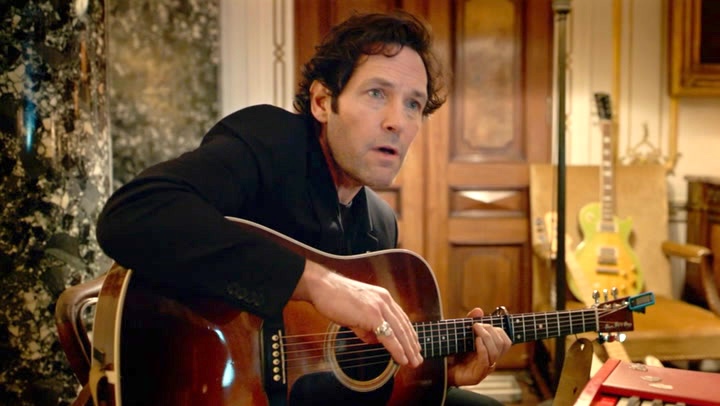
Rick Power (Paul Rudd) is a former member of an influential band. Back down the years, he swapped his dreams of stardom for marriage and fatherhood. He’s living happily with Rachel (Marcella Plunkett) and their teenage daughter, Aja (Beth Fallon), in the suburbs of Dublin. To earn a crust, Rick fronts a band called Bride and Groove, who specialise in playing weddings, covering all the usual hits. Occasionally (and much to the chagrin of his fellow band members), he throws in one of his own compositions, with predictably dancefloor-clearing results.

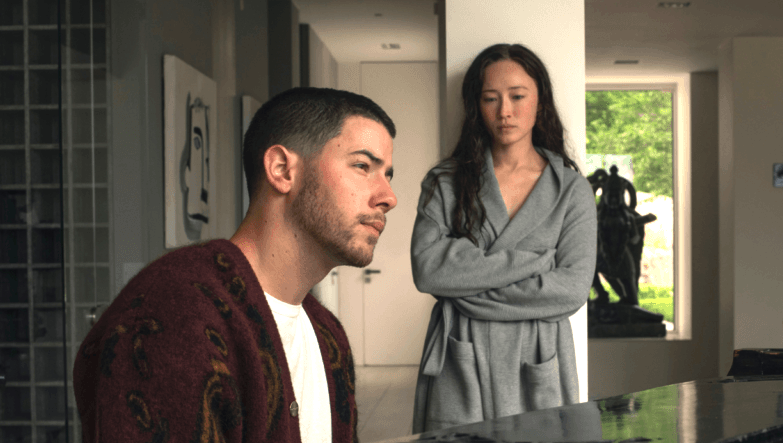
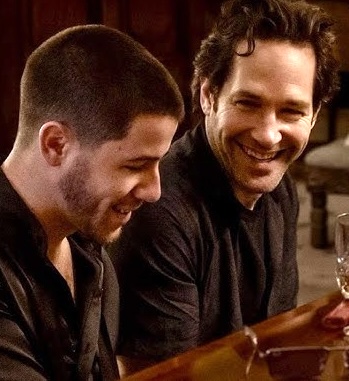
When the band picks up a gig at a swanky hotel, one of the wedding guests turns out to be Danny Wilson (Nick Jonas), a former member of a chart-busting boy band, now trying to find his way as a solo artist. Danny joins the band on stage for a Stevie Wonder song and Rick and Danny appear to have an easy rapport. After the gig, they hang out together, drinking whiskey, smoking spliffs and exchanging ideas. 

Rick plays Danny one of his old compositions, How To Write a Song Without You, which Danny seems to take an instant shine to.

Six months later, Rick is walking through a shopping mall when he hears a very familiar melody playing on the tannoy. It turns out that Danny has recorded Rick’s song as his new single and it’s on track to be a massive number one hit… but there’s no mention of Rick’s involvement.

Anyone who has played in a band will identify with Rick’s resulting anguish. His song has been appropriated but he has no proof that it’s his original composition. When he tells people about it, a lot of them (even his friends) think he’s fantasising. His inability to obtain the recognition he deserves sends him into a spiral of frustration that threatens to destroy everything he has – including his relationship with his daughter.

Rudd is always an appealing performer and he’s terrific in the lead role, performing his own vocals and looking every inch a musician, while Jonas (a genuine former boy band member) does a great job of portraying Danny’s conflicted emotions, his inability to own up to what he has done. Keith McErlean is impressive as Kyle, Danny’s ruthless American manager, and I also love Peter McDonald’s performance as Sandy, Rick’s supportive best friend, ready to back his mate up no matter what happens – even if it means hopping on a flight to Los Angeles to take the bull by the horns.

Power Ballad is perfectly pitched and manages to keep its conclusion tantalisingly unresolved until almost the final shot. If you don’t come out of this with an earworm for that central song, then there’s frankly no hope for you.

4.7 stars

Philip Caveney

Fanny Lye Deliver’d

14/07/20

Curzon Home Cinema

Thomas Clay’s oddly titled film has clearly been a labour of love. Ten years in the making and set shortly after the end of the English Civil War, it’s been well reviewed elsewhere – and it stars Maxine Peake, surely the closest thing to a guarantee of quality that film lovers could reasonably ask for. So finally viewing the finished product comes as a crushing disappointment.

There are, of course, some good things to say about Fanny Lye Deliver’d. The look of the film is ravishing and the authenticity of the period setting sings out from just about every frame, putting me in mind of Michael Reeves’ wonderful Witchfinder General. A pity then that the authenticity doesn’t seem to extend to teaching the actors how to convincingly ride horses; they all look like they’ve never sat on a horse before, let alone ridden one. The musical score (composed by Clay and played on period instruments) is also rather good. But then there’s the story…

Fanny (Maxine Peake) is the hard-working wife of the much older John (Charles Dance), a former soldier and a hard taskmaster. It’s clear from the outset that Fanny is led a dog’s life, toiling from sunup to sundown, as she cares for her husband and her young son, Arthur (Zak Adams). The family’s routine is rudely disrupted by the arrival of Thomas Ashbury (Freddie Fox) and Rebecca Henshaw (Tanya Reynolds). The couple arrive stark naked and steal clothes from the Lye’s wardrobe but, when they explain that they have been set upon and rubbed of everything they own, the Lyes take them in, feed them, and tolerate their strange behaviour.

But a visit from the High Sheriff (Peter McDonald), who is in pursuit of two ‘heretics,’ changes everything, unleashing a whole series of violent events…

This might work if the visitors were charming enough to convince an audience that they really could fool a family like the Lyes into accepting their story, but, as played by Fox and Reynolds, they are about as likeable as a cockroach infestation. Quite why young Arthur would trust them – when their only interaction with him involves bullying him mercilessly – is therefore baffling.

We’re told that the two visitors represent a new sexual freedom, one that challenges the strictures of Puritanism,  but – when this supposed freedom seems to be demonstrated by its followers acting just as brutally as the people they supposedly oppose  – it doesn’t really cut the mustard. Furthermore, since the cathartic effect on Mrs Lye is the whole raison d’être for this story (narrated by Henshaw, years after the event) it’s frustrating to see how little opportunity Peake is given to shine, mostly having to convey Fanny’s inner turmoil with sidelong glances and occasional shrugs.

As if the nasty, spiteful storyline isn’t enough to put me off, the film has a slow, lumpen middle section, which drags remorselessly.  I find myself listening to Thomas Ashbury’s heavily accented drivel and vainly wish that Curzon Cinema would get around to offering subtitles for their films.

Fanny Lye Deliver’d feels like something of a missed opportunity, its good points totally swamped by an unpleasant and rather unconvincing storyline.

2.8 stars

Philip Caveney