Theatre

Beetlemania: Kafka for Kids

12/08/18

Pleasance Dome (Queen), Edinburgh

Kafka? For kids? Really? It doesn’t sound like a goer, to be honest. But – it turns out – Kafka can indeed be repurposed for kids, and rendered funny and entertaining for adults too.

I’m vaguely familiar with Kafka’s work. I first encountered Die Verwandlung while studying for a degree in German literature, and then – during a second degree course, this time in theatre studies – met up with its English translation (Metamorphosis) via Berkoff’s infamous production. I’ve read The Trial, too, and The Castle, but not recently; in short, I know just about enough to be sure that Beetlemania: Kafka for Kids will have to pull something rather special out of the bag if it is to hit its mark. And does it? Oh yes, it really does.

The show is a delight from start to finish, the deceptive simplicity of the knockabout comedy concealing some clever structural stuff, and layered references to Kafka’s obsessions and stylistic tics. It’s all there: humanity-crushing bureaucracy, alienation, despair. There’s poverty too, and hope – and much absurdity. And, in Tom Parry (he of Pappy’s fame)’s script, it all comes together to make a genuinely funny and illustrative hour of fun – for all the family.

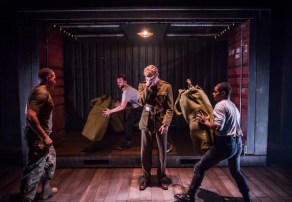
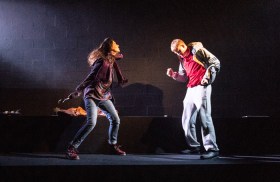
Parry stars in the show as well, as Karl, the hapless entertainer who’s inadvertently robbed a Royal Mail van, the contents of which serve as makeshift set and props. He’s joined by Will Adamsdale, who plays the troupe’s frustrated leader, Karter, and Heidi Niemi (Kat), who speaks Finnish throughout. The trio are interrupted, intermittently, by the marvellous Rose Robinson (last seen by Bouquets & Brickbats in Great British Mysteries: 1599? earlier this week), who plays a series of officious bureaucrats, each one more demanding than the last.

We’re introduced to miserable tales, where Poseidon is crushed by the weight of his paperwork, where a bridge loses faith in its ability to connect. We’re drawn in, made accomplices; we tell lies to officials to protect the performers. The kids in the audience are utterly enthralled. We don’t have any kids with us, but we are entranced too.

It’s a rainy day, so numbers are down; it’s a shame to see so many empty seats when the material is as good as this. Any families out there looking for something quirky, something different – I urge you to give this a go.

5 stars

Susan Singfield

Stardust


11/08/18

Pleasance Dome, Edinburgh

Stardust is all about cocaine – its history, its usage, its properties. It’s about the way a tribal drug, used for thousands of years in religious ceremonies has been taken up by the Western world, exploited and commodified; how people are enslaved by it, murdered because of it and how casual users across the Western world, no matter how they might protest, now have blood on their hands. Make no mistake, this is a hard-hitting piece.

Our MC for this show is Miguel Hernando Torres Umba, a charismatic artist/performer making his debut at the Fringe. He uses many different techniques to get his story across. There are dreamy back projections, and ethereal music. For one section he adopts the persona of a game show host and gets the entire audience to interact with him. In another, he spoofs the famous scene from Scarface where Pacino takes all those bullets. Oh, and did I mention that he’s also an incredible dancer? One section where he depicts, through dance, the way that cocaine acts on the senses is a real highlight for me. He dances like he’s just inadvertently stepped on a 60,000 volt cable… leaping and scrambling around the stage until the inevitable comedown hits him and everything goes eerily into slow motion.

There are plenty of laughs scattered throughout this exciting multi-media show, but it clearly has a very serious message. Umba now lives in London, but was born in Colombia and is understandably sick of the way his nation is habitually depicted, how everybody in the West assumes that his countrymen are all drug dealers. He demonstrates very effectively how the people that grow coca are themselves victims of the organised crime that has grown up around the harvesting of the plant. There are the harrowing testimonies of people too scared not to grow it, people who have seen their relatives tortured and murdered in order to make them obey.

This is a powerful polemic delivered as a slice of entertainment, sharp enough and affecting enough to change hearts and minds. Go and see this and, whatever your views on cocaine, prepare to be enlightened.

4.5 stars

Philip Caveney


Gulliver Returns

11/08/18

Underbelly (Big Belly), Cowgate, Edinburgh

Gulliver Returns, written and directed by Dan Coleman, is an interesting piece of work. We first meet Lil (Cathy Conneff), whose introduction warns us that her husband, Adam (Jack Bence), has recently started demanding that she call him Lemuel Gulliver, and that he identifies completely with the protagonist of Swift’s most famous book.

What follows is a clever interweaving of Gulliver’s Travels and Adam’s apparent breakdown, the novel serving as an allegory for Adam’s struggle to cope with bereavement, with loss. Lil humours him, supports him, helps him to tell his tall tales – because she loves him and she wants him to be well. As Gulliver, he moves ever further away from her; by joining in his stories, she tries to draw him back.

It’s serious stuff, with a lot to say about mental health as well as an analysis of a fine piece of literature. But it’s funny too – often laugh out loud – as Lil mediates Lemuel’s pomposity, punctures his self-aggrandisement and sets him right on a few things.

Both actors are first-rate, actually; we are drawn into the horror of their disintegrating marriage, fearing for them even as we laugh at their antics. And there’s some innovative use of puppetry, the Houyhnhnm in particular a curious spectacle. The set – three bookcases and a stool – is remarkably effective, conveying oceans as well as living rooms, simultaneously vast and stifling.

The only thing that lets this down is the venue: there’s water dripping on the bare concrete stairs that lead up to Big Belly, and it stinks in there of damp and mould. But still, it’s worth steeling yourself and putting up with the fetid air for this quirky, fascinating play.

4.5 stars

Susan Singfield


A Substitute For Life

11/08/18

Assembly Hall, Edinburgh

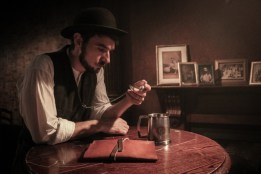
A Substitute For Life is an intriguing monologue, written by Simon Brett and performed by Tim Hardy. It’s the story of Francis Kenworthy, a man who has largely abandoned life in order to subsume himself in his greatest passion: books. When we enter the venue, we find him already seated at his desk, surrounded by his beloved tomes. The lights dim and, by candlelight, he tells us his story – about his passion for the work of Wilkie Collins, about his harsh upbringing at the hands of an uncaring father and a cruel governess. He tells us about his brother, who received all the attention, the one who was destined to be the heir, while Francis was merely the ‘spare.’ But of course, time has a habit of correcting the best-laid plans of controlling fathers and this is no exception.

There’s the feel of a Victorian ghost story about this production, though it doesn’t feature any supernatural happenings, unless of course, you include Hardy’s performance, which is absolutely spellbinding. As Kenworthy’s tale unfolds, the audience are drawn closer into his confidence and, despite the fact that he is not the most pleasant of characters, given to the kind of prejudices that were so prevalent at the time, still we fully empathise with his situation – which makes the story’s conclusion all the more powerful – and it would be unfair of me to reveal anything more than that.

Directed by Alison Skilbeck (Hardy’s wife, whose  Are There More of You? is showing in the same venue and with which this would make an excellent double bill), A Substitute For Life is an object lesson in how to deliver a monologue. It also leads me to remark on the way out, that it seems unfair to have so much talent in one family.

But talent there undoubtedly is, and you’ll find it in abundance at the Assembly Hall.

4.5 stars

Philip Caveney

Aye, Elvis

10/08/18

Gilded Balloon, Rose Theatre, Edinburgh

Joyce Falconer stars as Joanie in Morna Young’s engaging play. Joanie’s world is dreary and dull: she bickers daily with her housebound mum, and dreams of something more exciting than her supermarket checkout job. Singing karaoke at the local pub leads to an obsession with Elvis, and she sets herself up as a tribute act, drawn into the cameraderie of online chat groups dedicated to the King. Encouraged by Fat Bob, the pub landlord, she sets out on an ambitious project that is sure to change her life.

Aye, Elvis is a big hit with tonight’s (largely Scottish) audience, who are vocally appreciative throughout, joining in with the big numbers, clapping and laughing and generally enjoying what they see. It’s not hard to see why: this is entertaining, feelgood stuff: silly and poignant and hilarious throughout. Falconer clearly has a strong fan-base here; she has a twinkle in her eye, and seems to be relishing her time on this small stage. Karen Ramsey makes the most of some deliciously acerbic lines as Joanie’s crabby mum, and David McGowan’s Fat Bob is a charming, calming presence.

Dazzlingly costumed and played for laughs, this is a lot of fun, and definitely worth making a trip to see. It even gets a standing ovation from the crowd – the first we’ve seen at this year’s Fringe.

4 stars

Susan Singfield

Velvet

10/08/18

Pleasance Courtyard (That), Edinburgh

Tom Ratcliffe’s Velvet is a fascinating piece,  an I-can’t-bear-it-but-I-can’t-look-away depiction of a young actor’s downfall, as unscrupulous industry moguls prey on his vulnerability.

He plays Tom (the name is a nod to the fact that the play, which he has written, while not autobiographical, draws on his own experiences), a recent drama school graduate, ambitious and hopeful, determined to realise his dream. He is working, just not as much as he wants, and – like most actors – he has to take on temping jobs so that he can pay his bills. His banker boyfriend, Matthew, doesn’t really understand; he thinks Tom should pursue other career options, find something more stable, but Tom has a vocation and he needs to follow his star. His mum isn’t much better; she’s over-critical and unsupportive. Tom has no one to turn to when things start to unravel.

And unravel they do, pretty much from the start, when a casting director makes a pass and Tom refuses. It’s all terribly polite, but the ramifications are life-changing. The calls dry up. He’s desperate. And, of course, there are always vultures out there, ready to take advantage of despair.

This is a bravura performance, captivating and engrossing; I’m utterly beguiled. There is a disarming authenticity to the piece, which draws us deep into Tom’s world. It’s a clear example, too, of why the #MeToo movement matters: there are people with too much power, abusing their positions to control the powerless. Of course Tom makes foolish decisions; he doesn’t know what else to do. The establishment have closed ranks, barred him; he hasn’t danced to their tune and now he must be punished.

It’s painful to watch, and all too convincing. Ratcliffe performs with real openness, so that Tom’s humiliation makes us hurt with him, and I find myself blinking away tears. The play’s structure is interesting, a non-linear depiction of events, with simple light and sound effects jolting us in and out of key moments. I like the image of the casting couch too, the velvet chaise longue that remains onstage throughout, a permanent reminder of what this is about.

This is a triumph, actually – and deserves a bigger audience than the one we were part of today.

5 stars

Susan Singfield

The Basement Tapes

09/08/18

Summerhall, Edinburgh

Zanetti Productions’ The Basement Tapes is a startling piece of theatre, compelling and surprising, throbbing with energy. The site-specific environment of the creepily named ‘Former Women’s Locker Room’, deep in the bowels of the Summerhall building, all clanking radiator pipes and low ceilings, enhances the rising tension, and we find ourselves utterly enthralled.

Stella Reid plays a girl who, after her grandmother’s death, is tasked with clearing out her home. We’re with her in the cluttered basement, resonant with memories, boxes everywhere. The girl is part way through her onerous assignment: some of the boxes are open, their contents strewn around the room. She’s clearly bored, dancing as she works, pausing to order pizza, trying on her grandma’s coat. She grapples with unfamiliar technology: calling her mum via a landline, because there’s no mobile signal here; intrigued by an old tape recorder and a bag full of cassettes.

From hereon in, the story revolves around those cassettes, those titular basement tapes. The eerie, disembodied voice of her dead grandmother weaves its way into the tale, taking us (and the girl) on a strange journey, with macabre revelations that really make the spine tingle.

The atmosphere is fraught, crackling like the electricity that intermittently cuts out, leaving us in darkness as black as the secrets that have been set free. Stella Reid’s performance is powerful and riveting; I realise, as I leave, that I have been holding my breath.

An exciting, innovative production from this award-winning New Zealand company, the show is deservedly sold out for much of its run. If you can, get hold of a ticket now while there are still a few available.

4.5 stars

Susan Singfield

Stupid Cupid

09/08/18

Underbelly, Med Quad

Stupid Cupid marks Canadian Liz McMullan’s first show on the Fringe, a one woman monologue written by Kerianne Cameron and Miguel Eichelberger. McMullan plays the titular wannabe cupid, who has come along to the venue to take her ‘cupidity test.’ She hopes to be awarded an official set of wings, at which point she will be allowed to go forth and wreak havoc on an unsupecting world with her little bow and arrow

But an administrative error has left several other bows stored in the room where she’s taking her exam. These are the infamous Bows of Destiny, belonging to her illustrious predecessors, and she has been warned not to go near them. But, when she inadvertently spikes herself with a love arrow, she cannot help but pick up each bow in turn, to try it out for herself…

I’ll confess that my first impressions of this are not promising. The concept feels a little too sacharine for my taste and I’m fully expecting not to enjoy it – but McMullen soon wins me over with her assured and confident performance, interracting expertly with the audience and displaying not one ounce of inhibition as she careers through all aspects of love from prim and correct to downright saucy. (A gentle word of warning. This may not be suitable for children.)

Love, we learn, is a complicated process – and McMullen is the perfect guide to help us steer a path through the potential pitfalls.

Charming and thoroughly enjoyable stuff. Those of a romantic disposition, should pop along for further instructions – and it seems, there’s even hope for grumpy old devils like me.

4 stars

Philip Caveney


Blue Heart

08/08/18

C Too, St Columba’s by the Castle, Edinburgh

The Bathway Theatre Company comprises students and recent alumni from the University of Greenwich, and they have certainly chosen a complex piece for their Edinburgh Fringe debut. Caryl Churchill’s 1997 Blue Heart consists of two one-act plays, and they are both extremely difficult. But these young performers seem undaunted, rising gamely to the challenge, proving that they are more than capable of delivering Churchill’s high concept work.

First up is Heart’s Desire, where a London-based family awaits a visit from their daughter, who has been living in Australia. They run through the same scene, again and again, some ideas repeated word for word, while others change or are replaced. It’s about wish-fulfilment, clearly, about divergent paths, and choices made. We think it’s also probably about the writing process, about the possibilities of a blank page, of editing and redrafting. Whatever, it must be hard work to perform, a nightmare to remember lines where the same cues act as prompts for different responses, but these actors make short work of it. Bethan Shaw is both funny and tragic as the girl’s mother, Alice, her timing impeccable, and Jason Kennedy (as Bryan) and Jess Buckley (Maisie) are also impressive, his obvious anxiety contrasting beautifully with her placid acceptance.

The second act is Blue Kettle, starring John Dawson as Derek, an adoptee apparently seeking his birth mother, convincing several women that he is their son. His aim, he says, is to defraud them, to claim their money – and they are more than willing to believe his story; they want it to be true. The title refers to the disintegration of language in this piece – the words ‘blue’ and ‘kettle’ are inserted into the dialogue with increasing frequency, at first replacing just occasional nouns, or verbs that rhyme with blue, but soon reducing whole conversations to repeated utterances of the same two words – yet still, somehow, we can discern the meaning, the essence of what’s being said. It’s as audacious an idea as we might expect from Churchill, and another mighty challenge for the performers. But again, this company proves its worth, earning our admiration for their control of the material. Blue Kettle is more of an ensemble piece than Heart’s Desire and the actors work skilfully together – even the detailed set change between the acts is perfectly choreographed, woven into the production, fascinating to observe.

Tucked away down a flight of stairs at the back of a church on Johnson Terrace, this might be hard to find. But it’s well worth seeking out this ambitious production – it really is a little gem.

4 stars

Susan Singfield

Are There More of You?

08/08/17

Assembly Hall, Mound Place, Edinburgh

After last year’s The Power Behind the Crone (which we awarded an Edfest Theatre Bouquet), we know that Alison Skilbeck is a truly gifted player, and are keen to see her latest offering. Are There More of You? is another one-woman show, this time a series of four loosely connected monologues, and it’s a masterclass in character acting.

We first meet Claire, an ambassador’s wife, recently returned to the UK from Morocco. But their shared retirement plans have been scuppered by his revelation that he’s leaving her, and Claire is struggling to build a new life for herself.

Then there’s Sofia, who owns the trattoria down the road from Claire’s art class; she has big ambitions for the café’s future, but family problems keep getting in the way.

Sara is a “spirit weaver”, and she has a lot to say about the people that she treats. When her old school friend, Sam, a successful business woman, finds herself drunk and alone in Sofia’s trattoria, she sets aside her scepticism and calls on Sara for some spiritual healing.

Skilbeck segues between characters with almost indecent ease; she is a chameleon, transforming before our eyes. There’s not much in the way of props or costume to assist her: she simply adds a headband, shakes her hair loose, changes her jacket or puts on an apron. But her face sags or tightens, her jawline tenses, her lips purse, her shoulders drop, her hand gestures become expansive: she looks somehow completely different; each woman is distinct. Her voice changes too, from prim and clipped to a gravelly drawl, and it’s all so subtle, so nuanced, so precise – I am in awe. Every ambitious young actor at this Fringe should make a point of seeing Skilbeck’s show; it’s an object lesson – and a delight.

Her writing’s good too. There’s a Bennett-esque appeal to these four pieces: a gentle humour permeates throughout, and there’s warmth and fondness for the characters.

So, if you’ve an hour to spare one morning, why not head up to the Assembly Hall and watch this marvellous production? It really is something special.

5 stars

Susan Singfield