The Moortop

IMG_1543CPV7a8SWIAAl6IN

11/09/15

The Moortop, Heaton Moor Road

The sleepy suburb of Heaton Moor is all of a buzz at the moment – new dining establishments seem to be springing up on every corner and even the iconic Savoy cinema is currently being restored to its former glory, complete with doric columns and a programme of films that people might actually want to see. So it was interesting to hear that in the midst of all the bustle, Damson’s ebullient owner, Steve Pilling, had quietly taken over the Moortop pub, right across the road from his celebrated gourmet restaurant.

To be honest, the Moortop was always a bit of an anomaly here: it had the ambiance of your average Weatherspoons and specialised in the kind of cut price, ‘pile it high’ deep fried nosh that gives pub grub a bad name. To be fair, the latest incarnation is just a temporary stage. In the New Year, the place will be receiving a full upgrade (more of that when we have the information.) For the moment, its been given a lick of paint and offers a small but classy menu with all items reasonably priced –  the ‘proper’ Sunday dinner, complete with a tasty vegetable soup comes in at a tenner – pies and pizzas are priced around £6.75. So you don’t have to break the bank to eat here.

The afternoon we called, we presented them with something of a challenge. There were six of us to dine, three of us vegetarians – but after a little uncertainty, we all found things we were happy to eat. Susan opted for the beef dinner and it was indeed everything you’d expect. Preceded by a small bowl of deliciously creamy parsnip soup, the beef was perfectly cooked, the accompanying vegetables just al dente enough and the Yorkshire pudding (always the trickiest thing to get right)  light and crispy. The rich red wine gravy came in its own pot and made a perfect accompaniment.

One of the veggies opted for the same meal without the meat, when she was told that the chef could provide a suitably non-meat gravy. The absence of beef was compensated for by the addition of an extra Yorkshire pudding. Good move!

I sampled the Feta Cheese pie (as did two others in our party), which was satisfyingly flavoursome, the pastry crisp, the filling rich and creamy. It came accompanied with chips, a generous dollop of Manchester caviar (mushy peas) and the aforementioned red wine gravy.

The youngest member of the party wanted a Neapolitan pizza and this was provided, even though, it wasn’t supposed to be on the menu that day. It was wafer thin and crispy and big enough to make it a struggle for her to finish. (Luckily, purely in the interests of this review, we helped her out!)

All in all, a satisfying family Sunday dinner at a great value price. Would we go again? Yes, indeed! It will be interesting to see what plans Steve has for the place in 2016. In the meantime, get on down there and enjoy.

4 stars

Philip Caveney

Macbeth

MV5BMjA5NjgyMzY1NV5BMl5BanBnXkFtZTgwOTk3NTY2NjE@._V1_SX214_AL_

08/09/15

Macbeth has been filmed many times with varying degrees of success. Indeed, the story is so familiar there’s no point at all in describing what actually happens, since it is indelibly imprinted upon most people’s consciousness. Yet every single film made thus far has overlooked a really important opportunity. Macbeth and his wife need to be teenagers. Only the overbearing hubris of youth and rampant ambition can ever fully explain their actions. Of course, when you’re in the business of financing a movie, the simple truth is that you need names that will put bums on seats, so the chances are we’ll never get to see such an interpretation on the big screen. Which is a shame.

Here, Michael Fassbender gives us a grimy, muscular Macbeth, while the usually dependable Marion Cotillard struggles somewhat with her Scottish accent as his scheming wife. If you’re going to film this play, you really need to have something different up your sleeve and apart from a few neat flourishes, director Justin Kurzel doesn’t have an awful lot to offer us. He opens with the funeral of the Macbeths’ young son (something alluded to in the text but not, to my knowledge, ever shown before) and then he gives us a big slow motion battle, set against some bleak highland scenery. The witches are nicely restrained (some of their most famous lines summarily dispensed with) and from there, matters proceed at a funereal pace, with Fassbender and Cottilard reciting their lines whilst gazing into the middle distance, like actors in an Ingmar Bergman film.

It isn’t terrible, you understand, but the leaden quality rather neuters this most virile of Shakespeare’s plays, making you long to push on to the next action sequence, rather than relishing those wonderful words. There’s also a terrible misstep when Macbeth appears to discuss the assassination of Banquo (Paddy Considine) as the entire court listens in. It must have been Kurzel’s intention to do it this way, but it looks, frankly, risible.

The closing sections, in which the avenging forces set fire to, rather than transport the woods of Dunsinane, finally allow a touch of awe into the proceedings and the confrontation between Macbeth and Macduff (Sean Harris) is visceral enough to ensure this probably won’t be suitable to show in schools. There’s also a nice twist at the end involving the King’s sword – but by this time, it’s a little too late to salvage proceedings.

Advance reviews for this had led me to expect something extraordinary, but overall this felt like just another version of a tried and tested story. Decent but not a game changer.

3.5 stars

Philip Caveney

Golem

images images-1

07/09/15

Home, Manchester

It’s not often that you sit down in the theatre with no real expectations and witness something so unique, so unexpected, that you leave with your mind well and truly blown; but that’s exactly how I felt after watching Golem by the experimental theatre company 1927. This eye popping amalgam of live action, music and (occasionally jaw dropping) animation is the most innovative and exciting spectacle I’ve seen in years.

The myth of the Golem, is of course, one of the oldest tales in existence. A creature created out of clay to do mankind’s bidding, its most famous manifestation was in Paul Wegener’s silent movie of 1915, the imagery of which is sometimes evoked here. In this version of the story, Robert (Shamira Turner) leads a life of unremitting tedium, enacting the same sequence of events every day, working in a ‘binary backup centre’ to earn his wages and too shy to approach new employee, Joy (Rose Robinson, brilliantly conveying the antithesis of what that name suggests). But when a friend, Phil Sylocate (Will Close) launches his new business, offering Golems that will carry out the owners every whim, Robert is an eager customer. At first all goes well, but as time passes, the Golem becomes ever more assertive, until inevitably the question arises; just who is in charge here? And what happens when the original Golem is updated to the new, faster, smarter Go 2?

If the story seems familiar, it should be borne in mind that the execution is key here – the perfect meld of acting, animation and music create a surreal, dreamlike world and one can only marvel at the degree of precision that must have been required to bring this extraordinary production together. Lest you be worried that it all sounds a bit dour, don’t be fooled – there’s plenty of comedy skilfully woven into writer/director Suzanne Andrade’s witty script. Ultimately, the word that best describes Golem is ‘magical’. Though on reflection, ‘unmissable’ will do just as well.

The production is at Home, Manchester until the 17th of October.

5 stars

Philip Caveney

Jane Eyre

Unknown-3 333880_770_previewFullSizeRender

03/10/15

National Theatre, London

Jane Eyre is one of my favourite books, but I’ve been bitterly disappointed by most film and theatre adaptations, despairing of directors who interpret Jane as quiet and reserved. Thank goodness then for this collaboration between the National Theatre and Bristol’s Old Vic, devised by the company, which is by far the best I have ever seen.

It’s a dynamic interpretation, eschewing the rigid formula of a period drama, in favour of a more holistic view of the novel. This makes for a surprisingly faithful telling of the narrative: free from the confines of a naturalistic set and strict chronology, director Sally Cookson has created space for Jane’s whole story to be centre stage.

The set is functional: a series of wooden boards and platforms linked by steps and ladders. It works, each of the locations rendered believable by the way in which the actors interact with it. This is a very physical production, with actors hurtling up and down and all around. With less assured direction it could all seem chaotic; in these hands, it’s a lively, energetic delight, with all Jane’s feisty, angry, raging spirit spilling out over the stage.

Madeleine Worrall, as Jane, embodies that spirit perfectly, and Melanie Marshall’s musical Bertha, dressed in red and looming large throughout Jane’s life, is truly glorious: Jane’s inner self writ large, demanding both our attention and our care.

There is humour too. Craig Edwards’ Pilot is a triumph of physical theatre: a huge, enthusiastic, bounding dog brought convincingly to life. Laura Elphinstone’s Adele is equally engaging, a needy, sweet and funny child, just desperate for love.

But this is ensemble theatre, and the whole cast work together well. I can’t do justice here to the breadth of ideas sewn so seamlessly into this play. It’s an imaginative, exciting and innovative piece of theatre, breathing fresh life into a tale I thought I knew too well.

Do try to catch it if you can.

5 stars

Susan Singfield

Our Country’s Good

Unknown-2 Unknown-1

02/10/15

National Theatre, London

Our Country’s Good is undoubtedly a wonderful play; the text is intense, thought-provoking, heartbreaking and funny. Based on Thomas Keneally’s novel The Playmaker, it tells the tale of the first convicts deported from Britain to Botany Bay, and how they put on a production of The Recruiting Officer in honour of the king. Even on the page, it has the power to make the reader question the very nature of humanity, and to consider how theatre can aid the civilisation of the most troubled soul.

A shame, then, that the National Theatre’s production, directed by Nadia Fall, should play up the comedic aspects at the expense of everything truly important in the play. We laughed, yes – but we didn’t cry.

The set is magnificent, and the opening moments genuinely awesome, the rotating wooden stage splitting and rising to reveal the ship’s hold, an unfortunate convict lifted through the hatch to be whipped. But the ensuing cacophony of singing and shouting from below means that we hear neither the convict’s cries nor the subsequent silence, and the unbearable sight of seeing a man so maltreated has barely any effect at all.

In truth, it’s just not grimy enough: the prisoners’ plights not desperate enough to make me yearn for their redemption in the way I have in other productions I’ve seen. By foregrounding the comedy, Fall has sacrificed a key ingredient of the play: the abject misery and desperation which marks the convicts’ lives. Nor do we get a sense of what the officers suffer: they too are far from home, cut off from everything they know. But it’s hard to feel much empathy here, when their brutality is rendered so superficially.

But it’s the music that really undermines this piece. Cerys Matthews’ score is clearly thoughtful and well-intentioned, but – for me, at least – it really doesn’t work. It undercuts the tension instead of heightening it, impeding the audience’s emotional response. The scene where Harry attacks Duckling, for example, is rendered absurd by his sudden bursting into song.

There are good things too: Lee Ross skewers Sideway’s pretensions with deft precision, and Matthew Cottle’s Wisehammer is nuanced and complex. But they’re not enough to save this production, and that’s a crying shame. It could so easily have been a triumph.

2.6 stars

Susan Singfield

Roger Waters: The Wall

roger-waters-the-wallRW_TOUR_2010___IMG_0501

29/09/15

Well, you can’t say the show wasn’t big enough.

Infamous rock-curmudgeon Roger Waters has finally released his long talked-about movie adaptation of The Wall and it is, as you might expect, a mammoth undertaking. Co-directed by Waters and Sean Evans, it’s essentially a documentary, culled from the show’s three year long world tour. The concert footage is intercut with a more personal tale, in which Waters drives across France and Italy to visit the graves of his grandfather and father, both of them the victims of war. It makes for a lengthy cinematic experience, a bum-numbing two hours and fifty minutes in total. The original double album was, in Waters’ own words, ‘the whinging of an over-priviliged rock star.’ But across the years, it has developed into something more worthy, a powerful polemic about the futility of war and a tribute to ‘the fallen.’ There’s no doubting Waters’ absolute sincerity in this, even if the personal footage occasionally feels a tad over-indulgent. I could have done without his drunken ramblings to an Italian barman, but the scenes where he plays a simple trumpet theme in two different graveyards is, it has to be said, touching.

As for the show itself, The Wall is what it has always been – a great big sprawling carnival of sound and light, shot through with occasional flashes of pure brilliance. I always thought that it was a patchy double album that could have been a killer single album. As somebody who has been a Pink Floyd fan since 1967, this was of course, a movie I had to see – and it’s definitely a marked improvement on Alan Parker’s rather shrill attempt to film it in 1982. It’s not all plain sailing though. In this day and age, the scantily-clad female imagery that accompanies Young Lust looks suspiciously like an old rock star having his cake and eating it; and despite Gerald Scarf’s wonderful cartoons to accompany The Trial, I was never convinced that this part of the show actually works. But there are so many other highlights to relish here; the jaw-dropping visuals projected onto the wall as it is built between the band and the audience (such an audacious concept!); the note-perfect guitar work from Snowy White and Dave Kilminster which capture David Gilmour’s sonic stylings perfectly; the hilarious Nuremburg Rally chic of Pink’s paranoia-filled stadium show, and the final spectacle of the wall coming down as a packed crowd bays for its destruction.

The high point? It has to be Comfortably Numb. Close up shots of a transported audience howling the lyrics back at the stage, demonstrate how universally adored this song is – and the moment when Kilminster rises above the parapet to deliver that guitar solo has to be one of the defining moments of rock theatre.

Overheard on the way out, a lady complaining to her husband that what she had just watched was ‘an endless anti-war rant.’ This seems a tad unfair, particularly as said husband had a distinctly beatific smile on his face. You don’t have to be a Pink Floyd fan to enjoy this film, but it certainly helps.

4.2 stars

Philip Caveney

The Martian

MV5BMTc2MTQ3MDA1Nl5BMl5BanBnXkFtZTgwODA3OTI4NjE@._V1_SY317_CR0,0,214,317_AL_Unknown

27/09/15

With The Martian, Ridley Scott takes us back into outer space. Given that his previous excursion in that direction was the much anticipated, but decidedly underwhelming Prometheus, there are many out there who didn’t have great hopes for this movie. Happily, their fears are unfounded, because this is the best Ridley Scott movie in a very long time.

Based on Andy Weir’s recent bestseller, it’s the story of Astronaut Mark Watney (Matt Damon), who, during a manned mission to Mars, is caught up in a violent storm and knocked for six by a flying projectile. After a desperate search for him, his fellow crew members, led by Melissa Lewis (Jessica Chastain) come to the assumption that he must be dead and make a hasty exit in the direction of earth. But Watney isn’t dead. He wakes up several hours later with a nasty wound to his stomach and the awful realisation that he is totally alone on a planet that is millions of miles away from home. When the people at NASA finally learn of his situation, the decision is taken not to inform the other members of his crew of his plight for fear they will ‘lose concentration’ on their journey home. Watney is, to put it mildly, in a bit of a pickle. It will be four years before a rescue mission can be mounted and he only has enough food for around a month. If he’s to survive, he will have to (to use his own words) ‘Science the shit out of this.’

What follows is a fascinating and captivating couple of hours as Watney works out a complex plan to stay alive, starting with the idea of growing potatoes planted in the packaged human waste from the expedition’s toilet. Meanwhile, there’s an even more serious problem. The only music available to listen to is Lewis’s collection of disco hits circa 1980 – he may go stark raving mad before help arrives.

Damon is always an appealing performer and he’s perfect for the wisecracking, plucky Mark Watney. You’re rooting for him from the word ‘go,’ and, as his position becomes ever more precarious, you feel every setback as keenly as he does. As the story moves on and his crew mates finally learn of his situation, proceedings metamorphose into a complex rescue mission, which results in an absolutely nail biting climax. What’s more, there are all the tropes we’ve come to expect from Ridley Scott – magnificent cinematography (with Wadi Rum in Jordan standing in for Mars), a fabulous soundtrack utilising the delights of Abba and vintage David Bowie, plus the absolute conviction that no matter how far fetched the story becomes, it’s backed up by a wealth of detail, enough to convince you that this really could happen. It’s ironic that I’m reviewing this film on the very day that NASA will announce a ‘major discovery on Mars.’ I appreciate that Scott always puts aside a huge budget for publicity, but that may be going too far!

Scott, by the way, is pressing on with his production of Prometheus Two, so he isn’t quite giving up on outer space just yet. But The Martian is definitely a keeper. Watch it on the big screen and yes, for once, it’s actually worth booking for the 3D showing, because those vast, alien landscapes really are out of this world.

5 stars

Philip Caveney

Solace

b00b5ff7-161e-4ab9-ab18-e93c65773bca-2060x1236

26/09/15

This fast moving pyscho-thriller, directed by Alfonso Poyart and executive-produced by its star, Anthony Hopkins was originally intended as a follow up to Se7en and it certainly treads similar territory, though it has to be said, with rather less spectacular results. A killer is at large in the city of Atlanta, despatching his disparate victims with a single stab wound to the base of the skull and the FBI are frankly, baffled. Agent Joe Merriweather (Jeffrey Dean Morgan) turns to his old colleague, John Clancy, (Hopkins) a psychic who has worked with him on previous cases but who has retired since the death of his young daughter from leukaemia. At first, Clancy is adamant that he doesn’t want to get back in the game but a brief encounter with Joe’s partner, Agent Katherine Cowls (Abbie Cornish) grants him a disturbing vision of her future and persuades him to change his mind. Once on the case, he soon uncovers the fact that all the murder victims are linked by one thing they have in common…

To be fair, the film is slickly directed and well acted by its cast, but it’s fatally skewered by the fact that Clancy’s abilities are so pronounced, he comes across as some kind of psychic superhero, leaving his FBI partners with very little to contribute to the proceedings. One quick touch of the deceased (or one of their possessions … or a flower they recently touched…) unleashes a whole barrage of cinematic images in his head, which act as a kind of conduit for him to anticipate the killer’s every move. Not only does this seem quite ridiculous, it kills any sense of suspense the story might have generated.

In the film’s final third, the killer steps into the spotlight only to reveal that (oh boy) he is psychic too, whereupon all hope of rescuing this movie goes straight out of the nearest window. A shame, because it’s nicely done and entertaining in its own, galumphing way. Those who actually believe in the supernatural may enjoy this more than I did, but honestly, if so-called psychics really were this adept, police forces across the world would have a much easier time of it.

3.2 stars

Philip Caveney

vaguely vaguely

The Crucible

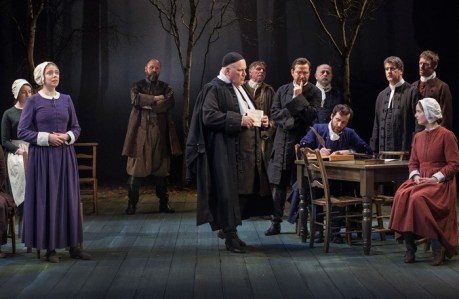
Royal Exchange - THE CRUCIBLE Jonjo O'Neill (John Proctor) background Sam Cox (Giles Corey), Leah Haile (Betty Paris) photographer Jonathan Keenan Royal Exchange - THE CRUCIBLE Peter Guinness (Dept Governor Thomas Danforth) & Stephen Kennedy (Rev. Samuel Parris) photographer Jonathan Keenan

23/09/15

Royal Exchange, Manchester

Arthur Miller’s The Crucible is, undoubtedly, one of the great plays of the twentieth century. Written in the early 1950s, it was based around actual events that unfolded in the Puritan community of Salem Massachusetts in 1689; it was also Miller’s opportunity to openly air his feelings about a current event, Senator Joseph McCarthy’s Communist ‘witch’ hunt, without fear of retribution. The similarities were there for all to interpret, but Miller was above reproach, as he could argue that he was simply retelling a slice of history – even though, on closer examination, it appears that he took considerable liberties with the facts. Luckily, nobody bothered to check.

The Royal Exchange’s latest reinterpretation, directed by Caroline Steinbeis, is fascinating. It takes place on a stripped, circular dais across which the sizeable cast act and interact with considerable skill, so much so that when they take their final bow, you’re amazed to realise how many people are actually involved in the proceedings. It’s no longer a period piece – there’s not a stovepipe hat or lace collar in sight. The male actors wear clothing that could easily fit into any rural community of the past thirty years, while the women are dressed in frumpy, near identical dresses, emphasising how much they are made to conform to the expectations of the God-fearing men who surround them.

We’ve seen many versions of The Crucible, but few that delineate the various strands of the tale as clearly and powerfully as this one does, and, in an age where political and sociological witch hunts have become an everyday occurrence, the story seems more prescient than ever. As John Proctor, Jonjo O’ Neill gives a dynamic performance, his strident Northern Irish accent lending his final scenes added power, while Ria Zmitrowicz’s portrayal of the hapless Mary Warren is also a highlight; who knew that there was so much comedy to be mined from her role?

But it’s perhaps unfair to single out individual performances, when this is so undeniably an ensemble piece; there are, frankly, no false notes here.

The Exchange is famed for its ‘wow’ moments and, in the final stretches of the play, that slightly inverted dais is suddenly transformed into a gathering pool of water under a jaw-dropping rainstorm – through which the protagonists are obliged to wade. Coming as it does during Proctor’s final confession, this seems to us to symbolise the way in which a truth can irresistibly spread, to engulf all those who would seek to adapt it to suit their own ends. It is also, perhaps, an allusion to ideas of rebirth and baptism. Others will undoubtedly have their own interpretations; whatever, it will certainly stimulate much after-show conversation as you head for home.

This is a superior production, beautifully staged and expertly acted. Don’t miss it.

4.6 stars

Philip Caveney and Susan Singfield

A Walk Among The Tombstones

MV5BMTQ3NzY2MTg1M15BMl5BanBnXkFtZTgwODY2Njk4MTE@._V1_SX214_AL_

21/09/15

Annoyingly, I missed this one at the cinema and it’s taken me far too long to catch up with it on the small screen. Based on a novel by Lawrence Block, it’s a dour slice of American grunge, featuring Liam Neeson as former detective and alcoholic, Matt Scudder, now plying a precarious trade as a private detective. Given Neeson’s relatively recent incarnation as everyone’s avenging Daddy of choice, it’s good to see him in a role where he actually carries a badge in order to justify his brutality, even if the badge in question is no longer valid. A pre credit sequence which shows him in his former incarnation, involved in a shootout with three bad guys, carries an entirely different accusation – that of crimes against fashion.

Now clean shaven and sans loon pants, Scudder receives a frantic phone call from drug trafficker, Kenny Kristo (Dan Stevens, demonstrating just how far he is able to depart from his Downton image when necessity calls.) Kristo’s wife has been kidnapped and despite him paying a hefty ransom, she’s been murdered anyway. Now he wants revenge and feels that Scudder is just the man for the job. Despite his reservations, Scudder undertakes the job and soon finds himself pitted against a ruthless duo of sociopaths who have enacted the same routine over and over. It’s quickly demonstrated that the bad guys are such scumbags that any retribution rained upon them will be richly deserved. A scene where Ray (David Harbour) espies his latest victim, a young girl dressed in a Little Red Riding Hood style, is the film’s most powerfully repellent set piece. Other scenes depicting the torture of the murderer’s female victims, stray very close to the line between powerful and gratuitous, so this certainly won’t be for everyone.

Written and directed by Scott Frank, AWATT is a powerful crime drama, though its stygian look can be a little dispiriting and its demonstration of the depths to which the human psyche can descend makes for grim viewing.

3.8 stars

Philip Caveney