Bird Box

06/01/19

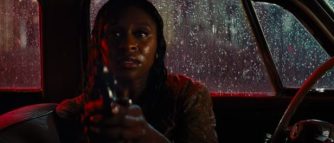
I’m not sure what to make of Netflix’s latest hit, Bird Box. On the one hand, it’s a decent little sensory-deprivation horror movie (is that a genre now?), nicely acted and directed, and it certainly takes me along for the ride. But on the other hand… well, there’s some pretty dodgy subtext here, and I’m not sure I want to overlook this stuff.

Sandra Bullock is Malorie, single and pregnant, ambivalent about impending motherhood. She wisecracks her way through her maternity appointments and avoids discussing crucial issues such as where a baby might be accommodated in her tiny artist’s studio. Of course she’s an artist: she has to work in a visual medium to underline the awfulness of what comes next.

Not that her art is ever mentioned again, once the mysterious beings arrive and begin their decimation of the human race. The conceit here is that ‘they’ can only get you if you look at them, but if you even catch a glimpse they’ll drive you to kill yourself. I like that director Susanne Bier never lets us see them ourselves, that their awfulness is left to our imaginations. But for the characters holed up in Greg (BD Wong)’s house, where they’ve fled in terror from the first attack, the beings are an ever-present threat, and survival is almost impossible.

There’s a great cast, featuring John Malkovich and Jacki Weaver, Sarah Paulson and Tom Hollander. Trevante Rhodes is Tom, and he’s a charming, likeable leading man. It’s always nice to see Parminder Nagra on screen, albeit this time in a minor role, as Malorie’s obstetrician. And the tension is palpable, even though the time-hopping structure means that we know from the beginning that Bullock ends up a lone adult, looking after two small kids, and pitting her wits against this unknown enemy.

But…

*MINOR SPOILER ALERT*

… there’s the heavy-handed extended metaphor about motherhood to deal with: the implication that Malorie has to endure all this heartbreak and struggle in order to accept her true calling as a mother; that her earlier consideration of adoption for her baby could never really have been the right answer.

And the depiction of people with mental health issues is problematic too. ‘They’ (because they’re different from ‘us,’ right?) don’t commit suicide when they see the beings; they become converts to the beings’ cause, committed missionaries, cajoling and persuading as many people as possible to take off their blindfolds and see the light. It’s unsettling, actually, to see such a toe-curling division drawn between the sane and the insane; I thought we understood things better than that now.

So, on the surface, a fun way to pass an evening. But it doesn’t really bear much scrutiny. If you really want to see something in this ‘genre,’ A Quiet Place is far superior.

3.4 stars

Susan Singfield


Welcome to Marwen

05/01/19

Robert Zemeckis is a veteran director who refuses to rest on his laurels. Over the years, he’s been responsible for some major hits – Back to the Future, Forest Gump, Who Killed Roger Rabbit?  – and, of course,  there’ve been a few misfires –  Beowulf for example? And The Polar Express is a film that tends to divide viewers.

Welcome to Marwen is a ‘so weird it must be true’ story, based on the life of artist, Mark Hogancamp, though it should be noted that, like a lot of ‘true’ stories, the scriptwriters don’t hesitate to jettison those facts that don’t fit with their vision of the tale.

Hogancamp’s backstory is a harrowing one. A talented artist with a passion for World War 2 imagery and an obsession with wearing women’s shoes, he drunkenly confessed this to some strangers he met in a bar, who then ambushed him and beat him mercilessly, putting him into a coma for nine days. When he finally came back to his senses, he found that he had lost all memory of what happened to him before the night of the attack – and he could no longer remember how to draw.

When we first encounter Hogancamp (Steve Carell), he is engaged in a long-established photography project that is an attempt both to rekindle his artistic abilities and to come to terms with the awful hate crime that has robbed him of his former life. In his garden, he has constructed Marwen, a miniature Belgian town, occupied by Nazis and populated by dolls. It’s here that his avatar, Captain Hogie, a fearless maverick (who also has a liking for high heels) is running an energetic resistance movement, backed up by five female freedom fighters – all based on women who are important in the artist’s life,

It must be said that the women in question seem to take his somewhat creepy depictions of them with unbelievably good grace, but I guess they knew him before he was attacked, and are prepared to cut him some slack.

Of course, this being a Robert Zemeckis film, Hogie’s adventures are recreated through state-of-the-art motion-capture and there’s no denying that the ensuing scenes are an extraordinary technological achievement. But the main problem is that the film can’t seem to decide what it wants to be. For the most part, it’s about a man going through a slow healing process and gradually gaining the necessary strength to confront his assailants in court, but the real life scenes are regularly interspersed with more of those mo-cap sequences and I can’t help feeling there’s rather too many of them and that – until the very end – they all seem to play out in exactly the same way, without really advancing the story.

There’s a tendency too to punch home the film’s messages with a heavier hand than seems strictly necessary. Déja (Diane Kruger)’s significance, for example, is immediately apparent, but spelled out laboriously for the hard of thinking,

Carrell, it must be said,  is terrific in the lead role and Merritt Wever is appealing as the manager of the local toy shop who quietly carries a torch for him.

Welcome to Marwen is never less than interesting – but, despite all that cutting-edge brilliance, there’s something here that doesn’t quite add up to a satisfying night at the cinema.

3.8 stars

Philip Caveney 


Free Solo

04/01/19

There’s something endearing about people who have a mission in life: an obsession so integral to their being that it defies all rationale. There are not many – not even many rock climbers – who would look at the sheer cliff face of Yosemite’s El Capitan and think, ‘Yeah, I’d like to scramble up that. On my own. Without a rope. Without anything, except a good pair of shoes and a light dusting of climbing chalk on my hands.’

But Alex Honnold is as single-minded as they come, and free-solo-ing means the world to him. He knows the dangers. Ironically, within the parameters of what is undoubtedly a hugely risky business, he’s actually pretty risk-averse. He plans carefully. He practises. He doesn’t let the fact that there’s a film crew following him influence his decision about when to climb. But still… There’s no denying that his death is only ever one unlucky slip away, and the tension generated by this movie is almost unbearable.

It’s a fascinating story, actually, despite the narrow focus. Honnold is an engaging character, good-humoured and self-aware. An extra layer of human interest is added when Alex hooks up with Sanni McCandless, and finds himself negotiating a serious relationship for the first time, testing the boundaries between his compulsion and his love.

The crew are an active part of this documentary, present on film, serving almost as a Greek chorus: commenting on the action and offering their opinions. They’re all climbers; they’d need to be – and so they understand the enormity of the undertaking. Their responses inform ours, and we spend a lot of time sharing their awe and disbelief.

The landscapes are stunning, and we are left in no doubt as to the scale of this feat. I will never understand what motivates someone to do something like this, but there’s no denying how impressive Alex’s success is. It looks like something beyond human capability. And yet there he is, just doing it.

4 stars

Susan Singfield


Life Itself

02/01/19

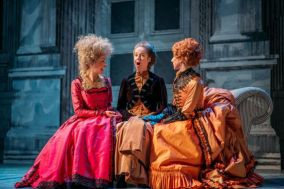
There’s a lovely little movie trapped inside Life Itself. An arch, playful, beautifully acted and intriguingly populated film, with a gently emotive storyline. It’s all there: ripe and ready. Unfortunately, it’s covered in an unwelcome layer of fridge-magnet cod-philosophy, with a side helping of pomposity thrown in. Oh dear.

Things start well. We meet Will (Oscar Isaac) as he stumbles drunkenly into a coffee shop, clearly having hit hard times. His therapist (Annette Bening) encourages him to talk about his relationship with his wife, Abby (Olivia Wilde), and their back-story is revealed in a series of flashbacks. The idea of the unreliable narrator is introduced early on, and reinforced by Abby’s student thesis on the subject. Life, concludes Abby, is the ultimate unreliable narrator, more random and unpredictable than anyone cares to acknowledge. Her friends like the idea, but she fails her course, because the essay strays too far from literary criticism.

Still, as the film goes on to show: she’s right. Time and again, writer-director Dan Fogelman pulls the rug from under our feet, throwing us swerve balls and catching us unawares. The action moves, almost arbitrarily,  from Will and Abby’s New York to Javier González (Sergio Peris-Mencheta)’s Spain – where all the dialogue, naturally, is in Spanish – and back again to New York, where we meet Will and Abby’s daughter, Dylan (Olivia Cooke). All this I like. The characters are captivating, and the seemingly unrelated strands are pulled together expertly. Segmenting movies into ‘chapters’ seems to be a bit of a recent phenomenon, and it works well here. Antonio Banderas is wonderfully understated as the emotionally needy Mr Saccione, and Laia Costa, as Javier’s wife, Isabel, really lights up the screen.

So why doesn’t it work? Because that premise, of life being the ultimate unreliable narrator, is overworked. It’s not left to be played out; we’re not trusted to understand without an actual lecture, delivered in the final chapter by Elena (Lorenza Izzo), Dylan’s teenage daughter, who, we discover, has been narrating throughout. There’s not enough substance to the idea to merit this much talk; it’s a simple – dare I say banal? – concept, enough to carry a story but not to bear such scrutiny. It takes itself too seriously, accords itself too much weight. And that’s a real shame.

There’s a filmed Q and A at the end of our screening, but it reinforces rather than alleviates our concerns. The interviewer, Jenny Falconer, talks of weeping copiously as she watched, but we both feel curiously unmoved. It’s clearly a movie that wants to tap into our emotions, but the narration distances us from events, and makes that level of engagement difficult. I don’t mind this – the film is at its best when it’s witty and stylised, which it is, a lot of the time – but it feels muddled, as if the ‘message’ is getting in the way of all the good stuff that’s on offer here.

3.3 stars

Susan Singfield
 

The Favourite

01/01/19

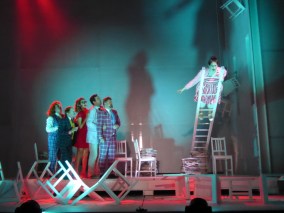
Since 2015’s The Lobster, Greek director Yorgos Lanthimos has established a reputation for quirky and enigmatic films that approach their subject matters from completely unexpected directions. Take The Favourite for instance. This sumptuously dressed costume drama offers us a story that seems as mad as a box of frogs – but it only takes a cursory Google search to establish that most of what happens here cleaves fairly close to established historical truth – proof if ever it were needed that fact can be a lot stranger than fiction. That said, Lanthimos finds ways of amping up the oddness to the max.

We are in the early 18th century, in the court of Queen Anne (Olivia Colman), a troubled monarch plagued by recurring bouts of gout, who wanders about the place like a sulky teenager. She is totally under the control of the manipulative Lady Sarah Churchill (Rachel Weisz), who – as well as being Anne’s secret lover – also uses her to further her strong political ambitions. Into the court comes Sarah’s cousin, Abigail (Emma Stone), whose family have fallen on hard times and who is now looking for gainful employment. Sarah grudgingly takes her in as a servant, but Abigail soon tires of a life of drudgery, and decides instead to insinuate herself into the Queen’s good graces, something she proves to be rather adept at.  It isn’t long before a powerful rivalry is ignited between Sarah and Abigail and it’s clear that both women are prepared to do whatever it takes to gain the upper hand.

Lanthimos manages to convey an atmosphere of cold suspicion beautifully and his regular use of a fish eye lens amplifies the claustrophobic ambiance of this troubled court. The film is built around three superb performances from the female leads, with Colman already nominated for a best actress Oscar, and Stone and Weisz for best supporting actress. Indeed, the three of them dominate the film to such a degree that few of the male characters get much of a look in, though I do enjoy Nicholas Hoult’s sardonic turn as Harley, leader of the Tories, who forms a sneaky alliance with Abigail in order to oust his political opponents from power. Those of a prudish persuasion should note that the film is rumbustious enough to fully earn its 15 certificate – some of the scenes here are a bit saucy, to say the very least.

With a running time of just under two hours, The Favourite positively gallops along, making me laugh out loud and, occasionally, gasp in surprise. It would be very hard to think of a more enjoyable way to begin a new year’s viewing.

4.7 stars

Philip Caveney


Black Mirror: Bandersnatch

30/12/18

We haven’t reviewed earlier episodes of Charlie Brooker’s excellent Black Mirror series, mainly because we don’t really do TV shows – but a couple of things feel different this time around. For one thing, with so many feature films making their debuts on Netflix these days, it seems more appropriate. And for another, Bandersnatch is something of a game-changer. This is an interactive story, heavily influenced by the ‘make your own adventure’ books of the 1980s and one in which viewers can participate. As the tale unfolds, we are faced with a series of simple decisions: should a character choose Sugar Puffs or Frosties, for example? Clicking on one suggestion or another will influence what consequently happens on the screen. It starts small but the choices become ever more dramatic as the story scampers along.

It’s 1984 and young Stefan Butler (Fionn Whitehead) is an ambitious video game designer, who, after the tragic death of his mother, is living alone with his secretive father, Peter (Craig Parkinson). Stefan, when not spending time with his analyst, Dr Haynes (Alice Lowe), is developing a brand new game called Bandersnatch, which he takes along to major video game publisher, Tuckersoft, headed by ponytailed entrepreneur, Mohan Thakur (Asim Chaudrey). At the initial meeting, Stefan is introduced to one of his video game designer idols, Colin Ritman (Will Poulter), and is subsequently astonished to discover that the team like his ideas and want to offer him the opportunity to make it a reality.

But will he accept the offer? Well, that’s kind of up to you…

Bandersnatch is an astonishingly meta idea. As our choices send the action into deeper and ever more labyrinthine rabbit holes, it occurs to me that I am watching something that I am, however tangentially, able to influence. Rather than just being a passive observer, I am involved in the creation of a fiction. It gets even more interesting when characters I am trying to influence begin to disobey me. This is a genuinely exciting idea and it soon becomes apparent that the episode may require at least one repeat viewing to see if different choices will radically affect the outcome.

I’m not suggesting that Bandersnatch is one hundred percent successful. There’s a tendency to come up against buffers which repeatedly send you back to watch the same sequences over again – and I can’t help feeling that one particular outcome may happen in every version of the story – but Brooker deserves plaudits for coming up with this – and Netflix too, for having the chutzpah to finance it.

Where this concept may lead audiences in the future opens up fields for speculation, but to me it feels like an interesting first step. Watch this space.

4.7 stars

Philip Caveney

Theatre Bouquets 2018

Bouquets&Brickbats

Bouquets&Brickbats

Bouquets&Brickbats

Another year, another plethora of exciting theatre. We’ve been moved, motivated and mesmerised by so much of what we’ve seen. And here, in order of viewing, are our favourites of 2018.

The Belle’s Stratagem – Lyceum Theatre, Edinburgh

bellesstrat1

This production looked ravishing, the brightly-hued costumes blazing against the simple monochrome set. Fast, furious and frenetic, this was a real crowd-pleaser.

Rhinoceros – Lyceum Theatre, Edinburgh

rhinocerous2.jpg

A truly glorious production, as witty and vivacious as it was prescient. There were some great comic turns, and the sensual, Middle Eastern-inflected music added to the mood of transformation.

Creditors – Lyceum Theatre, Edinburgh

creditors-1.jpg

We thought we’d seen all we wanted of Strindberg, but Creditors made us think again. Because this production was a prime example of the director’s art: the realisation of a vision that illuminated and animated the playwright’s words, breathing new life into old ideas.

Sunshine on Leith – King’s Theatre, Edinburgh

sunshine2.jpg

Sunshine On Leith was an absolute charmer. From the opening chords of the climactic I’m Gonna Be (500 Miles), the entire audience was delightedly clapping hands and stamping feet with a force that seemed to shake the beautiful old theatre to its very foundations.

Home, I’m Darling – Theatr Clwyd, Yr Wyddgrug

home-im-darling-1.jpg

A clever play, with a lot to say. Katherine Parkinson starred as Judy, a woman obsessed with the 1950s. Through her brittle fetishisation of the past, the script laid bare the problem with rose-tinted reminiscence and looked at the present with an eye that matched Judy’s gimlet cocktail.

Not in Our Neighbourhood – Gilded Balloon, Rose Theatre, Edinburgh

kopae2.jpeg

This powerful and compelling production, written and directed by Jamie McCaskill, tackled the difficult subject of domestic abuse and featured an astonishing central performance from Kali Kopae. We saw some superb acting at the Fringe this year, but this was singularly impressive.

Six the Musical – Udderbelly, Edinburgh

six1.jpg

An inventive and exuberant pop-opera, which felt like the most exciting, vibrant history lesson ever. The band and actors powered effortlessly through a whole range of different musical styles, from straight pop to power ballad, from soul to Germanic disco. The songs featured witty lyrics which related the women’s experiences in modern day terms – and we’ve been obsessed with them ever since.

The Swell Mob – Assembly George Square, Edinburgh

swell2.jpg

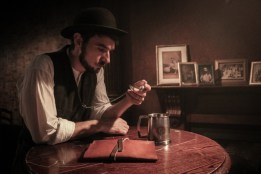
The most genuinely immersive theatrical experience we’ve ever been part of. We were free to wander the 1830s tap room, replete with a real bar, and mix with a whole host of extraordinary characters: a crooked American doctor, a fortune teller, a soldier, a card-player… The more we engaged, the more was revealed… Superb and truly innovative.

Macbeth – Festival Theatre, Edinburgh

macbeth3.jpg

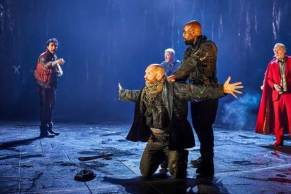
We were relieved and delighted that this touring production was so good. We knew that this interpretation of the play had been quite controversial, but it really worked for us. It captured the very essence of Macbeth and illuminated the themes and characters with great clarity.

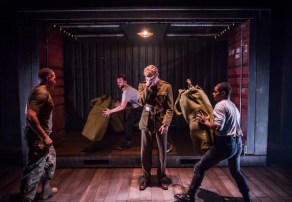
The Unreturning – Traverse Theatre, Edinburgh

unreturning2.jpg

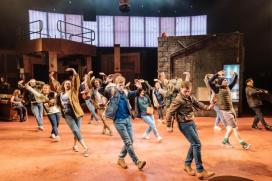
A tale about young men and the shattering effect that war can have on them, simultaneously a requiem for the past and a chilling warning for our potential future. The haunting prose was augmented by incredible physicality as the actors ran, leapt, clambered and whirled around the stage in a series of perfectly choreographed moves.

Beauty and the Beast – King’s Theatre, Edinburgh

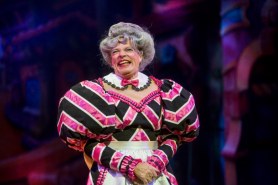
allanstewart.jpg

There’s panto – and then there’s panto at the King’s, where the ante is well and truly upped. Here, we were treated to an absolute master class in the form: there’s an art to making the precise look shambolic, the crafted seem accidental. And it was so funny – even the oldest, daftest jokes had us roaring with laughter.

Mouthpiece – Traverse Theatre, Edinburgh

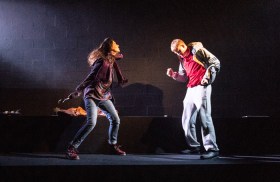
neve-mcintoshlorn-mcdonald.jpg

Powered by searing performances from Neve Macintosh and Lorn MacDonald, Mouthpiece was, quite simply, an astonishing play. Kieran Hurley’s ingenious circular narrative eventually brought the two protagonists head-to-head in a brilliant fourth-wall breaking climax.

Susan Singfield & Philip Caveney


Film Bouquets 2018

Bouquets&Brickbats

Bouquets&Brickbats

Bouquets&Brickbats

2018 has yielded a lot of interesting films, and it’s been hard to choose which most deserve Bouquets. Still, we’ve managed it, and here – in order of viewing – are those that made the cut.

Downsizing

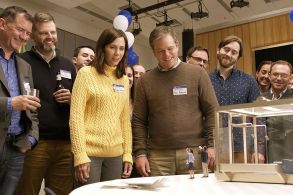
Downsizing 2

Alexander Payne’s brilliant satire had its detractors, mostly people who had expected a knockabout comedy –  but we thought it was perfectly judged and beautifully played by Matt Damon and Hong Chau.

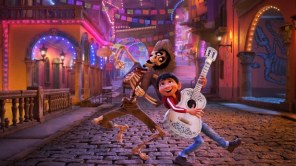
Coco

coco3.jpg

A dazzling, inventive and sometimes surreal love letter to Mexico, this Pixar animation got everything absolutely right, from the stunning artwork to the vibrant musical score. In a word, ravishing.

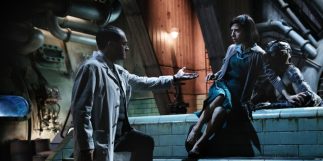
The Shape of Water

shapeofwater3.jpg

Guillermo del Toro’s spellbinding fantasy chronicled the most unlikely love affair possible with great aplomb. Endlessly stylish, bursting with creativity, it also featured a wonderful performance from Sally Hawkins.

Lady Bird

ladybird1.jpg

This semi-autobiographical story featured Saoirse Ronan as a self-centred teenager, endlessly at war with her harassed mother (Laurie Metcalfe). Scathingly funny but at times heart-rending, this was an assured directorial debut from Greta Gerwig.

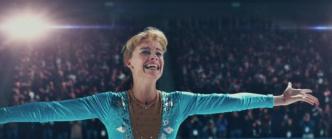
I, Tonya

itonya1.jpg

Imagine Good Fellas on ice skates and you’ll just about have the measure of this stunning biopic of ice skater Tonya Harding, built around an incandescent performance from Margot Robbie, and featuring a soundtrack to die for.

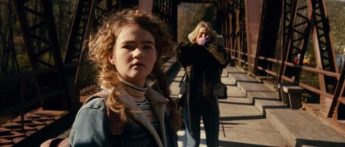
A Quiet Place

quietplace3.jpg

This film had audiences around the world too self-conscious to unwrap a sweet or slurp their cola. Written and directed by John Kransinski and starring Emily Blunt, it was one of the most original horror films in a very long time – and we loved it.

The Breadwinner

breadwinner3.jpg

Set in Kabul, this stunning film offered a totally different approach to animation, and a heart-wrenching tale of a young woman’s fight for survival in a war-torn society. To say that it was gripping would be something of an understatement.

American Animals

animals1.jpg

Based on a true story and skilfully intercutting actors with real life protagonists, Bart Layton’s film was a little masterpiece that gleefully played with the audience’s point of view to create something rather unique.

Bad Times at the El Royale

el-royale3.jpg

Drew Goddard’s noir tale brought together a brilliant cast in a unique location, and promptly set about pulling the rug from under our feet, again and again. There was a superb Motown soundtrack and a career making performance from Cynthia Erivo.

Wildlife

wildlife-2.png

Based on a Richard Ford novel, this subtle but powerful slow-burner was the directorial debut of Paul Dano and featured superb performances from Carey Mulligan, Jake Gyllenhaal and newcomer, Ed Oxenbould.

The Ballad of Buster Scruggs

buster1.jpg

The Coen brothers were in exquisite form with this beautifully styled Western, which featured six separate tales of doom and despair, enlivened by a shot of dark humour. But, not for the first (or the last) time, we heard those dreaded words ‘straight to Netflix.’

Roma

Street-Scene.jpg

Another Netflix Original (and one that’s hotly tipped for the Oscars), this was Alfonso Cuaron’s lovingly crafted semi-autobiographical tale off his childhood in Mexico, and of the nanny who looked after him and his siblings. It was absolutely extraordinary.

Philip Caveney & Susan Singfield
Mary Poppins Returns


23/12/18

Sporting a ‘what it says on the can’ title, Mary Poppins Returns is a thoroughly decent and handsomely mounted sequel to one of Disney’s most iconic films. I’ll ‘fess up right here and now and say that I don’t hold the original movie in the kind of esteem that some of my friends evidently do – but I entirely understand that, with its combination of whimsy and fantasy, it’s become a popular Christmas perennial.

The sequel takes place in depression-era London, some twenty years after the events of the first film, where the Banks children have grown up to a rather more depressing reality than they’ve been used to. Michael (Ben Whishaw) is a recently bereaved widower with three adorable young children to look after, while his sister, Jane (Emily Mortimer), has devoted her life to working for worthy causes. Michael hasn’t been too diligent about paying the bills and is now in danger of losing the beloved family home to the very bank he works for, after failing to keep up the repayments on a loan. The bank’s dastardly new manager, Wilkins (Colin Firth), is taking every step to ensure that the family home will soon be subject to repossession.

Into this troubled scenario, floats Mary (Emily Blunt), hanging onto the tail of a passing kite. Blunt is perhaps the logical actor to fill those famous red shoes,  but her incarnation is sterner and, it has be said, a good deal more mischievous than her predecessor. She is clearly in cahoots with local lamplighter, Jack (Lin Manuel-Miranda), and together the two of them lead the Banks children into a whole series of magical situations.

If this sounds familiar, it ought to. The sequel sticks pretty closely to the format of the first film, replete with song and dance numbers – one of which is rather more fruity than you’d ever have expected from Julie Andrews – cleverly animated sequences (an underwater spectacle is perhaps the standout) and brief appearances from high calibre guest stars like Meryl Streep, Angela Lansbury and a very spry Dick Van Dyke.

As I said, it’s all decently done, but perhaps, in the end, that over-familiarity works against it. Nothing here comes as a surprise and some of the plot strands are so needlessly over-complicated, they can only be solved by Mary – but she does have an infuriating habit of hanging back until the last possible moment. Also, sadly, none of the songs here are quite as memorable as the likes of Go Fly A Kite or A Spoonful of Sugar.

If you’re looking for a suitable Christmas film for all the family, this is probably the logical one to aim for, but be warned, you may not come out singing one of the songs.

3.6 stars

Philip Caveney

Mowgli: Legend of the Jungle

20/12/18

You have to feel a little bit sorry for Andy Serkis. This film was his brainchild and he worked on it for something like five years, only to find himself pipped at the post by Jon Favreau’s (admittedly, impressive) live action Jungle Book, made for Disney. After that, the projected release dates for Mowgli were repeatedly pushed back by Warner Brothers, who clearly believed the public wasn’t quite ready for yet another version of such a familiar tale – and then, of course, along came Netflix, waving a chequebook and everything changed.

The first thing to say about Serkis’s film is that it’s a much darker and more feral beast than either of the Disney incarnations. This has a 12 certificate, so those parents thinking of sitting their toddlers down in front of it while they get on with the Christmas dinner might want to think twice. Screenwriter Callie Kloves, for the most part, sticks closely to Rudyard Kipling’s original short stories, so within a few minutes of the film’s opening I’ve witnessed the slaughter of Mowgli’s parents by man-eating tiger, Shere Kahn (voiced by Benedict Cumberbatch), a scene that little children may find too red in tooth and claw for comfort. Kipling’s story was always a brutal one, reflecting the abandonment he felt as a youngster when his parents left him in the care of ruthless guardians while they headed back to India, and this film reflects that wildness.

Baby Mowgli grows up to be young Mowgli (Rohan Chand), who lives with wolves headed by Akela (Peter Mullan), but he never feels as though he’s a full member of the pack. As he grows, he is tutored by good-natured bear, Baloo (Andy Serkis, and by stern black panther, Bagheera (Christian Bale), both of whom try to teach him the basic laws of the jungle. (Happily they achieve this without ever bursting into song, something that Favreau’s version couldn’t quite resist.) Meanwhile, Mowgli can’t help casting an enquiring eye in the direction of the ever-encroaching humans, who day-by-day are venturing closer to the wolves’ hideout.

It’s when Mowgli visits the human’s village that the biggest changes to the original story occur. The presence of big game hunter, Lockwood (Matthew Rhys), is clearly intended to be a comment on white imperialism (though why it was decided to give this character the same name as Kipling’s father remains an enigma). Lockwood gives the impression of being a benevolent saviour, always ready to hand out gifts to the local villagers, but his home is full of grisly hunting trophies, one of which provides the film with its most poignant moment. Ultimately, Mowgli learns that while he isn’t an animal, he isn’t exactly a human either. He must somehow be the bridge that unites the different species and the only way to achieve this aim is for him to take on his greatest foe.

Once again, here’s a Netflix Original that really deserves to be seen on the biggest screen available. There are lush landscapes, stunning aerial shots and dramatic chases. The animal characterisations are particularly interesting, eschewing the photo-realistic approach of Favreau’s effort in favour of more stylised creatures that really do reflect the expressions of the actors that play them. Cate Blanchett as Kaa, the snake? She’s right there and, weirdly, you can tell it’s her.

Mowgli: Legend of the Jungle is a remarkable creation in its own right and one that deserves to exist proudly alongside those earlier screen versions of Kipling’s classic tale. But be warned, this has teeth and isn’t afraid to use them.

4.4 stars

Philip Caveney