Olivia Cooke

A Talent for Murder

26/11/26

Cineworld, Edinburgh

For fans of crime writing – particularly for fans of the late Patricia Highsmith – A Talent for Murder is something they won’t want to miss. This classy movie, tautly directed by Anton Corbijn and handsomely filmed by Robbie Ryan, is confident enough to leave several elements of the convoluted plot open to an audience’s own interpretation, something that’s rarely risked in  these ‘hard of thinking’ times.

It’s 1995 and Edward Ridgeway (Alden Ehrenreich), a mild-mannered, bespectacled young American,  embarks on a train journey to Zurich, where he bumps into fellow passenger, Clementine Balfour (Olivia Cooke). They are indeed Strangers on a Train.The  two of them fall into conversation and Edward explains he’s been despatched by publishing house where he works to talk to the reclusive crime writer, Patricia Highsmith. His job is to try to persuade her to write yet another Tom Ripley novel.The books are very lucrative and the publisher is need of another hit. Edward also explains that he’s not the first person to be entrusted with this task. A more senior colleague was recently dispatched to do the same job but hasn’t been heard of since.

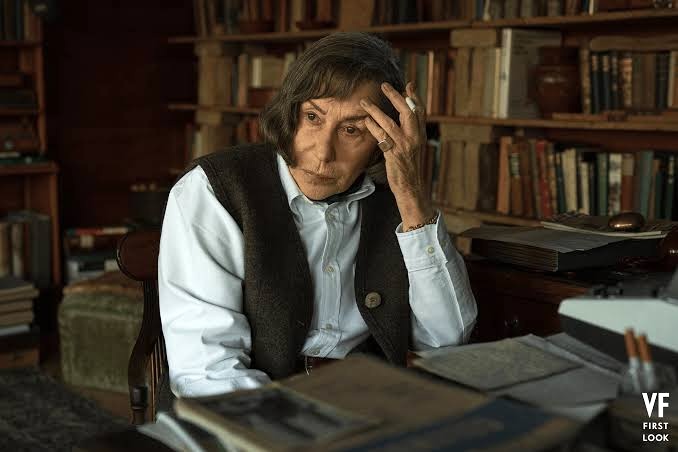
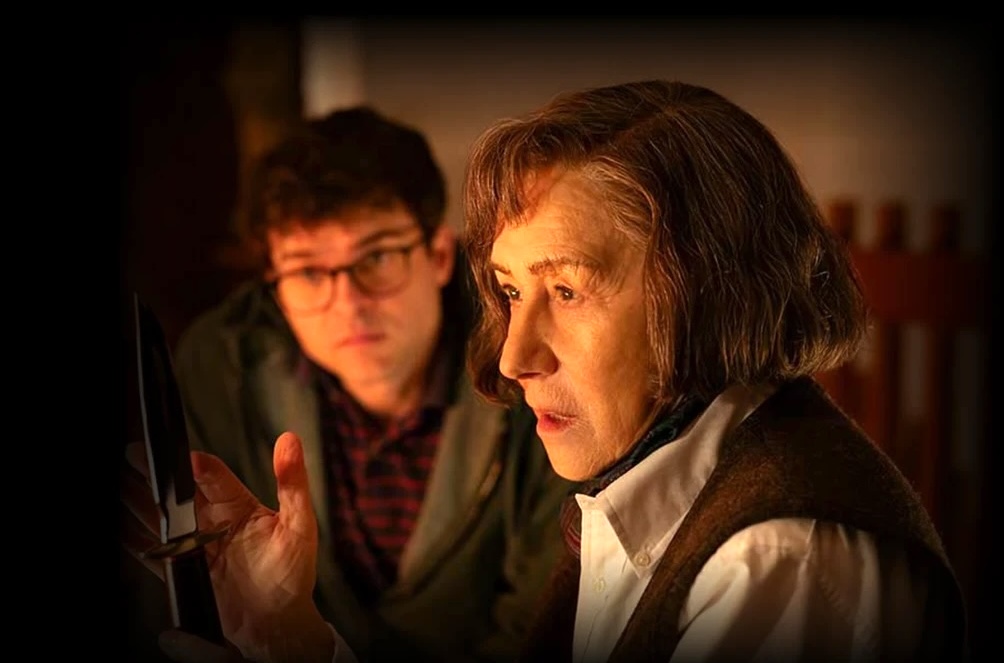
Edward arrives at the author’s remote residence to find Patricia Highsmith (Helen Mirren, in the dowdiest role I’ve ever seen her inhabit). She chain smokes, drinks straight whisky and seems more than happy to hurl homophobic and anti-Semitic remarks at her visitor, even though there’s no evidence whatsoever that he’s gay or Jewish. When he finally calms her down enough to be civil, she says that she’s ‘blocked’ and has absolutely  no intention of writing another Ripley book, so he may as well catch the next train home – whereupon he tells her that he’s an orphan (a detail that immediately gets her attention) and that, if he doesn’t manage to persuade her to sign the contact, he’ll be out of work.

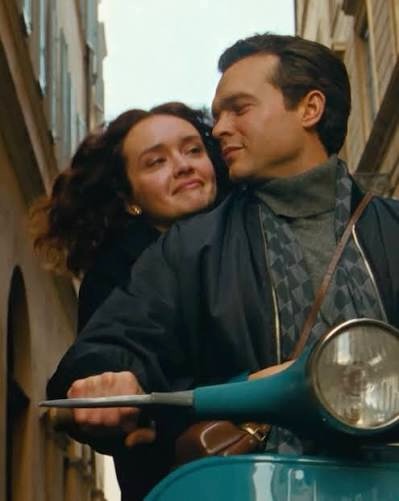
She grudgingly settles down to brainstorm what might possibly happen in a new Ripley adventure. This one begins in Rome – whereupon Ehrenreich morphs into Tom Ripley, who bumps into a fictional Clementine Balfour (Cooke again) and quickly latches onto her. Ripley soon learns that Clementine is to be the beneficiary of an estate belonging to her wealthy grandfather and that once he – and then her aunt Peggy (Juliet Stevenson) – are dead, Clementine will inherit a considerable fortune. Ripley instantly spots a way to improve his own money-fixated lifestyle and promptly sets to work…

Joanna Murray-Smith cooks up a splendid literary feast here as the screenplay (adapted from her stage play, Switzerland) switches deftly back and forth between what’s actually happening and what could happen in the hands of an accomplished novelist.

At times, I can’t help wondering what the estate of Patricia Highsmith must have thought when first presented with this premise. There’s little attempt here to soften the writer’s character; indeed, some of her more unwholesome characteristics are played up to the hilt. (I had thought that her predilection for keeping snails as pets must be a fabrication, but no, that bit is absolutely true. Her large collection of dangerous weapons, on the other hand, is an invention.)

Few punches have been pulled. The moment where Ridgeway tells Highsmith that her first release in the series, The Talented Mr Ripley, is a work of genius but that the following four books are nowhere near as good is incredibly blunt but nonetheless accurate. And of course, 1995 was to be an auspicious year for Highsmith. It’s the year that she died.

As the story switches back and forth through a series of possible permutations, Corbijn keeps the pace propulsive enough to move us effortlessly from one scene to the next, rarely giving us time to ponder the likelihood of what’s happening onscreen. By the time our runaway train slams headlong into the buffers of the film’s thought-provoking ending, we realise that we have been swept up and decently entertained by what we’ve seen.

And in the end, what more can we reasonably expect?

4 stars

Philip Caveney

Sound of Metal

13/04/21

Amazon Prime

Sound of Metal has been making waves at film festivals around the world and has recently garnered multiple nominations for both BAFTAs and Oscars. It’s easy to see why it’s earned such acclaim. Despite that pugnacious title, this is a surprisingly gentle and reflective film and it’s also, I think, rather unique. It’s fair to say that I’ve never seen another movie quite like it.

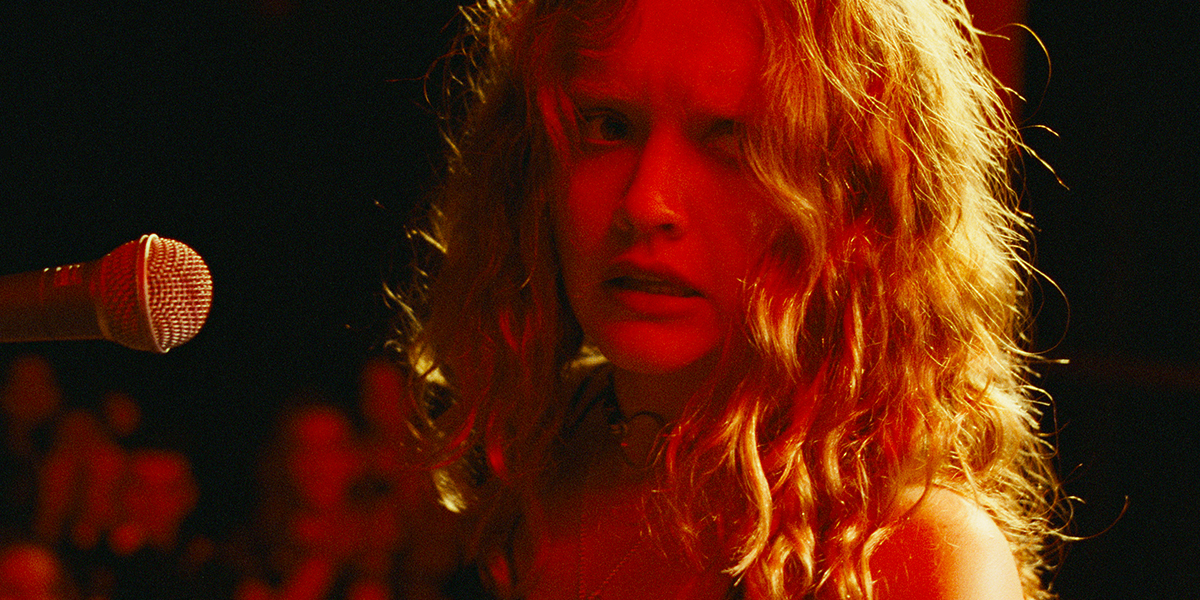
Ruben (Riz Ahmed) is a drummer in a heavy metal duo, providing the beat for his singer/guitarist girlfriend, Lou (Olivia Cooke), to vocalise over. The two of them are in the middle of a big tour, driving around America in Ruben’s RV and looking forward to the releasing of their new album. From the brief performance we witness over the opening credits, it’s clear that Blackgammon devote considerably more attention to their amplification than they do to their songs – but they do manage to create a thumping, propulsive sound that has stirred up a sizeable following.

Ruben and Lou are both former drug addicts, and are just about managing to stay clean, despite all the temptations they encounter on tour.

And then, just before going onstage one night, Ruben suffers a sudden and catastrophic loss of hearing. He has to get through the ensuing performance on autopilot, but it’s evident to Lou that something isn’t right. Afterwards, he confesses his problem to her, and she insists that they contact their sponsor, Hector, to see what can be done about the situation. Meanwhile, Ruben visits a hearing specialist, who advises him that he needs to avoid loud noise at all costs – tricky, to say the least – and also mentions the possibility of cochlear implants, an operation that costs thousands of dollars, but which could give Ruben back some degree of hearing.

In the meantime, he is despatched to a rural shelter for deaf, recovering addicts, run by the taciturn Joe (Paul Raci), who lost his own hearing in the Vietnam War. Joe insists that Ruben can only stay at the retreat alone – or not at all, should he decide to have those implants. Joe is adamant that deafness is not a handicap and that surgery is the wrong approach. He advises Ruben to sit alone, to learn sign language and to experience his own ‘stillness.’

Ruben struggles to engage with the latter and though he starts to make progress at the retreat, he is still torn about the thought of those implants… and he thinks he can see a possible way to pay for them.

Sound of Metal is full of unexpected delights, one of which is – ironically – the soundtrack. Not the song that Blackgammon play, mind, but the incidental effects, which it took fifteen technicians to create. Elaborate soundscapes are featured throughout the film, alternating between the rich textures of nature and the weird, twisted versions that Ruben receives as his hearing begins to deteriorate. The most vivid example is at Lou’s birthday party, hosted by her musician father, Richard (Mathieu Almeric), where the sound cuts from a pretty duet performed by Lou and Richard, to the desecrated travesty that Ruben can actually hear. It’s the film’s most poignant moment.

It’s more than just the sound, though. Ahmed (who currently appears to be one of the busiest actors in the business) does a terrific job of portraying Ruben’s mounting terror as the thing he loves most in the world – the music that he and Lou create together- is cruelly taken away from him.

This won’t be for everyone – and that misleading title doesn’t really help – but it’s well worth the watch.

4 stars

Philip Caveney

Life Itself

02/01/19

There’s a lovely little movie trapped inside Life Itself. An arch, playful, beautifully acted and intriguingly populated film, with a gently emotive storyline. It’s all there: ripe and ready. Unfortunately, it’s covered in an unwelcome layer of fridge-magnet cod-philosophy, with a side helping of pomposity thrown in. Oh dear.

Things start well. We meet Will (Oscar Isaac) as he stumbles drunkenly into a coffee shop, clearly having hit hard times. His therapist (Annette Bening) encourages him to talk about his relationship with his wife, Abby (Olivia Wilde), and their back-story is revealed in a series of flashbacks. The idea of the unreliable narrator is introduced early on, and reinforced by Abby’s student thesis on the subject. Life, concludes Abby, is the ultimate unreliable narrator, more random and unpredictable than anyone cares to acknowledge. Her friends like the idea, but she fails her course, because the essay strays too far from literary criticism.

Still, as the film goes on to show: she’s right. Time and again, writer-director Dan Fogelman pulls the rug from under our feet, throwing us swerve balls and catching us unawares. The action moves, almost arbitrarily,  from Will and Abby’s New York to Javier González (Sergio Peris-Mencheta)’s Spain – where all the dialogue, naturally, is in Spanish – and back again to New York, where we meet Will and Abby’s daughter, Dylan (Olivia Cooke). All this I like. The characters are captivating, and the seemingly unrelated strands are pulled together expertly. Segmenting movies into ‘chapters’ seems to be a bit of a recent phenomenon, and it works well here. Antonio Banderas is wonderfully understated as the emotionally needy Mr Saccione, and Laia Costa, as Javier’s wife, Isabel, really lights up the screen.

So why doesn’t it work? Because that premise, of life being the ultimate unreliable narrator, is overworked. It’s not left to be played out; we’re not trusted to understand without an actual lecture, delivered in the final chapter by Elena (Lorenza Izzo), Dylan’s teenage daughter, who, we discover, has been narrating throughout. There’s not enough substance to the idea to merit this much talk; it’s a simple – dare I say banal? – concept, enough to carry a story but not to bear such scrutiny. It takes itself too seriously, accords itself too much weight. And that’s a real shame.

There’s a filmed Q and A at the end of our screening, but it reinforces rather than alleviates our concerns. The interviewer, Jenny Falconer, talks of weeping copiously as she watched, but we both feel curiously unmoved. It’s clearly a movie that wants to tap into our emotions, but the narration distances us from events, and makes that level of engagement difficult. I don’t mind this – the film is at its best when it’s witty and stylised, which it is, a lot of the time – but it feels muddled, as if the ‘message’ is getting in the way of all the good stuff that’s on offer here.

3.3 stars

Susan Singfield


Ready Player One

31/03/18

If ever there was a man to qualify as ‘World’s Greatest Living Film Director,’ Steven Spielberg would surely be a strong contender for the title. Few movie makers have his longevity – his first cinematic release, Duel, was released in 1971. Even fewer can boast his extensive range. Here is a man who is happy to film pure popcorn crowd pleasers like Raiders of the Lost Ark or Jurassic Park, but who is equally at home helming powerful dramas of the ilk of Munich or Schindler’s List. Recently the recipient of Empire Magazine’s ‘Legend of Our Lifetime’ Award, it’s hardly surprising that few people have bothered to put up voices of dissent. He really is that accomplished. With his latest release, he takes on the world of virtual reality gaming and it would have been so easy to come a cropper here, an older man desperately trying to be ‘down with the kids.’ But, as ever, Spielberg passes his self-appointed test with flying colours.

Set in the year 2045, the story is set in a dystopian vision of America (has there ever been an optimistic cinematic view of its future, I wonder?). Most of the population is addicted to virtual gaming and, like our hero, Wade (Tye Sheridan), spend nearly all of their leisure hours in a pixellated environment called The Oasis. Wade competes there using his more handsome avatar, Parzival, and he’s not just playing to escape from the drudgery of his life, oh no. He’s in search of three special keys, hidden there by the Oasis’s late creator, Halliday (Mark Rylance). The finder of those keys will inherit his world and the billions of dollars it generates in revenue.

Whilst in the Oasis, Wade regularly interacts with the avatars of gamer friends who he has never actually met in real life. Then he meets a new one, Art3emis (Olivia Cooke), who, he soon realises, is somebody he really would like to know better. Their introduction – during a riotous vehicle chase – sets the tone for the story that follows and makes The Fast and the Furious look like a Sunday drive in the suburbs. In the midst of all the excitement, Wade is blissfully unaware that he has a major adversary in the real world. Sorrento (Ben Mendelsohn) is a ruthless businessman, intent on securing the Oasis for himself and ready to go to any lengths to eliminate his competitors.

In terms of plot, that’s pretty much all you need to know. Suffice to say that Spielberg and his team have concocted a dazzling, fast-paced riot of sound and fury, with visual references to so many of Spielberg’s movie influences (plus several images from his own films) that you will be constantly trying to spot them all. Some are obvious, and actually contribute to the story, while others are onscreen for the briefest of glimpses. If ever a film demanded repeat viewings, this is the one – if only to allow the geeks in the audience to tick the various references off their list. If I may be allowed to single out one particular  sequence for praise, it’s the extended homage to Stanley Kubrick’s The Shining.

Okay, so this is definitely one to go on the ‘popcorn’ side of Spielberg’s resumé, but oh my goodness, what succulent popcorn it is! After the relatively lacklustre BFG, and the rather straight laced The Post, this puts him back where he belongs, as the foremost purveyor of cinematic wonder. Where will he go next? Well, that’s anybody’s guess, but I would venture to suggest that, close to fifty years since his low budget debut, Spielberg’s well seems a long way from running dry.

4.6 stars

Philip Caveney

The Limehouse Golem

11/09/17

This Ripper-esque murder mystery, adapted from the novel by Peter Ackroyd and written for the screen by Jane Goldman, has plenty of things to commend it, even if the story seems a little over-familiar. Bill Nighy (in a role originally intended for the late Alan Rickman) plays Inspector John Kildare, brought in by his superiors to investigate a series of grisly murders in the East End of London. Kildare, we quickly learn, has been passed over for promotion because he is a homosexual. The baffling nature of the crimes suggest he’s being offered as some kind of sacrificial lamb, somebody to take the inevitable hit when he fails to get a conviction.

Kildare is also drawn into the trial of former music hall star, Elizabeth Cree (Olivia Cooke), who stands accused of poisoning her husband, John (Sam Reid). The problem is that the dead man is one of the chief suspects for the Golem murders. The others are famous music hall star, Dan Leno (Douglas Booth), George Gissing (Morgan Watkins) and Karl Marx (Henry Goodman): yes, that Karl Marx! Assisted by Constable George Flood (Daniel Mays), Kildare starts his investigation – and quickly discovers that he is wandering into a very tangled web indeed…

So yes, plenty to enjoy here – superlative performances from most of the cast (especially Booth), an intriguing look at the kind of entertainment laid on in the music halls of the period (I have to say, people must have been easily pleased in those days – it’s not exactly comedy gold) and some convincing recreations of Victorian London in all its grubby glory.  And yet, something doesn’t quite gel. The story unfolds slowly and fitfully, feeling longer than it’s one hour and forty nine minute running time. It only generates a full head of steam as it moves towards the final half hour or so. Nighy is always a pleasure to watch, but I couldn’t help feeling he wasn’t really given enough to do here, required mostly to stand around and look perplexed.

It would be criminal to give away the ending, so I won’t – but suffice to say, that I thought it was one of the stronger elements of the film. Rookie director Juan Carlos Medina may not have the lightness of touch needed to make this work perfectly, but it’s nonetheless a decent effort.

Be warned, though, the visceral murder scenes are not for the squeamish.

3.8 stars

Philip Caveney