Author: Bouquets & Brickbats

Locus Amoenus

locus-amoenus-1

8/01/16

Studio Theatre, The Lowry

Atresbandes are a young theatre company from Barcelona and ‘Locus Amoenus’ is a term used to describe an idealised paradise, something that we all long for, even though our personal interpretations of such a paradise may differ wildly. We catch the company’s latest production towards the start of their UK tour and we’re very impressed with what we see.

The simple set represents the interior of a train and as the three actors take their seats, we’re informed, via a screen at the back of the set, that they are all going to die in a freak accident in one hour. As the action unfolds we’re horribly aware that time is rapidly running out for them. If this sounds dour, don’t be misled, because what follows is a sprightly mixture of techniques, much of it performed without dialogue and often laugh-out-loud funny. Microphones are placed around the set to emphasise sounds – a sequence where one character repeatedly zips and unzips the various compartments of her rucksack is particularly effective and much milage is made from the fact that one character speaks only English, one only Spanish and the third is bi lingual and has to act as an interpreter for the other two. The piece is beautifully precise and understated – incidents that seem at first baffling, are explained as the action progresses. As the clock ticks inexorably away, a countdown appears on the screen and the final stretch becomes almost unbearably suspenseful.

This is accomplished theatre that deserves a wider audience. Atresbandes will be at the Gulbenkian, Canterbury on the 29th January and can be seen thereafter at the Warwick Arts Centre, The Hub Leeds, Lighthouse Poole, the Square Chapel Halifax and the Derby Theatre. They will finish their tour with three days at the Camden People’s Theatre on the 3rd, 4th and 5th of March. If you’re close to any of these venues and you fancy something a little out of the ordinary, do take the opportunity to see this delightful production. You won’t be disappointed.

4 stars

Philip Caveney

Testament of Youth

MV5BMTAyOTI3OTgwMTdeQTJeQWpwZ15BbWU4MDAwNzM2NDUx._V1_UX182_CR0,0,182,268_AL_

27/01/16

What a useful thing Netflix is; a handy way of catching up with all those movies you somehow managed to miss on the big screen. Testament of Youth is one such film. Overshadowed by bigger, brasher options on its initial release, it slipped quietly through the multiplexes of our green and pleasant land, making barely a ripple. Luckily, it works well enough on the small screen. Based on Vera Brittain’s landmark book, we first meet Vera (Alicia Vikander) on Armistice day, looking decidedly distraught, while all around her are celebrating. Then we slip back in time to discover the string of incidents that have brought her to such a state.

Here is an England of eternal summers, where the upper classes bathe in lakes and wander in meadows with barely a care in the world. Vikander certainly looks the part of the English Rose, even if her accent occasionally gives her origins away. Vera is a ‘bluestocking’ who wants nothing more than the chance to study at Oxford, like her brother, Edward (Taron Egerton), even if their father (Dominic West) would rather see Vera bashing the keys of a piano and hunting for a suitable husband. But she sticks to her guns and passes the University’s entrance examination. Fairly soon, she meets Roland (her Game of Thrones co-star, Kit Harrington) and love starts to blossom between them. But of course, the advent of World War One is lurking in the wings and with barely a pause for breath, Roland and Edward enlist in the British army and march away to do battle; whereupon, Vera throws in her course at Oxford, enrols as a nurse and eventually ends up at the Front, nursing soldiers, many of them German.

It’s a handsomely mounted film, that manages to resist being too chocolate-boxy – scenes of soldiers with their arms and legs blown off soon see to that – and if it’s not the most hard-hitting dramatisation you’ve ever seen, nevertheless its compelling enough to hold your attention for a couple of hours and to confirm the notion that, yes, war is a terrible thing and wouldn’t we all be a lot better off it the powers-that-be could just agree to get along with each other? If also offers the opportunity to spot a whole string of notable actors in cameo roles, always a bonus.

If like me, you missed this on the big screen, here’s your chance to catch up with it. It’s well worth your attention.

4 stars

Philip Caveney

Wit

Unknown

26/01/15

Wit is nobody’s idea of a ‘fun night out at the theatre.’

Indeed, Margaret Edson’s Pulitzer Prize-winning tale of middle aged academic, Dr Vivian Bearing (Julie Hesmondhalgh,) who discovers that she has cancer – more specifically, advanced metastatic ovarian cancer – is every bit as bleak as you might expect. I’m certainly offering no spoilers when I tell you that one of Bearing’s first observations, made directly to the audience is that she isn’t going to make it out of the story alive.

Bearing’s speciality is the work of metaphysical poet John Donne, whom she quotes and refers to throughout. She attempts to intellectualise her advancing illness, treating it as though it is something to be studied, observed and reported back on, only to ultimately discover that these things are beyond the scope of such an approach. Death is ultimately the biggest grey area and as she drifts inexorably closer to it, a sense of futility overcomes everything else.

Because of the rarity of her condition, Bearing becomes a sort of prize guinea pig for her doctors, one of whom, Dr Posner (Esh Alladi) is a former student of hers. This elicits one of the play’ss most uncomfortably funny scenes as Posner is obliged to carry out a vaginal examination of the woman who gave him a poor grade for one of his essays. Her conversations with a nurse, Susie Monahan (Jenny Platt) are the only sections where she comes close to revealing anything of herself; and for me that was a problem. In order to fully care about Vivian, I needed to know a little more about her.

In the central role, Hesmondhalgh is extraordinarily good, managing to convey her wisecracking, American character with great aplomb. She is in every scene, so much so that the other actors struggle to make a connection with the audience. I was somewhat dismayed by the fact that I didn’t make enough of an emotional connection with the material, while others around me seemed to be visibly affected by what they were watching. At the play’s (admittedly thrilling) conclusion, the audience stood en masse to give a heartfelt standing ovation – but I thought that overall, the cool, detached style of the writing detracted from the potential power of the work. It was evident that the majority of the audience would have disagreed with me on that one.

As we get up to leave, a couple of women to our right, are crying their eyes out. Perhaps they are reflecting on something that has happened in their own lives that stirs such emotions – or maybe we just weren’t on the right wavelength tonight. At any rate, dry-eyed, we head for home.

3.5 stars

Philip Caveney

John Osborne & Molly Naylor

Naylor-Osborne_main

23/01/16

The Lowry, Salford Quays

There’s a pleasingly ramshackle quality to tonight’s poetry reading. Not the poetry itself; that’s not ramshackle at all. But this is certainly more about the poems than the performance, and it’s all the better for it.

First up is the shambling, self-effacing – and very engaging – John Osborne. He pulls the sleeves of his jumpers over his hands like a recalcitrant teenager, and tells us about the poetry tour the pair have been on. Tonight’s the final night; they’ve driven up from Norwich. Some of the shows have been sell-outs, he says; another had an audience of only six. He doesn’t seem perturbed. We number about fifty, I think, and we’re an appreciative crowd. We laugh at his jokes. Why not? They’re funny.

The poems are funny too. Not comic pieces, exactly; just wryly amusing. There’s one about being served by a waitress who is ’employee of the month’, for example; another about conducting an affair with a colleague. They’re prose poems, really; little anecdotes, condensed. I like them. They make me smile.

There’s a break, and then it’s Molly Naylor’s turn. She’s a more confident performer, with a stronger stage presence, and the same likeability that made the first half so much fun. Her poems are more crafted too; she plays with form, experiments. There’s a trilogy about love (before, during, after… “Well, sort of during…”), a long piece about beach combing. There are personal anecdotes between poems: she comes from Cornwall; she used to travel to school by boat. (Actually, when she starts this tale, she says, “I used to go to school on a boat.” It takes me a while to realise the boat is the transport, not the institution. I am mildly disappointed.)

I enjoy listening to Naylor. I like the way she reads. The excerpt she shares from her play, Whenever I Get Blown Up I Think Of You, is riveting, detailing as it does her experience in London on July 7th 2005: she was on a tube train when it was bombed. It’s the minutiae that make this piece so absorbing: the scarf, the Sainsbury’s toilets, the walk home in the aftermath.

And then they’re gone. No bows, no joint moment, no milking of applause. It’s thank you, goodnight, and off we go.

What a lovely way to spend a Saturday.

4 stars

Susan Singfield


The Girls

Gary Barlow, Tim Firth and the original Calendar Girls credit Matt Crockett

19/01/15

The Lowry, Salford Quays

I’ll be honest. I didn’t have high expectations for this. After all, I thought, Calendar Girls had already been a hit film and a successful stage play. The news that author Tim Firth had spent the last couple of years turning it into a musical with his friend, Gary Barlow, suggested that this particular idea had been taken just about as far as it could possibly go. So I’m surprised and delighted to say that The Girls, from its jaunty opening chords onwards, is an unqualified delight, a production that has the word ‘hit’ written all over it. Nor is it the kind of cheesy nonsense that often qualifies a show for such a description.

It’s a  very familiar true life story – how a group of Women’s Institute members in an obscure Yorkshire town, decided to raise money for a local cancer hospital by appearing in a nude calendar. But Firth has opened up the story to give it a wider scope and the wry, witty lyrics seem to have so much to say about the everyday life of ordinary people that you can’t help admiring them. This show surprised me. I hadn’t expected to laugh as hard as I did, nor had I expected to cry quite so much – there are moments here that will wring tears from the coolest people in the audience.

It’s an ensemble piece with an eighteen strong cast, all of whom deliver faultless performances. The main story focuses on the friendship between Annie (Joanna Riding) and Chris (Claire Moore), but every character has a story arc and each one is fully explored. If I have an issue, it’s with the title – the six lead protagonists aren’t ‘girls’ at all but mature women; and when was the last time you saw a musical that offered major roles to so many of them? Roles, more importantly, that treat their subjects with respect even when the women are stripping off for charity. The nudity, by the way, is handled with consummate skill, so it never feels exploitive – you are laughing with the women, not at them and that’s an important distinction.

A word too about Robert Jones’s ingenious set design. What appears at first to be haphazard heaps of painted cupboards and lockers becomes a whole variety of locations, including the hill that overlooks the village of Cracoe where the story is set and, in one memorable driving sequence, the outline of a city at night.

Gary Barlow knows a thing or two about writing a decent pop tune and here’s the proof that he can write show tunes too – you’ll most likely come out of the Lowry humming, whistling or singing one of them. The real life ‘Calendar Girls’ were in the audience for tonight’s performance and I’d say they must have been delighted with the latest incarnation of their remarkable story. Indeed, if this show doesn’t get a West End transfer soon, then I’ll be very surprised. For once, an enthusiastic standing ovation was thoroughly deserved.

Who saw that coming?

5 stars

Philip Caveney


Hasret (Yearning): Ben Hopkins

Bild-000001-Editimages

18/01/15

Ben Hopkins seems genuinely pleased. He’s flown in from his home town of Berlin for a special screening of his ‘expressionist’ documentary Hasret (Yearning) at Home, Manchester and it must be gratifying to see a full screening theatre for the event. Hasret is, after all, not the kind of film that usually packs out cinemas. It’s a vibrant love letter to the city of Istanbul and forms the final part of what Hopkins refers to as his ‘Turkish trilogy.’

What appears at first to be a conventional documentary, quickly metamorphoses into much more than that, as elements appear that confirm it is in fact, a kind of meta-fiction. Interspersed with vivid footage shot on the streets of the city, there are elements that appear to have stepped straight out of an MR James story – the unexplained appearance of a ghostly woman in a landscape, a mysterious man who gives Hopkins phone numbers which enable him to speak to dead people. It’s all so cunningly done that you constantly find yourself asking which parts are real and which parts are fake, something that I take up with Ben as we settle ourselves at a table in Home’s second floor bar.

For instance, the film begins with Ben claiming that he was originally commissioned to make a straightforward travel documentary, but was increasingly tempted to go off-brief.’

‘No,’ says Ben, gleefully. ‘That was all lies!’

OK, so how would he describe Hasret?

‘Well, it’s a documentary about Istanbul, but it’s also a documentary about the process of making a documentary. I’m lucky in that I have a body of work that is well-regarded, which allows me to do films like this. For anyone just starting out, the opportunity to make a film about Istanbul that wasn’t just a straightforward travel documentary… well, it would be very difficult. As it is, I struggled to get funding. There’s an element in our televisual culture that edges towards the superficial. Producers would rather see something about the great food on offer, the oysters, the baked goat.’

Amazingly though, we should be aware from the very start that something is up. All that business about Hopkins and his two man crew arriving at their destination in a container ship, because the company that commissioned the film ‘couldn’t afford plane tickets’…

‘Exactly,’ agrees Ben. ‘It would probably be cheaper to fly than to travel that way. I’m saying, right from the beginning, don’t take this entirely seriously.’

There are scenes in the film, I suggest, thinking particularly of the ones shot amidst the city’s late night club scene, that suggest Ben and his team might occasionally have been in danger of being caught up in violence.

‘I’ve been robbed in Istanbul once and ripped off another time, and sure I’ve witnessed a couple of fights, but I’ve never personally felt physically threatened,’ he assured me. “The fights are usually about somebody disrespecting somebody else’s sister and as I don’t go around disrespecting anyone, I usually get by.’

Much of the film is concerned with the gentrification of Istanbul, how some of the oldest parts of the city being bulldozed to create swish new homes for the wealthy. I ask Ben how he feels about that.

‘Very sad,’ he says. ‘’Of course, all cities change and regenerate. This building we’re sitting in now, for instance, is brand new and replaced something that was here before. Sometimes these things are good. Sometimes they’re inevitable. The difference in Turkey is that often there’s an entirely politically motivated intention for the changes… so for instance an area that’s home to communists and shiites will be bulldozered, simply to disperse the people who live there, to teach them a lesson. I’m afraid that happens a bit too often in Turkey.’

I ask Ben if he has anything else in the pipeline.

‘I actually have another film opening in Britain on Friday, called Lost In Karastan. It’s a film I made before this one and I’ll be doing some publicity for that later in the week.’

And given a substantial budget, what would he do next?

‘A horror film,’ he says, without hesitation. He’s clearly a fan of the genre. I ask him is he has an all-time favourite and I’m delighted to learn that it’s one of my favourites too, Jack Clayton’s superb supernatural chiller, The Innocents, a film that these days carries a 12 certificate despite being absolutely terrifying.

I ask if he has already written the screenplay for his horror movie and he smiles and nods. ‘It’s all ready to go,’ he says. ‘All I need now are the actors and…’ He grins ruefully. ‘The budget.’

Ah yes, there’s always the budget.

‘There is,’ he agrees. ‘And that’s the main reason why, if I won the lottery tomorrow, I’d probably give up film-making.’

‘Really?’ I ask incredulously.

‘Yes. Don’t get me wrong. I love filming, I love writing, I love working with the actors and I love working with the producers. I just hate the process of trying to raise money.’

And with that, he moves on to his next interview and we head out into the night. My feeling is, we should all watch this space. Provided Ben doesn’t win the lottery… and let’s face it, what are the odds? -there should be a really chilling horror film with his name attached heading in our general direction in a year or so. Until then, Hasret is screening in London tonight (19th January) at the Bertha DocHouse, Curzon Bloomsbury, before a wider opening in Turkish cinemas in March, so if you get the chance to go along to the event, please do. It’s a remarkable and enigmatic film that deserves a wider audience.

Philip Caveney


A Little Chaos

MV5BMjI3Mzg5ODkwM15BMl5BanBnXkFtZTgwNjc3MDMzNTE@._V1_SX214_AL_kate-winslet-alan-rickman-a-little-chaos

17/01/15

We missed its theatrical release but here it is, courtesy of Netflix, made all the more prescient by the recent death of its much-admired director and star, Alan Rickman. This isn’t quite Rickman’s swan song (there are a couple of films still awaiting release) but given the sadness of the situation, I only wish I could say that I liked A Little Chaos more than I actually did. It’s a polite film, handsomely mounted but lacking power and conflict and moreover, it’s a story that plays fast and loose with history.

King Louis XIV (Alan Rickman) is in the process of creating the famous gardens of Versailles and the man appointed to oversee the task is master gardener, Andre Le Not (Matthias Schoenaerts). Realising that it’s too big a job for one person, he decides to apportion certain areas to other contractors and holds interviews for the posts. One applicant is the (completely fictional) Sabine De Barra (Kate Winslet), trying to make headway in a world dominated by men – the fact that she manages to do so, probably emphasises more than anything else that this really is fiction. Something about her captivates Le Not (it’s definitely not her skills with herbaceous borders) and he assigns her the job of creating a water garden for the King. But as she struggles to carry out the work, she meets with considerable opposition, not least from Le Not’s bitchy wife, Madame Le Not (Helen McRory) who does everything she can to scupper Sabine’s plans. All the while, Sabine is harbouring a secret – a sadness from her past that keeps returning to haunt her.

There’s not much else to report. The inherent bitchiness of Louis’s court is nicely sketched  and there’s a fabulous scene where Sabine encounters the king and mistakes him for a gardener, something that Louis enjoys and encourages. It’s here where you really appreciate Rickman’s qualities as an actor, offering a sleepy, lizard like sensuality that makes the sequence a bit of a standout – but sadly there aren’t enough delights of this quality to carry the film. Winslet is terrific, but then she generally is and Schoenaerts, a Belgian playing a Frenchman, makes a decent fist of an English accent, something he’s obliged to do in order to tie in with everyone else.

And a major problem is, that when we finally see Sabine’s water garden, something she’s laboured on throughout the film, its… well, a little underwhelming.

It’s not a trial to watch – it will provide a diverting hour or so of entertainment – but one can’t help feeling that it might have been more than that. Which given recent circumstances makes the whole thing seem a trifle sad.

3.2 stars

Philip Caveney


Hangmen

Unknown-2Unknown-1

17/01/16

Wyndham’s Theatre, London

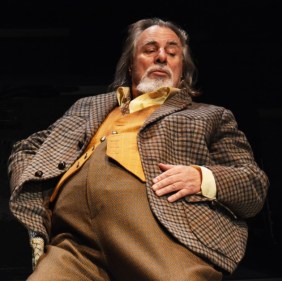
Martin McDonagh’s latest play, Hangmen, marks a significant change from his earlier, Ireland-bound dark comedies – but it shares with them an incredible ear for dialogue and an uncanny knack for finding humour in the bleakest of situations. If you thought The Lieutenant of Inishmore pushed this quality as far as it could go, then prepare yourselves to go just a little bit further. If I told you that this play begins with a man pleading for his life, just moments before his execution, you probably wouldn’t expect to be laughing out loud. But trust me, you will be. Originally a Royal Court production, Hangmen has now transferred to the Wyndham Theatre, where it’s playing to packed houses every night and it’s easy to see how it has achieved its ‘hot ticket’ status.

We start in the gaol cell of convicted murderer, Hennessy (Josef Davies), about to be despatched by Britain’s current chief hangman, Harry Wade (David Morrissey). It’s a brief and shocking scene, the humour suddenly extinguished by the brutal execution itself; and then, just as you’re starting to wonder how they will ever manage to change the setting, the entire cell – walls, floor, door and furnishings – rises majestically upwards into the flies, revealing the interior of a pub beneath. It’s a jaw-dropping transition.

It’s now two years later, 1965. Wade is the landlord of a pub in Oldham and the death penalty has just been abolished. Wade is coasting on his former reputation and is still indulging in an old rivalry with the more famous Albert Pierrepoint, also now a pub landlord in nearby Failsworth. Harry has surrounded himself with a coterie of cronies, who, if you’ll forgive the pun, hang on his every word and treat him as some kind of grotesque celebrity. They are not so much customers as his Greek chorus, commenting hilariously on the action and applauding every twisted thing he says.

Matters take a strange turn with the arrival of Mooney (Johnny Flynn), a smooth-talking Southerner, who seems to know a lot about Hennesy, who went to his death protesting his innocence. Mooney applies to lodge at the pub by exerting his charm on Wade’s wife, Alice (Sally Rogers) and, more especially, on his shy daughter, Shirley (Bronwyn James). It’s apparent from the word ‘go’ that Mooney knows something and he’s come here to make trouble – but what is his connection to the events of the past?

On the night we attend, there’s a technical fault that means the proceedings have to be briefly halted at a very suspenseful moment. We’re worried this might ruin the experience, but the cast respond brilliantly, snapping straight back into character and taking the action on again, without breaking stride. The concluding scenes wrack up the suspense to almost unbearable levels.

Hangmen is a brilliant production, that deserves every accolade that’s been thrown at it, and it confirms McDonagh as one our finest contemporary playwrights. Tickets are in very short supply, but if you can get hold of one, do so, because this is simply too good to miss.

5 stars

Philip Caveney


Fishworks

Unknownimages

Swallow Street, London

16/01/15

We were in London to review a show and decided we’d like to dine afterwards, somewhere we hadn’t tried before. Fishworks have two venues, one in Marylebone and the other on Swallow Street, the latter just a ten minute walk from the Wyndham Theatre. It being a Saturday evening, amidst the general chaos of the Lumiere Festival, we booked in advance a couple of days beforehand. On arrival, we were delighted to see that the venue had its own fishmonger right there on site, a huge marble slad laden with ice and displaying an impressive array of fishy delights, so there was clearly no danger of the ingredients not being fresh enough. The place was packed but our seats were all ready for us and though the tables  were all fairly close to each other, the atmosphere was convivial and the staff pleasant and attentive.

We were 0n a budget so we opted for the set menu, which offered two courses for £18.95 or £21.95 for three, which in the heart of the capital is excellent value. I began with the Brixham fish soup, served with Gruyere croutons and a small bowl of rouille, a light sauce of olive oil, garlic, saffron and chilli peppers. The soup was delicious, thick and smooth, with a real depth of flavour. Susan opted for a bowl of steamed mussels, in a white wine and garlic sauce, served with lemon thyme and shallots. This too was spot on and happily didn’t feature any cream, which is generally the easiest way to spoil a bowl of mussels.

For the main course, I ordered the homemade fishcake with buttered spinach and hollandaise. I’m a big fan of the humble fishcake, but it’s surprising how many chefs manage to get it wrong. How often have we been served something that resembles a deep fried hockey puck? No such problems here, though. The generously proportioned fish cake was light, feathery, delicately spiced and augmented by a  rich Hollandaise sauce, which made it an absolute delight. Susan had the fillet of sea bream, served on a bed of shaved cucumber, with a chilli and mint salad. Again, just as it should be, light, cooked just so. We shared a side portion of chips, which were old-school good, crispy and scrumptious, with no oily aftertaste.

Unusually, we eschewed pudding and both ordered a second glass of the rather pleasant sauvignon blanc that is Fishwork’s house wine. And then it was out onto the street to fight our way through the packed crowds gawping at the illuminations floating in the air above us. We made it back to Euston station by the skin of our teeth.

Fishworks has a lot going for it. If you feel like splashing out, the a la carte offers a selection of more indulgent delights and there’s a daily selection of specials chalked up on boards around the venue. Amidst the ubiquitous chain restaurants that seem to dominate theatre-land, this is a little gem worth seeking out.

4.2 stars

Philip Caveney


The Revenant

UnknownUnknown-1

14/01/16

This time last year, Alejandro Gonzalez Inaritu dazzled the cinema-going public with his quirky comedy, Birdman. Now he dazzles us again, with something entirely different – a bleak, gruelling historical drama, based on a real life story, a film that pulses with bone-jarring violence offset by eerily beautiful location photography.  The Revenant looks set to dominate this year’s Oscars and it’s clearly a hard-won victory. At times, the actors look as though they’re going through as gruelling an experience as their screen counterparts. Here is the life of an 1820s fur trapper in all its grimy glory. It doesn’t look an appealing way to make a living.

The story concerns an expedition into the American wilderness in the depths of winter. Hugh Glass (Leonardo Di Caprio) is the team’s scout and he’s accompanied by his mixed-race son, Hawk (Forest Goodluck). Barely ten minutes into the action, the men are attacked by Arikara warriors and only a handful of them escape with their lives. Matters aren’t helped when, shortly afterwards, Glass is attacked by a grizzly bear (a prolonged scene of almost unwatchable savagery) and is left close to death. The team leader, Captain Andrew Henry (Domhnall Gleason) decides to strike out for their home base and leaves Glass in the care of seasoned trapper John Fitzgerald (Tom Hardy) and callow youth Jim Bridger (Will Poulter). Henry instructs Fitzgerald to give Glass a decent burial when ‘his time comes.’ But Fitzgerald is a survivalist. He murders Hawk and leaves Glass for dead, throwing him into a half dug grave and abandoning him to a slow and painful death. But Glass’s hunger for revenge somehow keeps him alive…

This is the second time the story has inspired a film. In 1971, Man In The Wilderness starring Richard Harris, used the basis of it but changed Glass’s name to Zachary Bass. Inaritu’s film actually sticks closer to the real tale and has the added advantage of Emmanuel Lubezski’s stunning cinematography, his fluid camerawork soaring and sweeping throughout the action to create an almost immersive experience. Often you’ll find yourself closer to the action than is strictly comfortable. In one scene, Glass’s breathing actually fogs the camera lens – in another, blood spatters the screen. And then there are sequences featuring Glass’s fever dreams, strange, hypnotic, almost hallucinatory. It all makes for grim but compelling viewing. Many will be repelled by the extreme violence and a scene where Glass takes refuge from the cold inside a freshly killed horse – yes, you read that right – isn’t going to sit well with any vegetarians in the audience. (Strangely, this isn’t as ridiculous as it might seem. It was an old buffalo hunter’s trick to keep warm inside the gutted carcass of a freshly killed bison. Like a fleshy electric blanket).

The Revenant is an extraordinary slice of cinema, an epic story of survival, of man against nature. If Di Caprio ends up lifting the best actor Oscar (despite speaking only a handful of lines in the entire film) I for one won’t begrudge it to him. I’d say he’s earned it, if only in the scene where he’s required to devour a live fish.

Unmissable.

5 stars

Philip Caveney