Author: Bouquets & Brickbats

Room

11/01/16

Emma Donoghue’s Room is one of my favourite books of recent times: a terrifying tale of kidnap and abuse, rendered somehow hopeful and life-affirming by its young narrator, Jack. The boy has no idea that the tiny, locked room he lives in is a prison; he thinks it is the world. And the world, as he knows it, is small but full of love. After all, Ma is with him all the time, and she is always good to him.

But it’s a worry – isn’t it ? – when a favourite novel is adapted for the screen. There’s no way a director can ever realise every reader’s vision and, when you’ve constructed clear and absolute impressions of the characters and their environs,  disappointment seems almost inevitable.

Almost. But not quite. Because Emma Donoghue is a bona fide artiste, and she did not merely sell the rights to Room to the highest bidder. Instead, she waited for an offer that allowed her to write the screenplay herself and, oh, am I glad she did. Because Room the movie is just as heartbreaking and affecting as its source material and, although there are of course changes made to suit the form, it seems that very little is compromised. ‘Room’ is just as weirdly claustrophobic, joyous, repellant and homely on film as it is on the page.

Jacob Tremblay, as Jack, is a revelation. He’s expressive and appealing and extremely natural; hats off to director Lenny Abrahamson for eliciting this performance from such a  young actor. And Brie Larson is marvellous too, delivering a subtle but curiously intense and credible portrayal of Joy, a young woman who has, against such overwhelming odds, managed to create a happy childhood for her beloved little boy.

OK, so maybe there are a couple of scenes that could have teased out some more tension (when Old Nick drops Jack, for example), and it would have been nice to have seen William H. Macy’s part developed into something more, but these are minor quibbles in the face of an affecting and engaging film.

4.6 stars

Susan Singfield

Theatre Bouquets 2015

Unknown-1

Unknown-1

Unknown-1

We saw some fantastic theatre in 2015. Here, in order of viewing, are our favourite productions of the year.

Unknown

The Caucasian Chalk Circle – Lyceum Theatre, Edinburgh

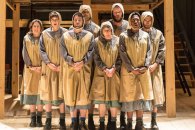
A production so enchanting, funny, lively and, yes, engaging (sorry) that no one in the audience could fail to feel its impact, Mark Thomson’s Caucasian Chalk Circle was Brechtian theatre at its very best.

Unknown-1

The Venetian Twins – Lyceum Theatre, Edinburgh

A farce majeure, beautifully played, timed to precision and rib ticklingly funny from start to finish, The Venetian Twins was proof indeed that farce doesn’t need to be toe-curling; it can be a thing of beauty too.

gc_home_funfair_dressr-491

Funfair – Home, Manchester

HOME’s inaugural production, Funfair by Simon Stephens, was a dazzling box of delights, a real multi-media event that employed lights, shadows, live rock music, back and front projection, masks, movement and a central turntable  used to stunning visual effect.

Unknown

The Skriker – Royal Exchange, Manchester

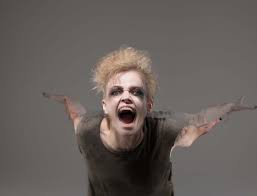
The Skriker was a screaming, hurtling explosion of a play. Caryl Churchill’s script was frightening, angry, funny and weird and Maxine Peake was perfectly cast as the shape-shifting fairy, inhabiting each persona completely.

2015charola_xs

Charolais -Spotlites, Edinburgh Festival

Written and performed by Noni Stapleton, Charolais was an unlikely comedy about a young Irish woman and the jealousy she felt towards a beautiful heifer. It was an unusual tale, as beautifully written as it was acted: a one-woman performance that not only made us laugh and cry, but also brought to life a horny cow.

unknown8

Lungs, Roundabout, Edinburgh Festival

On a grey, rainy day in Edinburgh, Paines Plough’s productions of Lungs by Duncan Macmillan was a breath of fresh air. The witty, sparkling script picked us up by the scruff of the neck and hurled us along in a series of perfectly created flash-forwards as the central couple argued, chattered, broke up and made up again.

unknown7

Filthy Talk For Troubled Times, Venue 106, Edinburgh Festival

Phantom Owl’s actors were seriously top-notch, and Matthew Lillard’s direction was flawless too: the choreography looked effortless but was perfectly orchestrated. The atmosphere was wonderfully tawdry and menacing – Neil LaBute’s script brought expertly to life.

6-dominic-marsh-as-macheath-in-dead-dog-in-a-suitcase-and-other-love-songs-by-kneehigh-theatre-home-manchester-11-26-sept-2015-photo-c-steve-tanner

Dead Dog In A Suitcase (and Other Love Songs) Home, Manchester

Kneehigh’s reputation precedes them: we knew before the show began that we were in for an energetic, multi-disciplined, high-octane experience, and were well-prepared to be dazzled by what we saw. We were not disappointed!

images

Golem, Home, Manchester

The story of the Golem might be traditional, but this production, by experimental theatre company 1927, was anything but. Execution was key here: the perfect meld of acting, animation and music created a surreal, dreamlike world and we could only marvel at the degree of precision that must have been required to bring this extraordinary production together.

333880_770_preview

Jane Eyre, National Theatre, London

The National Theatre’s Jane Eyre was a dynamic interpretation, eschewing the rigid formula of a period drama in favour of a more holistic view of the novel. This made for a surprisingly faithful telling of the narrative: free from the confines of a naturalistic set and strict chronology, director Sally Cookson created space for Jane’s whole story to be centre stage.

lord_of_the_flies_main-photo_johan_persson

Lord of the Flies, Lowry, Salford

A superb adaptation of a literary masterpiece,Anthony Sheader’s Lord of the Flies was a delight from start to finish. And plaudits to choreographer, Jonathan Holby, who co-ordinated the movements of the large cast flawlessly, regularly cutting between normal speed and slo-motion to display simultaneous events – building steadily to a thrilling conclusion.

Susan Singfield

Film Bouquets 2015

Unknown-1

Unknown-1

Unknown-1

08/01/2016

It was a pretty decent year for film. Here, in order of release rather than stature, are our favourite movies of 2015.

Unknown

Birdman – Director: Alejandro Gonzalez Inaritu

This effortlessly quirky film was really all about live theatre and the essential differences between the two disciplines. Michael Keaton dazzled in the lead role and was brilliantly supported by a stellar cast. It was all ingeniously edited to look like one continuous tracking shot.

Unknown

The Theory of Everything – Director: James Marsh

A superb biopic of Professor Stephen Hawking featuring stunning central performances from Eddie Redmayne, and Felicity Jones as his long-suffering wife. It managed to be genuinely tear-jerking but never strayed into sentimentality. A hard tightrope to walk, but accomplished with ease.

Unknown

Whiplash – Director: Damien Chazelle

The adventures of a young jazz percussionist,(newcomer, Miles Teller) and the brutal bandleader (JK Simmons) who drove him to the very edge of sanity. Riveting stuff from start to finish and though Teller’s buttoned-up character was rather unlikable, nevertheless you cared about him.

Unknown-1

It Follows – Director: David Robert Mitchell

This nifty low budget delight reinvigorated the horror movie, throwing in a generous splash of vintage John Carpenter. Look at it as an allegory about STDs or a protestant condemnation of promiscuity, but it manages to wrack up almost unbearable levels of tension. Look behind you!

Unknown

Mad Max: Fury Road – Director: George Miller

Miller’s triumphant return to his famous franchise after a thirty-five year absence was a jet-fuelled, turbo-charged jolt of pure adrenalin. For the uninitiated, it must have been like putting your head in a tumble drier and pressing the ‘on’ switch. I went back for a second look, days later!

Unknown

London Road – Director: Rufus Norris

Clearly indebted to its theatrical roots, but still a truly cinematic work and probably the most original movie of the year, Rufus Norris’s film about the infamous Ipswich murders of 2006 is a compelling and occasionally staggering ensemble piece that lingers long in the mind.

Unknown

Inside Out – Directors: Pete Docter, Ronnie Del Carmen

Pixar rediscovered their mojo with this animated delight, which seemed to draw its inspiration from The Numskulls. With as much to please adults as there was for a younger audience, this didn’t put a foot wrong, while the script would have given Sigmund Freud a run for his money.

images

Amy – Director: Asif Kapadia

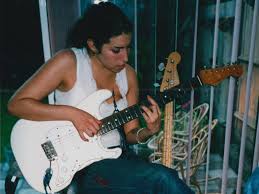
Compiled from found footage, this stunning documentary did more than confirm what we thought we already knew about Amy Winehouse. It showed she’d been virtually hounded to her death by the tabloid press and gave her story a sense of tragedy that left most audiences in tears.

Unknown-1

45 Years – Director: Andrew Haigh

This stylish film lays bare the complexities behind the relationship of a long married couple as they approach an important anniversary. Tom Courtenay and Charlotte Rampling excel in this slow-burning tale of love and regret set against the bleak backdrop of the Norfolk Broads.

Unknown

The Martian – Director: Ridley Scott

After the disappointment of Prometheus, Scott needed to find his way back into outer space and he did it with this winning tale, based on Andy Weir’s novel. More science fact, than fiction, Matt Damon starred as an astronaut stranded on the red planet, but determined to get back to earth.

Unknown-1

Carol – Director: Todd Haynes

This stylish 60s set melodrama confirmed Haynes as one of the finest directors of our time. There were splendid performances by Cate Blanchett and Rooney Mara and a stunning evocation of a lost era. Throw in a gorgeous score by Carter Burwell and really, what’s not to like?

Unknown

The Lady In The Van – Director: Nicholas Hytner

There has to be a comedy, right? And this wry  adaptation of Alan Bennett’s book pitched everything perfectly, with stand out performances from Dame Maggie Smith and Alex Jennings as the distinguished author – or rather as two different versions of him – an inspired touch.

Philip Caveney

Creed

MV5BODg5NDM1MDI4NF5BMl5BanBnXkFtZTgwMzg0MzQxNzE@._V1_UX182_CR0,0,182,268_AL_Unknown

07/01/15

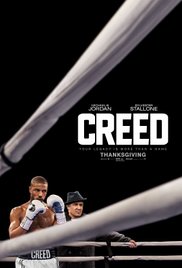
if asked to create a list of franchises that didn’t really need another instalment, the Rocky series would surely figure high on a lot of people’s lists. It’s easy to forget, though, that back in 1977, the original film lifted the best movie Oscar, trouncing rivals of the calibre of Taxi Driver and Network. Sadly though, the film’s writer and star, Sylvester Stallone went on to produce a series of increasingly cartoonish sequels (he did the same thing with his other big franchise, Rambo) and its these inferior films that tend to linger in the public’s consciousness.

So how do you find a new angle on the story? Writer/director Ryan Coogler, creator of the much-admired Fruitvale Station,  has given it his best shot and it’s to his credit that the resulting film is as watchable as it is. Creed  focuses very much on an African-American perspective. Where earlier films had a powerful white man overcoming black champions, here the familiar story is pitched in reverse (and is therefore arguably a more realistic premise).

Adonis (Michael B. Jordan) is the illegitimate son of the late former world champion, Apollo Creed. He’s grown up with not so much a chip on his shoulder as a five ton boulder. Raised by Creed’s wife in the lap of luxury, Adonis still has an overpowering urge to punch people for a living and has already been the victor in a string clandestine bouts in Mexico, but he longs to go legit. So he throws in his cushy job in L.A, moves to a tiny flat in Philadelphia and searches out a suitable trainer. Inevitably, his gaze falls upon Rocky Balboa, the only man ever to have beaten his old man in the ring.

These days, Rocky (Stallone) is running a restaurant named after his late wife, Adrian and is suffering from a few health issues. Initially reluctant to return to his former life, he sees something in Adonis and… well, you can pretty much work out the rest. Ultimately, it does come down to another gruelling string of training and fighting sequences and those viewers who are turned off by the sight of grown men brutally pummelling each other to unconsciousness are not going to like this at all. There are a few cleverly placed references to the original movie and interestingly, Adonis’s main opponent here is former heavyweight champion, Tony Bellew, playing a character called’Pretty’ Ricky Conlan. Ironically, he looks considerably less buff than most of the actors in the film, but having said that, I still wouldn’t want to trade punches with him.

Jordan is convincing as the ‘hungry’ kid on the block, Stallone still mumbles so much, you only recognise three words out of every five and the film is ultimately KO’d in the final round by some decidedly mawkish dialogue as Rocky points out that Adonis’s punch up with Conlan is just the same as his own battle with the big C. But the climactic fight is thrillingly staged and while it’s not a patch on the likes of Raging Bull or The Fighter, it’s nonetheless the best Rocky film in a very long time.

Not exactly a knockout, then, but it wins on points. Stallone is already threatening a rematch.

3.8 stars

Philip Caveney


Slow West

MV5BNTYxNDA5ODk5NF5BMl5BanBnXkFtZTgwNzMwMzIwNTE@._V1_UX182_CR0,0,182,268_AL_

05/01/16

I’ve been trying to see this for quite a while. I missed its brief appearance in cinemas, failed to pick up the DVD and then, by chance, noticed it when I was scrolling around Netflix looking for something to watch. I was initially delighted for the opportunity to catch up, but, inevitably, I suppose, was left feeling a little disappointed, because reviews I’d read on its release had led me to expect something amazing; but John Maclean’s film didn’t thrill me as I’d been promised.

Slow West, as you might expect, is set in America but is actually filmed in New Zealand and though the widescreen vistas are undoubtedly handsome, they didn’t really convince as genuine locations. Jay Cavendish (Kodi Smit-McPhee) is a vulnerable sixteen year old Scottish lad, on a mission to find his former ‘sweetheart’, Rose Ross (Caren Pistorius), who has  fled to America with her papa, after he accidentally killed Jay’s wealthy father in a brawl. Jay is rescued from an encounter with bad guys and befriended by the more experienced Silas Selleck (Michael Fassbender) who offers to chaperone him to his eventual destination – but Jay is unaware that Selleck is actually a bounty hunter, after the reward that’s been offered for the Scottish runaways. As it turns out, Selleck is only one of a whole crew of bounty hunters all intent on claiming the hundred dollars ‘dead or alive.’ But who will get there first?

As I said, it’s all handsomely mounted but there’s no real sense of urgency  in the film and despite the fat that a high body count mounts up throughout  proceedings, (something that Maclean focuses on only in the film’s closing moments) you don’t really feel the impact of those killings. Throw in occasional jokey appearances by some rather unconvincing Native Americans and an ending that ought to be devastating, but somehow isn’t, and I can’t help feeling that this film has been somewhat overpraised. It’s not awful, you understand, just a bit… meh.

3.5 stars

Philip Caveney


The Bridge

imagesUnknown

05/01/16

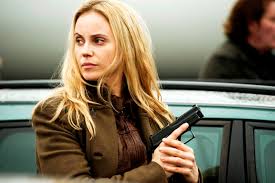
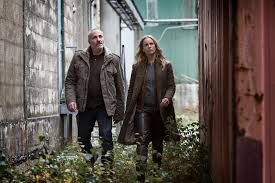
Since the success of The Killing, Scandi Noir has become something of a TV growth industry – it seems the viewing public can’t get enough of lurid crimes in snowy landscapes – and out of all the series that followed the adventures of Sarah Lund, perhaps The Bridge is the most assured. It incorporates fiendishly twisty (and it has to be said, highly unlikely) plots with a hist of fascinating characters. Most intriguing of all, of course, is Sofia Helin’s remarkable turn as police inspector Saga Noren. I could probably fill a book with praise for Helin’s creation. Saga is somewhere on the autistic spectrum, (it’s never really pinned down) which means that her responses to social situations can be somewhat inappropriate and often, wildly funny, a device that cleverly undercuts the series’ visceral story lines, which would otherwise make relentlessly grim viewing.

In Season One, the corpse of a woman is found lying on the Oresund Bridge – or rather, two corpses, since the top half belongs to one victim and the bottom half to another. (Yes, I know. It’s a trope of this series that no killing is ever straightforward). As the corpse has been deliberately placed at the halfway point between Denmark and Sweden, Saga is required to collaborate with Danish copper, Martin Rohde (Kim Bodnia), an affable married man with serious commitment problems (when we first meet him, he’s just undergone a painful vasectomy). The pairing of the two characters is a masterstroke, creating some ‘odd couple’ interplay that powers the first ten episodes to a suspenseful and heart breaking conclusion. Unlike their American counterparts, the Scandis never shy away from tragedy and Martin in particular is put through the emotional wringer.

In Season Two, Saga and Martin are reunited when a tanker heading towards the Oresund Bridge is found to be without a crew, apart from five drugged youths, who have no idea how they came to be there. The story cleverly links back to Season One and we’re on for another ten episodes of fascinating crime drama, as Saga and Martin try to unravel the ensuing mystery. Martin is called upon to confront the criminal mastermind who tortured him in Season One, Saga tries to establish a stable relationship with spectacularly awkward results and just to up the stakes, there’s a potential outbreak of a killer plague virus…

Season Three presented its fans with a potential problem. After a disagreement with the show’s creators, Bodnia walked, leaving author Hans Rosenfeldt to do a frantic last-minute rewrite. It’s absolutely to his credit that he not only manages to pull it off, but that the introduction of Saga’s new, pill-popping male partner, Henrik (Thure Lindhardt), gives the series a whole new lease of life. It soon becomes clear that Henrik is not the kind of character we have initially assumed he is and in fact, has his own, complicated and tragic back story. (There’s a moment where the rug is pulled out from under us with an unexpected revelation, that is quite frankly, brilliant). Meanwhile, we learn a lot more about Saga’s troubled family background. This new case kicks off with the murder of the owner of Copenhagen’s first gender-neutral pre school and leads to another incredibly complicated series of murders, which involve the recreation of contemporary paintings, using corpses as the raw material. Once again, it’s all rather ridiculous and yet the brilliance of the characters makes you accept what’s happening, no matter how bizarre the events. Against all the odds, the Bridge delivers a third slice of compelling television.

Will there be a fourth season? I certainly hope so. The Bridge is engaging stuff and there’s no indication that Hans Rosenfeldt is running out of ideas. If anything, he’s upping his game… so my advice is to tune in to Netflix and gorge yourself on one of the best crime dramas of recent years.

5 stars

Philip Caveney

Hector

MV5BMjAyODcyNDI0OF5BMl5BanBnXkFtZTgwOTQzOTYzNzE@._V1_UX182_CR0,0,182,268_AL_

04/01/16

Through a wintry landscape of the highways and byways of the United Kingdom, hobbles Hector (Peter Mullan) an ageing ‘gentleman of the road’. For the past fifteen years, he’s led a solitary life, sleeping in doorways and homeless shelters, eating in motorway service areas and down-at-heel cafes. But now he’s suffering from a serious medical condition, Christmas is coming and he’s finally looking to reconnect with the brother and sister he walked away from all those years ago. Perhaps understandably, they’re unwilling to see him…

Jake Gavin’s low budget tale is undeniably bleak and yet, at the same time,  strangely life-affirming, concentrating as it does more on the little kindnesses that strangers give to Hector – the cashier in the motorway services area who stands him a free breakfast, the Sihk corner shop owner who rescues him from the attentions of a couple of muggers, and the adorable Sara (Sarah Solemani) who runs the annual Christmas shelter where Hector is a regular visitor. And here is a film that will actually make you think about those helpless characters in shop doorways that so many of us pass by on a daily basis, often without a second thought. This is by no means a polished production. It’s rough around the edges and has no real conclusion to offer, but it’s a film full of heart, a raw and affecting slice of cinema verité.

Peter Mullan is, of course, a gifted actor and he makes Hector a fully fleshed out character. When he finally reveals the reason why he walked away from his family all those years ago, only the staunchest viewers will manage not to shed a tear. Hector is a delightful film, that barely made it to the multiplexes. If you get a chance to see it, big screen or small screen, take it. It’s a charmer.

4.5 stars

Philip Caveney

The Danish Girl

01/01/15

The Danish Girl tells the true story of 1920s landscape artist Einar Wegener, and his transformation into Lili Elbe, the woman he always knew he was supposed to be. Eddie Redmayne stars as the transgender pioneer, but it is Alicia Vikander, as Gerda (Einar’s wife), who really steals the show.

This is a good movie, with a lot of heart. The central relationship and its emotional complexities are explored unflinchingly, and the characters are nuanced and sometimes difficult. Gerda’s bond with Lili is especially dichotomous, as Lili’s emergence serves both to undermine her marriage and elevate her art (Gerda’s portraits of Lili ensure her success as an artist).

It’s beautifully shot: all gorgeous landscape or cityscape, costumes and décor. There isn’t a drab corner in this film, and maybe that’s the reason why it doesn’t quite reach the heights it could; it’s all a little too pretty, even the ugly stuff.

And there is, or should be, a lot of ugly stuff. Lili was one of the first people to undergo sex reassignment surgery – and the consequences were brutal. There need to be some darker elements to make this really clear.

There’s no denying Eddie Redmayne’s skill in depicting both Einar and Lili, but the performance is a little too mannered for my taste. His portrayal of femininity is somewhat overdone: too arch, too simpering, too coy. Maybe this was true of Lili Elbe herself, but it feels a little old-fashioned for a contemporary audience, as if the telling itself has snagged somehow on the very question of gender constructs it purports to explore.

But these are quibbles. It’s an important story, and a very watchable film.

4 stars

Susan Singfield

Sherlock: The Abominable Bride

01/01/16

The recent small-screen success of the BBC television series, Sherlock has prompted its creators to try something a little different this time around; after successfully updating the concept, they’ve decided to present a standalone episode as a period piece and moreover, to simultaneously release The Abominable Bride in cinemas across the UK in a series of exclusive one-off screenings; all things, no doubt designed to generate excitement in the hearts and minds of its huge army of ardent followers.

The problem is, of course, we’re not quite sure how this switch in time has been achieved – (is it the result of one of Sherlock’s cocaine-adulterated dreams? Or are we simply inhabiting one of the scenarios dreamed up by Doctor Watson in his role as an author of detective fiction?) The fact that we’re never really sure is one of the blades that fatally stabs this enterprise, even as it sprints merrily out of the starting gate, but infinitely more worrying is the ensuing surfeit of intolerable smugness that seems to drip from every sly in-joke and ‘clever’ character interplay we’re presented with. Authors Steven Moffat and Mark Gatiss seem to be hovering in the background, proudly announcing how very arch they’ve been with Conan Doyle’s legacy, but I have to confess that after careful viewing and much consideration, I’m still really not sure what was supposed to be happening in the story and can’t help feeling that the writers have been rather less clever than they suppose.

Anyway, the plot revolves around the case of Emilia Ricoletti (Emily O’ Keefe) dressed in a bridal gown, who appears in a public place, indiscriminately firing pistols at passers-by before committing an apparent suicide; only to reappear shortly afterwards, complete with a large hole in her head, to murder her husband. She then promptly disappears. Baffling? Well, yes. Holmes (Benedict Cumberbatch) and Watson (Martin Freeman), go gamely into detection mode, but the eventual solution for the murder is so risible, it’s hard to believe that the authors thought it would pass muster as anything more than a joke. Blaming it on the Suffragettes? Oh, please… A late appearance by Professor Moriaty (Andrew Scott) at the Reichenbach Falls, has been crowbarred into the story with a total absence of subtlety, which just about puts the deerstalker hat on it.

Of course, Sherlock fans are usually a notoriously loyal regiment, so it must be extremely worrying for Moffat and Gatiss, that amidst the onslaught of social media pronouncements, posted shortly after transmission, only a very few scribes have arisen to defend this debacle and the ones that have, seem to be channelling a definite whiff of the Emperor’s New Clothes (take a bow Lucy Mangan of the Guardian). I’ll admit, I haven’t been a massive fan of the series before now, but this ‘event’ has pretty much put me off investigating further instalments. I’d have loved to have finished this review with the word ‘elementary,’ but sadly, that’s a quality that was missing here.

2 stars

Philip Caveney

In the Heart of the Sea

MV5BMjA5NzUwODExM15BMl5BanBnXkFtZTgwNjM0MzE4NjE@._V1_SX214_AL_images

30/12/15

Around a year ago, searching for a new story to write, I pitched an idea to my editor. Why not, I suggested, rewrite Moby Dick – or rather, base it around the true story of The Essex, the ship that inspired Herman Melville’s classic tale? And just to make it more relevant to younger readers, why not present it from the POV of the cabin boy?

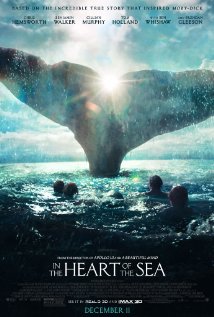
For a variety of reasons, my editor said no and it  would now seem fortunate that she did, because this is exactly what In the Heart of the Sea is and I’d probably have found myself the author of an unreleasable book (or at the very least open to accusations of plagiarism). Ron Howard’s take on the story is a big, sprawling epic of a film, a gorgeous evocation of a lost era and I loved every minute of it.

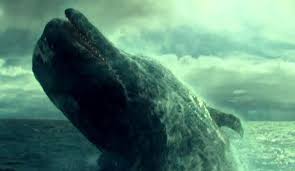
The story starts some fifty years after the main event, when Melville (Ben Whishaw) visits the grown-up Tom Nickerson (Brendan Gleeson) in Nantucket to research the true story of the Essex. Nickerson grudgingly obliges and we flash back in time to meet Owen Chase (Chris Hemsworth) who despite being promised a captaincy for his next voyage is appointed first mate to the rather better connected George Pollard (Benjamin Walker). The Essex sets sail in search of sperm whale and the crew experience a series of disasters that would try the patience of Job, not least the malevolent intentions of a giant white whale, who seems intent on exacting a terrible revenge on the men who have dared to take him on. The whale itself is an incredibly convincing CGI creation and while the killing of such creatures will not sit easily with contemporary audiences, this is an issue that is addressed (albeit obliquely) in the film – and the truth is that men really did go after these marine giants in tiny rowing boats in search of the precious oil to light their lamps and you have to marvel at their courage and endurance in the face of such danger.

This is ultimately a story of survival against incredible odds and one, moreover that is based on real events. The word is that Howard’s film has failed at the box office and it’s certainly not for everyone, but I thought it a remarkable achievement that kept me enthralled from start to finish – a perfect choice for my birthday.

4.5 stars

Philip Caveney