Traverse Theatre

Play Pretend

24/11/23

Traverse Theatre

Framework Theatre is a rather special support organisation for emerging theatre-makers in Scotland, helping to build a “better, stronger, Scottish theatre sector”. It’s often said that you should write about what you know, and playwright Katie Fraser certainly does that, with this self-referential piece about, um, emerging theatre-makers, battling the old guard and forging a new way.

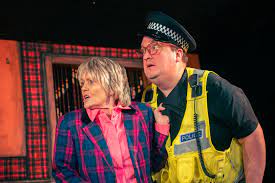
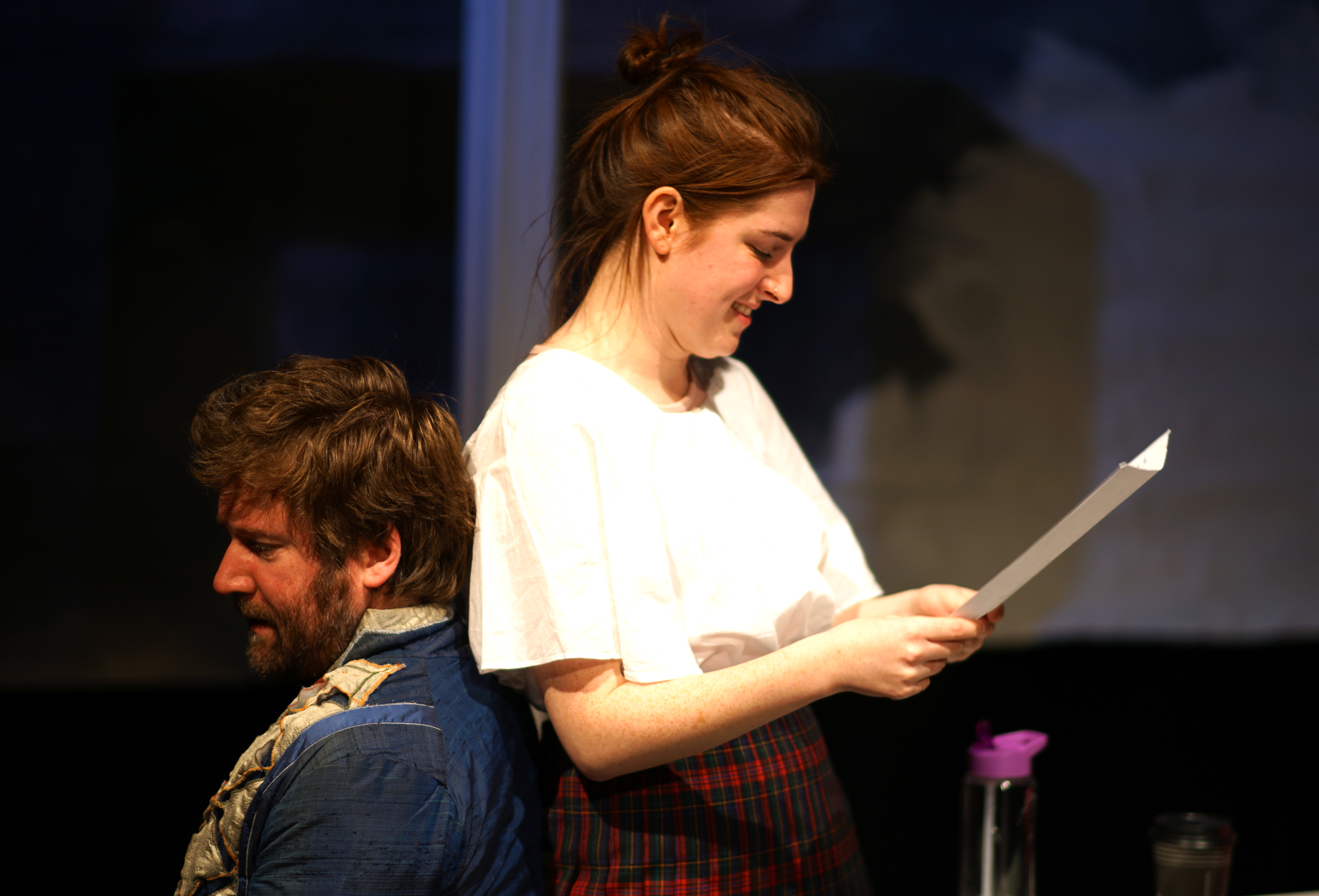
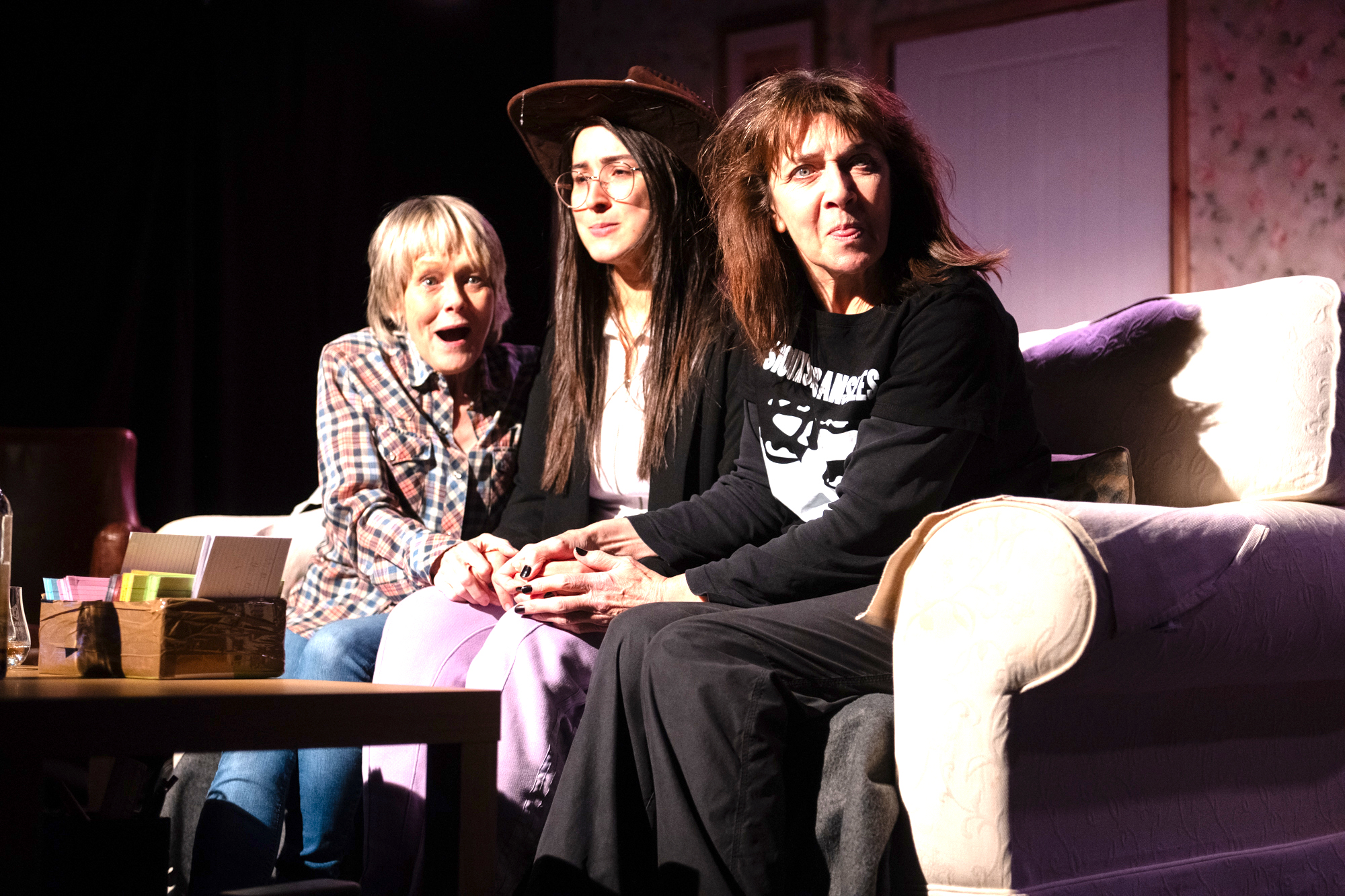
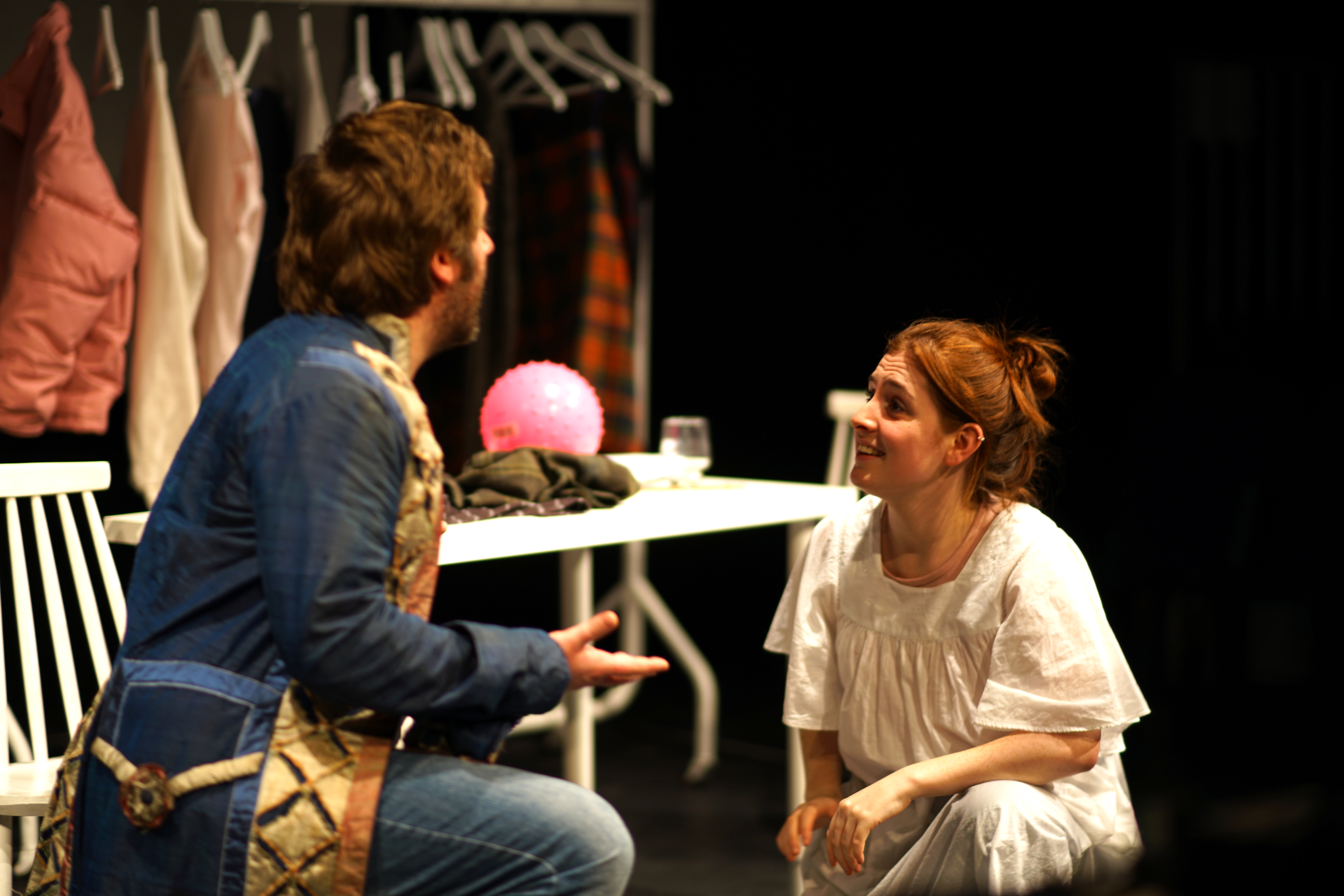
Actors Amy (Claire Wootton) and Greg (Gerry Kielty) are rehearsing a new piece about Flora MacDonald and Bonnie Prince Charlie. For her, it’s an exciting opportunity, her first professional role since leaving drama school. For him, it’s a backwards step; his career trajectory has been stymied by an unspecified scandal, so he’s slumming it, waiting out his time on the naughty step by directing and starring in this ‘little’ play.

To begin with, Amy is deferential, and Greg responds well to this. He’s pleasant, happy to share the benefits of his experience. But we soon see his darker side as Amy gains confidence and begins to question his peculiar interpretation of what is supposed to be a feminist play, written by ‘Harriet’, a young female playwright.

It makes sense that Greg should contrive to keep Harriet from the rehearsal room, as he tries to assert his dominance over the narrative. But Play Pretend suffers a little from the absence of this third character: I find my attention diverted from the action on stage as I wonder why she doesn’t ignore his instructions and come to see what’s happening to her play. It might be more convincing if we were to hear Greg making up outrageous excuses about why she can’t attend.

Fraser’s script comprises a series of vignettes, from which the story emerges bit by bit, the two actors learning more about each other as the rehearsal process goes on. It’s a strong idea and generally works well, although I do find myself wishing for higher stakes, and for a bolder, more cathartic climax.

Laura Valerie Walker’s sprightly direction highlights the meta-theatricality of the piece. The slow-motion transitions are effective in conveying the passing of time, moving us from one snapshot to the next, reminding us that this is all a performance, but they are too protracted, and start to become a little wearisome towards the end. The set, by Isadora Gough, with its over-abundance of tape marks on the floor and moveable furniture, reinforces the point that this is a constructed image, an illusion, designed to tell a tale.

Both Wootton and Kielty inhabit their dual roles convincingly. Wootton nails Amy’s mixture of self-assurance and desperation, her superficial politeness masking her frustration with Greg’s pomposity. She needs this part to kickstart her career, so she forces herself to put up with his condescension – but Wootton shows us what a struggle this is. It is to Kielty’s credit that we feel any sympathy for Greg: he is a bombastic, arrogant man, showing no contrition for his past aberrations and riding roughshod over the two young women he’s working with, assuming that he knows more than both the playwright and female lead about what this feminist drama needs. Nonetheless, Kielty manages to convey Greg’s underlying vulnerability, his fear at being left behind as the tide turns, his self-esteem dependent on his status.

With its artfully-woven historical and contemporary strands, Play Pretend is a thought-provoking and insightful piece about the struggles we face as we try to move towards a more egalitarian society. When you’re used to privilege, as the saying goes, equality feels like oppression.

4 stars

Susan Singfield

The Grandmothers Grimm

01/11/23

Traverse Theatre, Edinburgh

The Grandmothers Grimm, written and directed by Emily Ingram, returns to Edinburgh for the final two nights of its latest tour. Premiered in 2017, this long-running play continues to resonate six years later, drawing in a sizeable crowd tonight at the Traverse.

Revisionist fairy tales are nothing new: like pantomimes, these stories survive because they’re endlessly adaptable. But this production, by Some Kind of Theatre, is more about intellectual property: who invented the stories, who owns them – and who gets the credit.

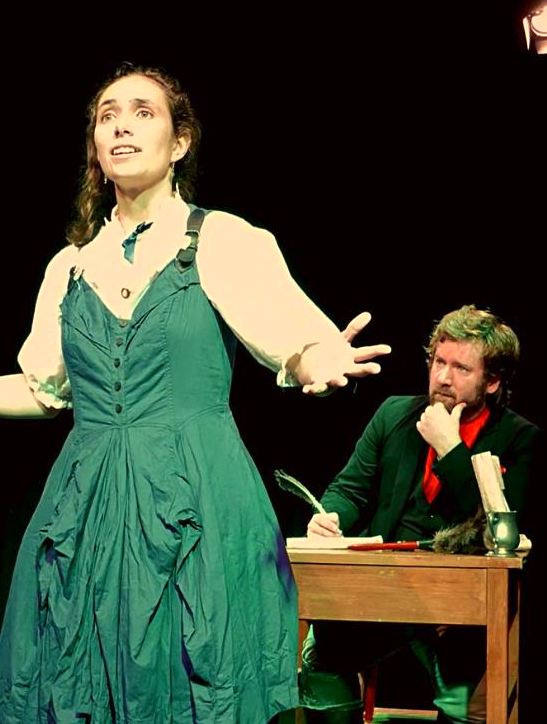
It’s no surprise to learn that the past was sexist (the present is pretty sexist too). But it is perhaps news that the Grimm brothers’ project – collecting traditional folk tales for a compendium – actually deprived a lot of working-class female storytellers of their living, like a nineteenth-century Spotify. After all, who’s going to pay to listen to an old woman tell them a story if they have ready access to a printed copy of the text? Jacob (Justin Skelton) and Wilhelm (Gerry Kielty) might argue that they never claimed authorship of the tales, readily acknowledging their process, but it was their names on the cover – and their profits in the bank.

Marie Müller (Ingram) opens the play, alone, weaving her narrative with practised ease. This, we understand, is how the stories were traditionally told: a paying audience listening, rapt, as an elderly, peasant woman draws us in. When Jacob and Wilhelm burst onto the stage, accompanied by the middle-class Marie Hassenpflug (Sophie Harris), it’s clear that Old Marie doesn’t stand a chance. She’s displaced, allowed to speak only for as long as it takes for the brothers to transcribe her words.

Hassenpflug doesn’t fare much better. She’s educated so the Grimms are superficially more respectful towards her. Nonetheless, they purloin her stories with a blatant disregard for her authorship; it doesn’t occur to them to credit her (a bit like those celebrity children’s authors, who don’t credit their ghost writers…). Harris imbues Hassenpflug with a fierce dignity, which makes for a stark contrast to the brothers’ pettiness.

Kietly’s Wilhelm is focused on sales. He thinks the stories need to be sanitised so that parents will buy them for their children. Skelton’s Jacob hates this idea: he doesn’t want to create the kind of sappy stories he associates with Charles Perrault. He favours a warts and all approach, arguing that the darkness is what makes the tales. I’d agree with him if it weren’t for the fact that his version of ‘authenticity’ denies the existence of the real originators.

The staging could hardly be more simple: the performance area is almost empty, save for a desk and a couple of books; the only additional props are some feathers, cups and apples. This is no-frills, low-budget, black-box theatre – and none the worse for it. Skelton provides the comic relief, galloping round the stage as a donkey prince, as the quartet bring the various tales to life. It’s deftly done, so that we hear the original versions and then see them warped and changed. The pace never falters.

If The Grandmothers Grimm feels like a natural fit for the Edinburgh Fringe, then it’s nice to be transported back to August on this cold November night.

4 stars

Susan Singfield

Battery Park

26/10/23

Traverse Theatre, Edinburgh

Whatever happened to Battery Park? Back in the 90s, they were ‘the band most likely to happen’, but they suddenly – irrevocably – split, leaving just one iconic album for their many fans to remember them by. So where and why did it all go wrong.? The beauty of Andy McGregor’s love letter to the Britpop era is that it’s all done with such veracity it’s hard to believe that it’s a piece of fiction – that the titular band never existed.

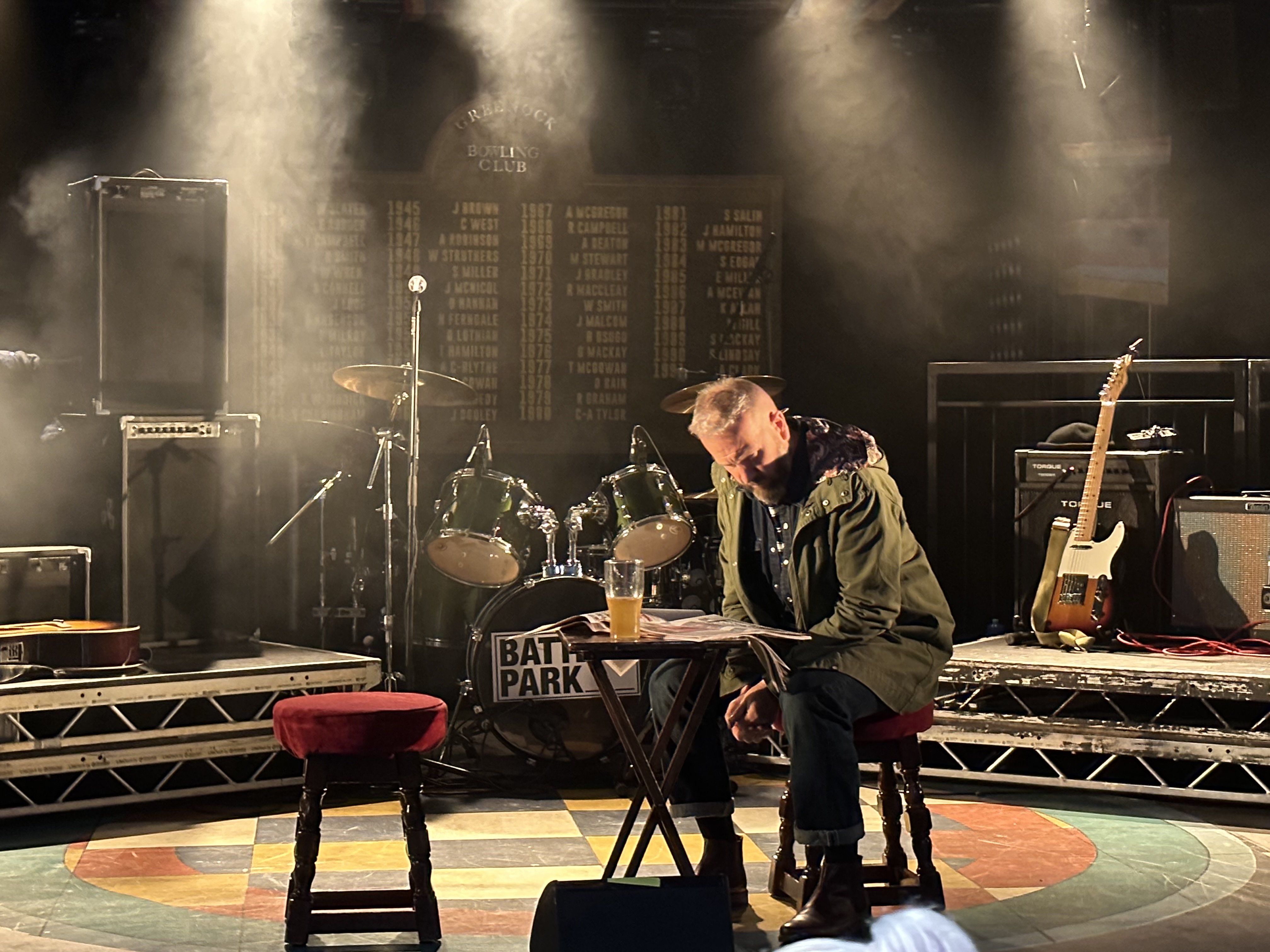
The play opens in the present day. Angie (Chloe-Ann Tylor) is at University and she’s doing her dissertation on Britpop (of course she is!). She tracks down Tommy (Chris Alexander), drinking alone in his regular haunt at Greenock Bowling Club, and asks him for the inside story. He needs a little persuading but soon enough he’s reminiscing about his younger self (Stuart Edgar), his older brother, Ed (Tommy McGowan), and their best pal, Biffy (Charlie West), who is one of those guys who likes to hang around with musicians – a drummer. Tommy has been writing songs and, lured by the possibility of a paid gig at the aforementioned bowling club, the boys hastily put together their band.

But while Tommy can write a catchy song, he’s not that confident a performer, so when Lucy (also played by Tylor) mentions that her best friend, Robyn (Kim Allan), is a brilliant vocalist/guitarist, it’s a no-brainer. Robyn is confident, talented and determined to make it big, no matter what it takes. From their very first performance, the new line-up seems destined for success…

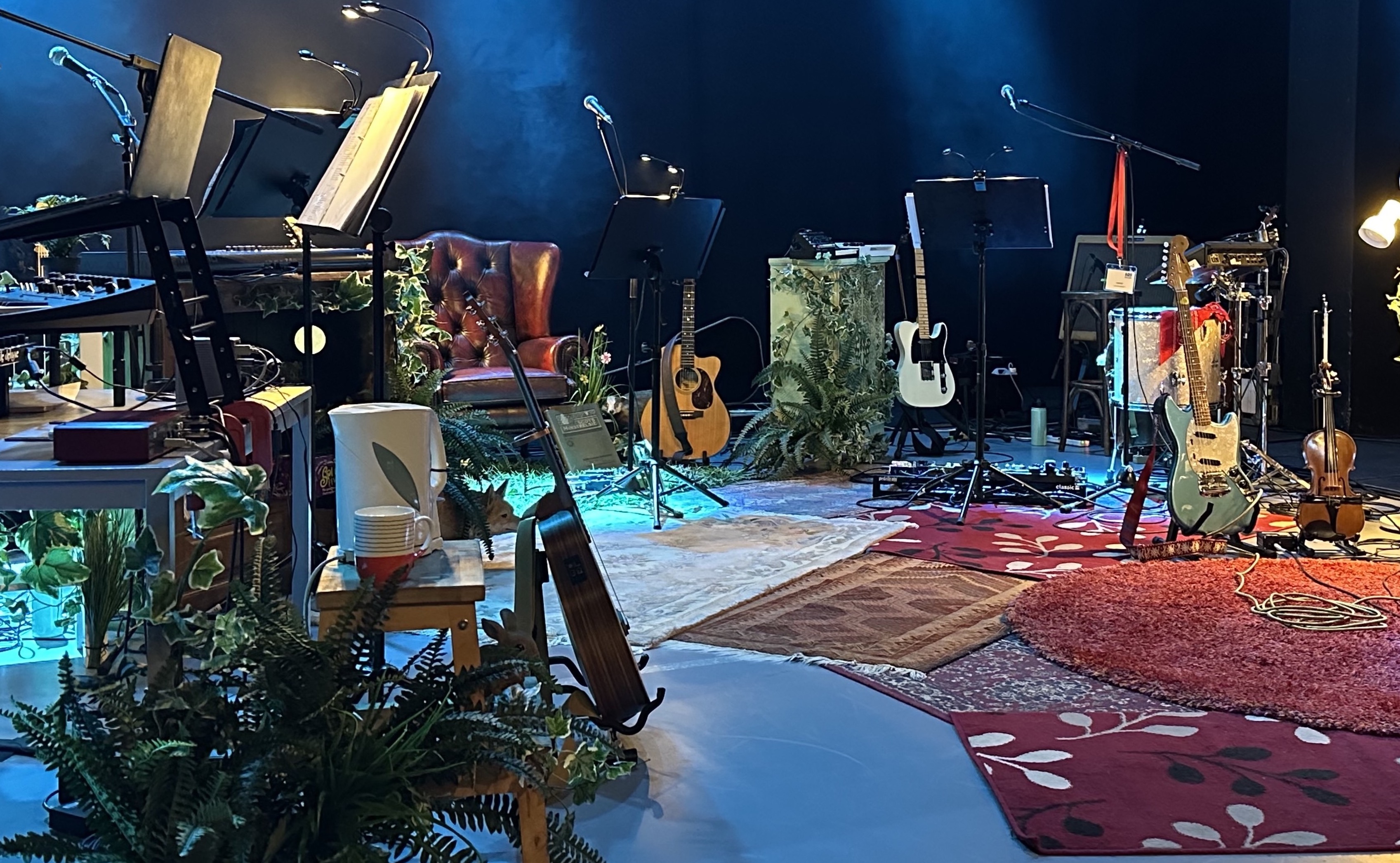
Battery Park captures the sweaty exuberance of a band’s early days with absolute authority, providing an inspired mix of drama and high-octane rock. Kenneth McLeod’s set design somehow manages to incorporate all the necessary jumble of instruments and amplification into the story without ever getting its leads tangled, and I find myself marvelling at the ingenuity: the speaker cabinet that doubles as a safe is inspired!

While the first act chronicles the band’s dizzy rise to the brink of stardom, Tommy has signalled from the outset that the second will detail its heartbreaking descent into ignominy. The resulting dramatic irony is almost too much to take. By the closing stages, I’m watching with tears in my eyes.

All the performers excel, both as actors and musicians – and it certainly helps that the band’s numbers (also written by McGregor) are a series of propulsive bangers, each one containing a memorable hook in the chorus. As the musicians hit the final chords of the closing song, the applause erupts, intense and heartfelt.

As gig theatre goes, this is a perfect example of the craft. Don’t miss it.

5 stars

Philip Caveney

Disfunction

24/10/23

Traverse Theatre, Edinburgh

Sadly, this is the final PPP of the season; Tuesday lunchtimes just won’t be the same without an invigorating hour of original theatre. Luckily, Disfunction (“with an ‘i'”) provides a rousing send-off. This is first-rate stuff: a beautifully distilled character study, with a slice of social commentary on the side.

Kate Bowen’s play tells the story of sisters Moira and Melanie (Maureens Beattie and Carr respectively) and a game they’ve been honing for fifty years. Their goddaughter, Tanya (Betty Valencia), thinks she’s found a way to monetise their creation – by turning it into a sort of reality-TV experience, where viewers can pay to watch them play. At its best, the game is all Taskmaster-style fun: one round requires a blindfolded participant to put a pin in a map and then (sans blindfold) make their way to wherever the pin lands. Caveat: no cars allowed. Oh, and once they get there, they need to take a photograph of themselves. With four animals.

At its worst, the game is an exercise in, well, dysfunction. With a ‘y’.

The Maureens are surely two of Scotland’s national treasures, aren’t they? It feels like a real privilege to see these two great actors in such an intimate setting. They clearly relish their roles, especially Carr, who gets the plum part of the sassy, self-destructive Melanie. But Beattie is just as impressive as the more reserved and taciturn Moira, and Valencia more than holds her own as troubled Tanya, all bright-eyed desperation, a paper-thin smile covering her pain.

Lu Kemp’s kinetic direction means that the characters are always in motion (notable moments include a hilarious performance of Whigfield’s Saturday Night routine), and highlights that peculiar combative closeness that defines so many families.

Are there any negatives? Not really. Disfunction‘s role-playing political round perhaps stretches credulity (if there are only three people playing and each one has to ‘be’ a politician, who has set the questions to catch the others out?), but that’s my only gripe. Otherwise, it’s a pure delight. After all, as Tanya so cannily perceives, who doesn’t want to watch a bunch of strangers tearing themselves apart?

4.5 stars

Susan Singfield

Stay

10/010/23

Traverse Theatre, Edinburgh

Stay, it turns out, is a musical, but lest that word should conjure images of hordes of costumed performers, leaping and gyrating across a stage, let me quickly point out that this is the latest in the Traverse Theatres’s A Play A Pie and A Pint season. It’s a two-hander. But its smallness of scale is more than made up for by its sweet, affecting nature and for the insights it offers into its difficult theme.

Rowan (Craig Hunter) and Kit (Daisy Ann Fletcher) meet up in their favourite corner of the local park. Rowan is carrying an urn containing somebody’s ashes: he’s finally prepared himself for the task of scattering them in the duck pond, but he needs back-up for this grim task and, of course, Kit is there, dressed in her hospital scrubs, ready to make jokes about every aspect of this solemn occasion.

The two of them were once lovers but four years ago something went badly wrong – and yet, somehow, Rowan doesn’t want his current girlfriend here today. For this challenge, Kit is the perfect choice…

Written by Jonathan O Neil and Isaac Savage and directed by Melanie Bell, Stay is a deceptively simple piece, its quirky plaintive songs recounting a poignant story about a relationship gone awry. Rowan is steady and dependable, Kit adorably scatty, forever taking the narrative off in unexpected directions, but together they have something special. Both leads deliver the plaintive, haunting songs with considerable skill and the piece is cunningly written, luring you in with its seemingly innocuous narrative, before heading off into darker territory and deftly delivering a climactic gut punch.

If I wanted to nitpick, I’d say there’s one song too many after that change of direction; nevertheless, Stay is a delightful piece of lunchtime theatre that will make you laugh and cry in equal measure.

4.5 stars

Philip Caveney

And… And… And…

07/10/23

Traverse Theatre, Edinburgh

Though still at high school, Cassie (Caroline McKeown) is already a committed eco-warrior, working tirelessly to organise regular beach clean-ups in her locality. She takes every opportunity to lobby big corporations to plead on behalf of environmental causes and lately has even taken to making her own clothes from natural fibres. But as the climate change disasters inexorably mount, she finds herself increasingly obsessed with the subject. And it’s an obsession that threatens to overpower everything else in her life.

Meanwhile, Cassie’s best friend, Claire (Tiana Milne-Wilson), has her own pressing issues to contend with. Her mother is steadily succumbing to a deadly lung disease after years of smoking cigarettes and is no longer able to work. The final demands for rent and electricity are coming in on an almost daily basis and Claire desperately needs to find a paying job. The only possibility she’s discovered is the chance to apply for an apprenticeship at a locally-based multi-national plastics manufacturer, a company that she knows Cassie openly despises.

Isla Cowan’s And… And… And… is a topical story from Strange Town Theatre, one that isn’t afraid to address the horrifying scale of its central premise and to openly accept the impossibility of finding an easy solution – indeed, there’s a strangely satisfying meta-twist in this tale that comments on its own artificiality, the very idea of finding an ‘answer’ within the confines of a fifty-minute play.

The two leads give compelling and nuanced performances and the duo’s friendship feels utterly palpable. This is a youthful and exuberant approach to the subject, created for and by the generation who have been handed the poisoned chalice of a devastated planet. The frustration they feel is written large. Katie Innes’s simple but effective stage design is created mostly from heaps of detritus, an approach that serves as a constant reminder of the play’s theme, while Steve Small handles the direction with aplomb.

The play’s conclusion – that everyone needs to do whatever they can to reduce their personal carbon footprints and work together towards a more optimistic future – may not be exactly earth-shattering, but nevertheless, it comes through loud and clear.

4 stars

Philip Caveney
Disciples

06/10/23

Traverse Theatre, Edinburgh

Disciples is a compelling piece of performance art, combining poetry, music, movement and visual imagery. Conceived and directed by Rachel Drazek and written by Ellen Renton, it’s about belonging and expectations, interdependence and joy. It’s also about giving people the chance to take up space – especially those who are often denied that opportunity.

The five-strong cast of disabled women and non-binary people bring Drazek’s vision to life: this is the “bold and beautiful new piece of dance theatre” she aspired to make. The creative process, we learn in an illuminating after-show discussion, was a collaborative one, the piece devised in rehearsal before being shaped by Renton. It shows: the performers’ agency is palpable. The resulting production is nuanced and doesn’t shy away from difficult emotions, but the layering of ideas ultimately adds up to something joyful and positive, reinforcing the idea that we are all connected and inter-dependent.

The costumes, by Zephyr Lidell, are simple but striking, each performer clad in a single, shimmering colour. Visually impaired musician Sally Clay (yellow) is all optimism; her singing voice is ethereal and she plays the harp and ukulele with aplomb. But she’s more excited about the dancing: post-show, she reveals that this is a long way from her comfort zone, and that she’s delighted to have been challenged in this way. Indeed, this point is echoed by Rana Bader (red), who seems to embody passion and strength; she is bursting with energy and exuberance, making a gazillion press-ups look easy. She’s not used to demands being made of her, she says; in rehearsal rooms, she sees her non-disabled peers being given detailed notes, while she is patted on the head just for turning up. She prefers being pushed.

Laura Fisher (lavender) is a dancer, so graceful and elegant that they take my breath away, while Irina Vartopeanu (green), uses BSL in a way I’ve never seen before, incorporated into the piece, not as a straight interpretation of what others are saying but as an expression in itself. She’s vivacious and somehow diaphanous.

Emma McCaffrey (orange), last seen by B&B in the excellent Castle Lennox, explores the idea of inner rage; they are an engaging performer with a bold stage presence and bring the humour needed to balance this play.

Disciples is a thought-provoking, sensory piece, and well worth catching if you can.

3.6 stars

Susan Singfield

The Sheriff of Kalamaki

03/09/23

Traverse Theatre, Edinburgh

In this unusual two-hander by Douglas Maxwell, Paul McCole plays the eponymous law-keeper. It’s not an official role but alcoholic Dion is proud of the title, even if he did choose it himself. He swaggers (and staggers) his way through the bars and clubs of Zakynthos, seemingly unaware that he’s being used as a lookout by the local drug dealer. He’s a loveable character, his cheery bluster doing little to hide just how damaged and vulnerable he really is. His existence is precarious but he seems to be coping – until his apparently straight-laced brother, Ally (Stephen McCole), comes looking for him, after almost thirty long years…

Maxwell eschews a duologue in favour of two almost completely separate monologues, a structural device that mirrors the brothers’ estrangement. Dion, when we first meet him, is alone – as he has been since 1994. When Ally shows up, the ensuing conflict shows us how this situation began, and then it’s Ally’s turn to find himself bereft and isolated in Kalamaki, a solitary figure standing on a cliff, facing his demons, while in the town below him, everyone else is having fun. The script’s construction makes for an oddly unsettling experience, but I think it serves the story well.

Gemma Patchett and Jonny Scott’s set design is suitably stark: a raised platform, overshadowed by a huge, curved sheet that represents the sea and sky. This works well on a figurative level too, the brothers dwarfed by the natural world, the quarrel that once seemed so all-consuming now rendered petty and insignificant. After all, the planet’s burning: Ally’s plane is half-empty; tourists have turned their backs on the island’s unbearable heat and unpredictable wildfires.

Jemima Levick’s direction is lively and pacy, highlighting the superficial contrasts between the two men, while the real-life McCole siblings are both formidable performers, creating a convincingly acrimonious relationship. Their differences are slowly peeled away, revealing their essential similarities and exposing the myths we tell ourselves about what ‘a good life’ really is.

4 stars

Susan Singfield

Ship Rats

19/09/23

Traverse Theatre, Edinburgh

It’s the year 1880 and Jessie (Madeline Grieve) is in big trouble. She’s just murdered her husband and she’s covered in his blood. He’s the captain of the ship she’s currently aboard, a cruel tyrant who recently condemned an innocent cabin boy to fifty lashes for stealing a biscuit. He probably had it coming, but still, his crew are unlikely to be sympathetic.

To make matters worse, Jessie has sought refuge in the cabin of the ship’s Chinese cook, Jin Hai (Sebastian Lim-Seet), a man with probelms of his own. Shunned by the other members of the crew, he is planning a daring escape from the ship – but, try as he might, he cannot find the box of matches he needs in order to make his departure go with a bang.

When the inevitable hue and cry kicks off, Jessie and Jin Hai realise that they’ll have to ignore their respective differences and hide out together. In doing so, they begin to realise that they actually have quite a bit in common. Their conversation takes in a range of subjects: colonialism and Chinese medicine; murder and morning sickness; ginger and gunpowder.

Alice Clark’s spirited two-hander, a co-production between Òran Mór and the Traverse Theatre, is inspired by the adventures of the playwright’s own great-great-grandmother, a seafaring lass with a colourful backstory. The fact that the two protagonists in Ship Rats speak like contemporary Glaswegians out on the lash is initially jarring but, once I settle into the rhythm, it makes for a fun-filled fifty minutes, even if the tone is sometimes relentlessly frenetic.

Grieve offers a rollicking turn as the amusingly foulmouthed Jessie, while Lim-Seet makes an astute foil for her bawdy barrage of invective. If occasionally Jessie and Jin-Hai seem to possess the kind of insight that really only comes with the advantage of historical perspective, well that’s acceptable, given that this wants more than anything else to be a commentary on the toxic nature of Empire.

Director Laila Noble keeps the action propulsive enough to ensure that the pace never flags and Ship Rats has me entertained right up to the final scene.

3.4 stars

Philip Caveney
Edfest Bouquets 2023

August in Edinburgh, and the Fringe was back with a boom! As ever, after seeing so many brilliant productions, it’s been hard to select our favourites, but it’s (virtual) Bouquet time and so, in no particular order, here are the shows that have really stayed with us:

COMEDY

John Robins: Howl (Just the Tonic)

‘Raw and achingly honest….’

The Ice Hole: a Cardboard Comedy (Pleasance)

‘An inspired piece of surreal lunacy…’

Dominique Salerno: The Box Show (Pleasance)

‘One of the most original acts I’ve ever seen…’

The Umbilical Brothers: The Distraction (Assembly)

‘An amorphous mass of nonsense – but brilliantly so!’

THEATRE

Bacon (Summerhall)

‘A whip-smart, tightly-constructed duologue…’

The Grand Old Opera House Hotel (Traverse)

‘Part slapstick, part comic-opera, part mad-as-a-box-of-frogs spectacle, this is something you really don’t want to miss.’

Salty Irina (Roundabout at Summerhall)

‘Fresh and contemporary, all minimal props and non-literal interpretation…’

Dark Noon (Pleasance)

‘A unique piece of devised theatre, sprawling and multi-faceted…’

JM Coetzee’s Life and Times of Michael K (Assembly)

‘A gentle but powerful production…’

One Way Out (Underbelly)

‘The piece is brave enough not to offer a solution…’

SPECIAL MENTIONS

After the Act (Traverse)

‘We have to learn from what has gone before…’

Woodhill (Summerhall)

‘Though unnervingly bleak, this does offer a glimmer of hope…’

Things Hidden Since the Foundation of the World (Traverse)

‘The closest I’ve ever come to experiencing an acid trip in the theatre…’

Susan Singfield & Philip Caveney