Summerhall

Daughterhood

Summerhall (Roundabout), Edinburgh

We enjoyed last year’s Paines Plough/Theatr Clwyd collaboration, Island Town, so we’re keen to see what they have to offer us this time. Philip and I are from North Wales, and Theatr Clwyd featured heavily in both of our young lives. It feels good to have a slice of home right here with us in Edinburgh.

Charlotte O’Leary is back, this time playing Rachel, a Little-Miss-Sunshine younger sister with an exciting job in London. Her sister Pauline (Charlotte Bate), who’s nine years older, still lives at home, caring for their disabled father, growing steadily more miserable as life passes her by. Daughterhood is an examination of their relationship, of duty and fairness and doing the right thing.

It’s brutal: Pauline is stuck; she can’t find a way out. Someone has to look after Dad. Bate exudes despair, her face locked in a silent scream; it’s a stellar performance. Rachel cares too, but she’s busy lobbying parliament for access to better medication; she’s not there, clearing up the shit. When she does visit, Pauline’s resentment bubbles over, and they find themselves trapped in an endless argument, repeated ad nauseam each time they meet.

O’Leary portrays Rachel as sparky and likeable, her energy and sense of purpose a stark reminder to Pauline of what she could have had. The dynamic between the two is compelling; they’re on opposite sides but I’m rooting for both of them.

Toyin Omari-Kinch plays a range of supporting characters: Rachel’s colleague, her teenage bestie, a doctor, a professor – and their sick father. The first time he switches roles, I’m momentarily confused, but I soon work out what’s happening from the context – and he changes his accent and demeanour too. From thereon in, it’s always clear who he is, and he steps up to the challenge most impressively.

I like this play. Stef O’Driscoll’s direction means that the frequent flashbacks are well signalled, and we’re always sure of when and where we are. Despite the bleak subject matter, Charley Miles’ script is often laugh-out-loud funny, the humour helping us to engage with both women. I like the relentless repetitiveness of the sisters’ rows, entrenched as they are in the roles they’ve come to inhabit. And I like the fact that redemption, when it comes, is small and tentative.

A lovely piece of theatre in my favourite Fringe venue.

4.3 stars

Susan Singfield

Big Aftermath of a Small Disclosure

14/08/18

Summerhall, Edinburgh

What I love most about the Fringe is the sheer variety of what’s on offer. Two weeks into a rigorous viewing timetable, patterns start to emerge (for example, table lamps and portable cassette recorders are popular props this year); I start to think maybe I’ve seen it all. And then I find myself in Summerhall, watching ATC’s Big Aftermath of a Small Disclosure,  and am reassured that theatre still offers endless possibilities, that I can still be surprised.

We start with a bare stage and two characters, Jon (Abhin Galeya) and Louise (Wendy Kweh). They cross, meet in the middle, and Jon tells Louise he is thinking of leaving town. Their dialogue comes in short, staccato bursts, spare and unrevealing. It’s an intriguing opening, the bare bones of an idea. When Johan (Sam Callis) and Sjon (Mark Weinman) join them, the stylised he-said-she-said repetition is both funny and strangely alienating – but slowly, slyly, the power dynamics are revealed, and we see the characters pacing, circling, approaching and retreating, vying for control and understanding of the crisis created by Jon’s simple announcement.

This is choreography as much as direction: the moves become more complex as the drama is fleshed out, and it’s beautifully crafted by Alice Malin. Layer by layer, we learn about the group: who they are, what they mean to each other, what Jon’s leaving really signifies. The set grows with each round of revelations too: now we have grass, now chairs, now beer bottles and other props. The whole piece is an illumination of the storytelling process, how we start knowing nothing and are fed details piecemeal.

Magne van den Berg’s script, translated by Purni Morell, is oddly ethereal; the characters’ speech patterns are slightly jarring – it has a disorienting effect. I like it: it’s the opposite of naturalism; nobody speaks like this, with such precision and control. And yet, even in its strangeness, it’s all very recognisable: the unuttered agendas, the circling around real issues.

A thought-provoking, unusual piece – and one I highly recommend.

4.5 stars

Susan Singfield
 

Island Town

13/08/18

Paines Plough at Roundabout, Summerhall, Edinburgh

We’re big fans of Roundabout here at B & B. Paines Plough’s portable, in-the-round theatre is a wonderful space and we’ve  seen some fantastic performances here. Island Town is an especially exciting prospect for us, being a co-production between Paines Plough and Theatr Clwyd; as North Walians, we’re keen to see what this collaboration brings.

Writer Simon Longman clearly knows about small towns, about the stifling going-nowhere feelings that make people feel trapped. The location here is unspecified, ‘this town surrounded by fields’, circled by a ring road, is impossible to escape. It’s anywhere and everywhere, as symbolised by the actors’ regional accents: one Derby (I think), one Manchester and one Welsh.

This is Kate’s story, and Katherine Pearce is captivating in the role of the angry teen, full of impotent fury, raging at the injustice that sees her marooned, caring for her dying father, permanently drunk because it’s the only outlet she has. She yearns for something better, longs to head off beyond her narrow horizon, to see more of the world. But she’s tethered: too poor, too tied down, too ill-equipped to leave.

Her friends, Sam (Charlotte O’Leary) and Pete (Jack Wilkinson), are more accepting of their lot. Sam’s main concern is protecting her little sister from their violent dad, while Pete’s only ambition is to be a dad himself. Pete in particular is a tragic case: he’s a sweet character, positive and hopeful; he doesn’t ask for much. But the system seems designed to grind him down. He hasn’t any qualifications and there are no jobs locally. He can’t even get the benefits he’s entitled to, because the bus service has been cancelled so he can’t get to the job centre to sign on.

There’s no doubt about it, this is a bleak play, but there is humour too, a nicely balanced tug of war between hope and despair. And, as we draw towards the teens’ inevitable fate, we start to make sense of the strange jerking movements they’ve been making in the transitions between scenes…

Perhaps the penultimate section is a tad too long, a little too spelled-out, but all in all this is an impressive piece, a darkly accurate commentary on those society leaves behind.

4.5 stars

Susan Singfield

The Basement Tapes

09/08/18

Summerhall, Edinburgh

Zanetti Productions’ The Basement Tapes is a startling piece of theatre, compelling and surprising, throbbing with energy. The site-specific environment of the creepily named ‘Former Women’s Locker Room’, deep in the bowels of the Summerhall building, all clanking radiator pipes and low ceilings, enhances the rising tension, and we find ourselves utterly enthralled.

Stella Reid plays a girl who, after her grandmother’s death, is tasked with clearing out her home. We’re with her in the cluttered basement, resonant with memories, boxes everywhere. The girl is part way through her onerous assignment: some of the boxes are open, their contents strewn around the room. She’s clearly bored, dancing as she works, pausing to order pizza, trying on her grandma’s coat. She grapples with unfamiliar technology: calling her mum via a landline, because there’s no mobile signal here; intrigued by an old tape recorder and a bag full of cassettes.

From hereon in, the story revolves around those cassettes, those titular basement tapes. The eerie, disembodied voice of her dead grandmother weaves its way into the tale, taking us (and the girl) on a strange journey, with macabre revelations that really make the spine tingle.

The atmosphere is fraught, crackling like the electricity that intermittently cuts out, leaving us in darkness as black as the secrets that have been set free. Stella Reid’s performance is powerful and riveting; I realise, as I leave, that I have been holding my breath.

An exciting, innovative production from this award-winning New Zealand company, the show is deservedly sold out for much of its run. If you can, get hold of a ticket now while there are still a few available.

4.5 stars

Susan Singfield

Lovecraft (Not the Sex Shop in Cardiff)

Lovecraft1.jpg

05/08/18

Summerhall, Edinburgh

Sporting one of the most unforgettable titles of the festival, Lovecraft (Not the Sex Shop in Cardiff) is the creation of Carys Eleri. She swaggers into Summerhall’s Red Lecture Theatre from behind the audience, announcing into a microphone that she is the goddess of love and that she is here to spread the word.

I’ll admit that at first I don’t think I’m going to like this very much but, happily, I’m wrong. Eleri’s vivacious personality soon wins me over and I start to enjoy her witty and enthusiastically presented songs, which range in style from hip-hop to power ballad and all points in between. It helps that she has a terrific singing voice and the kind of bubbly personality that you can’t help but like.

She promptly takes us on a picaresque journey through her (mostly disastrous) love life. She’s clearly done some research here, concentrating on the science of human attraction. Her subjects include endorphins, neuro-transmitters and dopamine and, if that all sounds a bit technical, don’t worry, because these bits are accompanied by colourful and amusing animations that cleverly illustrate what she’s talking about.

The audience is also treated to a ‘cwtch’ apiece (if you’re not Welsh, you’ll need to see the show to find out exactly what that is) and a taste of some very nice dairy and nut-free chocolate, which let’s face it, is not something you’ll get at many Fringe shows.

Those looking for a bit of light relief from the more serious fare on offer at the Fringe could do a lot worse than head up to Summerhall to catch this funny and engaging show. Unless you’re made of stone, you’ll have a really good time.

4 stars

Philip Caveney


Pike Street

07/08/17

Roundabout @ Summerhall, Edinburgh

Pike Street is an ingenious monologue, written and performed by Nilaja Sun, and staged in the marvellous Roundabout pop-up theatre. It’s set on New York’s Lower East Side in the heart of a vibrant Puerto Rican community where the residents are bracing themselves for the impending onslaught of a major hurricane.

We are introduced to a whole host of characters onstage – male and female, young and old – and Sun, in a performance that can only be described as a tour de force, plays every single one of them.

We meet Evelyn, a determinedly optimistic single mother who is tasked with the monumental challenge of caring for her brain-damaged teenage daughter, Candi, a child who cannot survive without constant life support. We meet Evelyn’s father, Pappy, a hard drinking macho widower, and we meet her decorated war veteran brother, Manny, home on leave from the navy and clearly damaged by his experiences in Afghanistan. We meet Mrs Applebaum, an elderly Jewish neighbour and, in passing, a whole bunch of other friends and acquaintances. It’s really quite uncanny to witness Sun flipping effortlessly back and forth from one character to the next with such utter conviction; we really feel we are there, amidst the crowd, waiting anxiously for the hurricane to hit.

This is exciting and incendiary theatre, that will have you laughing at one moment and filling up the next.

At the play’s conclusion, Sun is given a standing ovation and I’ve rarely seen one that was more deserved. Go and see this, if only to marvel at that extraordinary performance.

4.8 stars

Philip Caveney

Joanne Ryan: Eggsistentialism

07/08/17

Summerhall, Edinburgh

Eggsistentialism is an absolute gem of a show. Written and performed by Irish actor Joanne Ryan, it tells the very private story of a woman trying to decide whether or not she’d like to have a child. But it’s a lot more than that: it’s also a history of Ireland and its social, sexual history. Deftly constructed, so that it feels light and palatable even when it’s punching hard, this is a clever piece of work, which made me laugh out loud, but also brought me to tears.

Ryan is an extremely engaging performer, with wit and warmth enough to envelop her audience. There are animations too: this is a multi-media piece. But it never feels heavy-handed, or techy-for-the-sake-of-it, like such things sometimes do. The animations here are charming and quirky, and used to excellent effect, contextualising Ryan’s modern-day dilemma and adding layers of meaning to the fears she faces. Veronica Coburn’s direction is lovely too: there’s an ease and subtlety to the whole production, which makes it most enjoyable to watch.

This is a must-see: a deeply personal play with universal appeal. Don’t miss it.

5 stars

Susan Singfield


The Trial

People-Zoo-The-Trial-Image

08/08/16

Summerhall, Edinburgh

Adapted by People Zoo Productions, as part of the Rose Bruford College season at Summerhall, Franz Kafka’s ultimate tale of paranoia and alienation is presented here as an absurd farce with the volume cranked up to eleven. On his 30th birthday, Josef K (William J Holstead) wakes one morning to find himself under arrest. He has no idea what his supposed crime is or even exactly who is accusing him, but he has embarked on a slippery downward path that will eventually lead him to his own destruction.

This stylish and thought-provoking production has already won a couple of prestigious awards at this year’s Manchester Fringe Festival and it’s easy to see why. There are elements of physical theatre here (the stage combat is particularly assured) and characters are played in a grotesque, almost cartoonish fashion. The scene in which K is instructed to beat three teenage girls in order to prove his innocence is particularly chilling. I liked the simple but effective staging of the story and the way in which the six strong cast switched effortlessly from character to character, providing their own musical accompaniment along the way.

It’s always daunting to take on such a famous work but People Zoo rise to the challenge. This powerful and effective play, ably directed by Craig Sanders, is definitely one to watch at this year’s fringe.

4 stars

Philip Caveney

If There’s Not Dancing at the Revolution, I’m Not Coming

2016IFTHERE_9S

04/08/16

Summerhall, Edinburgh

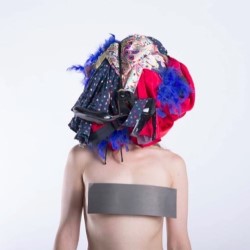
Julia Croft’s ‘performance collage’ is an unconventional piece of theatre, laying bare  -quite literally – the representation of women’s bodies in contemporary popular (western) culture. Swathed in an extraordinary number of layers, Croft’s exploration evokes the shedding of skins, as she sloughs off costume after costume to reveal yet another unpalatable image of womanhood. Finally, she stands before us, naked and silent. The preposterous outfits are now heaped on her head, disguising her face, but exposing the truth: this is a female body.

It’s a serious, disturbing and thought-provoking production, but there is laughter here too: Croft is an engaging performer, interacting with the audience, prolonging eye contact and forcing us from our comfort zones. But the apparent simplicity is deceptive; our expectations are subverted here. The familiar is exposed as absurd; what we have come to accept is clearly unacceptable. The juxtaposition of The Ying Yang Twins’ The Whisper Song with Taylor Swift’s Love Story makes for a particularly discomfiting vignette, as does a mirroring of a scene from horror movie House of Wax: while Paris Hilton, clad improbably in underwear, flees a serial killer on screen, Croft, similarly dressed, crawls around the small performance space, climbing over and under the audience, bringing the horror far too close for comfort, showing how brutal the scene really is.

This is an important piece, I think, that a lot of people should see. Be one of them. You won’t regret it.

4.2 stars

Susan Singfield

Thread

e9d4c784-60d4-43dd-b870-3edacb8e5504-300x300

16/08/2015

Demonstration Room, Summerhall, Edinburgh

So, we’re in the Demonstration Room at Summerhall, waiting for the show to begin and I can’t help but notice that four young women in the audience are staring intently at their Macbooks. And I’m just thinking that this is a bit rude, when ambient music starts up and the women begin to clamber across the benches and descend to the performance space, where three of them start to leap and whirl, while the fourth inscribes the words ‘blind trap’ on the floor in chalk.

OK, an interesting start but, for our money, at least, this is about as interesting as Thread gets. As the women interact with each other, we remind ourselves that this piece is about the myth of Ariadne and the blurred lines between reality and fantasy. To us it just looks like four young women bullying each other.

There are some nice moments; we like the conceit of the dancer being confined by the chalk circles being drawn around her feet, nimbly side-stepping them, but ultimately being ensnared.

And there’s some tantalising projection, which works best when illuminating the dancers’ bodies, incorporating them with their set. But somehow it’s a bit restrained; to be fully effective it needs to be more spectacular.

In all honesty, this feels just a bit… teenage. Which would be all well and good if this were a school production (and if it didn’t cost £10 a ticket), but it isn’t (and it does), so it’s, well, not quite good enough.

2 stars

Philip Caveney and Susan Singfield