
Becky Hope-Palmer

Gush

23/04/26

Traverse Theatre, Edinburgh

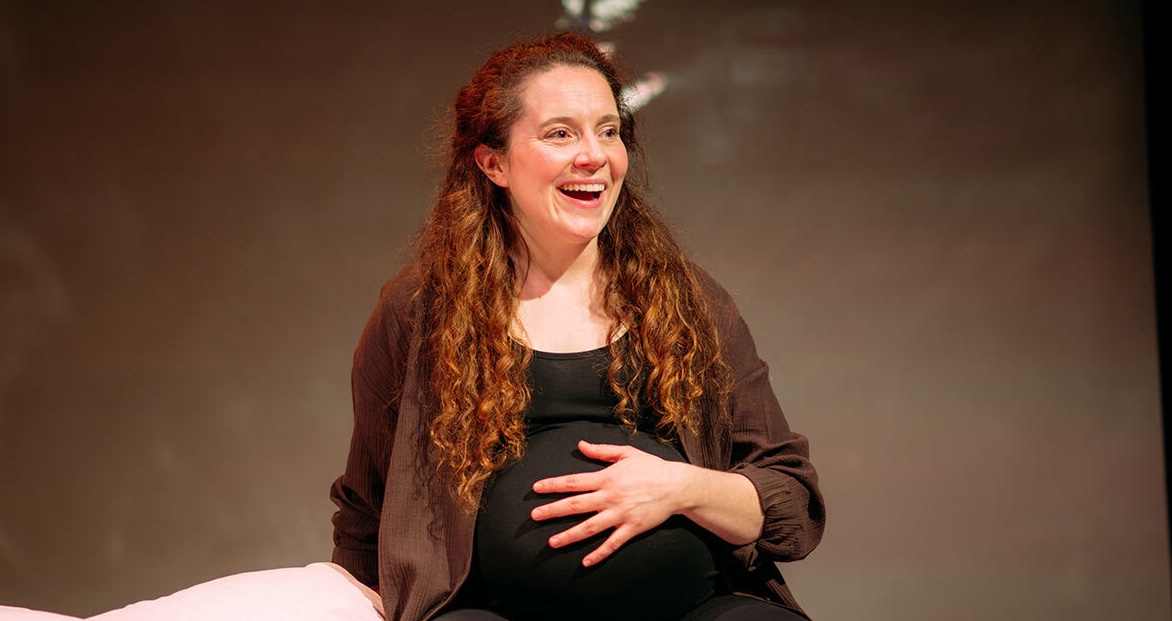
Ally (Jessica Hardwick) is expecting her first baby. She’s looking forward to becoming a mum, but she’s also scared of losing her own identity. Already, before ‘Bug’ has put in an appearance, she’s ceded some of her autonomy to Kevin, her loving but anxious husband, who asks her to drink rooibos tea instead of her preferred English Breakfast, and keeps imploring her to ‘relax.’ Her world seems to be shrinking and she’s desperate to claw back her sense of self…

Especially that one particular aspect of herself she’s never had the courage to explore.

In a few short weeks she’ll be too busy, too tired, too focused on looking after her child, so it’s now or never, she reasons. And never isn’t an option. Ally’s always known she’s bisexual but she’s only ever been with men. She needs to try sex with a woman, just once, before she settles down for good. She deserves this last hurrah, doesn’t she?

Hardwick’s ebullient performance anchors the monologue effectively: she’s funny and appealing, so that we want her to find fulfilment, despite the moral ambiguity of her plan (namely, cheating on her husband with a sex worker). Jess Brodie’s script is witty and well-paced, the cringe-comedy elements perfectly judged, so that I often find myself laughing from behind my hands, my toes literally curled, as Ally’s quest leads her from one awkward moment to the next.

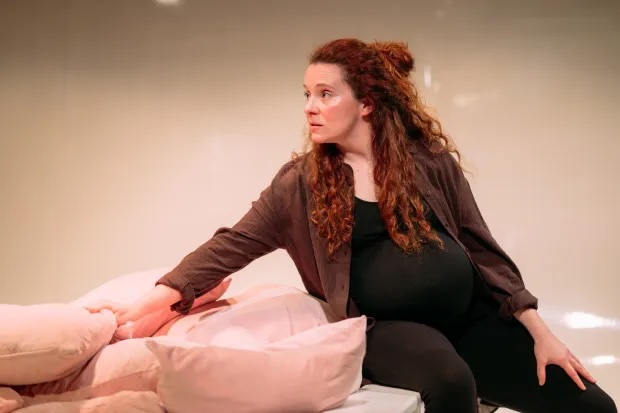
Becky Minto’s design is deceptive. At first, the set appears to be all clinical white surfaces, a perspex-coated cyclorama morphing into a hard-edged bed, softened only by a few cushions. But as the play develops and the lighting (courtesy of Renny Robertson) becomes more subdued, we notice that the bed’s walls are clad in intricately knitted wool, reminiscent of a baby’s blanket, and there’s a pleated cotton valance around the raised platform.

Under Becky Hope-Palmer’s direction, this is a lively, kinetic piece of drama, and there are some lovely creative touches. I like the way the audience is manipulated into vicarious embarrassment and, more specifically, the simplicity of Ally’s bump becoming her baby.

If you’re in the mood for a highly-original take on impending parenthood, Gush might just be the play for you. There are only two nights left to see it in Edinburgh though, so you’ll need to get your skates on.

4 stars

Susan Singfield

He Who Opens the Door

04/10/22

Traverse Theatre, Edinburgh

The ‘Play Pie Pint’ season continues, and this week’s offering is a dark comedy by Ukrainian playwright, Neda Nezhdana. The morgue where Vera (Louise Stewart) works is situated in an underground bunker, originally built as a bomb shelter. For Vera, this is just a normal, boring nightshift, babysitting the dead: filling out paperwork, flicking through a magazine and half-heartedly exercising – anything to pass the time. But then Vika (Yolanda Mitchell) stumbles from the freezer into the office, still drunk from the night before. She doesn’t know where she is, or why there’s a tag on her foot. Vera faints at the sight of a walking corpse and, when she comes round, she’s confused. Is Vika alive, or is Vera dead? Suddenly, shockingly, the two women realise the doors are locked and Vera’s phone has no signal. And then the landline rings…

He Who Opens the Door has been adapted by John Faradon, and – although the setting is still Ukraine – there’s a distinctly Scottish flavour to this production. I can see what director Becky Hope-Palmer is aiming for but, for me, this muddies things somewhat. It’s a metaphorical play, “reflecting the limbo for some people in eastern Ukraine, caught between opposing forces”, but I’m not immediately aware of where I am supposed to be: the signs, flags and magazine title tell me one thing, while the tone tells me another. Likewise, the programme says ‘present day’ but that’s not quite true: the script pre-dates the Russian invasion. This adds to my confusion, as I try to piece together what it all means. Not all of the jokes land, either, although the more serious points are eloquently made. I have to confess I’m a bit uncomfortable with Vera’s anti-abortion rhetoric (in particular, the assertion that women are always damaged by the process), and I’m not sure how this particular revelation contributes to the discourse. Still, this is only one idea amid a kaleidoscope of other, more enticing hypotheses about autonomy and independence.

In truth, there’s a lot of good stuff here. Both Stewart and Mitchell deliver strong, compelling performances, and it’s a lively, engaging piece. There are echos of Beckett in the waiting and uncertainty, and of Pinter too: those enigmatic phone calls reminiscent of the notes the dumb waiter delivers to hitmen Ben and Gus. Impressively, Hope-Palmer manages to convey a sense of time passing inexorably, as the women await their fates, while simultaneously offering us a play that gallops along at pace. Amidst the existential dread, there is dancing and singing; in the darkness, there is light.

He Who Opens the Door is not an easy play, but it is a fascinating one, and I can’t think of a more fruitful way to spend a lunchtime.

3 stars

Susan Singfield