Brian Ferguson

The Prime of Miss Jean Brodie

09/10/26

The Royal Lyceum Theatre, Edinburgh

The titular educator is an Edinburgh icon, her legacy woven into the fabric of the city, from the Vennel’s Miss Jean Brodie Steps to Bruntsfield’s Muriel Spark Walk. Her very name references Deacon Brodie, one of the city’s most infamous 18th century luminaries, a thief and philanderer she proudly claims as her ancestor. Perhaps her duplicitous nature is part of her DNA.

This vibrant production (from the National Theatre of Scotland, The Royal Lyceum and Pitlochry Festival Theatre) breathes new life into the old favourite, amplifying the teacher’s allure as well as her failings.

It’s 1935. In Europe, Adolf Hitler is a rising threat but Benito Mussolini, although polarising, is admired by many for his bold authoritarianism. Primary school teacher Miss Jean Brodie (Gayle Rankin) is certainly a fan: she shares his aesthetic obsession with order and control. Like the Italian fascist, she is a charismatic leader – and her classroom is her country.

Miss Brodie’s eleven-year-old pupils are in their final year of Juniors and she’s supposed to be preparing them for their Senior school entrance exam. Instead, as soon as her classroom door is closed, she kicks off her shoes and denounces the system. She lambasts the conservative Miss Mackay (Maureen Beattie), encouraging the girls to mock their headmistress. In lieu of maths, she shares bon mots; rather than history, she tells tales of her holidays. In short, Miss Brodie casts a spell over her students, inspiring a cult-like devotion that feeds her monstrous ego.

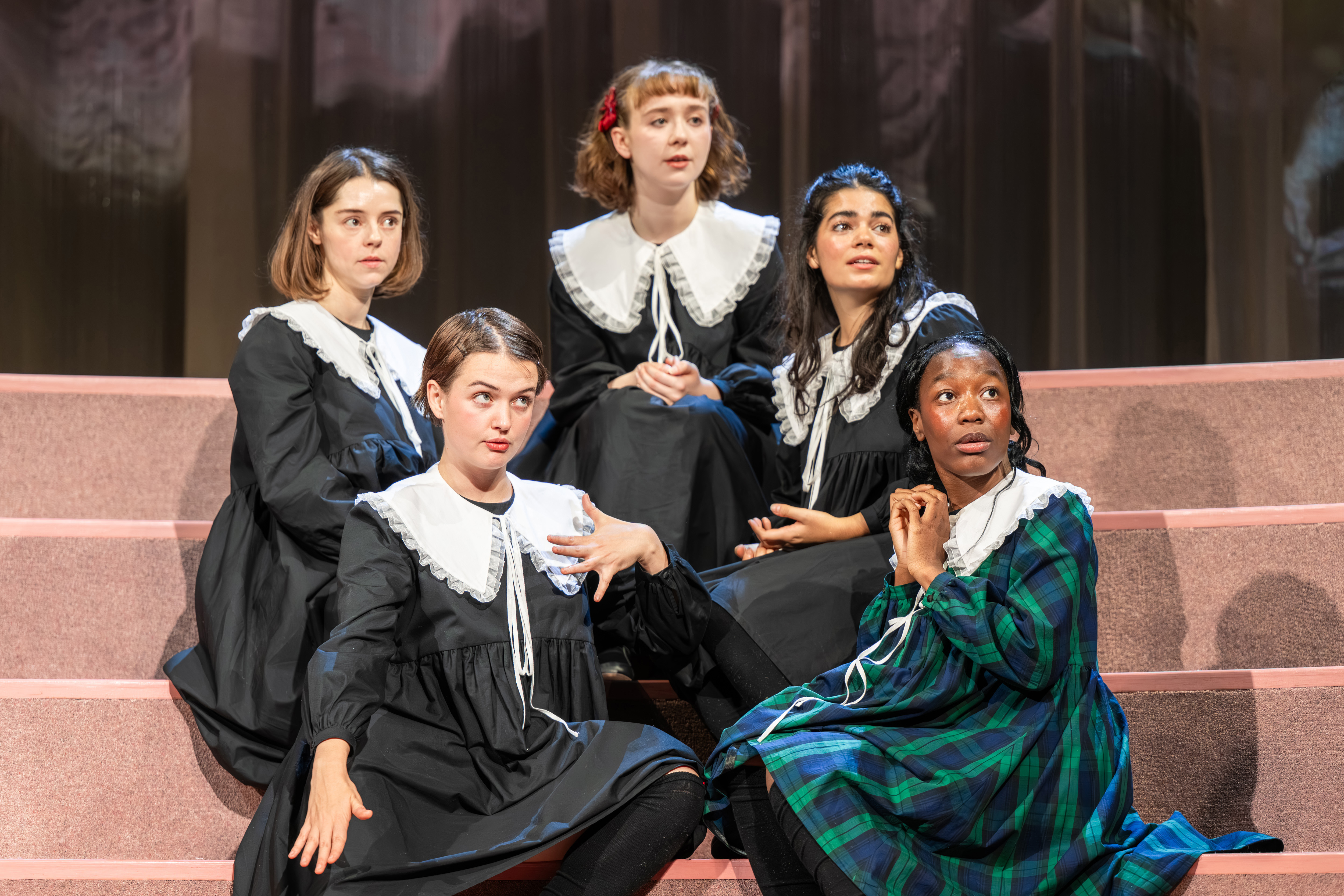
Of course, we’d call it grooming nowadays. Miss Brodie’s ‘set’ are carefully selected for their pliability and romanticism, wooed with flattery, sex-talk, secrets and booze. For preteens Sandy (Bobby Rainsbury), Jenny (Shreya Khaund Marshall), Monica (Tallulah Greive), Mary (Liberty Black) and Joyce Emily (Sophie Fortune), it’s a heady, irresistible mix, in stark contrast to Miss Mackay’s moribund regime. But children have a habit of growing up and noticing their heroines’ feet of clay. And who is Miss Brodie without her posse of adoring fans?

Written by David Harrower and directed by Vicky Featherstone, this adaptation of Sparks’ best-known novel is a triumph, with a clarity of vision that renders the play every bit as engaging as its protagonist. The three-hour running time flies by. Rankin is mesmerising as the charismatic lead; it’s easy to understand why the girls are so in thrall to her, not to mention her two suitors, drippy, devoted Mr Lowther (Brian Ferguson) and brooding badass Mr Lloyd (Dyfan Dwyfor).

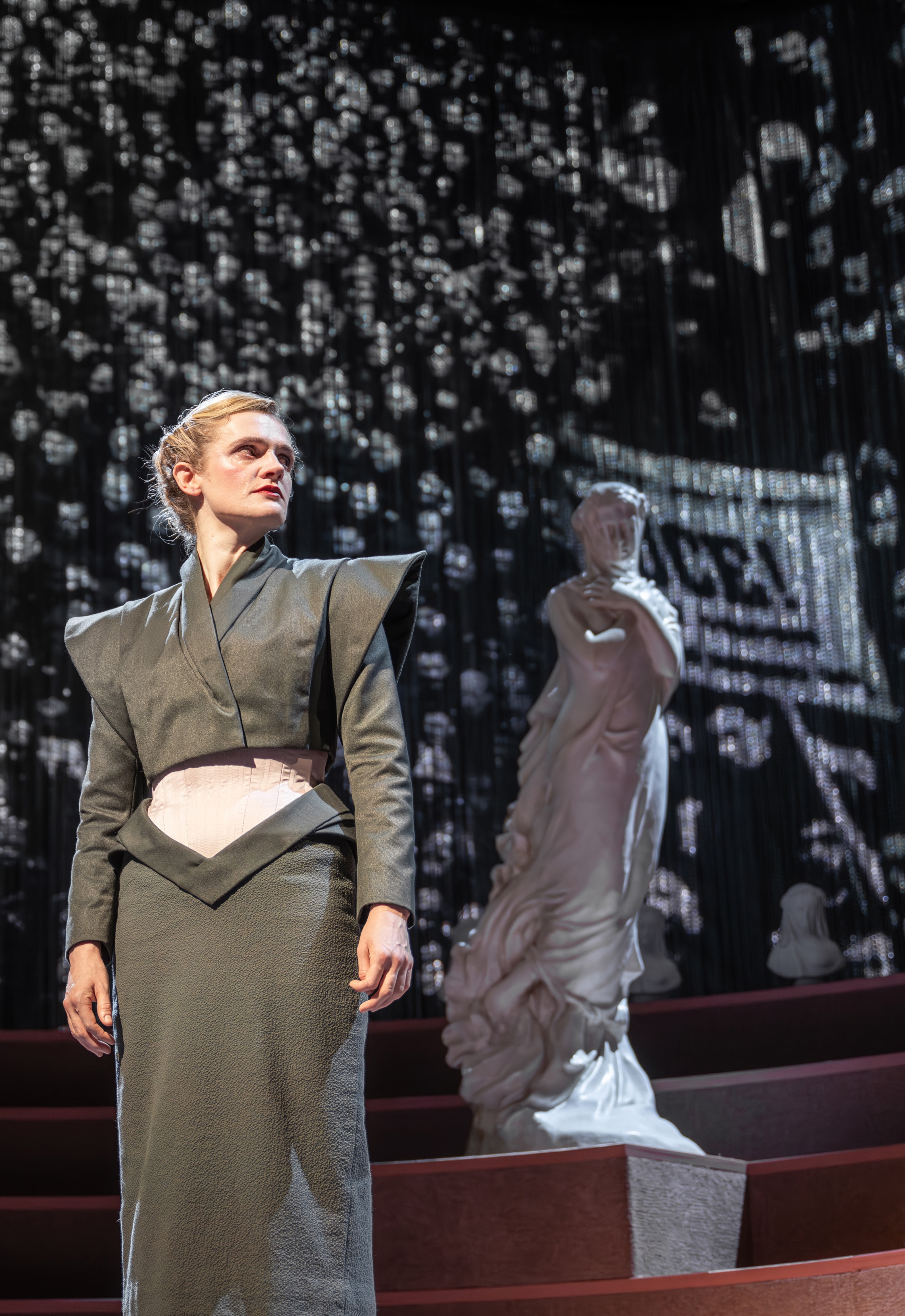
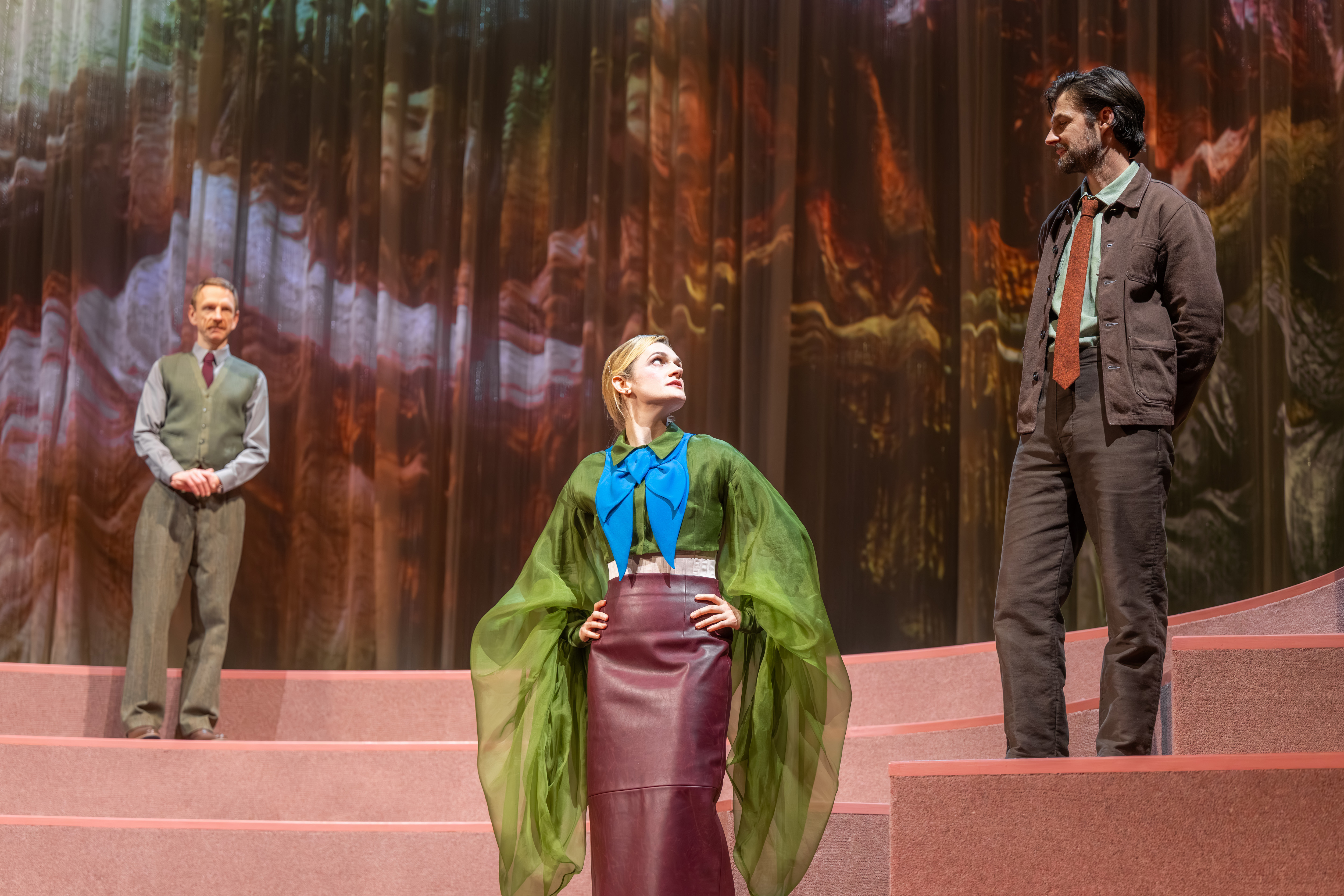
Chloe Lamford’s spectacular set design – a giant semi-circle of tiered steps – resembles nothing so much as a Roman amphitheatre (with the auditorium completing the circle), the perfect venue for the gladiatorial-style battle Miss Brodie believes she is engaged in, determined as she is to promote individualism and free the girls from the tyranny of ‘team spirit’. Behind the steps, Lewis den Hertog’s enormous video projections throw up ever-changing images, from Proto-Renaissance art to fascist marches, Miss Brodie’s adult worldliness dwarfing her young acolytes’ limited experience. No wonder she clings to her job so passionately; in this arena, she appears all-knowing.

I love Anna Orton’s costume design, Miss Brodie’s outfits reflecting the different stages of the girls’ relationship with her. When Rankin first enters, striking a powerful pose centre stage, she’s dressed flamboyantly in a fitted pink leather skirt and a green shirt with oversized, wing-like sleeves. We see her through her pupils’ eyes as she morphs from exotic and exciting to strong and commanding, changing into a structured suit with sharp lines and pagoda shoulders. As the girls grow older and she confides in them about her love-life, she begins to dress in a more overtly sexy way (cue tight-fitting zebra print) before finally being cut down to size, literally undressed and relegated to a nursing home and a dull dressing gown.

The girls’ costumes are interesting too. In the first act, they wear simple black smocks, complete with white collars and black knee socks. After the interval, it takes me a few minutes to notice a subtle difference: the dresses are now sheer, the girls’ sensible underwear clearly visible beneath. The imagery is clever in its simplicity, showing how the girls are becoming young women, their sexuality burgeoning despite the school’s strictures.

It’s also a sign that Miss Brodie’s reign is coming to an end.

To be honest, when I re-read The Prime of Miss Jean Brodie a few years ago, I didn’t enjoy it, and I wondered if the story had lost its potency. Thanks to this magnificent production, I now know that it has not.

5 stars

Susan Singfield

Beats

08/05/19

It’s cold and it’s raining and we’re in two minds about going out tonight. We’re booked in for an Unlimited screening of a film we know nothing about and it is really miserable out there. On the other hand, we reason, what if the film turns out to be great? We’ll be mad we missed it, won’t we? So, after some deliberation, out into the raging elements we go and boy, are we glad we do!

Beats is set in 1994. The TV screens are awash with images of Tony Blair and scenes of violent civil unrest. Johnno (Cristian Ortega) lives with his mum, Alison (Laura Fraser), and his would-be stepdad, Robert (Brian Ferguson), a straight-laced police officer. Alison and Robert dream of moving away from the depressing estate in which they live to a starter home in a nicer neighbourhood. In the meantime, schoolboy Johnno has a thankless part-time job stacking shelves at the local supermarket, and spends his downtime hanging out with his best pal, Spanner (Lorn MacDonald). This does not sit well with Alison and Robert, who openly refer to Spanner as ‘scum.’ Spanner’s older brother, Fido (Neil Leiper), is a notorious drug dealer, and seems to get a kick out of bullying his younger sibling at every opportunity.

On a local radio station, D-Man (Ross Mann) keeps trumpeting an upcoming illegal rave (details to follow) and Spanner tries to persuade his friend to go along to it with him, so they can have one last fling together before Johnno heads off to his new home in the suburbs. But nicking a stash of money from Fido to enable them to finance the trip might not be their wisest move…

Beats manages to do the impossible, making me nostalgic for a music scene I have no personal experience of. Ortega and MacDonald enact a brilliant odd-couple partnership – the former all glum-faced desperation, the latter a grinning, gurning powerhouse. (We last saw MacDonald in the terrific Mouthpiece by Kieran Hurley, who also wrote this screenplay.) Brian Welsh directs with aplomb, and the stark black and white cinematography of Benjamin Kracun is an absolute joy to behold, building as it does to an extended rave sequence, where the loved-up, E-fuelled revellers dance wildly and the screen suddenly explodes into full colour. The effect is, quite simply, mesmerising.

If I have a minor niggle it’s simply that the sound levels of that pulsing, throbbing soundtrack are kept a little too polite. I keep anticipating a sudden push into full volume that never comes – but, well, I guess you can’t have everything.

Beats is a film about escape. All the characters, for their own particular reasons, are trying to outrun something that brings them down – poverty, violence, bullying, boredom… you name it. For one night, in a deserted warehouse off the M8, it can all be put aside and forgotten in a blaze of lights and music.

On our way home it’s still raining, but somehow we barely even notice it.

4.8 stars

Philip Caveney


Cyrano de Bergerac

13/10/18

Lyceum Theatre, Edinburgh

Since its debut in 1897, Edmond Rostand’s most celebrated play has seen many reboots, reimaginings and reinterpretations – perhaps most unusually in Steve Martin’s 1980s movie, Roxanne, which pitched the American comedian as the head of a fire station, opposite cinematic newcomer Darryl Hannah – and of course, many will remember a more traditional movie version of the tale starring a never-better Gerard Depardieu.

This co-production with The National Theatre of Scotland and Glasgow’s Citizens Theatre, directed by Dominic Hill, is a revival of Edwin Morgan’s 1992 translation, which envisions Rostand’s celebrated hero as a Glaswegian, complete with unflinchingly authentic dialect. Why? Well, Morgan felt the character of swashbuckling soldier-poet Cyrano was perfectly suited for such a transformation, and who am I to argue with him? Ihave to confess though, that it takes me a little while to adjust to this particular aspect. Despite living in Scotland for over two years, some of Brian Ferguson’s earlier utterances in the leading role are initially hard for me to decipher, something that isn’t helped by the huge false nose he’s obliged to wear. However, as I gradually adjust to that undiluted accent, so I begin to warm to the character and there’s no denying that Ferguson’s performance here is a veritable tour de force, as Cyrano jokes, swaggers and bellows his way through the proceedings, barely offstage for more than a few moments at a time. One can only wonder if his voice will hold up to such a battering.

Of course, the central premise of this story is one of unrequited love. Cyrano is madly in love with his cousin, Roxane (Jessica Hardwick), but she has eyes only for the handsome Christian (Scott Mackie), the new recruit to Cyrano’s regiment. She begs Cyrano to help her win the newcomer’s heart. So besotted is Cyrano that he is powerless to resist her entreaties and so pledges to do his level best to help her achieve her aims. Christian, of course, is a plain speaking sort of fellow, so Cyrano uses his poet’s intellect to open a series of heartfelt letters to Roxane, passing off his own devotion as Christian’s. The deceit works like a charm, but of course, tragedy is always waiting in the wings to throw a well-timed spanner into the works.

This rumbustious production has much to recommend it, not least the spectacular set designs of Tom Piper and Pam Hogg’s eye-catching costumes, which combine traditional elements with an irreverent dash of punk rock. There are live musicians onstage throughout the proceedings, that infamous ‘nose-insults’ routine is delivered into a microphone in standup style and there’s a beautifully executed sword fight to help to keep the action flowing.

But there’s no denying that this is a long play, a full three hours in the telling – and, with most of the most memorable scenes occurring in the first half, it feels as though a little judicious editing in the second would make this feel a wee bit more fleet-footed. See this for Ferguson’s barnstorming performance and for those audacious costume designs. And whatever you do, don’t mention the size of Cyrano’s nose. He’s touchy about that kind of thing.

3.8 stars

Philip Caveney