Edinburgh

Spring Awakening

12/03/25

Bedlam Theatre, Edinburgh

It’s mind-blowing to think that Frank Wedekind’s Frühlings Erwachen was written in 1890, when Kaiser Wilhelm II ruled the Deutsches Reich, Queen Victoria was on the British throne and Robert Gascoyne-Cecil (nope, me neither) was our PM. In a world where women weren’t even allowed to show their ankles, it’s not surprising that it was sixteen years before someone dared to stage this controversial exposé of the dangers of repression, with its bold depictions of teenage sexuality – not to mention rape, suicide and abuse.

Steven Sater and Duncan Sheik’s musical adaptation premiered on Broadway in 2006, exactly one hundred years after Wedekind’s play finally opened at Berlin’s Deutsches Theater, under the direction of Max Reinhardt. Despite the addition of some banging rock songs and more than a few profanities, this modern version actually pulls more punches than the original, most notably by omitting the rape and softening the ending. Nonetheless, it still has the capacity to shock, and to remind us that we make sex dangerous by hiding it, by making it taboo.

Set in 19th century Germany, this is a story about a group of young people coming of age under the stifling weight of moral expectations. Wendla (Hattie Sumners) asks how babies are made. Scandalised, her mother (Sophie Davis, who plays all the adult women) first shouts and then equivocates, condemning her daughter to an ignorance which will have severe consequences. Meanwhile, Moritz (Shaun Hamilton) is struggling to keep up with his schoolwork, and fear of failure takes him to a devastating place. Melchior (Daniel Fischer) seems stronger than the others: thanks to a combination of intelligence and a liberal mother, he’s more knowledgeable than his friends, and therefore better equipped to cope with life. Still, the authoritarian regimes of school and church soon drag him under too; no one is safe in this society.

Theatre Paradok’s production succeeds in conveying those most fundamental of teenage emotions: exuberance and despair (I’m guessing the student cast don’t have to dig that deeply to remember how raw and overwhelming those feelings can be). Sheik’s eclectic soundtrack is beautifully interpreted by musical directors Nonny Jones and Ruairidh Nicholson, the choral numbers being particularly impressive. The live band – hidden in the wings – are terrific, and plaintive solos by Sumners, Gemima Iseka-Bekano (Ilse) and Hamilton evoke some strong responses.

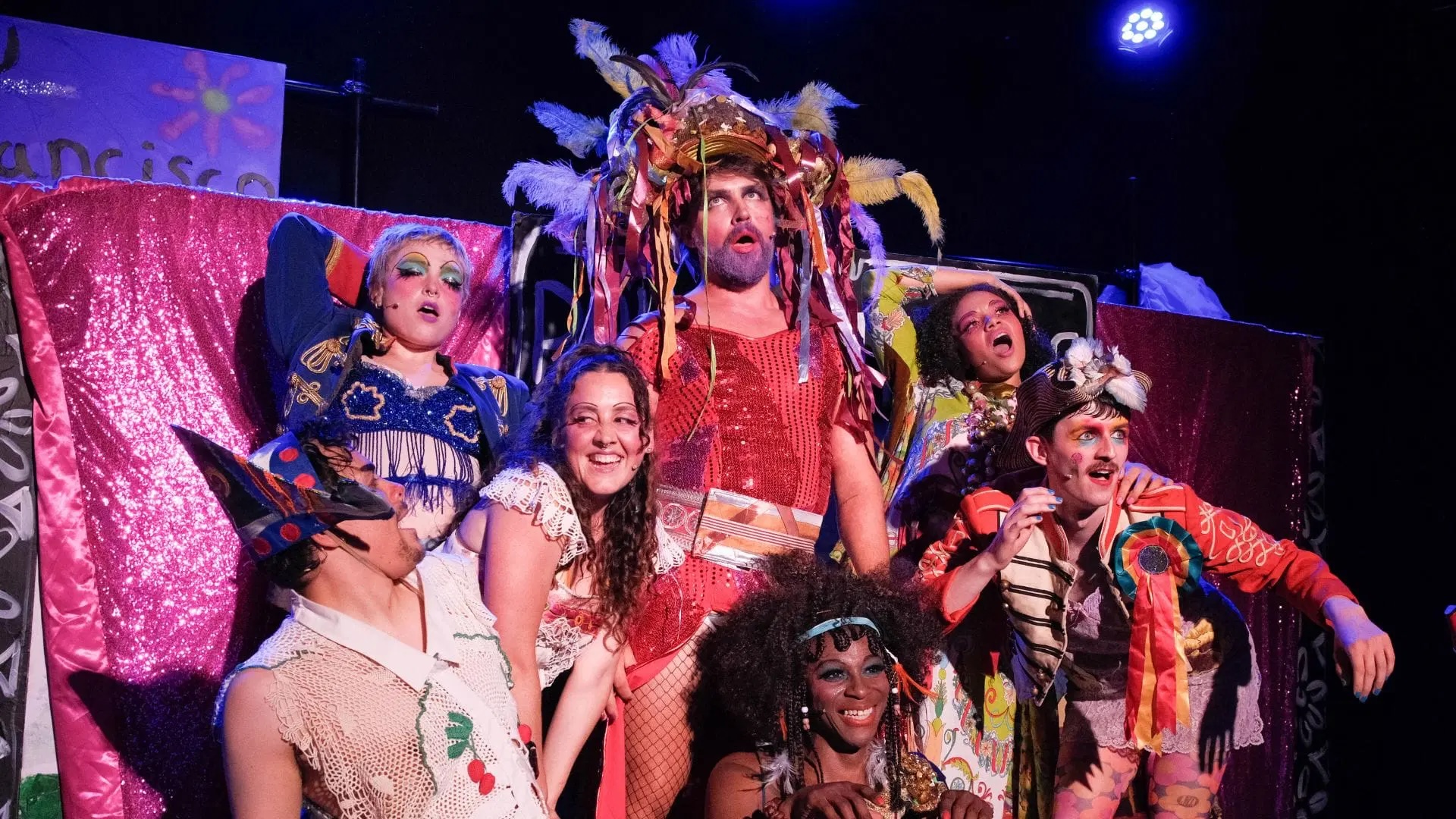
The show’s aesthetic is great. I love the androgyny of the costumes, with feminine dresses worn over masculine suits; the queer coding is fabulously done. The set is simple but very effective: items of underwear are stapled to a curtain framing a large gauze backdrop, onto which short animations and live videos are projected, creating an ethereal doubling effect and amplifying the characters’ emotions.

Directors Rue Richardson and Jane Morgan manage their large cast with aplomb. The play is dynamic and visually very appealing, from the arresting choreography (by Františka Vosátková, along with Richardson, Morgan and Andrea Adriana Prawono) to the boisterous shenanigans of the teenage boys. The gauze curtain makes metaphors literal: dead characters appear from ‘beyond the veil’, while ‘a veil is drawn’ over Wendla and Melchior’s lovemaking. However, Ernst (Michael Butler) and Hänschen (Max Middleton)’s homosexual relationship is placed boldly centre-stage – perhaps a subtle nod to the idea that some things shouldn’t be re-closeted.

I do have one criticism, and it’s the emergency exit door, stage left, which is open to the elements. Bedlam is a chilly venue at the best of times; tonight, with an outside temperature of 1°C, I could do without sitting in a freezing draught. And it’s not just the cold that’s a problem, there’s the noise of the city too: traffic and sirens and people passing by, all making a claim on my attention. I can see that the options are limited by the need to house the band, but – for the sake of one entrance and one exit – it’s surely not worth making the audience so uncomfortable.

Nevertheless, this production of Spring Awakening is a triumph: a lively, thought-provoking piece of theatre, as relevant now as it was more than a century ago.

4.2 stars

Susan Singfield


James Rowland: Piece of Work

08/03/25

Traverse Theatre, Edinburgh

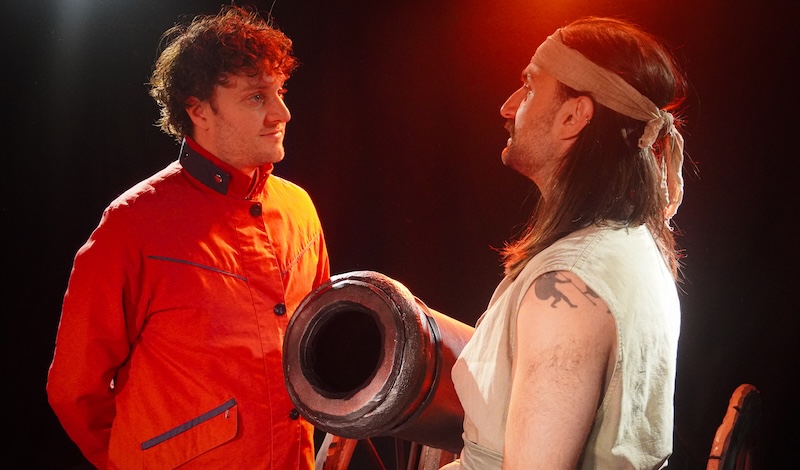
Piece of Work is the second in James Rowland’s Songs of the Heart trilogy. We saw the first, Learning to Fly, back in November 2023, and we’ve yet to catch the third, James Rowland Dies at the End of the Show. We’re here tonight with a friend and we’ve warned her about Rowland’s propensity for undressing, so none of us is particularly surprised when the show starts with him removing his T shirt and trackies and replacing them with plaid pyjamas. We’re just relieved he’s kept his undies on this time – and also a little confused by the costume choice. What do PJs have to do with anything? There’s nothing about him being in bed or even much about him being indoors…

Instead, this is a story about fathers and sons: about Rowland coming to terms with his old man’s death; about his ersatz brother, Chris, whose dad rejected him; and about The Prince of Denmark and Old Hamlet. The three narratives are interwoven, shining a (literal) light on the complexities of paternal relationships and their potentially devastating impact. Rowland, Chris, Hamlet – all abandoned, one way or another. All railing at their absent fathers for leaving them to deal with a scary, fucked-up world.

It’s also a story about suicide, and Hamlet’s ideation in the “to be or not to be” soliloquy is rendered very explicit here. It’s heavy stuff, but Rowland has a light touch, and knows just when to pull us back from the brink. His openness and affability make it easy to trust him with weighty topics without feeling overwhelmed.

It’s a great concept and Rowland has a charmingly vulnerable stage persona, but there are elements of the story that feel under-explored, especially the climactic confrontation between Chris and Dick, which feels almost thrown away. There’s surely more to explore in the tale of Rowland’s performance at the Royal College of Music too; for such a frank actor, it really seems like he’s holding back.

Nonetheless, I’m drawn into the story, and I find myself wanting to know where Rowland goes in the final part of this trilogy.

3.2 stars

Susan SIngfield

Driftwood

05/03/25

Traverse Theatre, Edinburgh

The opening moments of Driftwood are intense. To say this co-production by ThickSkin and Pentabus thrusts us straight into the action would be an understatement. One moment we’re in a brightly lit auditorium, muted chatter all around us, eyes drawn to the hypnotic rippling of the backdrop’s projected seascape. The next – without warning – there’s a blackout, paired with the thunderous roaring of crashing waves, and two boys, Mark and Tiny, in danger of drowning, are yelling each other’s names, desperately scrabbling to make it to shore.

That’s the past. And then, suddenly, we’re in the present. The boys are now men. Tiny (Jerome Yates) isn’t so tiny any more, and he hasn’t seen his older brother, Mark (James Westphal) in years. Not only is Tiny still in County Durham, he’s still in Seaton Carew, still living with their dad. He feels connected to the area – to its shoreline, its myths and to his family history. Anyway, he couldn’t leave if he wanted to. His dad needs a full-time carer and Tiny has filled that role for the past four years.

But now he finds himself on shifting sands. Dad is about to die. Mark – gay, estranged from his homophobic father – has come back from Manchester to say goodbye. The brothers love each other but they resent each other too. Tiny’s angry that he’s been left alone to cope, while Mark can’t quite forgive Tiny for sticking with the old man, nor for parroting his father’s homophobic slurs when he was young.

Tim Foley’s sprightly script keeps the story moving forward, even though most of the real drama happens offstage, the focus instead on the brothers’ relationship and their attempts to reconcile their differences. So we don’t get to meet Dad, nor to attend his funeral; we don’t see the arguments that led to Mark leaving; we’re told about but never shown the environmental protests dividing the town. It doesn’t matter. The piece feels very immersive nonetheless, thanks in no small part to Sarah Readman’s videos and Lee Affen’s rousing sound design. The ever-present image of the closed steelworks looming over the bay is affecting, reminding us throughout how bleak Tiny’s life is, his stubborn attachment to his home equal parts understandable and heartbreaking.

Yates and Westphal imbue both brothers with a likeable vulnerability: Mark’s obscured by a brittle carapace of self-protection; Tiny’s writ large in his wide-eyed naïvety. Co-directors Neil Bettles and Elle While strike an impressive balance between stillness and dynamism, Mark’s quiet rationalism contrasting effectively with Tiny’s chimerical obsessions. I especially like the funereal pace of the scene where the brothers dress for their father’s burial, the conceit conveying the emotions of the funeral without explicitly placing us there.

On tour until 31st March, Driftwood has – ahem – drifted on from Edinburgh now, but you can still catch it in Coventry, Ipswich, Leeds and Salford. It’s well worth an evening of your time.

4.2 stars

Susan Singfield

The Last Showgirl

02/03/25

Cineworld, Edinburgh

I haven’t seen any of Pamela Anderson’s previous work (Baywatch never appealed) so my knowledge of her is limited to three headline facts: red swimsuit, sex tapes and – recently – no make-up. I’m not surprised that this reductive list doesn’t do the woman justice, but I am impressed by her nuanced performance in Gia Coppola’s latest film.

Anderson is Shelly, the titular last showgirl, still strutting her stuff in a Vegas casino. The clock is ticking, both for Shelly and the show itself. They’re both past their sell-by dates, and they’re being pushed aside for newer, brighter, fresher fare. But the fifty-seven-year-old has devoted her whole life to Le Razzle Dazzle and she doesn’t know who she is without it. News of the show’s impending closure is utterly devastating.

The sacrifices Shelly has made are huge. For more than thirty years, she has placed this job before her marriage, her security, even before her daughter, Hannah (Billie Lourd). But it turns out her bosses owe her nothing in return: no pension, no severance pay, no training for a different job. And, this being the USA, she won’t even have any health insurance when the curtain falls for the final time. What has it all been for?

Kate Gersten’s screenplay is deceptively simple, a layering of vignettes that slowly build to something quite profound. We already know how vampiric the industry is, sucking the last drop of blood from its initially willing victims before callously discarding them and calling, “Next!” Here, we see what happens to the husks it leaves behind.

At its heart, The Last Showgirl is a film about delusion, about the myths we tell ourselves to justify our lives. Shelly clings to the idea that Le Razzle Dazzle is a cut above, a Parisian-style extravaganza of glamour and elegance. But when Hannah sees the show, she bursts her mom’s balloon. “I’d hoped it would be worth it,” she says, before eviscerating Shelly’s dream, denouncing it as tawdry and outmoded, a nude show like any other – nothing special at all.

And Shelly’s not the only one. Her old friend Annette (Jamie Lee Curtis) gave up dancing long ago, and claims to be happy working as a hostess on a casino floor. But she is sent home whenever the place is quiet, her boss favouring her younger colleagues. No wonder she drinks; no wonder she gambles. Jodie (Kiernan Shipka) is only nineteen, but she’s already starting to realise the costs of pursuing her art, as her family disown her. Meanwhile, Eddie (Dave Bautista) is immune to the devastation. He’s a nice guy, seemingly quiet and kind, but he’s not at the mercy of a sexist world. He’ll be kept on to do the lighting for the next batch of sexy young women who come to the venue to perform.

The Last Showgirl is – ironically – an unshowy film. The social commentary is sharp but it’s cleverly-cloaked; the characters bold but the performances restrained. There’s a lot going on beneath the rhinestones and feathers.

4 stars

Susan Singfield

The Importance of Being Earnest: NT Live

20/02/25

Dominion Cinema, Edinburgh

Despite having lived a mere thirty-minute walk from Morningside’s Dominion Cinema for the past decade, we’ve somehow failed to set foot inside – and we dare to call ourselves cinephiles! So tonight’s NT Live screening of The Importance of Being Earnest is extra exciting for us, as it’s also an opportunity to explore a new venue.

So let’s begin with that. The Dominion is undeniably boojie; indeed, it’s the fanciest cinema either of us has ever graced. The design is art deco (think flocked wallpaper, geometric shapes and a colour palette of gold, red and black); our seat is a super-comfy reclining sofa, with privacy screens and side tables. We pour our drinks (sparkling water and alcohol-free lager, since you ask) and sit back, feet up, more than ready to enjoy ourselves in these opulent surroundings.

I’ve seen, read and taught this play so many times that I know it almost by heart, but that’s not to its detriment. After all, the script is so packed with recognisable aphorisms that few in the audience are likely to be surprised by what is said; with Earnest, it’s all in the delivery.

And what delivery it is! Directed by Max Webster, this is an overt celebration of queerness, Wilde’s subtext amplified to the nth degree. From the opening number, where Algernon (Ncuti Gatwa) shimmers in pink-sequinned drag, to the exuberant Mardi Gras-style finale, the closet door is flung wide open, making for a fabulously unsubtle show. To quote the wild wit himself, “moderation is a fatal thing; nothing succeeds like excess.” Webster has certainly taken this to heart.

The plot – for those who need a reminder – is at once frivolous and deadly serious. On the surface, it’s a frothy farce, all mistaken identity and foolish foppery. Underneath, it’s about repression – about the lengths people are forced to go to when their very natures are outlawed. Unbeknownst to each other, both Algernon and his best friend, Jack (Hugh Skinner), have found inventive ways to circumvent society’s disapproval of their predilections. Algernon has a pretend-friend, Bunbury, whose ill health Algy uses to excuse himself from dreary social events, while Jack has an alter-ego – an imaginary older brother called Ernest – who gets into mischief whenever he visits the city.

But things become complicated when Jack falls in love with Algy’s cousin, Gwendolen (Ronke Adekoluejo), whose mother, Lady Bracknell (Sharon D Clark), is far from pleased about the match. In desperation, Jack confesses his lies to Algy – who, true to form, responds by assuming Ernest’s identity for himself, and heading off to Jack’s country house to woo his pretty young ward, Cecily (Eliza Scanlen). Throw in a conflicted clergyman (Richard Cant), a dithering governess (Amanda Lawrence) and a couple of manservants (both played by Julian Bleach), and the scene is set for some merry mayhem.

The multi-racial casting within a period drama (courtesy of Alastair Coomer and Chloe Blake) gives the piece a contemporary edge, as do the occasional strains of recent-ish pop music and a cheeky allusion to one of London’s gay hotspots. Gatwa’s newfound fame as Dr Who also helps this production to appeal to a hip young audience, as does the sexual fluidity of the characters.

Clark’s depiction of Lady Bracknell is inspired: she brings a whole new dimension to the part, dispelling all my preconceptions of the character. Here, those oh-so-familiar lines are imbued with a haughty charm to create a formidable British-Jamaican matriarch without so much of a hint of Dench. Adekoluejo’s Gwendolen is a chip off the old block, saved from monstrousness by her cleverness and humour. In contrast, Scanlen’s Cecily is deliciously weird, a mix of doe-eyed intensity, sweetness and steel. But there are no weak links here: even Bleach, in the minor roles of Lane and Merriman, makes his mark, creating two distinct but equally absurd personae, evoking laughter with the simplest of smirks or stumbles.

More than anything, though, this is Skinner and Gatwa’s show, the focus firmly on the men’s friendship and their journey towards coming out. Their performances are jubilant and euphoric, and yet deceptively weighty, carrying with them real emotional heft. I can’t help thinking about Wilde, condemned to hard labour for his homosexuality, and wondering what he’d make of this? Surely, it would gladden his heart to see his characters finally set free.

5 stars

Susan Singfield

Much Ado About Nothing

06/02/25

Pleasance Theatre, Edinburgh

Let’s face it, judged by plot alone, Much Ado About Nothing is a bit, well… silly. Like most of Shakespeare’s comedies, the humour relies on disguise, misunderstandings and a fickle approach to romance. As an audience, we really have to suspend our disbelief. Would sworn enemies such as Benedick and Beatrice (Benedict Harrison and Verity Mann) really have an immediate change of heart thanks to some very unsubtly orchestrated eavesdropping? Both of them? It seems unlikely. Would a respected celebrant (Dylan Kaeuper) really suggest that a jilted bride should fake her death, or her father embrace the idea – agreeing that “death is the fairest cover for her shame”? Hmm. And would the groom – a mere twenty-four hours later – agree to marry his dead fiancé’s looky-likey cousin without ever setting eyes on her? I mean, that’s a no, right? Meanwhile, we’re also supposed to accept that no one in Leonato (Faolán Ingram)’s household suspects the decidedly dodgy – almost moustache-twirling – Don John (Cameron Broadly) of being a villain, despite the many outward clues. But still. It is what it is, and there’s a lot of fun to be had along the way.

EUSC’s production of this sprawling play is sprightly and engaging. The directors (Madeleine Brown, Marina Funcasta and Anna Simurda) have chosen to emphasise the humour, eliciting larger-than-life performances from their actors rather than aiming for anything subtle – and I think this is a wise move. The action has been moved from Italy to California, from the 16th century to the 1970s but, while the period is clearly-evoked, I’m less certain about the place. There’s certainly a laid-back Summer of Love vibe, but most of the music is British (Bowie, Bolan, The Sweet, The Police) and the majority of characters speak with English accents, so it all feels a bit more Camden Town than Haight-Ashbury.

Leonato’s estate is Party Central as he and his wife, Antonia (Maria Wollgast), play host to the local socialites. What better way to make a match for their beloved daughter, Hero (Francesca Carter)? The dope is plentiful, the drinks are flowing – and love is in the air. Claudio (Rider Hartley) fancies his chances with Hero, and she’s rather keen on him as well. But “the course of true love never did run smooth” (yes, I know – wrong play), and what could go wrong with Don Pedro (Eric Parker)’s complicated plan to woo the girl on his friend’s behalf? Throw in some meddling servants, a fabulously drunken henchman (Fraser Murray), a local constable (Robbie Morris) and a veritable army of liggers – and the scene is set for some merry mayhem.

It’s a great idea to have a live band on stage, although I can’t help feeling they’re under-utilised. Still, the young cast are clearly having a ball, dressed up to the nines in flares and sequins (floppy hats off to costume designers Paloma Leigh-Stevenson, Alex Dunlop and Bea Fitz), their delivery as bold and brash as the script demands. Not everyone has a lot to do, but they all make the most of what there is, and there are some lovely moments of background detail, such as Margaret (Mia Dé)’s horrified realisation that her tryst with Borachio is being used to frame Hero. Harrison (Benedick) and Carter (Hero) are the standouts for me, but all of the actors and musicians perform with gusto, and I am thoroughly entertained.

There are just two more chances to catch this groovy rendition of Much Ado, so why not head on down to the Pleasance and hang loose with the hippies? Be sure to wear some flowers in your hair…

3.4 stars

Susan Singfield

Moments

30/01/25

The Studio at Festival Theatre, Edinburgh

One of the UK’s leading visual theatre companies, Theatre Re focus on making “deeply moving non-verbal productions about universal human challenges and the fragility of life”. Their latest piece, Moments, lays bare the creative process, taking the audience on a journey from nothing to something, from the flicker of an idea to a compelling dramatic sequence.

The metatheatrical concept is made clear from the outset, as four performers – dressed in rehearsal blacks – stand in a line and introduce themselves. They are: Guillaume Pigé – conceiver, director, actor and mime; Dr Katherine Graham – lighting designer; Alex Judd – composer; and Anna Kitson – BSL interpreter. From the sound desk behind us comes the disembodied voice of Benjamin Adams. They describe their roles and what they each bring to a show.

And then they begin. A chair, at first simply functional, changes before our eyes, becoming a child and then a father. The mood switches, initially light and amusing, then emotionally charged. The intensity swells with the music; the lighting focuses our attention one way and another. There is dialogue but it’s in French, so – for me, at least, with my school level knowledge of the language – it’s more about tone and tenor than it is about the words.

There’s no denying how skilful these theatre-makers are: the performances are incredibly precise and absorbing, and it’s fascinating to see what they can do with a bare stage, no costumes and one prop. However, it feels more like a demonstration than a play; it’s an exemplar of how to develop a piece of drama but the final scene – the culmination of the process – is too brief to be satisfying.

Moments would work well as an introduction to a drama workshop for A level, Higher or Uni students. It’s a dynamic and engaging piece of work that would surely appeal to anyone interested in learning about the process of making theatre.

3 stars

Susan Singfield

Singin’ in the Rain

23/01/25

Pleasance Theatre, Edinburgh

In Edinburgh, a storm’s a-comin’ in… but before it hits, there’s the chance to catch EUSOG’s delightful adaptation of this classic 1952 Hollywood Musical. Back in 2022, we saw the touring production at the Festival Theatre, which boasted a massive budget and gallons of real water bucketing down from the heavens. A high bar indeed. But we’ve seen enough EUSOG shows to know that these talented students will deliver something special – and we’re not disappointed.

The year is 1927 and Dan Lockwood (Ewan Robertson) and Lina Lamont (Amelia Brenan) are the golden couple of silent cinema. Movie fans believe them to be an item and, for the sake of their own popularity, they allow this belief to flourish. Dan has steadily worked his way up the slippery pole of fame alongside his childhood friend, Cosmo Brown (Dan J Bryant), a wisecracking song-and-dance man. But of course a new film release – Al Jolson’s The Jazz Singer – is about to change the face of cinema forever. Lockwood and Lamont realise that they need to make a talking picture. But there’s a problem: Lina has a screeching voice with all the appeal of fingernails being dragged down a clapperboard.

And then Dan meets Kathy Seldon (Hannah Shaw), a theatre performer, who claims to never go to the cinema, and who plans to head off to New York to pursue a career on the stage – you know, real acting. She also has a lovely singing voice. And Dan is irrevocably smitten…

There are many good reasons why the original film still features in most critics’ lists of the greatest musicals of all time. It boasts a sparkling screenplay by Betty Camden and Adolph Green and a whole clutch of memorable songs by Nacio Herb Brown and Arthur Freed. What this production might lack in special effects is more than made up for by the dazzling and exuberant performances of its young cast, who take on the most demanding of roles with aplomb.

Robertson is the powerful anchor at the heart of the piece, singing up a storm, while Shaw is a delight in the ingenue role. Brenan is having the best time as Lamont, gleefully mangling her lines and performing What’s Wrong With Me? in tones that could shatter plate glass. And, as is the case in the film, it’s Cosmo who steals so many of the scenes: Bryant clowns with considerable skill and his performance of Make ’em Laugh even manages to rival Donald O’Connor’s most celebrated routine.

As ever with these productions, there is a large chorus and every performer gives it one hundred percent. Director Freya White and choreographer Rosalyn Harper have their huge cast moving effortlessly through a series of pratfalls and complex dance routines – and let’s not forget the input of musical directors Evie Alberti and Sebastian Schneeburger, who guide a seventeen-piece orchestra through that unforgettable score. The standing ovation from tonight’s packed crowd is genuine and well-earned.

Sadly, Storm Éowyn has already put paid to Friday night’s performance and fingers are currently crossed for the Saturday. If it does go ahead, then please take the opportunity to catch this captivating show, which to my mind personifies the very essence of pure entertainment. I’m willing to bet you’ll come out smiling and singing the title song, no matter what the weather’s doing.

4.8 stars

Philip Caveney
The Merchant of Venice

22/01/25

The Royal Lyceum, Edinburgh

New York’s Theatre for a New Audience brings The Merchant of Venice to Edinburgh’s Royal Lyceum as part of a reciprocal exchange programme. Starring John Douglas Thompson as Shylock, this is a bold and provocative production, drawing explicit links between 16th century Venice and an all-too-believable near-future USA.

Director Arin Arbus says she wants “to discover what this play means to us in the here and now” – and she certainly does that, using Merchant to hold up a mirror to a divided society where people’s views are polarised and entrenched. In Shylock’s Venice, Jews have few rights. They are forced to live in ghettos, prohibited from owning property, limited in the kind of work they are allowed to do. The prejudice runs deep: even Antonio (Alfredo Narciso), widely reputed to be one of the good guys – “a kinder gentleman treads not the earth” – deems it appropriate to spit at Shylock and call him a dog, all while asking him for money. In the modern American dystopia where this production is set, Thompson’s Black Shylock suffers comparable – and recognisable – iniquities.

It feels like a timely reminder of what we need to avoid, of where discrimination and inequality inevitably lead. Who can blame Shylock’s daughter, Jessica (Danaya Esperanza), for wanting to escape the ghetto, for hooking up with Lorenzo (David Lee Huynh) and converting to Christianity? Why shouldn’t she seek a better life? But it’s her desertion that pushes Shylock, already at breaking point, over the edge, fuelling his thirst for vengeance. What has he left to lose? Just as the Christian Venetians treat the Jews as a homogenous group to be despised, so Shylock views them all as one enemy. No wonder he is furious; no wonder he shows Antonio no mercy.

But the odds are stacked against him. The legal system isn’t fair or balanced: the laws are written by the powerful. Plus ça change, plus c’est la même chose. Power corrupts. Even Portia (Isabel Arraiza), who seems a pretty decent sort at first, isn’t immune. She changes when she assumes the mantle of supremacy, swaggering into the court in her borrowed clothes and treating Shylock with cruel contempt. Arbus’s direction highlights this theme; indeed, this version of the courtroom scene is the most intensely horrifying I have ever seen. The auditorium is eerily silent, as if we’re all holding our collective breath, appalled by Portia’s gloating as she humiliates Shylock.

I’m watching this just three days after Donald Trump has issued an executive order dismantling federal diversity, equity and inclusion programmes, which lends this consciously diverse production even more weight and urgency. Shakespeare’s message transcends the centuries; we have to heed its warning.

4.6 stars

Susan Singfield

A Real Pain

12/01/25

Cineworld, Edinburgh

On paper, it sounds like a terrible idea: a comedy about chalk-and-cheese Jewish cousins on a tourist trip to a concentration camp. I’m sorry, what? But Jesse Eisenberg’s script successfully navigates the many potential pitfalls, and A Real Pain emerges as a thoughtful exploration of how we try to make sense of the horrors of recent history, expertly leavened by the mismatched buddy lols.

This is very much Eisenberg’s project: he also directs and co-stars as David, the uptight, neurotic half of the central pair. Kieran Culkin is Benji, the cousin he was inseparable from when they were young. Their backstory emerges through the dialogue: as they approach forty, we learn, David doesn’t want to hang out with Benji like he used to. He’s moved to NYC, where he has a wife, a child and a career to focus on. Benji, on the other hand, has yet to find his groove. Sure, he’s funny, charming and very popular, but he’s also living in his parents’ basement, depressed, without a steady job. Their paths rarely cross. But then their beloved Grandmother Dory dies, leaving money in her will for the two of them to travel to Poland, to see the house where she grew up and the camp that she survived. It feels like a canny final plan, to reunite her grandsons while also honouring the past.

It helps, of course, that Eisenberg and Culkin are both such strong actors, easily securing the audience’s sympathy. Culkin in particular shines here in the showier role, Benji’s vulnerability writ large, despite his devil-may-care attitude. Even as he’s selfishly appropriating the window seat – again – or disrupting a whole train carriage with a tantrum, it’s impossible not to feel protective of him, the carapace he’s constructed so obviously fragile. Eisenberg provides the comedic foil; he’s the helpless observer apologising for his cousin’s outbursts, blinking with embarrassment as Benji transgresses social mores.

The supporting cast are also well-drawn, a convincing mix of characters, contentedly muddling along. British tour guide James (Will Sharpe) is an affable chap. He’s not Jewish but he is an Oxford graduate with a detailed knowledge of Polish history. The two solo travellers are Marcia (Jennifer Grey), a recently-divorced woman in her early sixties, and Eloge (Kurt Egyiawan), a survivor of the Rwandan genocide who has emigrated to the USA and converted to Judaism. Married couple Mark and Diane (Daniel Oreskes and Liza Sadovy) complete the group; like David and Benji, they’re visiting Lublin because it’s where their family comes from – and where many of them were killed.

The scenes in the Majdanek concentration camp are very moving. Eisenberg sensibly eschews any directorial flourishes here: there’s no music, no flashbacks, no fancy editing tricks. The bare walls speak for themselves, atrocities literally etched onto them in the blue stains left by poison gas. The tour group moves through in silence; their return bus journey passes quietly too, as they reflect on what they’ve seen – and what it means. Later, smoking a joint on the hotel roof, David points out three lights. “That’s the camp,” he says. “It’s so close” – a perfect example of the understated poignancy that makes the movie work so well.

A Real Pain is a clever film, a tight ninety minutes of carefully-structured storytelling, with never a dull moment. Eisenberg straddles the line between respect and irreverence, gently mocking people’s reactions without ever trivialising the Holocaust. It’s no mean feat to create such a heartwarming, thought-provoking tragicomedy.

4.4 stars

Susan Singfield