Edinburgh

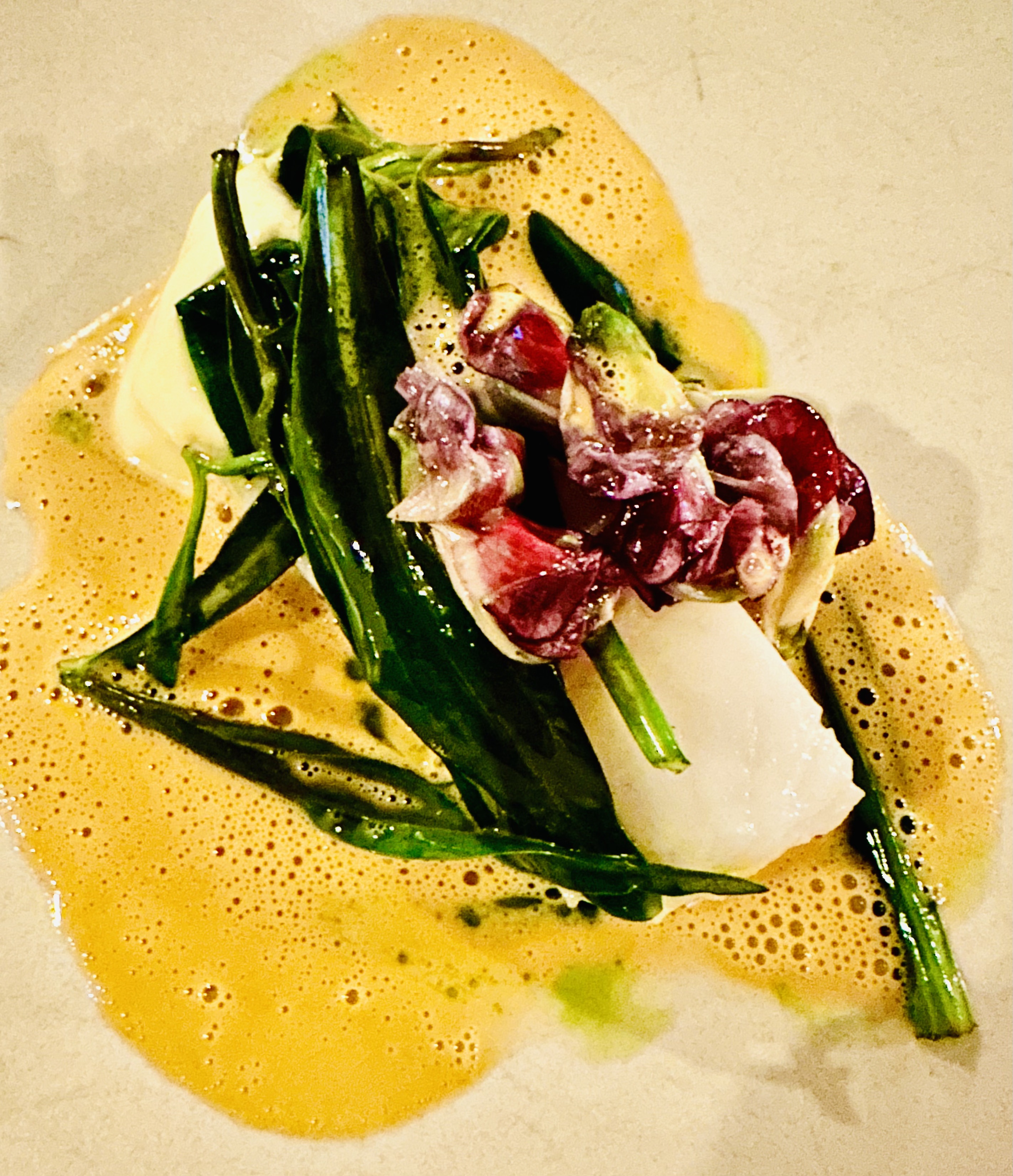
Kora by Tom Kitchin

16/12/22

Bruntsfield Place, Edinburgh

We visited Kora a few days after it opened, back in July, and loved it. But then it was in its infancy, and Mr Kitchin was a friendly and visible presence. The perfect storm of Brexit, COVID and cost-of-living crisis means that restaurants are even more vulnerable than they were before, and he was clearly focused on giving this place a decent start. The question is, five months on, with a slightly longer menu and the restaurant staff given more autonomy, is Kora still delivering five star meals?

The answer is: yes. Yes, it is.

It’s a welcoming place, with a cosy, informal vibe; the staff are warm without being overbearing, professional without being stuffy. The diners before us are running a little late, so we have to wait a while for our table, but we’re happy enough to sit at the bar with some wine (a Chilean Sauvignon Blanc), perusing the menu. It’s hard to pick from the delights on offer.

In the end, we both opt for the salmon starter. This comprises two thick slices of smoked salmon, served with a buckwheat galette, spinach, a perfectly poached egg and a buttery hollandaise sauce. It’s mouthwateringly-wonderful: the thick orange yolk cascading over everything; the salmon robust yet still delicate. It’s a great beginning!

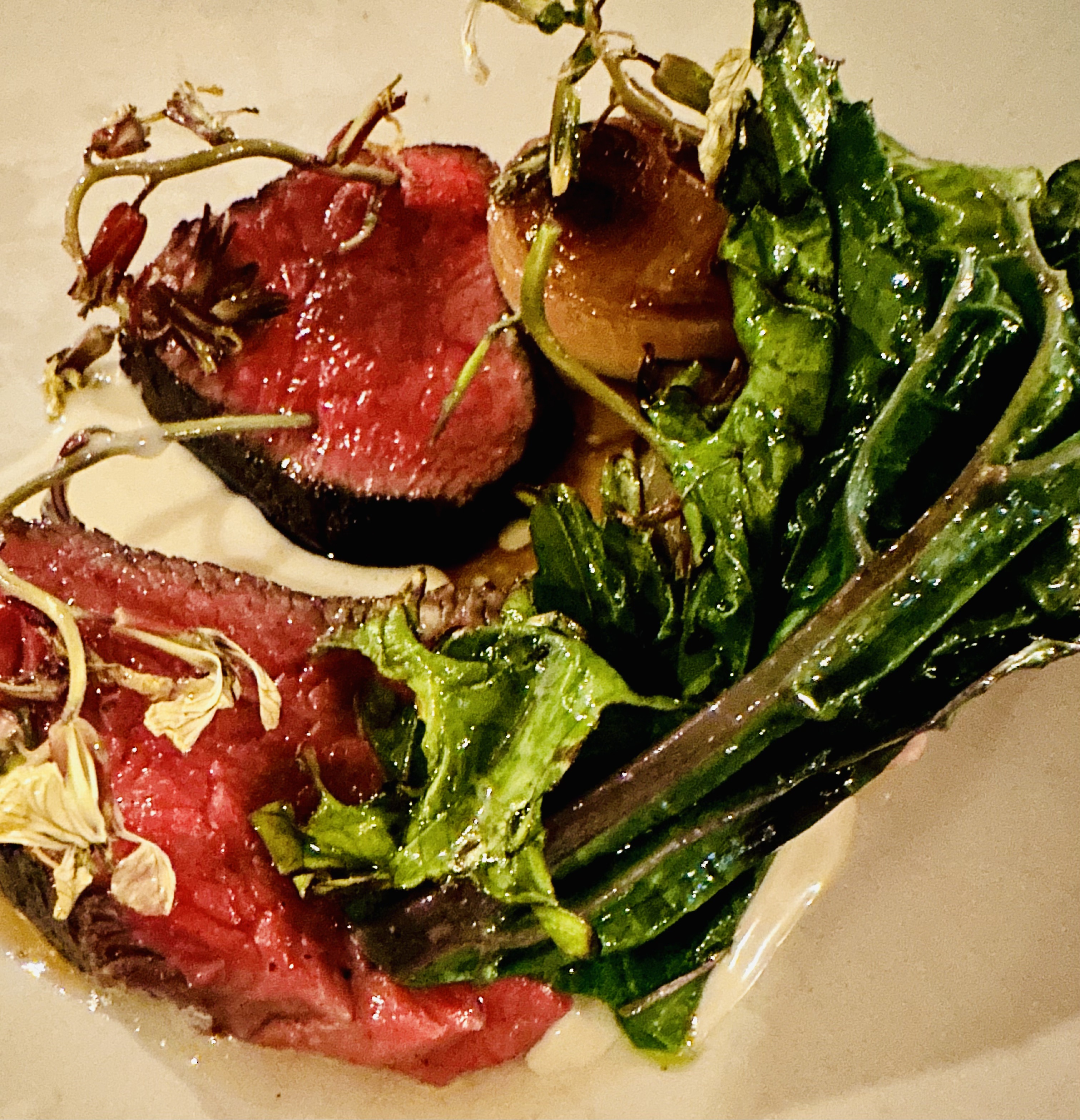
My main course is the Sika deer: a venison pithivier with some medium rare roasted loin, both cooked to perfection. I’m worried before it arrives that it’ll be too much, too rich, with all the pastry and red meat, but it’s perfectly judged, so that I feel satisfied rather than bloated. This comes with celeriac, which, although not my favourite vegetable, is beautifully cooked, and complements the meat well. Perhaps it would be better to have something fresh and green to offset all that richness, but this is just a minor quibble.

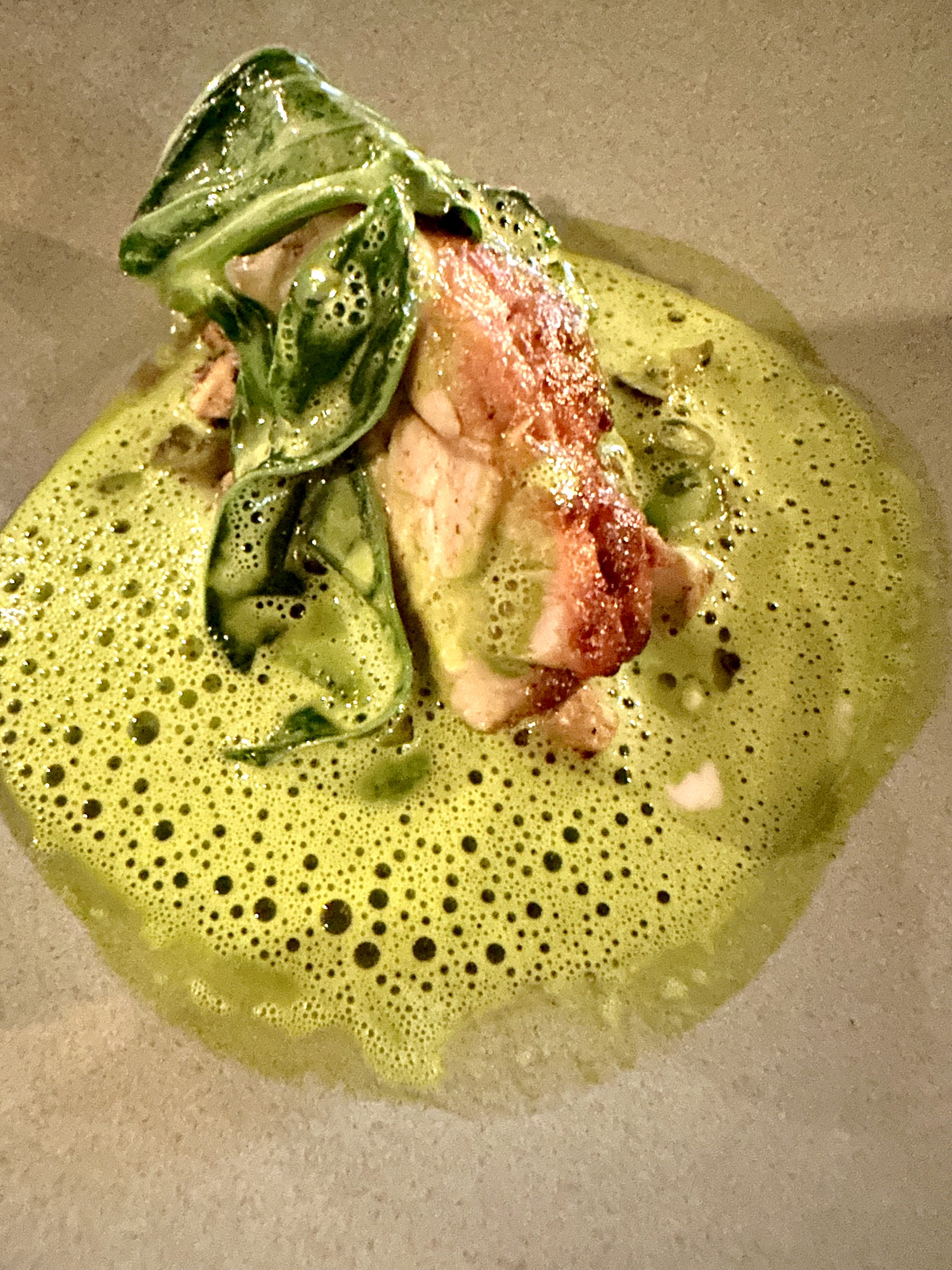
Philip has the partridge, which comes en croute, with a roasted leg on the side, as well as some salsify. This is succulent, well-spiced and subtly flavoured, the pastry flaky and crisp. He declares it to be ‘faultless’ and relishes every mouthful.

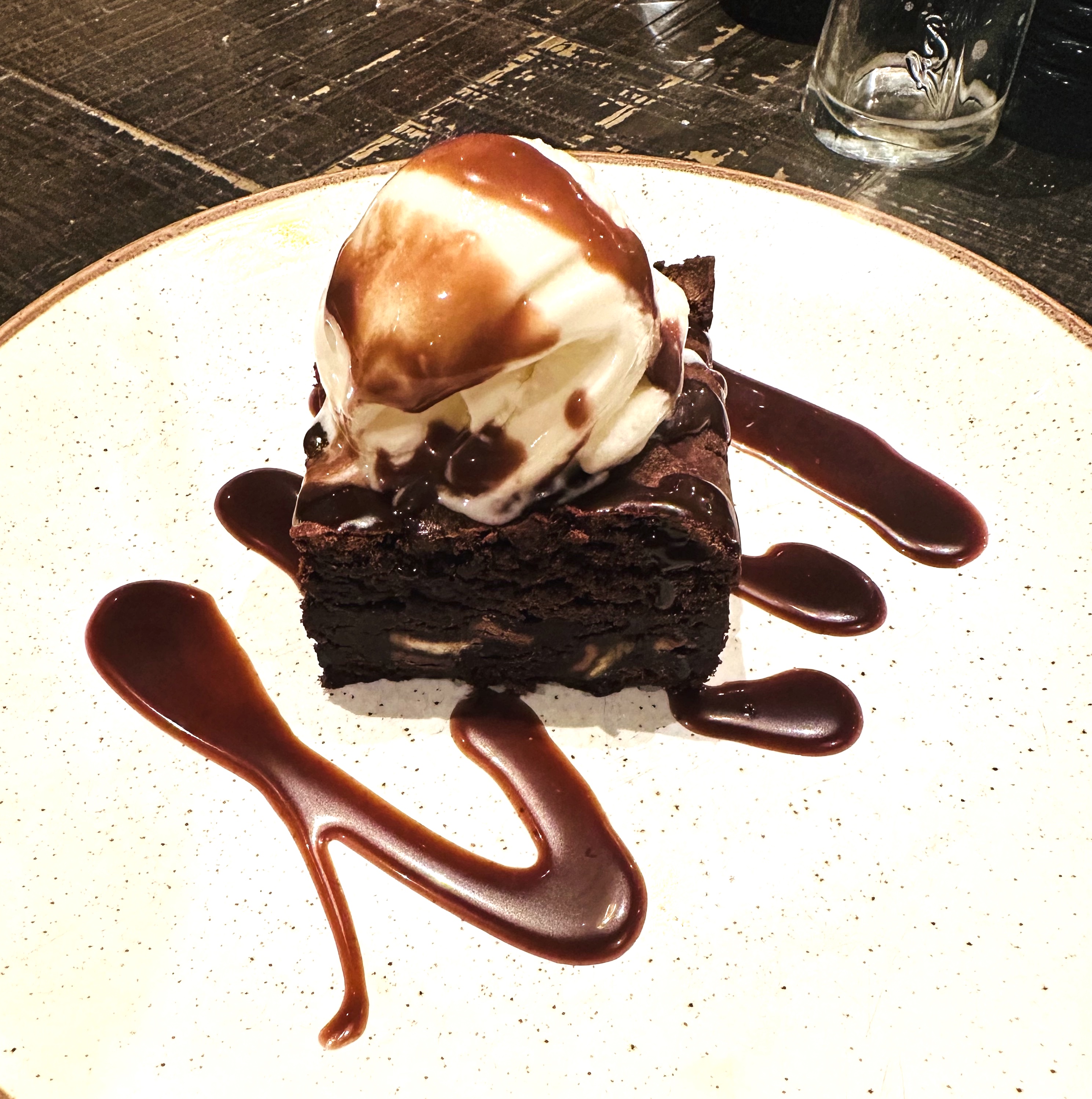
Philip’s pudding is chocolate, i.e. warm doughnut balls, a dark chocolate sauce, and Chantilly cream. It’s one of those dishes that makes you say ‘oooh’ a lot; it feels indulgent and nostalgic in equal measure. My cinnamon is something of an eye-opener, so much more than its description gives away. A real contender for my ‘Off Menu dream meal dessert’, this consists of a cinnamon panna cotta, served with tart, crisp pieces of apple and an apple sorbet, with a small, warm cinnamon bun on the side. I just know I’ll be ordering this again before too long.

We decline coffee, pay our bill, and head off into the cold, night air. Kora is only a ten minute walk from home; what a privilege to live so near a place as stellar as this.

5 stars

Susan Singfield

The Silent Twins

09/12/22

Cineworld, Edinburgh

The real-life silent twins of the title are Jennifer and June Gibbons, born in 1963, who refused – for years – to speak to anyone but each other. No one really knows why, but there are myriad theories: they were outsiders – the only Black kids in their small Welsh town; they were bullied; one was controlling the other – or, more crudely, they were ‘disturbed’.

Certainly ‘disturbed’ was the verdict of a baffled legal system, which over-reacted to the girls’ teenage crimes of petty theft and arson, and sent them to Broadmoor high security mental health hospital – a place more commonly associated with hardened murderers than wayward kids. How did they get through the eleven long years they spent there?

Director Agnieszka Smoczynska shows us how: by retreating into their rich inner lives. In this illuminating biopic, adapted by Andrea Seigel from the book by journalist Marjorie Wallace (played here by Jodhi May), we see that Jenny and June are far from mute and far from short of things to say. They just have a different way of expressing themselves. In reality, their so-called ‘secret language’ was a mixture of Bajan slang and super-fast English, which they used to tell stories to each other; here, their tales are depicted as distinctive animations. The girls are writers, producing countless reams of short stories, poems, even novels, spending their meagre benefits on foolscap, typewriter ink and – eventually – vanity publishing. They refuse to engage with their seemingly lovely family, rejecting any offers of help. Sent to separate schools for kids with special educational needs, they both become further withdrawn, refusing to move or eat, let alone speak. They’re driven by their art: once school is behind them, they realise they need to interact with the outside world – how can they write about romance if they’ve never experienced it? But romance is in short supply in their dalliances with the odious Wayne (Jack Bandeira)…

If only all biopics were as imaginative, engaging and sensitive as this! Jenny and June are not presented here as curiosities, but as troubled young people, let down by a system totally lacking in empathy, keen to other them, to set them apart. We see them as little girls (Eva-Arianna Baxter and Leah Mondesir-Simmonds) and as young women (Tamara Lawrance and Letitia Wright), by turns mischievous and vulnerable, selfish and self-absorbed. The four performances are exemplary, like a house of mirrors, amplifying the twins’ co-dependence, as well as the monstrous cruelty of sending them to an institution destined to destroy them, breaking two butterflies on a barbaric wheel.

Smoczynska imbues the girls’ story with humanity: there is sweetness here, and humour, as well as misery and obsession. It’s a thought-provoking, insightful piece of work.

4.5 stars

Susan Singfield

Once Upon a Snowstorm

09/12/22

Traverse Theatre, Edinburgh

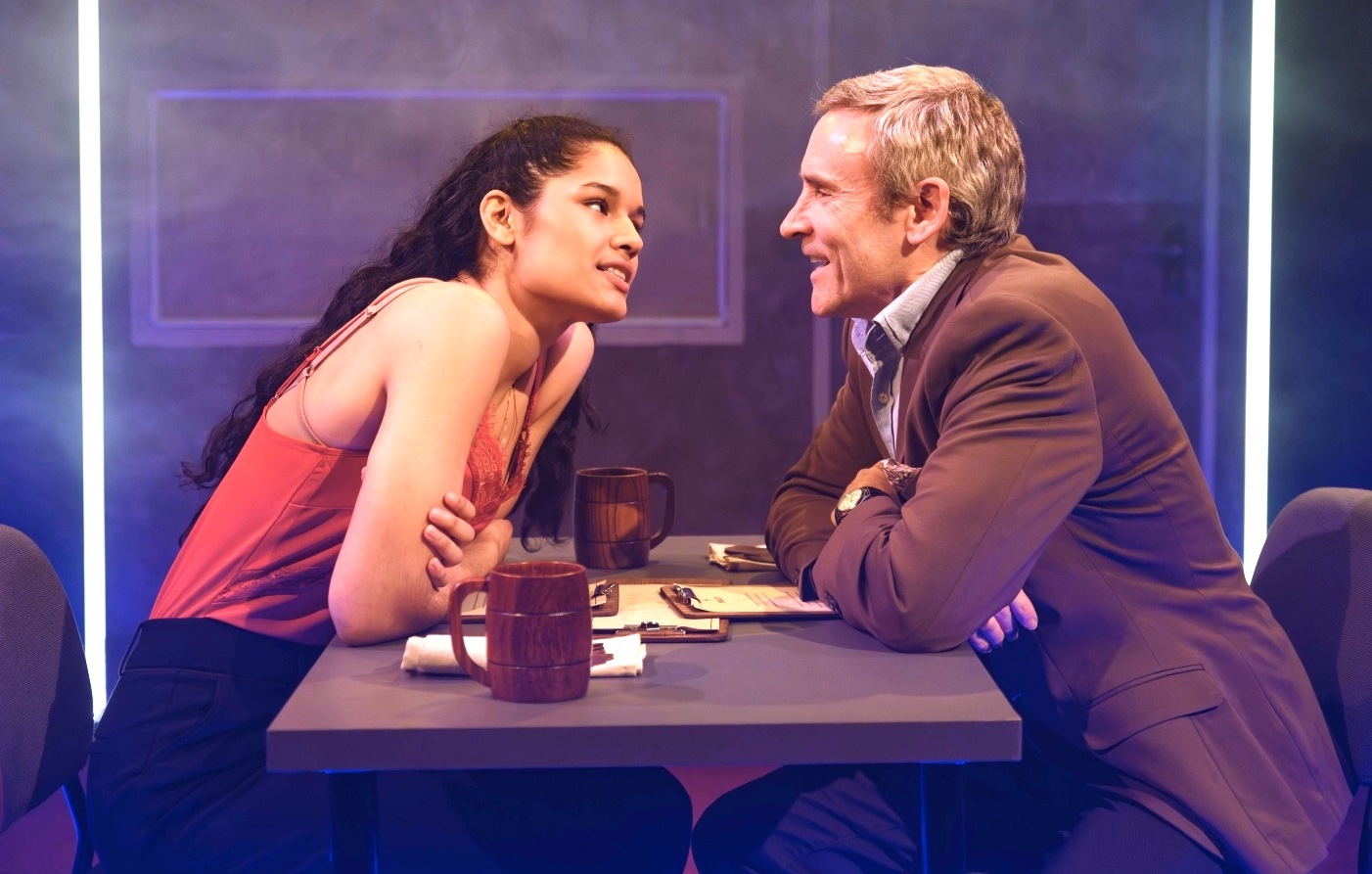
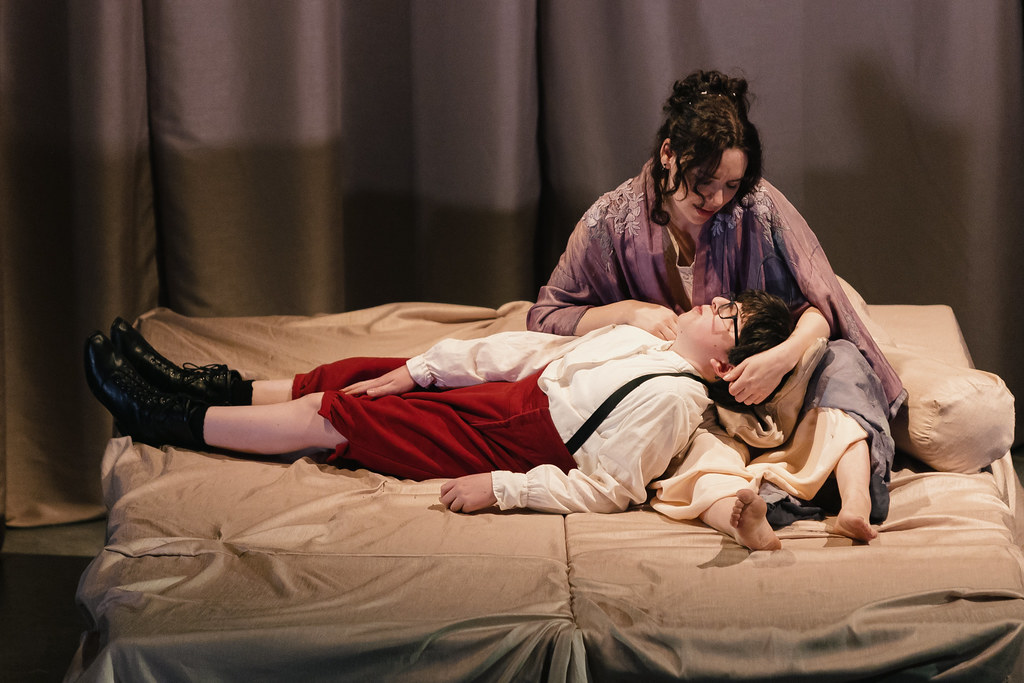
Described as a play for children aged 5-8 and their families, Once Upon a Snowstorm is based on the popular picture book by Richard Johnson. It tells the tale of a boy (Fay Guiffo) and his dad (Michael Sherin), who live in a woodland cottage. One day, they go out to hunt in the snow, but are separated and the boy is lost. Eventually, he ftakes shelter in a cavern and falls asleep. When he awakes, he finds himself surrounded by friendly animals, who teach him all about their ways…

It’s a charming – if slight – tale. Although Jo Timmins’ adaptation includes dialogue, it retains the quiet solemnity of Johnson’s wordless original, as well as the gentle pace. It feels true to the book, capturing its tranquil, earnest tone, and illuminating the boy’s sense of wonder. I’m especially entranced by the music (composed by David Paul Jones), and the way Guiffo’s violin is integrated seamlessly into her performance.

Traverse 2 has been reconfigured for this show, and it’s good to see it being used imaginatively. The acting space is tented with crumpled white sheets, and the seating comprises rows of ‘tree stumps’ (covered stools) and cushions, presumably intended for the wee ones to sit on and, at the back, a single row of adult-sized chairs. On entering, we’re asked to hang up our coats and remove our shoes, which somehow adds to the sense of occasion: something different is happening here. Largely, it works well, although there are some issues with the sight lines. There’s no one organising the smallest children to the front rows, and not enough full-sized seats for the grown-ups accompanying them. I can understand the wish to create something intimate, with no clear boundaries. But it might make sense to place the beautiful model house on a higher plinth, so that we can actually see it, and for the boy not to spend quite so much time sitting or lying on the floor.

Sherin and Guiffo embody all the different animals, and their performances are enchanting. Perhaps there’s a little too much repetition for me (the same route through the audience; three different lots of projected images), but the target audience seem to lap it up and, at forty-five minutes, there’s no time for this to flag.

Once Upon a Snowstorm is a sweet, simple tale, with some beautiful imagery.

3 stars

Philip Caveney

She Said

29/11/22

Cineworld. Edinburgh

She Said sets out its stall in the first few minutes. New York Times journalist Megan Twohey (Carey Mulligan) is about to publish a story about women being sexually abused by a presidential candidate, and the accused man calls to refute the claims. He’s boorish and threatening. The story is published, and the victims learn they were right to be afraid of speaking up. While they get death threats and envelopes of dog shit through the post, Donald Trump gets elected president.

So when Twohey and her colleague, Jodi Kantor (Zoe Kazan), begin to investigate rumours about Harvey Weinstein, they know what an uphill battle they face. The system is skewed in favour of powerful men. Uncovering the truth is relatively easy; acquiring sufficient evidence to publish it is horribly complex. As if persuading understandably anxious women to out themselves to a global audience weren’t difficult enough, there are also NDAs to contend with. How are these malignant settlements even allowed to exist? They’re just get-out-of-jail-free cards for rich arseholes, who can easily afford to spaff megabucks on silencing the people they abuse. But Twohey and Kantor are tenacious, and refuse to give up. It’s not easy for either of them. Kantor has a young family, and Twohey is in the throes of post-natal depression. Calls come at all times of the day and night – both threats from trolls and revelations from sources – but still, they can’t let go. It matters too much. So they grit their teeth and crack on, relying on their partners to do the lion’s share of parenting. (It’s refreshing, actually, to see Ron Lieber and Tom Pelphrey in these peripheral, domestic roles that are usually reserved for women.)

Maria Schrader’s understated direction works well, illuminating the sheer grit required to bring a prolific sex offender to account. The screenplay, by Rebecca Lenkiewicz, draws on the book written by the two journalists, and focuses on the painful process rather than the assaults. This is one instance where telling is better than showing: we don’t need to see these women being abused. Instead, we see the aftermath. We see how, while Weinstein continued to live the high life, perpetuating his attacks over and over again, any woman who dared to reject him or, worse, complain about his behaviour, had her life turned upside down. From Ashley Judd (appearing here as herself) being blacklisted and branded ‘a nightmare to work with’ to Zelda Perkins (Samantha Morton) fleeing to Guatemala, the fallout was immense.

The performances are detailed and meticulous. Kazan and Mulligan both fizz with pent-up energy, and the supporting cast are just as committed. Jennifer Ehle stands out as Laura Madden, attacked by Weinstein back when she was a young assistant, naïve and excited to be working for him. Thirty years later, she has a double mastectomy to deal with, so speaking out seems urgent, not least to show her daughters that they don’t need to internalise abuse.

She Said does a good job of highlighting the inherent power discrepancies in our society, and how ‘consent’ is problematic if one party holds the other’s prospects in their hands. It also shows how we can fight back.

#MeToo.

4.6 stars

Susan Singfield

Tim Minchin: BACK

23/11/22

Cineworld, Edinburgh

The tagline for BACK promises “old songs, new songs and fuck you songs” – and that’s exactly what we get. It’s great to see Minchin ‘back’ on the stage, albeit – for today – via the medium of screen. I loved Matilda, and am truly sorry his animated movie was so cruelly canned, but I did miss Tim-the-performer while he was working on those other projects, and BACK is a triumphant return.

I admire his resilience. Whatever private tears were shed over the Hollywood let-down, his public self is irrepressible. And I imagine live performances as popular as these provide quite the tonic for a bruised ego.

BACK is wide-ranging – both topically and musically. There’s an ode to cheese, a rant about progressives’ infighting and a plaintive memorial to a lost loved one; there’s a capella, solo piano and an accomplished eight-piece band. This makes sense: after all, the show is loosely constructed as a memoir, looking back at almost thirty years of an unusual career.

Three hours seem to fly by. Minchin’s ebullience makes him fascinating to watch, as well as listen to: this is as much a spectacle as it is an evening of song. As if his trademark bare feet, big hair and eyeliner weren’t arresting enough, he’s rarely still, jumping on and off the piano, doing backward rolls off the stool, and even sweeping broken glass off the stage (his own glass, I should add; the crowd is on his side).

Standout moments include If I Didn’t Have You, for it’s cheeky observations, and I’ll Take Lonely Tonight, for its wistful honesty, but the whole show works well. I find myself impressed anew by Minchin’s witty lyrics and musical dexterity, and I’m also engaged by his attempt to confront the thorny issue of ‘cancel culture’ from a liberal standpoint, highlighting the hypocrisy of promoting empathy via rage.

The tour is over, but this recording remains, and – if you get the chance to see it – do. Minchin is a joy.

4.6 stars

Susan Singfield

Jinnistan

08/11/22

Traverse Theatre, Edinburgh

Jinnistan, directed by Niloo-Far Khan, is the last of this season’s PPP productions, and – in a break with the norm – it’s in the ‘big theatre’, aka Traverse One. This seems fitting, as the play’s parameters are bigger than normal too, encompassing not just the world as we know it, but the spirit realm as well. The Jinnistan of the title co-exists with Pakistan – but relations are strained, to say the least.

Malik (Taqi Nazeer, who also wrote the script) moved from Scotland to Pakistan a year ago. His wife, Layla (Avita Jay), and teenage daughter, Asiya (Iman Akhtar), have followed him there. Asiya’s not happy, and neither is Malik. She wanted to stay at home with her pals. and he – well, he isn’t saying. I guess it isn’t easy to tell your family that it’s your destiny to be a genie-fighter, and that there are annual rituals you need to perform in order to save lives.

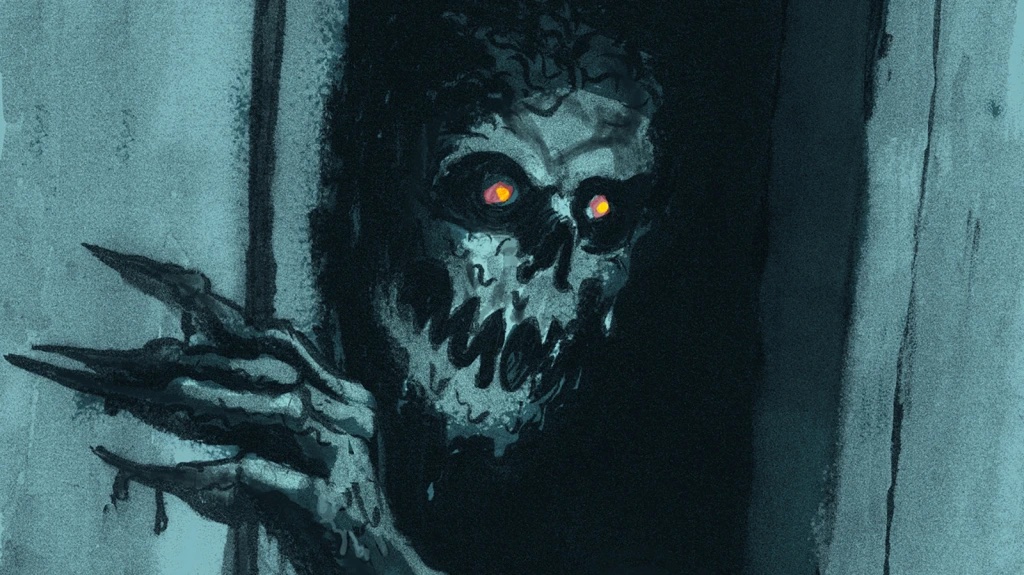
This is essentially a low-fi horror, and all the genre’s tropes are in evidence here. Spooky graveyard? Check. Family secret? Check. Wayward teenage girl possessed by an evil spirit? Check. Nazeer keeps things fresh by transposing the action to a different culture, seamlessly blending Arabic and English to give a clear sense of place. The setting is enhanced by special effects, which – though obviously constrained by budget – are serviceable enough, conveying a feeling of unease.

Akhtar delivers an impressive performance, imbuing Ayisa with a convincing mix of swagger and insecurity. The sound design (by Niroshini Thambar) is also excellent: the jinn’s voice truly seems to emanate from somewhere beyond the here and now.

I do have some quibbles: the script is a little uneven, for example, and there are jarring moments of humour that undermine the building tension, so that – ultimately – the stakes are never really raised. The recorded voices, though well-delivered, are over-used: all too often, I find myself listening to a block of exposition, while looking at a blank or static stage.

Nonetheless, Jinnistan is an entertaining piece of lunchtime theatre, and a fitting end to this round of PPP’s lunchtime offerings.

3 stars

Susan Singfield

Decision to Leave

26/10/22

Cameo Cinema, Edinburgh

A new release from Park Chan-wook is always a cause for celebration, but anyone expecting the unbridled sexuality of The Handmaiden may be surprised to learn that Decision to Leave is a much more chaste affair. Yes, there’s passion here, but it’s portrayed almost entirely in words (in some cases via a Chinese-Korean translation app) and in discreet sidelong glances.

Workaholic Detective Hae-jun (Park Hae-il) is summoned to investigate the death of a mountain climber who has fallen from a great height. But did the man jump or was he pushed? Suspicion soon falls on his Chinese wife, Seo-rei (Tang Wei), and Hae-jun, who is already suffering from chronic insomnia, starts to spend his nights surveilling her. He follows her around Busan, studies her routines and chronicles her every move. And then he begins to realise that he is falling in love with her and that what began as professional interest is turning into something much more compelling…

This is one of those films where it would be criminal to give too much of the plot away – and besides, the ensuing story is so labyrinthine, so full of unexpected twists and turns, it would be pretty much impossible to do that even if I wanted to. Armchair detectives will have a field day trying to figure out the mysteries wrapped up in this story and I’m fairly certain that very few are likely to guess at the baffling solution to this strange, enigmatic puzzle of a film.

Park Chan-wook’s distinctive visual style – aided and abetted by cinematographer Kin Je-yong – is to the fore throughout and, as ever, he relishes playing tricks on the viewer, constantly tinkering with our perceptions and expectations. Both the leads dazzle in their roles, and are ably supported by a fine cast, particularly by Lee Jung-hyun as Hae-jun’s statistic-obsessed wife, Jung-an – but this is essentially a two-hander.

With a running time of two hours and nineteen minutes, I do occasionally find myself wishing that the pace wasn’t quite so glacial, but the great director has never been one to hurry himself over anything and, despite my reservations, Decision to Leave manages to hold me in a powerful grip right up to its chilling final frame.

4 stars

Philip Caveney
Crocodile Rock

25/10/22

Traverse Theatre, Edinburgh

Seventeen-year-old Stephen McPhail feels marooned in his tiny island hometown, Millport. Sure, the mainland is only a short ferry-hop across the water, but the distance seems insurmountable. Stephen’s faither owns a pub, and his maw a B&B, and he’s expected to follow them into the family businesses. But the blokey banter at the bar leaves Stephen tongue-tied and blushing, and he dreams of something more. It’s only when handsome newcomer Henry Thomas arrives that Stephen finally figures out why he doesn’t fit in: he’s gay. The realisation brings him little comfort: Henry not only rejects him, but also makes sure he’s ostracised by his peers. Because being gay in 1997 – especially in a small town, and even more especially when you’re still at school – is a long, long way from easy. Things only improve when the annual Country and Western festival rolls into town, and a keyboard-playing drag queen offers Stephen a way out…

Andy McGregor’s one-man (and a band) musical is a delight. The writing nails the open homophobia still so prevalent in the late 90s; I was a teacher then, and Clause 28 was crippling. Coming-out tales are far from rare, but this one soars: the songs are bold yet nuanced, and actor Stephen Arden really brings to life the young man’s loneliness and yearning. It’s always apparent that Stephen is a caterpillar, waiting to grow his wings, and – when he does – his exuberance is catching. There’s a real sense of celebration in the final act, and we leave smiling, sharing some of Stephen’s catharsis. Arden has an impressive vocal range, and the three-piece band (Kim Shepherd and Simon Donaldson, led by musical director Andy Manning) produce an impressively full sound. Arden acknowledges their presence, interacting with them occasionally, so that they are seamlessly integrated into the play.

The set (by Kenny Miller) is simple but very effective. A large photograph of Millport’s famous but – sorry – undeniably awful Crocodile Rock serves as a background, contrasting wonderfully with the sequinned glamour Stephen eventually embraces. The photo not only hides a sliding door, but also some hinged boards that open up to show us Stephen’s cartoon-themed bedroom, reminding us of just how young he is, poised on the cusp between boy and man.

Crocodile Rock is on tour. If you haven’t seen it yet, you’ve missed your chance in Edinburgh, but you can still catch it at the Lemon Tree in Aberdeen on 4th November. It’s a real treat.

4.1 stars

Susan Singfield

Pride and Prejudice* (*sort of)

20/10/22

Lyceum Theatre, Edinburgh

It’s a real treat to revisit writer/director Isobel McArthur’s rambunctious retelling of Jane Austen’s best-loved novel. Since we last saw it in January 2020, a lot has happened – and I’m not referring to the pandemic. Pride and Prejudice* (*sort of) has wowed the West End and bagged itself a well-deserved Olivier award. McArthur must be buzzing.

This adaptation is actually pretty faithful to the original. The set-up is intact: we have the Bennett family facing financial ruin, and Mrs Bennett (McArthur) desperately trying to marry off her five daughters. And the central romance is intact too: we have sparky, reckless Lizzy (Leah Jamieson), determined to marry for love or not at all – consequences be damned – and we have Darcy (McArthur again). Her portrayal of the enigmatic, uptight ‘hero’ is as exquisite as I remember. She nails his inarticulacy, highlighting his inability to express himself, rendering him sympathetic, despite his brusque manner.

The difference lies in the telling. The conceit is that five servants are dressing up, playing, showing us what they’ve observed in the houses where they work. Thus class barriers are broken down, and so is the gap between the 19th century gentry and the theatre-goers of the 21st. McArthur’s talent lies in unveiling the jokes, so that Austen’s satire – hidden from a modern audience behind bonnets and mannered language – is exposed to the light. Via karaoke and biting sarcasm.

Hannah Jarrett-Scott almost steals the show: she’s a natural clown, clearly relishing the twin roles of Caroline and Charles Bingley, but also flashing her acting chops in a nuanced depiction of Charlotte Lucas, repressing her feelings for Lizzy. Christina Gordon (as Jane, Wickham and Lady Catherine) and Tori Burgess (as Lydia, Mary and Mr Collins) are both excellent too. I’ve nothing negative to say.

Pride and Prejudice* (*sort of) is at the Lyceum until November 5th, which seems appropriate for such a dazzling firecracker of a show.

4.6 stars

Susan Singfield

Dine Murrayfield – Wine Club

12/10/22

Murrayfield Place, Edinburgh

We’re already familiar with the Dine in Saltire Court, conveniently situated above the Traverse Theatre, a three minute walk from our apartment – and okay, when I first receive the invitation to this combined wine-tasting and four course meal, I’m under the impression that’s where I’m actually going. No matter, the Murrayfield branch is just a twenty-five minute stroll away and proves to be as delightful as its sister restaurant. One of the friendly waiters informs me that a new branch has just opened in Cannon Mills, so I make a mental note to check that out in due course too.

Pretty soon, we’re sipping a delicious glass of Loimer Brut Rosé and our host for the evening, Mike from Liberty Wines, sings its praises and points out details like the fact that it has a delicate ‘puff pastry’ aroma. (Weirdly, it actually does!) Mike pops up at regular intervals during the evening, telling us more about the joys of Austrian wines, of which – until now – I know nothing. He’s keen to point out that all but one of tonight’s offerings are certified organic and biodynamic, the latter of which he helpfully describes as ‘organic on steroids’. 

In comes the appetiser, a pretzel cheese fondue, which features a full size pretzel with rocket and port gel and a generous bowl of hot creamy, cheesy dip, which is absolutely delicious. Too big for a starter? Possibly, though I’m certainly not complaining!

Next up there’s the fish course, a Gulasch sea bream, which turns out to be my star meal of the evening, a mouthwatering stew featuring chunks of potato, carrot and bell peppers and, best of all, a fillet of bream with a delightful crispy skin. The paprika-laced broth causes a delightful catch at the back of the throat. A slice of sourdough is perfect for mopping up the last of it. This course is accompanied by a Südsteiermark Sauvignon Blanc, a subtle but zesty wine with gooseberry and pear notes.

Next up, the glasses arrive charged with Wieninger Pino Noir Select, heralding the fact that a meat course is coming. On paper, the Tafelspiz sounds unprepossessing: boiled beef in a broth of vegetables and spices. Can anybody make boiled beef appetising? It turns out they can. The meat is melt-in-the-mouth tender; there are a couple of perfectly cooked roast potatoes and an accompanying mixture of minced apples and horseradish, which I enjoy despite my initial reservations. What’s more, though I rarely enjoy red wine, the Wieninger’s robust tannin structure with flavours of red and black cherries makes an ideal accompaniment to the dish.

I’ve said it many times before: the pudding is often the crowning glory of many a good meal – but sadly, there’s no pudding here, just an Austrian cheese selection, which – though perfectly agreeable – seems like the one real misstep. Let’s be honest, we began with a cheese dish and Austria has no shortage of great puddings. A fruit strudel would surely be a better companion for the sweet Heidi Schröck Welschriesling that accompanies the final dish. I could also suggest that the courses are all a bit heavy on the carbs and might benefit from the presence of a few greens, but I can’t deny that I find all of this (even the cheese) utterly delicious and, at just £59 per head, exceptional value for money.

Another of these events is planned for the new year. 

Are we going to be there? Hell, yes!

4.6 stars

Philip Caveney