Edinburgh

Moonset

16/02/23

Traverse Theatre, Edinburgh

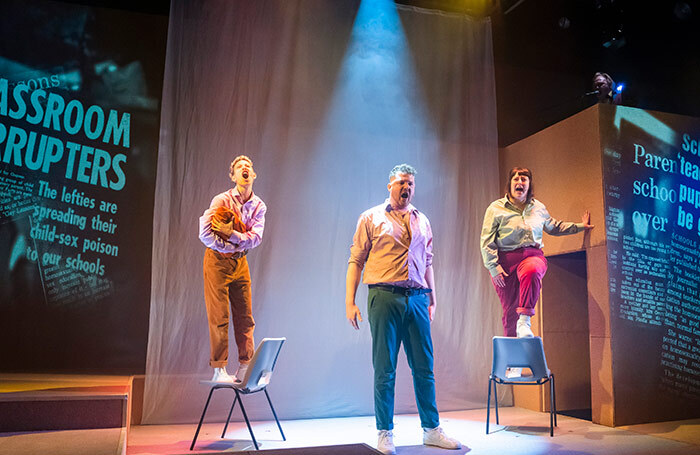
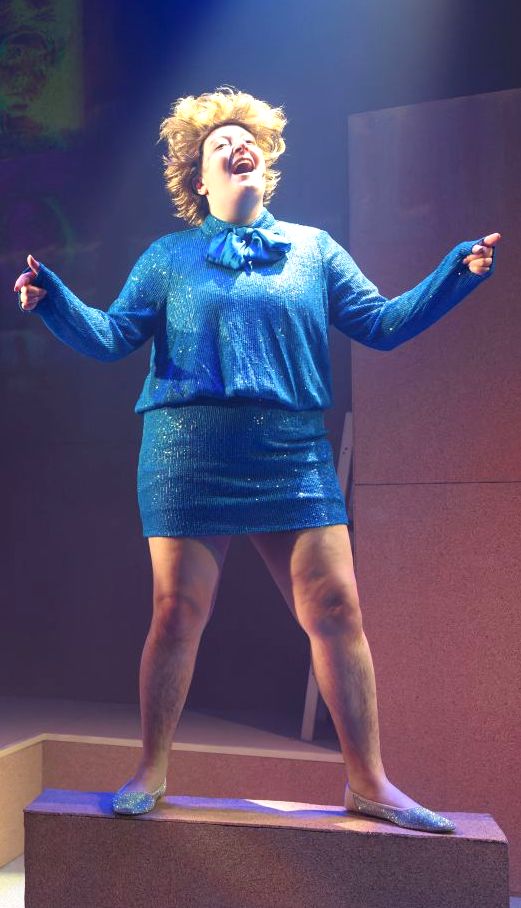
A school trip to the Paisley Witches’ Memorial proves momentous in Moonset, Maryam Hamidi’s spirited play about four teenage girls, who just need a little bit of power…

It’s a great premise. Surely the worst thing about being an adolescent is the lack of autonomy. There’s so much to deal with (exams, hormones, growing up, life), so much conflicting advice, so many rules and boundaries and exhortations to “be good”.

Roxy (Layla Kirk) feels like she’s on fire. Her best friend, Bushra, seems to be cooling on her, her mum (Zahra Browne) is concealing something, Nat 5s are looming – and why hasn’t she started her period yet? But Bushra (Cindy Awor) has her own problem – she has questions about her sexuality, and the answers seem scary. Meanwhile, Gina (Leah Byrne) is a ball of restless energy, bouncing from one calamity to another, and Joanne (Hannah Visocchi) isn’t sure her boyfriend, Gary, is quite the guy she’d like him to be.

They all feel powerless. And, like Abigail Williams and her friends before them, the girls seek strength in magic.

The teens’ exuberance is funny and engaging, but it doesn’t conceal the real problems they have to deal with. Hamidi’s bright, lively script grapples with dark themes – touching on coercive control, child abuse, immigration and cancer – treading this fine line with confidence. Director Joanna Bowman nimbly encapsulates the emotional turbulence of the formative years; she doesn’t hold back. We watch as the girls take terrible risks; they are as reckless and bold as only adolescents can be. And we’re on the roller-coaster with them, hoping against hope that the consequences of their actions won’t prove too appalling…

The set (by Jen McGinley) is a jumble, like the kids’ minds, with myriad items competing for attention. It works well, the empty circle in the middle representing their safe space: the junk yard, ironically, is the one place with nothing filling it, offering them room to think, to cement their friendship and ultimately find their hidden strengths. There are some pretty nifty effects too. I like the way the fire is created with smoke and light (courtesy of Simon Hayes). Movement director Vicki Manderson deserves a mention too: this is a kinetic piece and the momentum never flags, the performers interacting seamlessly with the space.

The set-up works well, leaving me scared for the girls and their futures. No spoilers here – suffice to say that, after the coup de théâtre at the end of the first act, the second provides a pay-off that is unexpected but satisfying. Although I’m crying as the lights go down, I’m also left with a feeling of hope.

4.3 stars

Susan Singfield

Blue Jean

14/02/23

Cineworld, Edinburgh

It’s hard to remember sometimes, from our current vantage point, just how deeply ingrained homophobia was in 1980s Britain. Writer/director Georgia Oakley’s debut film takes us back to 1988, and the implementation of Margaret Thatcher’s controversial Clause 28, which explicitly banned schools and local authorities from ‘promoting’ homosexuality. I was in sixth form then, and I mostly remember finding it ridiculous – as if, without the clause, there would be advertisements everywhere. “Come on, kids! Be gay! It’s great!” But I only had the luxury of dismissing it as stupid because I was straight. I don’t know how it made the gay kids feel. I didn’t know anyone who said they were gay back then (although, of course, many have come out since). I don’t blame them for keeping schtum. I don’t remember the schoolyard as a place that celebrated difference.

Jean (Rosy McEwen) is a PE teacher. She’s also a lesbian, recently divorced from her husband, and enjoying a new relationship with Viv (Kerrie Hayes). But while Viv is at ease with herself – out and proud and politically engaged – Jean is less confident about her sexual identity. She’s still keen to fit in with the heteronormative world; she doesn’t want to draw attention to herself, either at school or with her family. It’s a matter of survival: however shocking it may seem, she’s right to fear her that job is on the line. She manages by drawing a clear distinction between work and home: she lives in a different town from the one she teaches in, and refuses drinks invitations from her colleagues. Her social life revolves around a gay club and a lesbian commune, and here she’s free to be herself.

Until fifteen-year-old Lois (Lucy Halliday) shows up in the club. She’s belligerent and bold – and she’s also Jean’s student. Suddenly, Jean’s worlds collide. Her carefully segregated life is under threat, and she’s torn between fight or flight.

Oakley’s script gives us a clear insight into the era, and into the overt discrimination that permeated popular culture. McEwen shows us a young woman forced into a choice she doesn’t want to make: she has to be a hero or a failure; she can’t just be; the government’s weird preoccupation with consenting adults’ sex lives has a profound impact on real people. Hayes is heartbreaking as Viv, whose clear-eyed view never dulls her pain, and newcomer Halliday is mesmerising on the screen.

Clause 28 was finally repealed in 2003, and things have certainly improved – although, of course, there’s still a way to go. Blue Jean serves as an important reminder of why we can’t ever relax our vigilance, and why we mustn’t let things slide. People’s lives and happiness depend on it.

4 stars

Susan Singfield
Love Beyond (Act of Remembrance)

11/02/23

Traverse Theatre, Edinburgh

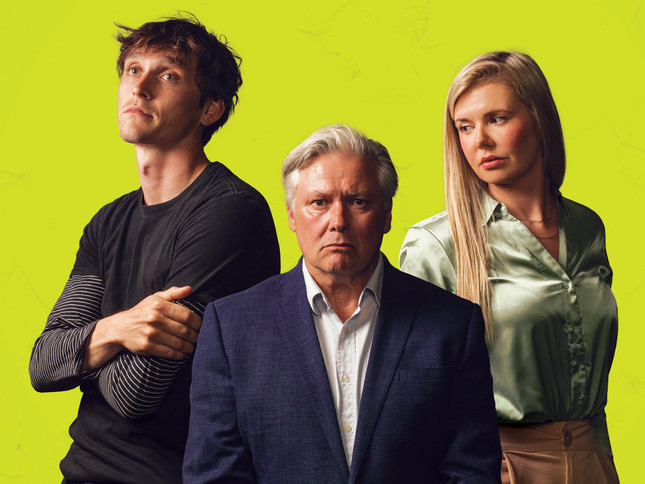
Love Beyond (Act of Remembrance) is billed as ‘a love story – but not a typical one’. And yet this play, by Ramesh Meyyappan is, like all tales of love and loss, at once unique and ubiquitous, quirky and commonplace.

We meet Harry (Meyyappan) as he moves into a care home. He has dementia, and he’s also deaf. His new carer, May (Elicia Daly), is sweet and attentive, but she doesn’t know sign language, although she is ‘going on a course’. Naturally, Harry’s disorientation is heightened by the pair’s inability to communicate. Matthew Lenton’s skilful direction ensures the audience is drawn in, as those of us who can’t sign miss much of what Harry says, while some of those who are deaf presumably miss May’s words. It’s nicely done: we’re all given enough information to understand what’s going on, while also experiencing a little of Harry’s alienation from his new home, and May’s frustration at not being able to do her job.

The set (by Becky Minto) comprises three moveable screens. At first these are mirrors, magnifying Harry’s discomfort: the reflection of the audience staring at him adds to the sense that he no longer has a private life, or much autonomy at all. Cleverly, the screens are also transparent: lit from behind, they reveal Harry’s jumble of memories. We get to know the young Harry (Rinkoo Barpaga) and his true love, Elise (Amy Kennedy): we see them meet and fall in love; we see their joy and their sorrow, their prime and their decline. There’s something spellbinding about the way these images appear and disappear, and Harry’s yearning for Elise is palpable and heartbreaking.

The strength of this piece lies in the movement, which is precise, slow and beguiling – a realisation of the phrase ‘poetry in motion’. There is a gentle earnestness here that defies cynicism, so that a simple swimming mime becomes a thing of beauty; the act of putting on slippers becomes profound.

Composer David Paul Jones’s soundtrack is integral to the piece. The music is by turns melodic and jarring, light and intense, reflecting Harry’s inner turmoil just as clearly as the mirrors.

This year’s Manipulate Festival has thrown up some absolute gems – and this is one of them.

4.4 stars

Susan Singfield
The Fantastic Life of Minnie Rubinski

09/02/23

The Fruitmarket Gallery, Edinburgh

Vision Mechanic’s production of The Fantastic Life of Minnie Rubinski was conceived during the pandemic and is inspired by creative director Kim Bergsagel’s mother (real name Sondra Rubin). Part movie, part installation and part puppet-show, it’s an affecting look into the memories and changing fortunes of one woman’s life.

Entering the performance space, we find ourselves in a darkened room dominated by a central ‘brain,’ a little shelter where we are invited to sit awhile and listen to the recorded sounds of a jumble of voices and musical cues. From there, we can follow one of a number of illuminated ‘synapses’ to a whole series of screens showing vignettes of key incidents from Minnie’s life. The characters are puppets, moving around custom-built sets, which are presented in intricate detail – check out the sequence in a 1950s supermarket and take a close look at the hundreds of items ranged on the shelves. The attention to detail is astonishing!

The scenes we are offered range from charming glimpses of Minnie’s childhood, to the years of her unfulfilling marriage, her time spent running a swish art gallery and latterly, her final days in a care home as she increasingly descends into dementia. It’s in these latter stretches that some of her adventures become particularly bizarre and the lines between memories and hallucinations are allowed to blur. We can choose to watch the sequences chronologically or simply go to whichever screen is vacant at any given time and piece everything together from what’s onscreen. (I really recommend this approach. It’s oddly like playing detective and the storyline is so skilfully handled, it never becomes confusing.)

Of course, a production like this isn’t the work of one person, but of a whole team of creative artists – puppet makers, set dressers, musicians, you name it – and their splendid endeavours are up there on the screens for all to see, as they pool their diverse talents to create a charming and fascinating narrative. I can honestly say I’ve never seen anything quite like this before.

Interested parties should make a beeline for the Fruitmarket Gallery, because this delightful production, showing as part of the Manipulate Festival, is only available to view until Sunday 12th February. Go and spend forty-five minutes in Minnie’s extraordinary world. It’ll be time well spent.

4.4 stars

Philip Caveney

Macbeth (An Undoing)

08/02/23

Lyceum Theatre, Edinburgh

Unlike the monarchs he wrote about, Shakespeare has reigned supreme for more than four hundred years: his plays, rich with examples of human fallibility, are endlessly relevant. But you’d think, wouldn’t you, that we’d run out of different ways to retell the same stories? I mean, the first time I ever saw Macbeth, way-back-when on a sixth-form theatre trip, it was set in a concentration camp (courtesy of Braham Murray at Manchester’s Royal Exchange). Next, I fell in love with Penny Woolcock’s 1997 film, Macbeth on the Estate, which transported the action to a maze of contemporary council flats, and I even enjoyed TV’s ShakespeaRe-Told, where chefs James McEvoy and Keeley Hawes killed off their rivals to take over a restaurant empire. More recently, Flabbergast Theatre’s wonderfully physical, visceral adaptation had me hooked, and there’s been a slew of others along the way. What I’m saying is: I know Macbeth. We all know Macbeth. It’s been done, right? What else is there to say?

And then along comes Zinnie Harris with An Undoing – and the whole thing is turned on its head.

Macbeth (An Undoing) starts from a simple premise: what happens if Macbeth and Lady Macbeth follow their natural trajectories? Because, let’s face it, although Lady M is arguably the best of Shakespeare’s female characters, she’s also the most frustrating, initially a force to be reckoned with – an interesting, complex woman – before disappearing for an age and then returning broken, for a brief goodbye, with very little to tell us why. What if, asks Harris, it’s Macbeth who crumbles? What if it’s Macbeth – whose conscience troubles him from the start – who unravels, while his wife continues unabashed, for a while at least, determined to make their plan succeed? It makes perfect sense, given their starting points.

At first, when the curtains open on a blank stage, and we’re treated to servant/witch Carlin (Liz Kettle)’s fourth-wall-breaking opening gambit, I think perhaps this will be a relatively straightforward version of the play, with just a little mischievous tinkering here and there. After all, “This story will be told, the way it has always been told. What use is it otherwise? The hags on the heath. The woman who went mad. The man who became a tyrant,” she tells us. And, for the first half, that’s sort of what we get: Macbeth at a gallop, mostly in the Bard’s own words, step-by-step through the plot. There are a few changes: we’re in the 1920s, or the early 1930s perhaps; Ladies Macbeth and Macduff (Nicole Cooper and Jade Ogugua respectively) are reimagined as sisters, and share some revelatory new scenes (An Undoing easily passes the Bechdel test); Lady Macbeth and her husband (Adam Best) don’t just want power for power’s sake – they have a meticulously-planned vision for a utopian Scotland. But, in the main, it’s as it’s always been, so that, in the interval, I find myself musing aloud, “How can there still be an hour and a bit to go? There’s not much story left…”

But then we get to the undoing…

Harris’s adaptation is bold, daring and witty. I love the idea of the witches as servants: it makes perfect sense. They’re the eyes and ears of the house, privy to the paperwork the Macbeths have drawn up, witness to intimate moments and careless asides. Invisible. Ignored. These witches are also a family – in fact, Kettle and Star Penders, along with impressive young actor Farrah Anderson Fryer, form the most functional family we see on tonight’s stage, with clear bonds uniting them. I also like the depiction of Malcolm (Penders again) as a petulant youth, patently ill-equipped for leadership and ripe for exploitation by the ruthless Macduff (Paul Tinto).

But this is, without doubt, Lady Macbeth’s play. It’s the part of a lifetime, and Cooper makes the most of it, imbuing her with strength and vitality – and just a hint of vulnerability. She’s ambitious and single-minded, but never merely cruel or heartless. We believe in her love for her husband and sister, and we believe in her idealism too. She’s angry when the lairds misgender her, referring to her as the King because they can’t conceive of a woman behaving as she does (even though, to be fair, she does ask to be ‘unsexed’). In a well-aimed swipe at other interpretations of the role, she’s also angry at being reduced to her infertility.

The set (by Tom Piper) is simple but extraordinarily effective, with warped mirrors concealing as much as they reveal, offering us multiple perspectives, and highlighting the Macbeths’ interdependence and duality. We’re there too, shimmering in the background, complicit and agog, just as Carlin accuses at the start.

The Lyceum is busy tonight – some of the boxes have even been pressed into use – and deserves to be so for the next month. You’ve probably seen Macbeth, but I doubt you’ve seen anything quite like An Undoing before.

4.7 stars

Susan Singfield
The Ship on the Shore

28/01/23

The Shore, Leith

It’s a Saturday night and friends have invited us to dine with them at The Ship on the Shore, a bustling, friendly venue in Leith which describes itself as a ‘seafood restaurant and champagne bar.’ I don’t have anything in particular to celebrate, so I eschew the champagne and settle for a couple of pints of Peroni, but seafood? Hell, yes – lead me to it!

As you might expect, the place is packed but the team here are friendly and efficient so ordering and receiving our food is no bother. We make our selections and settle down for a convivial chat, which – let’s face it – is an important element in most meals.

 For starters, I opt for the salmon and smoked haddock fishcakes. There’s something so innately comforting about fishcakes, isn’t there? And these are splendid examples of their kind, large, perfectly cooked and full of flavour, served with a mixture of mushy peas and tartare sauce. Susan opts for steamed Shetland mussels, another generous portion, nestled in a golden broth of cider, garlic and herbs. As ever, we sample a mouthful of each other’s food. We’re also impressed by the hot and cold Scottish smoked salmon, ordered by one of our companions – so much so that we decide to use a photo of it, because it’s much more photogenic than my main course!

It might not look much, but my seafood pie ‘Royale is perfectly delicious. Some so-called ‘pies’ can comprise a few scraps of fish hiding in mounds of mashed potato, but, happily, this is not the case here. Beneath that crisp, buttery surface there are chunks of smoked haddock and salmon, there are king scallops and big, juicy prawns. Susan’s seafood chowder is also a bit of a wonder: thick, creamy and featuring all the usual suspects plus some less obvious ones. Added to the salmon, smoked haddock and queen scallops and prawns, there are also mussels and squid. It’s like an aquarium in there!

You’d think, wouldn’t you, that after such a feast, we wouldn’t be able to face up to pudding? But here’s the thing. I’ve deliberately eaten barely anything all day in preparation for this. Plus, there’s a sticky toffee pudding on the menu and I don’t know what it is about me, some kind of inbuilt reflex, but whenever those words appear on a menu, I nearly always have to try it (though, in this case, I do manage to negotiate replacing the vanilla ice cream accompaniment with a scoop of salted caramel, because… why not?) Suffice to say, that I take the dish on and utterly vanquish it, which is, I think, a testament to my determination. Susan’s berry cheesecake is also pretty sumptuous – and so rich she can’t quite finish it, but we’ll let her away with that one.

Anybody who relishes good seafood will be glad they visited this cheery, welcoming restaurant – and those who ‘don’t do seafood’ should bear in mind that The Ship on the Shore also offers a rib eye steak, and, for the vegetarians, there’s a butternut squash risotto with blue cheese and toasted pine nuts. Seafood fans, though, will have an absolute field day.

4.4 stars

Philip Caveney

The Crucible

26/01/23

NT Live: Cineworld, Edinburgh

It’s a Thursday night, and a bit of a scramble getting to the cinema after work for a 7pm start. There’s certainly no time for anything so trivial as say, food, this evening. Sure, it’s The Crucible, and we’ve read a lot about this latest production from the National Theatre. But is it worth skipping a meal for?

Thankfully, Lyndsey Turner’s interpretation of Arthur Miller’s timeless classic is so absorbing that we forget our empty bellies: we’re right there in Salem, Massachusetts, drawn into the destructive hysteria of the seventeenth century witch trials.

The story is well-known. A restrictive society collapses in on itself; petty grievances escalate into accusations of witchcraft; accusations of witchcraft further escalate into a feverish cull. Powerful men exploit vulnerable children, and women pay the price.

In this production, power imbalance is given centre stage. Erin Doherty’s Abigail Williams is no feisty seductress; instead, she’s a troubled teenager, all stroppy self-absorption and wounded spite. I like the way the girls are styled – as artless kids, kicking against a regime that affords them little in the way of entertainment, let alone autonomy. Proctor’s attempt to blame Abigail for their affair is shown as fundamentally flawed. It is his transgression, because he is the adult.

But he’s a victim too, and Turner’s direction highlights class warfare as well as misogyny. Hathorne (Henry Everett) and Danforth (Matthew Marsh) represent the ruling elite, issuing diktats and seizing ever more control. Reverends Parris and Hale (Nick Fletcher and Fisayo Akinade respectively) are the useful middle-class idiots, serving up the workers to the toffs. They’re very different men, but they fulfil the same role: condemning the villagers to their dreadful fates.

Es Devlin’s roofed set is wonderfully oppressive, a sheet of rain acting as an extra barrier, showing how cut off and isolated the villagers are, making their implosion all the more credible. The costumes (by Catherine Fay) also work well to create a sense of timelessness: they’re sort-of period, sort-of modern; not-quite-now but not-quite then. And what is The Crucible if it’s not a play for all ages, exposing our ongoing susceptibility to witch-hunts, both literal and metaphorical?

Brendan Cowell’s John Proctor is fascinating. He’s a shambling contradiction of a man: an honest cheat; an exploitative victim. I think he might be my favourite of all the Proctors I’ve seen, illuminating the character’s complexities. Here, he’s styled almost as a lone cowboy – a broken maverick, who comes good in the end. “Because it is my name” is such a weighted line, fraught with audience expectation (akin to Lady Bracknell’s “A handbag?” or Hamlet’s “To be or not to be?”) and it’s nice to see it being played down, spoken softly, as if it’s a simple, self-evident thing.

I’ve said it before and I’ll no doubt say it again: hurrah for NT Live. It means that our ‘national theatre’ really is national – easily accessible and (relatively) affordable. And definitely worth one missed evening meal.

4.7 stars

Susan Singfield

Tár

13/01/23

Cineworld, Edinburgh

Todd Field’s Tár is a complex, demanding film. And yet, despite its difficult themes and its contemptuous, autocratic central character, it’s also engaging and exciting.

At first, I’m not quite sure. The film begins with the credit sequence. This feels pretty audacious in itself. They’re called ‘end credits’ for a reason, right? They’re for putting your coat on and fumbling your way down the stairs in the dark, not for actually watching. I mean, I don’t care who provided the catering truck, or who the post-production supervisor is. Here, I’m forced to watch, and to listen to the music (Elisa Vargas Fernandez’s Cura Mente).

Okay, so I’m unsettled, which I guess is the point, but from here we’re into an equally long opening scene, where we meet the eponymous Tár being interviewed. The discussion itself is deferred by an interminable introduction, listing not just the highlights, but every one of the great conductor’s achievements, and – when the questions do begin – they’re dry and academic, the answers a forensic examination of classical music from a maestro’s perspective. I find myself shifting in my seat, wondering how this is the film that’s just won Cate Blanchett a Golden Globe.

And then…

Suddenly, there’s a shift. We’re with Tár at Julliard, where she’s teaching a class. She’s angered by a young student’s dismissal of Bach as ‘irrelevant’, and we’re offered a glimpse of her scathing nature as she belittles his concerns. It’s a shocking moment – and it’s not the last. Because somebody is watching her…

Blanchett is utterly compelling. She towers; she glowers. Lydia Tár is both maestro and monster, impressive and imperious. She’s living her best life: conducting the prestigious Berliner Philharmoniker, launching her autobiography, Tár on Tár, flying first class around the world, and sharing a stunning apartment with her wife, Sharon (Nina Hoss), and their young daughter, Petra (Mila Bogojevic). But she’s also careless of other people’s feelings, and ruthless in her dealings, both personal and professional. She has dalliances with some of the impressionable young women she mentors, then ditches them when she grows bored. Nothing seems to touch her – until it all comes crashing down.

The whole thing is disquieting, elements of melodrama and thriller juxtaposed with the minutiae of how a professional orchestra works. I’ve never seen anything quite like it. Both the story arc and the characters are unconventional, the precise, deliberate nature of the structure mirrored by Tár’s meticulous dissection of Mahler’s fifth symphony.

By the time the end-end credits roll, I’m a complete convert. This is a fascinating film, so densely packed I know I need to watch it again (something I rarely do). Quite simply, Tár is a masterpiece.

5 stars

Susan Singfield


Dulse

08/01/23

Queensferry Street, Edinburgh

The New Year’s festivities are over, the decorations are packed away (in our case into a tiny box), and we’re into the dreary days of early January – a time when not very much happens. So aren’t we glad we took advantage of some Black Friday deals and lined up a couple of gastronomic treats for early 2023? The first of them is for a Sunday roast at Dulse. It’s here that chef Dean Banks has lined up a eclectic menu, all based around seafood. Seafood for a Sunday roast? Does this compute? More of that later.

We’ve dined in this building before, of course, back when it was L’escargot Blanc, a cosy French restaurant, all nooks and crannies, with an authentic country inn kind of feel. Now the place has been opened out and given a brighter, more contemporary look. Somehow it feels as though it’s doubled in size, which can’t be possible. We order a bottle of the house white – a lovely melon-flavoured Languedoc that rejoices under the name of Baron de Badassiere (which we inevitably dub ‘Baron Badass,’ mainly because there’s nobody to stop us). We sip our drinks and peruse the menu.

For starters we order a delightful trout pastrami – sashimi styled slices of fish bursting with flavour and served with rye bread and a dollop of Katy Rodgers creme fraiche. Each bite is a little taste of heaven, the crispy rye bread a perfect foil for the smoky, succulent slices of fish. There’s also a huge bowl of Singapore mussels, which for me are the star of the show, as they reside in a superb, spicy broth, packed with garlic and chillies, each mouthful offering that delightful catch at the back of the throat. We see now why the waitress advised us to also order the bread loaf with sustainable butter, because chunks of this fabulous grain bread dunked into the broth are just heavenly. The plates are cleared in record time and we’re already brighter than we were.

Now for the main course, the Sunday roast. Picture, if you will, the images that those two words conjure in your mind’s eye and then erase them and think again. In place of the meat course, there’s a whole slow roasted plaice, sliced down the middle but left on the bone, the flesh so delicate that it virtually melts in the mouth. I’ve had plaice many times, but this is a revelation. So too are the accompaniments, which are roast new potatoes, perfectly cooked, with a crispy exterior and soft, buttery inside. There’s a also a couple of wedges of charred hispi cabbage, deliciously crunchy and with a couple of sauces to pour over, one flavoured with saffron, the other, lemon. It’s hard to decide which is the best, but eventually we decide on the lemon. I’ve never had a Sunday roast like this before and, unlike the traditional alternative, when it’s finished I don’t feel stuffed to the gills.

Which is great because there’s a pudding (when is there not a pudding?) and, though both of them sound unprepossessing, each in its own way is quietly impressive. There’s a dulce de leche chocolate pave, served with a scoop of vanilla ice cream, and it’s both perfectly executed and perfectly delicious. Then there’s a plum and apple crumble, which in itself seems like a reinvention, the chunks of fruit cooked al dente, the crumble topping light and (dare we use this word?) sort of… healthy. It’s all finished off with a dollop of cream.

Suddenly, January doesn’t seem quite so dreary. Anybody wishing to partake of some stunning seafood should hurry on down to Queensferry Street at their earliest opportunity. This is a game-changer.

5 stars

Philip Caveney

Corsage

02/01/23

The Cameo, Edinburgh

Corsage, for me, is something of a history lesson, albeit one with a lot of fictional elements, so I have to do some frantic reading afterwards, to learn about the source material, and to understand the narrative that is being reimagined here. Austrian writer-director Marie Kreutzer has clearly grown up in a country familiar with Empress Elisabeth, who – along with her husband, Franz Joseph – ruled Austria and Hungary for the latter half of the19th century. It shows. There is almost no exposition: the audience is clearly expected to know Elisabeth, to be aware of her reputation. I’ve never heard of her until today, and I suspect that many others in this cinema are in the same position. This doesn’t spoil the film at all, but it does make me very aware that I am – even as someone who can speak German – experiencing it very differently from its native viewers.

Vicky Krieps plays the Empress. It’s 1877, the eve of her 40th birthday, and she’s desperately bored and unhappy. Her husband (Florian Teichtmeister) tells her that her job is simply to ‘represent’, while his is to, you know, do the actual work involved in heading up an empire. ‘Representing’ mostly means looking beautiful, and looking beautiful mostly means being thin, so Elisabeth’s days are spent exercising, eating tiny slivers of orange and being laced into impossibly tight corsets. No wonder she’s cranky: snapping at the servants, pretending to faint rather than endure another round of meets-and-greets. She’s contemptuous and entitled too – but why wouldn’t she be? Royalty is raised that way. Despite it all, she’s a tragic character, oppressed by the very regime she symbolises, and isolated from her children. I find myself drawn to her, empathising with her sense of entrapment. Krieps imbues her with a vulnerability that softens her, despite never pulling any punches about her capricious nature.

Kreutzer’s direction is interesting. The film moves at a glacial pace, which I find irritating at times, especially in the middle third. But there are many quirky flourishes to admire: the deliberate anachronisms; the audacious fabrications. There are some delicious little jokes (look out for the Emperor’s whiskers), and some very salient points about the nature of celebrity, and the ways in which women are expected to perform. Elisabeth’s straitjacket might be an invisible designer one, cut from the finest fabric, but – in her way – she’s just as trapped as the women she visits in the asylum. Given the opportunity to use her voice where she won’t be heard (in a silent movie reel), her mouth moves to mirror the screams she hears in the hospital. It’s the same gilded cage that did for Diana. And there’s only one way to escape… Let’s hope Meghan and Harry manage to buck the trend.

Corsage, then, is a fascinating piece of cinema. While I don’t exactly enjoy it, I am impressed by it, and I know I’ll be thinking about it for quite some time to come.

3.8 stars

Susan Singfield