Edinburgh

Castle Lennox

31/03/23

Lyceum Theatre, Edinburgh

The titular Castle Lennox is a hospital, but not as we know it. Places like this – providing long-term residential care for people with learning disabilities, shutting them off from the outside world – no longer exist. Here, playwright Linda McLean explores the pros and the cons: the deep, affecting friendships forged and the toxic regime, rife with bullying.

It’s 1969 and teenager Annis (Emma McCaffrey) is proving too much of a handful for her stepmother (Fletcher Mathers). Annis is lively, independent and full of fun, and she also has a learning disability, which means she’s eligible for enrolment at Castle Lennox. Simultaneously entranced and terrified by its fairytale appearance, Annis enters with hope as well as trepidation. But the staff nurse (Mathers again) takes against her, and – as the years tick inexorably by – Annis’s spirit seems to be quashed. Thankfully, there are also some moments of joy, such as her tentative romance with fellow patient, William (Gavin Yule) – but is she too institutionalised to cope when, twenty years later, Castle Lennox finally closes down?

Castle Lennox, directed by Maria Oller, is a joint production between the Lyceum and Lung Ha, Scotland’s leading theatre company for learning disabled actors. It’s a superb example of how empowering and inclusive drama can be, a cleverly-woven narrative that both supports and enables its fine cast, as well as engaging a sold-out house. McCaffrey shines in the lead role, but fellow actors Yule, Emma Clark (Jo) and Nicola Tuxworth (Marie) also stand out, the latter clearly relishing her devilish character.

But, although the individuals are great, it’s the choral scenes that really make this piece. Movement director Janice Parker creates a bold dynamic, evoking the cheerful chaos of the laundry and Saturday tea parties, and the performers are all absolutely on their game, singing and dancing with gusto and aplomb. BSL interpreter Rachel Amey is nicely integrated into the production, subtly assuming the role of Annis’s dead mother, reassuring her daughter when she’s feeling low.

Karen Tennent’s nifty set places us first in an enchanted forest, where a grand gateway yields to an altogether more prosaic and clinical space, where white curtains segregate the patients from outsiders – and from each other. The costume design (by Alison Brown) also helps to locate us both in time and place, and I like the way Annis’s clothes become drabber as the institution wears her down.

All in all, Castle Lennox is a delight, well-deserving of the standing ovation it receives tonight.

4 stars

Susan Singfield

How Not To Drown

29/03/23

Traverse Theatre, Edinburgh

The first thing that captures my attention as I enter the auditorium is Becky Minto’s extraordinary set: a raised island of wooden planks, stark, powerful, simultaneously ramshackle and magisterial. There’s no other set dressing here, just two high towers of lighting on either side of the island, leaving lighting designer Zoe Spurr and composer/sound designer Alexandra Faye Braithwaite to layer on the atmosphere. Onto the dramatically sloping set climb the performers, five actors led by Dritan Kastrati, whose real life story is the inspiration for what we are about to watch (and who co-wrote the script with Nicola McCartney). But it’s clear from the outset that this will be an ensemble piece, as each of the actors in turn – Ajjaz Awad, Esme Bayley, Daniel Cahill and Sam Reuben – step forward to announce that they too are Dritan.

The drama unfolds, as the cast move back and forth on that precarious island, each actor in turn slipping into the role of Dritan, and skipping nimbly out again to portray a whole selection of other characters. There is never a moment’s confusion as to who is who. Director/ choreographer Neil Bettles has the cast drilled to perfection, as – with a modicum of props – they evoke a series of diverse locations and situations… and then, in a jaw-dropping coup de théâtre, the island begins to move.

Dritan’s story is one of abandonment and survival. At the age of eleven, he’s despatched by his well-meaning father from the family home in Albania, as war threatens to engulf the country. What follows is Dritan’s arduous attempt to get to his older brother somewhere in England, a difficult and sometimes dangerous journey. A sequence that portrays a perilous sea crossing feels horribly immersive, capturing the panic and uncertainty of the situation.

 Once in the UK, Dritan is confronted by the punishing series of hurdles faced by all young asylum seekers – a thankless procession of foster families, social workers and interpreters, each trying to give this boy whatever he asks for, but failing to provide him with the one thing he really needs: a family. We watch as his hopes and expectations crumble into dust.

How Not to Drown isn’t easy viewing, yet I wholeheartedly recommend it. It’s a powerful and affecting examination of the failure of bureaucracy, demonstrating all too clearly the problems that occur when it comes to caring for a child, cast adrift from everything he knows. Dritan Kastrati is only one of millions of people who have survived this awful situation, but his play brilliantly illuminates the experience like a beacon shining in a storm.

4.4 stars

Philip Caveney

Heathers: The Musical

28/03/23

Cameo Cinema, Edinburgh

In 1988, I was seventeen – and so was Veronica Sawyer. “You’re right; it really blows.” Luckily for me, high school in Abergele wasn’t quite as combative as it was in Sherwood, Ohio, and I never had to murder anyone. I did love Heathers though, and not just because Winona Ryder starred in it.

Written by Daniel Waters and directed by Michael Lehmann, the gloriously anarchic Heathers soon gained cult film status, so it’s no surprise that it morphed into a musical a decade or so later, nor that this stage version also has longevity. Here we are in 2023; unlike me, Veronica is still a teenager, still navigating the halls of Westerberg High, still trying to fit in.

The plot is sprawling and bonkers, the humour dark. Tired of being bullied, Veronica (Ailsa Davidson) comes up with a cunning plan: she will use her excellent forgery skills to bribe the three most popular girls at school into letting her hang around with them. In return for a fake hall pass or two, Heathers Duke, McNamara, and Chandler (Vivian Panka, Teleri Hughes and Maddison Firth) give Veronica a makeover and the status she craves. And sure, she feels bad about turning her back on her best pal, Martha (Mhairi Angus), but it’s a matter of survival, right?

Except not everyone survives. Heather Chandler’s cruelty becomes too much for Veronica, and she longs to escape the stifling ‘friendship’. Enter bad boy JD (Simon Gordon). He takes an interest in Veronica’s problems – and offers some pretty drastic solutions. For a while, Veronica is drawn to his sexy brand of nihilism, but soon realises he is dangerous. Can she extricate herself before even more damage is done?

It’s no easy feat to make a rambunctious, feelgood musical about murder, attempted rape, homophobia, suicide and school shootings, but writers Kevin Murphy and Laurence O’Keefe seem to have done just that. Despite its age, the show clearly still resonates: tonight’s screening is full, and the audience is mostly young women – who probably only know Winona from her role in Stranger Things. It’s an unabashedly schlocky piece of theatre, as camp as Christmas and – despite the body count – just bursting with life. I like the slight softening of JD’s character (he’s less sympathetic in the film, without as much backstory), and the constant presence of Heather Chandler’s kimono-clad ghost works well: she’s the most dynamic character in the play, and it would be a shame to lose her in the first act.

Directed by Andy Fickman, the chorus numbers are vibrant and the choreography suitably zippy, maximising the potential of The Other Palace Theatre’s small stage. Davidson shines in the lead role, her vocals impressive and her characterisation spot on. With its bright colour palette and bold delivery, Heathers provides the same kind of high-octane girl-power as Six.

“I know who I’m eating lunch with on Monday. Do you?”

4.3 stars

Susan Singfield

Dulse by Dean Banks

19/03/23

Queensferry Street, Edinburgh

We rarely return to a restaurant so soon after reviewing it for the first time, but when we saw that Dulse was offering a five course seafood tasting menu for just £35 per head, it was a no brainer. Besides, we wondered, could anybody do the concept proud at such a great value price? Well, the answer to that question is a resounding ‘yes!’ Little wonder that the venue has started offering the menu on more nights of the week.

We start with some oysters – is there any better way to begin a seafood medley? There are just two apiece: fine, fleshy specimens, one doused in a citrusy sea buckthorn sauce, the other in a Bloody Mary mixture. Heads back, mouths open – they slip down perfectly, refreshing, appetising and redolent of the ocean. It’s an excellent start to the meal.

Next up there’s trout pastrami, finely-sliced slivers of smoky fish, served with whipped crème fraîche and crispy rye toast that supplies a satisfying crunch. Arranged on the plate it looks disconcertingly like a smiling clown, but that’s as far as the comedy goes, because this is seriously good, perfectly prepared and absolutely mouthwatering.

The next course is a bowl of Singapore mussels. For me it’s the standout, a rich fiery broth with that tantalising catch at the back of the throat – but then I’ve always been a pushover for those Asian flavours. This is when I’m glad we’ve opted for a side order of a miniature wholemeal loaf, which is absolutely perfect for mopping up the garlic and ginger-infused liquid at the bottom of the bowl, because you don’t want to miss any of that flavour, right?

Can it get any better? Well, how about a chunk of cod, meltingly soft underneath and perfectly seared on top to provide a crispy crunch, the whole thing nestled in a vivid green wild garlic sauce? Yep, once again, this is absolutely spot on.

Any pudding that can follow this needs to be light and appetising, so a deconstructed Eton mess seems the perfect answer – and so it proves to be, with a delightfully fizzy sorbet. It provides the final piece in a faultless tasting menu.

It’s hats off, once again, to Dean Banks, who gets another five star review from us. We make a mental note to visit Haar, his restaurant in St Andrews, when an opportunity arises, because that’s where he began his career and it will be interesting to see what’s on offer there. Interested parties should note that, at Dulse, there’s also the option of adding a half lobster to the selection for just £25 per head and that last orders for this menu are at 7 pm.

So don’t hang about.

5 stars

Philip Caveney

Babs

14/03/23

Traverse Theatre, Edinburgh

This week’s A Play, A Pie and A Pint is the pithily titled Babs by Morna Young. We’ve enjoyed Young’s work before – Lost at Sea and Aye, Elvis are both excellent examples of Scottish theatre – so we arrive at the Traverse this Tuesday lunch time with high expectations. The set, by Gemma Patchett and Jonny Scott, doesn’t give much away: there are a few fir trees, some pipes, a couple of skulls and a ukelele – an eclectic mix, promising something unusual.

We’re not disappointed.

Bethany Tennick plays Lisa, a troubled young quine from Aberdeen, who lives for her annual holiday with her best pal, Shelley. Apart from that, all Lisa has is her guitar, her tunes and a truckload of attitude. So when Shelley decides she’d rather go away with her new boyfriend, Gareth, Lisa is raging. How dare Shelley ditch her? Desperate and drunk, she signs up for a solo retreat, which turns out to be life-changing, because ‘Babs’, the mysterious host, is none other than Baba Yaga – she of the iron teeth and chicken-legged house… Why has she invited Lisa here?

Young’s decision to write the piece in Doric dialect gives it an urgent authenticity, underscoring Lisa’s need to be true to herself, even as she searches for a new identity. She is a bold, in-your-face character, and Tennick imbues her with such spark and vim that it’s impossible not to warm to her, even when she’s being completely unreasonable. The songs (composed by Tennick) add an extra dimension, showing us that Lisa has the potential to be more than ‘a sheep’, even if she can’t yet see it herself. The plaintive ode to her mother is especially emotive.

Despite its dark themes, Babs is essentially a comedy, and I spend much of the fifty-minute running time laughing at Lisa’s disproportionate outrage, or at her renditions of the other characters who populate the tale. Director Beth Morton keeps the pace snappy, and every joke lands well with the audience.

I’m fair-tricket to say this is another winner from 2023’s first PPP season.

4.2 stars

Susan Singfield

You Bury Me

08/03/23

Lyceum Theatre, Edinburgh

You Bury Me is a play about six young Egyptians coming of age in the aftermath of the Arab Spring – “a generation emerging from a national trauma, determined to live and love freely”. It’s a fascinating premise. I’m aware of the Arab Spring, of course; I read the news. But I don’t know anything about life in modern Egypt, nor of the ‘what happens next’. I’m keen to learn more.

Written by an anonymous playwright – under the alias ‘Ahlam’ – and directed by Katie Posner, the play is a co-production with the ever-dependable Paines Plough (among others), and the winner of 2020’s Women’s Prize for Playwriting. Its strength lies in the verve and vitality of the characters, all brimful of youthful energy, fighting to find their places in a changing world.

Alia (Hanna Khogali) and Tamer (Moe Bar-El) have both just graduated from university, but they’ve little experience of sex and relationships. They’re in love and want to get married, but it’s not as easy as all that. Alia is Muslim and Tamer is Christian; Alia’s family, who all work for the police, will not be pleased – and Cairo is a city where displeasing the police can have serious consequences…

Meanwhile, eighteen-year-old Maya (Yasemin Özdemir) is making the most of her last year of high school, attending every party she can, and making out with lots of guys. She’s bubbly and outgoing, and doesn’t care a jot about her ‘reputation’. New girl Lina (Eleanor Nawal) is shy and insecure, but opposites attract sometimes, and the two soon become firm friends – but is this enough for Lina?

Osman (Tarrick Benham) is Maya’s half brother, and he’s a political writer, publishing a blog that makes him a target for the authorities. We never see his girlfriend, Zeina, but we learn that she’s an activist too, so it’s no surprise to learn that Rafik (Nezar Alderazi) – who’s staying with Osman because his dad has kicked him out for being gay – thinks there are people watching the house. The two men fear for each other: Osman urges Rafik to delete Grindr, while Rafik wants Osman to stop writing his blog. But neither is prepared to sacrifice their sense of self in order to feel ‘safe’.

All six actors deliver lively and spirited performances, and I like the choral narration that provides context. Özdemir in particular really owns the stage; she is very charismatic, and Maya and Lina’s burgeoning friendship is always believable. Khogali and Bar-El make the most of the humour in Alia and Tamer’s fumbling sexual encounters, as well as inviting empathy for the lovers’ plight.

Although Benham and Alderazi both inhabit their roles well, their strand of the play is less satisfying, mainly because it is all told rather than shown. We don’t see any of Rafik’s dates, nor his family disowning him. Neither do we find out anything about what Osman is actually writing: the political discourse here is frustratingly vague. What is he saying that is so inflammatory, and how much danger is he really in? Without these details, Osman’s rage at his blog being deleted lacks context, and Rafik’s big emotional scene doesn’t elicit as much sympathy as it ought.

You Bury Me is eminently watchable – in the same way as an episode of Friends or Skins – and there are plenty of laughs, as well as moments of sadness. Ultimately, however, I don’t think it quite delivers on its political promise.

3.3 stars

Susan Singfield
Burning Bright

07/03/23

Traverse Theatre, Edinburgh

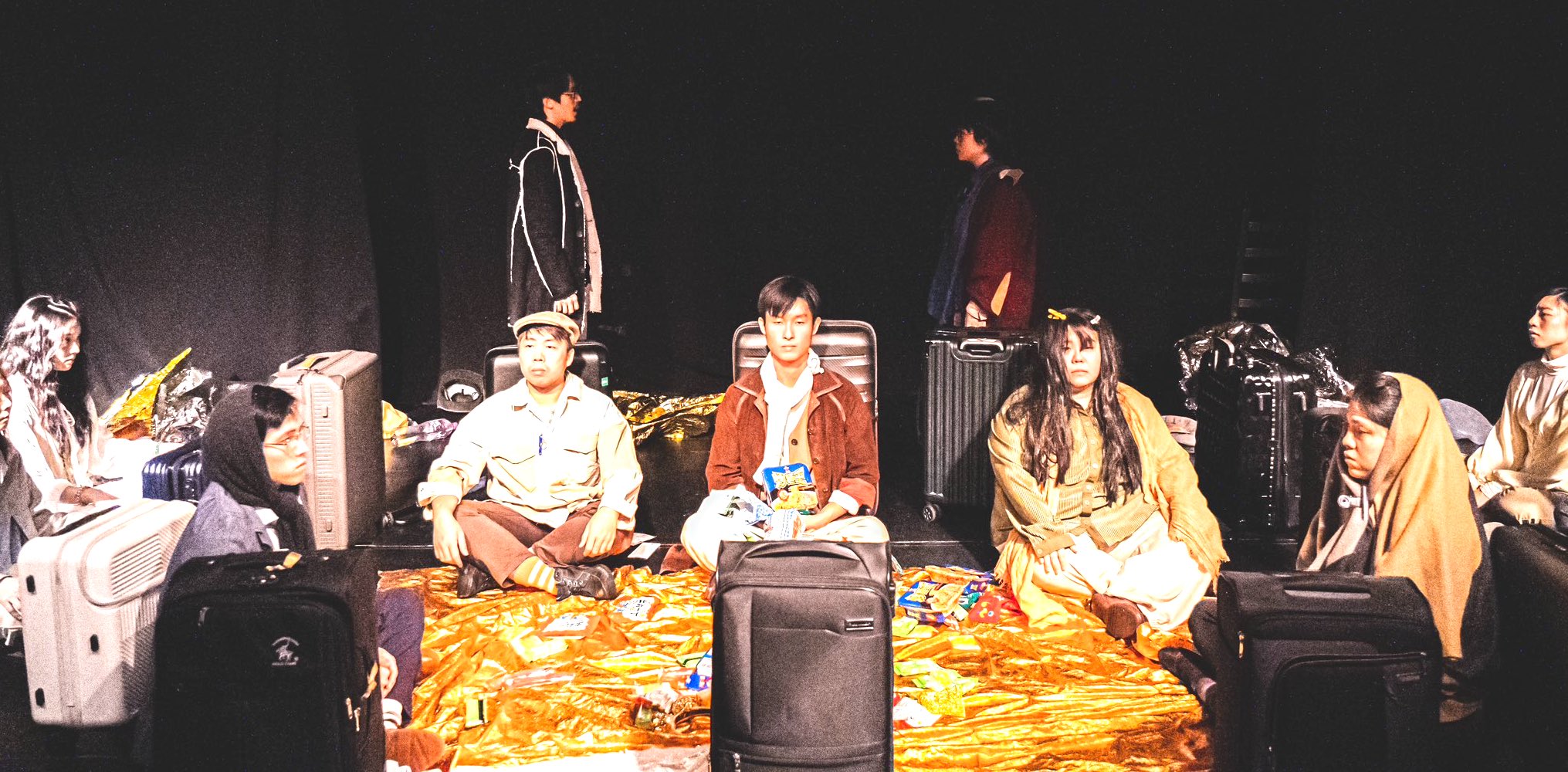
This latest season of A Play, A Pie and A Pint promises to be a good ‘un. Hot on the heels of last week’s sprightly Until It’s Gone comes Burning Bright, Áine King’s apocalyptic depiction of the climate crisis engulfing us. It’s no surprise to learn that this play won the 2022 David MacLennan award: it’s evocative and visual, a big story told in small fragments, as economical as poetry.

We are presented with three disparate narratives, linked by an over-arching theme of environmental collapse. Suzanne Magowan is a TV journalist desperately chasing a story about Australian wildfires, more interested in saving her career than in saving the earth. Hannah Jarrett-Scott plays a grief-stricken young woman with an eco-tourism business, taking rich adventurers on her boat, The Ice Princess, to see the polar ice caps before they’re gone. And Adam Buksh is a survivor: he’s escaped floods and tigers in his native India, and now he’s navigating racism on his Glasgow street.

The performances are all strong, the characters compellingly portrayed, and the writing is gorgeously cinematic – the image of a blazing horse, for example, is horribly mesmerising. Roxana Haines (director), Gemma Patchett and Jonny Scott (designers) achieve astonishing things with a tiny stage and a minimal set, so that it’s easy to suspend my disbelief and accept that I am, simultaneously, in the Arctic, Australia, Scotland and India, witnessing fire, floods and melting ice caps.

The conceit works to emphasise the ubiquity and urgency of climate breakdown. Even these characters, closer to the epicentres of disaster than most of us, are each only aware of one aspect of the problem. But here in the audience, we are shown the cumulative effect: their monologues are tangled and entwined, so that we see their interdependence and the extent of the catastrophe that’s looming over us. The image is there throughout, cleverly captured in the juxtaposition of the encroaching wave of plastic waste that dominates the set, and the tiny dinghy representing our precarious position.

Burning Bright is a superbly accomplished piece of theatre, skilfully illuminating why climate change is an issue we can’t afford to ignore.

4.7 stars

Susan Singfield

Until It’s Gone

28/02/23

Traverse Theatre, Edinburgh

This sprightly two-hander packs a lot into its fifty-minute running time. Until It’s Gone is the first of 2023’s A Play, a Pie and a Pint offerings, and it’s a corker: Alison Carr’s tight and cleverly-crafted script imagines a future where all of womankind have disappeared, and men are left to make the best of a world without them. In stark contrast to Charlotte Perkins-Gilman’s Herland, where women have created a female Utopia, this male-only Scotland is a dystopian mess, its citizens desperate for the women to return from their unspecified and unexplained exile.

We’re offered a glimpse into this terrifying scenario through a simple park-bench, chalk-and-cheese set-up: a meeting between an eager young man of twenty-five (Sean Connor) and a gruff older one (Billy Mack). They’ve been matched by a supposedly ‘world-beating’ app, but this is not a date – or at least, not a conventional one. They are two avowedly heterosexual, cis-gendered men, following a strict government mandate to ‘connect’ – because things aren’t sustainable as they are. Through this smallest of microcosms, Carr seeds just enough information into the men’s darkly comic dialogue to allow us to envisage the bigger picture, the tortured society in which they live, where schools are closed, most interactions happen online, and everything feels wrong.

The characters are beautifully realised, played with warmth and humour by Connor and Mack, even as they expose the men’s real pain. The generational divide is deftly managed, the initial chasm between them narrowing as they talk and share confidences, slowly realising that they’re more alike than not, that their shared fate should bind them rather than pull them apart.

Under Caitlin Skinner’s assured direction, the play’s political points are clearly made without ever feeling intrusive. I like the cheeky use of tableaux and blackouts to mark the passage of time at the beginning, and the set – by Gemma Patchett and Jonny Scott – is modest but strikingly effective. I’m especially drawn to the myriad images of women adorning the tumbledown walls, and find myself wondering if they are ‘missing’ posters or simply photos, there to remind the men of what they’ve lost. 

Because, of course, you never know until it’s gone…

4.4 stars

Susan Singfield

The Bonham: “Boozy Snoozy Lunch”

26/02/23

Drumsheugh Gardens, Edinburgh

Six years ago and still fairly new to life in Edinburgh, we took advantage of a special offer we found online and booked ourselves a ‘boozy snoozy dinner’ at the Bonham Hotel. We were blown away by the venue, the quality of the food and the great value. So when, more recently, we spotted a Black Friday deal at the same hotel, this time for a ‘boozy snoozy lunch’, we decided it was an offer we couldn’t pass up.

As we take our seats in the dining room, we reflect on everything that’s happened since we were last here. Edinburgh now feels like our home and, over those intervening years, we’ve survived some turbulent events – the pandemic being just one of them. The Bonham is exactly as we remember it: a warm, welcoming haven in a central (but surprisingly quiet) neighbourhood. The walls are hung with the same original oil paintings, there’s a soft murmur of conversation, and the staff are still as polite and efficient as ever.

First for the boozy bit – a bottle of Chilean sauvignon blanc, which we make a start on while perusing the menu. For starters, Susan has the heritage carrot panna cotta, quite the prettiest dish you could ask for and absolutely bursting with flavour. It’s accompanied by pink pickled ginger, salted baked carrots and puffed black rice. I opt for the Simpson game venison carpaccio, succulent slivers of ‘melt in the mouth’ meat adorned with beetroot. leek ash, pickled shimeji mushrooms and red vein sorrel. We’re afraid that the current national shortage of fresh fruit and vegetables might have a negative effect, but these fears are quickly assuaged. This is an inspired beginning.

For the main course, Susan samples the stone bass, a generous slice of perfectly cooked fish, presented on a laksa broth and topped with seaweed tapioca. The laksa would be better if it were more robustly spiced, but that’s really our only criticism. I keep things traditional and choose the Ayrshire pork, a mouthwatering chunk of belly meat with a gratifyingly crispy layer of crackling on the top. It comes with ham hock, kohlrabi, spiced compressed apple and hispi cabbage. The apple in particular is an inspired touch, the sharp flavour cutting through the meatiness with ease.

We also share a side order of hand cut chips sprinkled with rosemary scented blackthorn salt. ‘Ah,’ you may say, ‘chips are just chips,’ but these are perfection – crispy exteriors, soft, buttery insides, and completely irresistible.

For pudding, Susan enjoys a delicious chocolate fondant, which is rich and indulgent, accompanied by crispy honeycomb and zesty orange sorbet. I cannot resist the glazed lemon tart, again as pretty as a picture, and served with Scottish raspberries and Normandy créme fraiche. Both puddings are utterly delectable.

Other things may have changed in six years but this is still a perfectly executed menu. Even at the full price of £35 per head, it represents extraordinary value for money and, on the Black Friday deal we’ve booked, it’s an absolute steal. I can think of many venues in the city centre charging twice as much with half the flair of what’s on offer here. I’d heartily recommend The Bonham to anyone in search of somewhere to enjoy a special meal.

Here’s to the next time!

5 stars

Philip Caveney

Othello

23/2/23

NT Live: Cineworld, Edinburgh

Although we’re watching it in a cinema, Clint Dyer’s Othello is avowedly theatrical, overtly referencing the play’s stage history via a series of projected images as the audience trickles in. It’s a powerful conceit, acknowledging the fact that our interpretations of classic texts change with the times, informing us that this will be an Othello for the 2020s (and far removed from Olivier’s infamous 1960s blackface).

Dyer brings the play’s racism into sharp focus, as well as its sexism. Moving the action to the 1930s means that the widespread bigotry Othello (Giles Terera) endures fits into a recognisable framework of fascism. Brabantio (Jay Simpson), who doesn’t want his daughter to marry ‘a Moor’ – not even a super-soldier, credited with defeating the Turkish army – is far from alone in his prejudice. Indeed, we have a whole System (the chorus), all too willing to endorse his view. Roderigo (Jack Bardoe) is not played here as an amusing fool; instead, he is a jingoist, short on reason but bold in his assertions. Thus, as the only Black actor on stage, Terera’s Othello is isolated and visibly different from those around him, and his relationship with the politically-aware Desdemona (Rosy McEwen) is as much ideological as it is romantic.

In this context, it’s no surprise that an unscrupulous schemer such as Iago (Paul Hilton) can thrive. He is the ultimate embodiment of toxic masculinity, propelled by self-entitlement and envy; Hilton makes this Iago deliciously sinister. He abuses everyone: his wife, Emilia (Tanya Franks) bears the brunt of his frustration, but no one is immune. His bitter resentment sours everything, drags everybody down. Othello doesn’t stand a chance against such an insidious adversary, in such an imbalanced world.

Chloe Lamford’s set is stark and monochrome: a semicircular series of steps, suggestive of a Greek amphitheatre. The chorus heightens this notion, acting as a kind of on-stage audience, reflecting us back at ourselves. We are all the System, it seems to say; we are all complicit. The costumes (by Michael Vale) continue the monochrome theme, highlighting the binary opposition of black and white.

This is an excellent production: bold, contemplative, kinetic and engaging. Terera captures both Othello’s strength and his failings, his dignity and his deficiencies. We see his greatness, but also recognise and despise his misogyny when he tries to justify murdering Desdemona by saying he loved her “too well”. McEwen imbues Desdemona with a steadfast nature, confident and assertive to the end, but it is Franks’ Emilia who really surprises: I’ve never been so aware of her as a victim before, nor of her bravery in finally speaking out.

Dyer’s Othello is a complex, clever piece of work. It’s not a radical reworking – indeed, it’s almost entirely true to Shakespeare’s text – but the lens is very different.

4.5 stars

Susan Singfield