Bunker Two

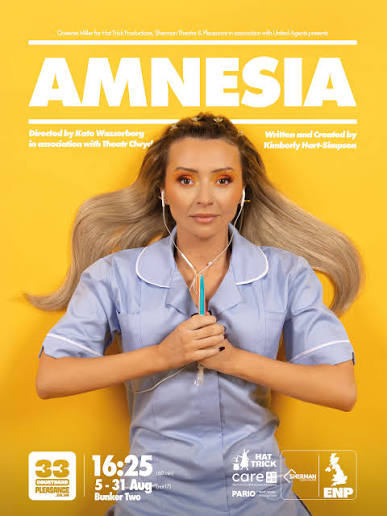
Amnesia

19/08/26

Pleasance Courtyard (Bunker Two), Edinburgh

What comes to mind when you think of Rhyl? If it’s “Blackpool after a neutron bomb” or “Satan’s armpit” then you’re not alone.

For me, it conjures up fond memories. I grew up in a village a few miles inland and Rhyl was the nearest town. The Little Theatre, where I spent my teenage Saturdays. The White Rose Centre, for shops and summer jobs. Nightclubs (I was a Bistro girl). And all the fun of the fair.

For Kelly (Kimberley Hart-Simpson), it’s home. She lives on West Parade with her bestie, Amrit, in a flat above Les Harker’s arcade with a glorious sea view. Everywhere they need to go is only a short walk away: the Bryn Môr nursing home, where they both work; the Cob and Pen, where they socialise (and where Kelly’s mum performs weekly Tom Jones tribute gigs). Kelly’s happy with her life – but Amrit, it transpires, is not.

And Kelly isn’t good with change…

Hart-Simpson paints a convincing portrait of life in a forgotten town – the sort of place that politicians love to talk about but where nothing ever seems to improve. Outsiders mock Rhyl: it’s “the Costa del Dole” – somewhere to escape from. But Kelly mounts a spirited defence. She’s proud of her home, the tourist spot that spawned not only Carol Vorderman and Mike Peters, but also Lisa Scott-Lee and, well, Kimberley Hart-Simpson. No one should need to feel ashamed of where they’re from (especially when it’s as beautiful as the North Wales coast).

If this all sounds a little po-faced, don’t be fooled. Directed by Kate Wasserberg in association with Theatr Clwyd, Amnesia is a wild ride, with as many highs and lows as Ocean Beach’s infamous Runaway Train. Kelly is always in motion – even when she’s still  – and Hart-Simpson effortlessly draws our attention to her pent-up energy and frustration, fizzing fit to burst. From Ibiza nightclubs to old ladies’ bed baths, we’re under the spell of a talented actor, who knows exactly how to engage her audience. 

Although Kelly is thirty-seven, this is essentially a coming-of-age story, as she learns to accept two crucial truths: things don’t always stay the same, and her own idea of happiness is perfectly valid.

4.5 stars

Susan Singfield

Hold the Line

02/08/25

Pleasance Courtyard (Bunker Two)

Hold the Line is the type of theatre that speaks to its time. Right here, right now, when the nation’s beloved NHS has been starved of funds for the past two decades, is exactly the moment for writer/performer Sam Macgregor to shine a spotlight on one of its least glamorous aspects, the 111 non-emergency helpline.

Gary (Macgregor) is a call-handler. The job has more in common with other call-centre work than it does with what we usually think of as healthcare, but with emotional trauma thrown into the mix. In amongst the standard queries there are, of course, the timewasters, ranging from the humorously trivial (“I’ve got a lash in my eye”) to the pointlessly abusive (“Fuck off!”). But there are also desperate people who, unable to get a GP appointment or unwilling to face an eight-hour wait in A&E, stretch the definition of ‘non-emergency’ beyond recognition, forcing Gary to exceed his remit. He’s not a medic: how can he be responsible for matters of life and death? And yet here he is, the only point of contact in a situation he’s not trained for, as his boss tells him there’s no clinician available just yet, so keep the patient on the line… 

Macgregor imbues the protagonist with a raw humanity, while Gabriela Chanova takes on the supporting roles, most notably Tim, calling about his diabetic dad, and Tony, Gary’s supervisor. Regular disembodied tannoy announcements remind Gary (and us) that he has targets to meet, that ‘comfort breaks’ are essentially selfish, causing waiting times to escalate, and that everything he does is being monitored. There is no downtime, no space to process difficult calls and no information available about the outcomes. As so often seems to be the case, the caring professions are not cared for. 

Director Laura Killeen utilises the small space well: Tony’s agitated pacing back and forth along the same path, over and over, serves to underscore the repetitive nature of the work, as well as the  sense of being on a treadmill, going nowhere fast. I also like the simplicity of the design (by Nalani Julien) with its central focus on Gary’s desk, and the cunningly hidden phones, which are used to good effect in the frenetic ‘workout’ routine, highlighting Gary’s inner turmoil. 

I have just one criticism: the section where Macgregor plays ‘Top Brass’, showing how Tony faces the same pressures as Gary, makes some important points, but it’s somehow weaker than the rest of the play, the polemic less artfully disguised. 

That aside, Hold the Line is a tight two-hander, holding up a dark mirror to the state of our health service. Voices like Macgregor’s highlight what’s happening – and hopefully help to bring the change we need. 

4 stars

Susan Singfield