
Titanic the Musical

21/06/23

Festival Theatre, Edinburgh

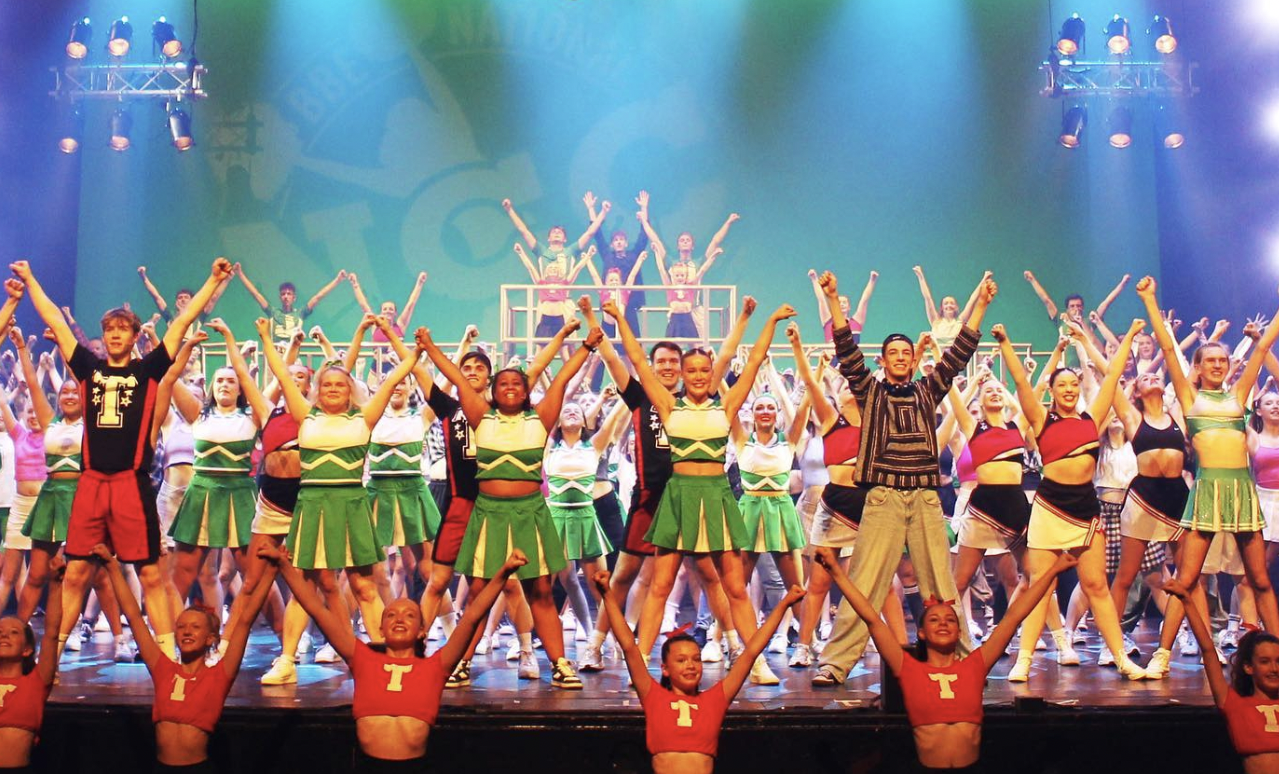
The tragic story of The Titanic has exerted a powerful hold on the public imagination ever since its doomed maiden voyage in 1912. It seems horribly ironic that, as we take our seats in The Festival Theatre, the vessel (or at least an ill-fated attempt to visit what remains of it) is once again dominating the news channels. Still, whatever you think about the subject, this stately musical by Maury Weston and Peter Stone offers an assured account of the events that led to one of the biggest disasters in maritime history.

In the first half, we’re introduced to the players as the ship prepares for departure. There’s Captain Edward Smith (Graham Bickley), looking forward to what he believes (rightly as it turns out) will be his final voyage. There’s the ship’s designer, Thomas Andrews (Ian McClarnon), proud of his own ingenuity and convinced that the ship he has built is ‘unsinkable.’ And there’s J. Bruce Ismay (Martin Allanson), the managing director of the White Star Line, presented here as the villain of the piece, a man whose rampant hubris is held largely responsible for the disaster. The truth is rather more complicated than that, but every story needs a villain, I suppose.

Around this triumvirate flock the passengers: the privileged toffs in first class, the hopeful emigrants looking forward to a brand new start in second, and the poor and the dispossessed down in third. There’s also the many members of staff who wait on more than two thousand passengers. The twenty-five members of the cast certainly have their work cut out to represent so many doomed travellers and, it has to be said, with umpteen speedy costume changes, they do a pretty good job of it.

Yeston’s sombre score avoids the cheesy power ballads so often associated with this kind of production, opting instead for a kind of operetta approach. In the jollier moments (and yes, there are a few in the first half), there’s even a hint of Gilbert and Sullivan in the delivery, as members of the cast waltz merrily across the deck.

But of course, the second half can’t be anything but mournful as the ship, having kept its rendezvous with that iceberg, begins (spoiler alert!) to sink beneath the waves.

It’s here, to be honest, that the production struggles to recreate the ensuing chaos. David Woodhead’s set design is impressive but stolid, and I find myself longing for some state-of-the-art special effects to contribute more Sturm und Drang to the closing moments. What’s more, it’s impossible to be surprised when the story I’m watching is so ingrained into my memory that I find myself picking up on its occasional deviations from the truth.

Still, there are some strong moments here. I particularly enjoy the duet between Frederick Barrett (Adam Filipe), sending a marriage proposal to his sweetheart back in England, and Harold Bride (Alistair Hill), the Marconi radio operator who enables him to do so. And anybody who can keep a dry eye through the final duet of elderly couple, Isador Straus (David Delve) and his wife, Ida (Valda Aviks), as they decide to face their fate together, is certainly made of sterner stuff than me.

The production closes with a tribute to the 1,500 people who lost their lives on that fateful night – and, after the enthusiastic applause has died away, Bickley steps forward to deliver the cast’s heartfelt hope that the passengers aboard the missing Titan submersible might be found safe and well.

That of course – like the Titanic itself – will soon become a matter of historical record.

4 stars

Philip Caveney

Timberyard

18/06/23

Lady Lawson Street, Edinburgh

We’ve lived in Edinburgh for seven years now and we’ve always been aware of this restaurant, just around the corner from where we live, but – for one reason or another – we’ve never eaten here. But our tradition of indulging in fine dining to celebrate Susan’s birthday, plus the fact that Timberyard has recently been awarded a Michelin star, suggest that now is a good time to give it a whirl.

So here we finally are, settling down at a table in the spacious, warehouse-like interior, while outside the long run of hot weather is about to to be interrupted by heavy rain. But in this glorious candle-lit interior, the rain comes and goes without us even noticing.

Firstly, a word about water. Most restaurants try to sell you bottles of the stuff (a practice I’ve long disapproved of for environmental reasons) but at Timberyard, our choice of still or fizzy water comes as standard and our glasses are regularly topped up by the attentive staff – an idea I’m in favour of seeing elsewhere.

Since we’re currently on the wagon, we both decide to try one of their homemade soft drinks. I sample the bramble & lemon seltzer, which is zingy and refreshing, while Susan opts for jam on toast, a drink that somehow – don’t ask me how – really does invoke those flavours. I mean, I understand how they might accomplish the ‘jam’ bit, but how do you make a soft drink taste of toast?

We’ve chosen the eight-course tasting menu, which sounds prodigious, but is carefully presented in perfectly-sized offerings to ensure that the diner is never overwhelmed. That said, we decide to skip the option of adding a cheese course. Even we have limits!

We begin with ‘snacks’ – bread and cultured butter with pickles and ferments, raw beef on toast with yellow beans and cod’s roe and a little bowl of beach rose and tomato broth. These offerings set the tone for the evening, a series of intense flavours, each one different to the last and, frankly, quite unlike anything I’ve eaten elsewhere. The much-lamented Edinburgh Food Studio is probably the venue that comes closest in recent memory.

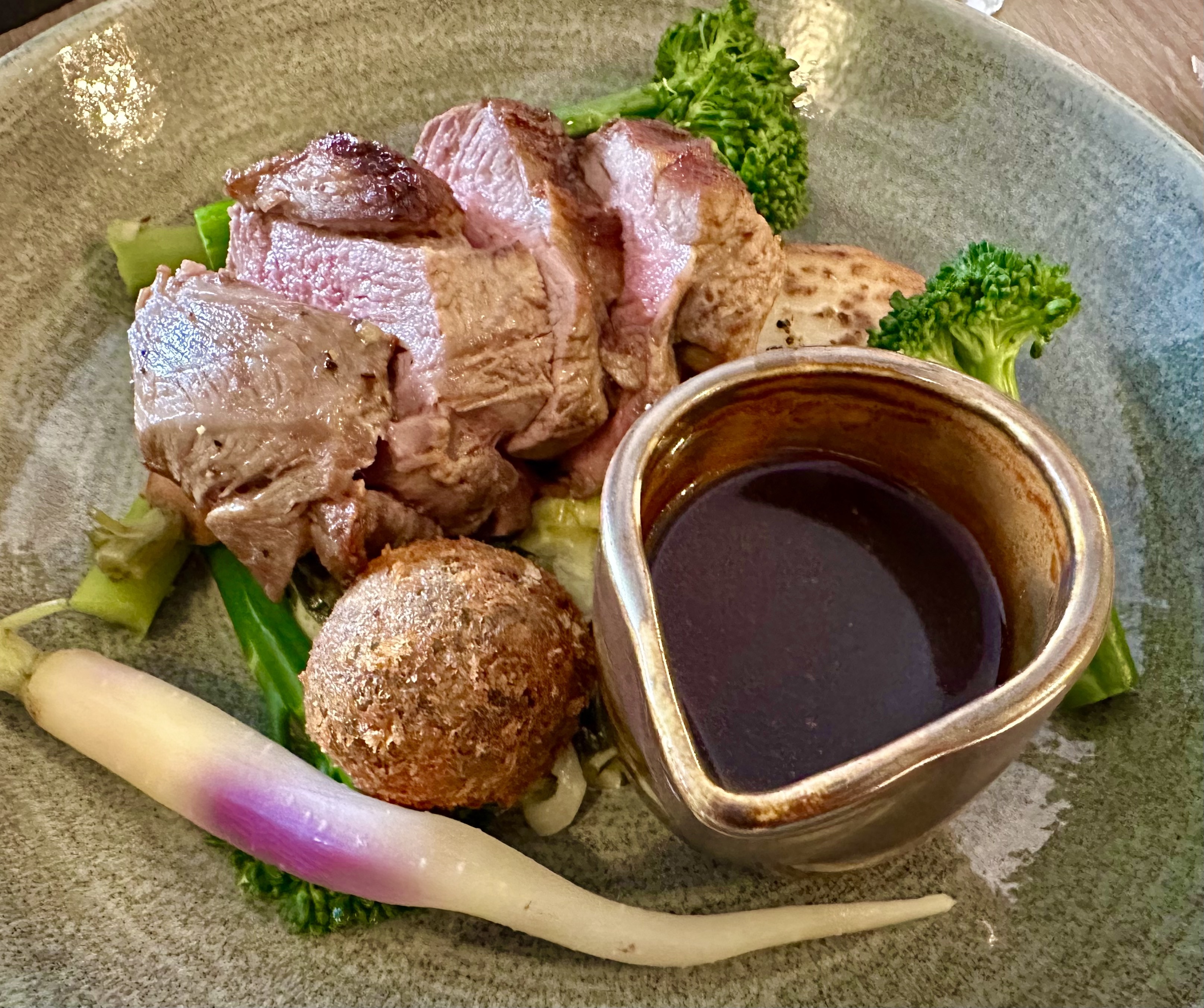
Timberyard’s efficient staff come and go bearing various dishes, each one a tiny revelation. There’s purple sword celtuce with nasturtium, conifer and smoked scallop roe; al denté green asparagus featuring coddled egg, pancetta, comte and hazelnut; veal sweetbreads, rich and succulent with pheasant back mushroom, broad beans and Scot’s lovage; a meltingly tender slice of turbot with pea flowers, sea aster, pil-pil and lobster butter; and chunks of deliciously rare Kerry beef with farm greens and anchovy. To say it’s all delicious would be something of an understatement.

And then of course, there are a couple of puddings. There’s elderflower – a frozen granita served with creme fraiche ice-cream, wonderfully refreshing after the richness of the beef – and there’s woodruff, an edible wildflower with hints of vanilla, cardamom and cinnamon, with a fluffy honey-rich exterior and a salty, bitter chocolate filling that lingers on the palette, ending the experience on a high note.

I can’t really explain why it’s taken us so long to try the Timberyard experience, but I’m glad we finally have. This is challenging food (in the very best sense of the word): an exquisite, constantly surprising selection of dishes that focus on local and seasonal ingredients. I can see exactly how the place caught the eye of the Michelin judges.

One thing’s for sure. We won’t be leaving it so long before we return.

5 stars

Philip Caveney
Greatest Days

18/06/23

Cineworld, Edinburgh

Back in the 1990s, when Take That took the world by storm, I was very anti-boyband. They’re still not really my thing (I’m no aficionado, but I tend to prefer bands that form organically and, you know, play their own instruments). Still, now that I’m a bit older and less tribal, I have to admit that TT did have some banging tunes (Rule the World and Shine are the best, to my mind), although I don’t think I’ll ever feel anything other than incredulous that The Samaritans actually had to set up a helpline for distressed fans when the group announced that they were splitting up. Like… what?

Greatest Days, a colour-by-numbers jukebox musical, leans into the deep emotional connections young followers attach to their oblivious heroes, mining Take That’s back catalogue to mixed effect. Teenager Rachel (Lara McDonnell) is obsessed. Things aren’t great at home – her mum and dad spend all their time arguing – so she retreats into a fantasy life, where ‘the boys’ help her out. An early dance routine, where the Take-That-Alikes pop out of kitchen cupboards to pass her utensils, lift her up to the overhead cupboards and stir her spaghetti hoops fills me with hope: it’s bold and theatrical and a lot of fun. (Sadly, it’s a technique that soon outstays its welcome: too many similar scenes follow, and it all starts to feel a bit overdone.) Her pals, Heather, Zoe, Claire and Debbie (Eliza Dobson, Nandi Sawyers-Hudson, Carragon Guest and Jessie Mae Alonzo), are all equally fanatical, and their friendship reaches its apotheosis the night that Debbie gets them all tickets to a gig in Manchester.

Fast forward twenty-five years. Rachel has grown up to be Aisling Bea (Heather, Zoe and Claire have morphed into Alice Lowe, Amaka Okafor and Jayde Adams respectively, while the adult Debbie is notably absent). Grown-up Rachel is a nurse, and still obsessed with the boys, forcing the kids on her ward to listen to what they perceive as her terrible music taste. She loves her job and her sweet-natured boyfriend, Jeff (Marc Wootten), but something is missing. When she wins a radio phone-in competition, she’s suddenly faced with the opportunity to put that right, to reconnect with the old gang and see their favourite band one last time, as they perform a reunion gig in Athens…

With such a lively, amiable cast and some gloriously OTT big numbers (neither boarding an easyJet flight nor travelling on a night bus have ever looked even a tenth as glamorous as they do here), there’s a lot to like about Greatest Days. However, it’s very uneven, as if writer Tim Firth and director Coky Giedroyc have thrown a match into a box of unlabelled fireworks, some of which prove spectacular and light up the sky (sorry, couldn’t resist), while others fizzle out like proverbial damp squibs. The revelation that the statues in the fountain are the boys, for example, should be a cheeky little wink of a moment, but instead is drawn out into a boring ten-minute montage of selfie-taking. The central premise seems a little overwrought too.

A pleasant – if ironically forgettable – trip down memory lane, Greatest Days probably isn’t going to relight anyone’s fire (I know, I’m doing it again) but, if you’re a fan of ‘the boys’, then you’ll probably enjoy it, so you’d better hot-foot it to the cinema before you run out of time.

3 stars

Susan Singfield

Leopoldstadt

16/06/23

National Theatre At Home

With live theatre events relatively thin on the ground at the moment, it seems a propitious time to indulge in NT Live’s ‘At Home’ selection – and the obvious first choice is Tom Stoppard’s Leopoldstadt, a play in five acts, which chronicles the lives of the Merz family in Vienna. With a cast of forty actors, this is a mammoth undertaking and, while Patrick Marber’s direction occasionally struggles to contain so many disparate characters, it’s nevertheless an education for me, providing an overview of world events that eventually led the Jewish people to the edge of annihilation.

The play opens in 1899, where Merz family patriarch, Hermann (David Krumholtz), his wife Greta (Faye Castelow), and their extended family are celebrating Christmas. Hermann (like many other Jewish businessmen) has converted to Catholicism in order to prosper in his everyday dealings, but he’s only too aware of the antisemitic sentiment of the true gentiles around him and at the party (where one of the children unthinkingly puts a Star of David at the top of the tree) there is already wistful talk of the idea of a Jewish homeland in Palestine.

As the story progresses – we jump first to one year later, then to the jazz era of the 1920s – we are aware that nothing has improved for the Merz clan and that their freedom to thrive is being rapidly diminished. The next section, set in November 1938 on the evening of Kristallnacht, is perhaps the most harrowing sequence, as the family home is visited by a sneering Nazi overseer, who quite literally gives them their marching orders, his callousness exemplified by the seemingly small act of brazenly stealing Hermann’s beloved fountain pen.

A moving coda, set in 1955, features three of the few survivors of that night, comparing notes and remembering the many – the very many – who died in the Nazi death camps. The play begins with a huge extended family on stage, but as the story progresses, their numbers steadily diminish until there are hardly any of them left and the performance space is almost empty. It’s a powerful moment when, in the final minutes, the rest of the cast drift back to stand behind the three survivors, silent witnesses to their own terrible fates.

While it’s nobody’s idea of an uplifting evening at the theatre, Leopoldstadt – which may well be Stoppard’s swan song – is an important and ambitious piece of theatre that highlights how an entire race of people, perhaps because of their very determination to succeed in the face of overwhelming odds, has been systematically tyrannised and subjugated throughout history.

While the complex nature of the Merz family tree (and the actors doubling as different characters) occasionally gives rise to some confusion as those we first see as children return as adults, it’s worth persevering for the powerful melancholy of that extraordinary epilogue, which for quite some time leaves the live audience in stunned silence before the applause finally begins.

3.8 stars

Philip Caveney
Chevalier

14/06/23

Cineworld, Edinburgh

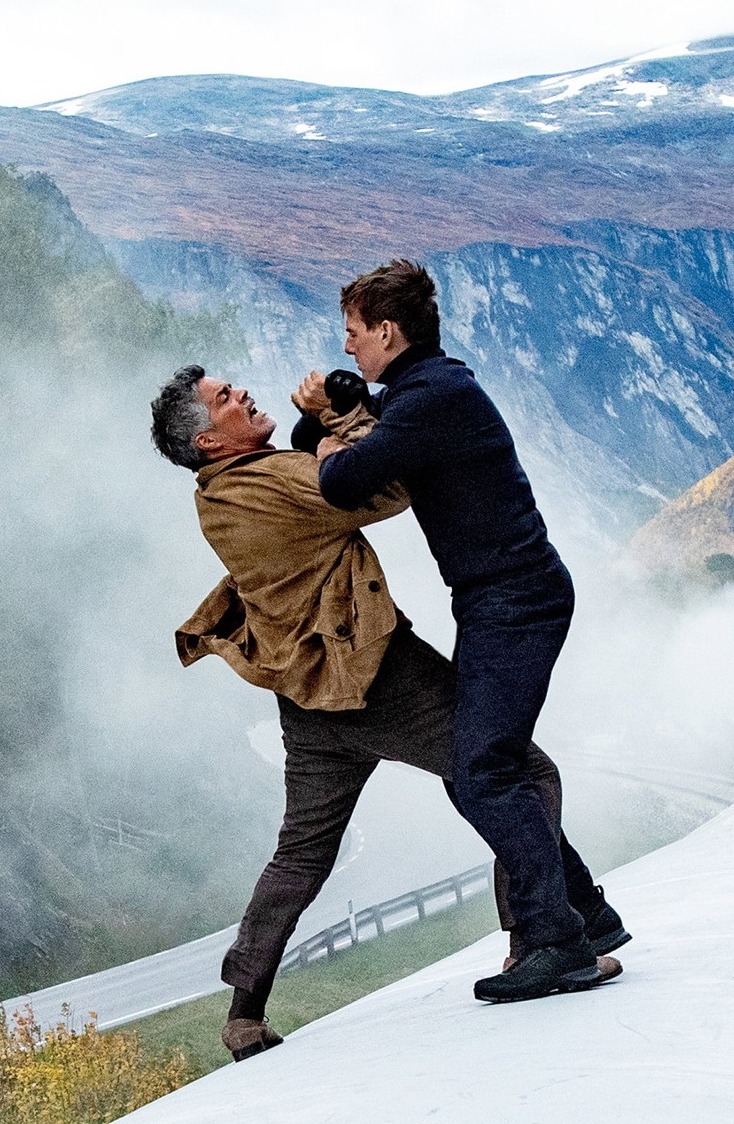
Chevalier is the latest Hollywood film to cast light on an important Black historical figure, previously relegated to a footnote. It’s too little, too late of course, but at least it is a start…

Kelvin Harrison Jr plays the titular Chevalier, Joseph Bologne, a young Black prodigy. The illegitimate son of Georges de Bologne (Jim High), a wealthy plantation owner, and Nanon (Ronke Adekoluejo), an enslaved Senegalese woman, Joseph’s musical proficiency spurs his father to uproot him from Guadeloupe, dumping him in a posh Parisian conservatory, where his violin skills – and knowledge of courtly etiquette – can be honed. Fortunately for Joseph, he is as good with a foil as he is with a bow, and his ability to lunge and parry proves useful, both literally and metaphorically, as he tries to make his way in French society.

The mid-1700s were turbulent times in France, but – for much of this film’s duration – Joseph is closeted from the outside world. Instead, he is protected by his talents, roped in to tutor Marie Antoinette (Lucy Boynton), and fêted by the opera-loving toffs. It’s not all plain sailing, of course: there are repeated slights as well as some open hostility, but – for a while – things seem to be going his way. But when he throws his hat in the ring as a contender to lead the prestigious Paris Opéra, it soon becomes apparent that he has overstepped the mark, and that the establishment will not countenance what they perceive as his presumption. Time to take him down a peg or two, they decide, and a trio of divas, led by La Guimard (Minnie Driver), announce that they will never deign to take orders from a “mulatto”. Joseph appeals to his ally, Marie Antoinette, but she refuses to act. Perhaps he shouldn’t be surprised to learn that a monarch believes in birthright…

But perhaps the Queen shouldn’t be surprised to learn that a victim will want revenge, and that her rejection is the final straw. Nanon, newly freed and reunited with her son in France, has already made some headway educating him about the ways of the world. Now the scales have truly fallen from his eyes, and there is only one thing for it: the Chevalier must join the revolution.

Directed by Stephen Williams, this is a handsomely mounted film, Stefani Robinson’s script sticking largely to the facts, although there is a little artistic license taken with the central romance, with much made of the scant historical information available. Here, Joseph embarks on a doomed affair with Marie-Josephine (Samara Weaving), wife of the vengeful Marquise de Montalembert (Marton Csokas). I think this is a good idea as, although the characters are all well-drawn, and Harrison Jr is particularly compelling, there’s not an awful lot of plot here. This really is Chevalier‘s main problem: the middle third sags. Another strand would help enormously: I’d love to have learned more about Nanon, for example, and her journey from slave to free woman.

Nonetheless, this is a rewarding and informative film, which will hopefully help to restore Bologne’s name to the musical canon.

3.7 stars

Susan Singfield

The Flash

14/06/23

Cineworld, Edinburgh

If Marvel Studios are having a thin time of things lately, spare a thought for DC, who have long struggled to establish a coherent onscreen presence for their cohort of superheroes and seem to feel obliged to put Batman into just about every film they produce. Flash is no exception to this rule. As for its titular hero, the producers must have been tearing their hair out when Ezra Miller’s off-screen controversy threatened to blow the whole project out of the water before it even got off the starting blocks. But here it finally is and, largely by virtue of not taking itself too seriously, it’s more entertaining than most of the recent comic book-inspired movies I’ve recently witnessed.

Barry Allen/The Flash (Miller) is managing to strut his stuff around the city, but is mostly playing second fiddle to everybody’s favourite hero, Batman (Ben Affleck). An opening sequence where The Flash saves a series of babies falling from a collapsing building sets the stall out well. But like most superheroes, Barry is haunted by something dark in his past – in his case, the murder of his mother, Nora (Maribel Verdú), a crime for which Barry’s father is currently serving time in prison, though Barry is convinced of his innocence. When Barry discovers that, by running at a particular speed, he can time travel, he hits on the idea of going into the past and changing one small detail, in order to save his mother’s life.

Before you can mutter ‘space time continuum’ the deed is done and suddenly everything is weirdly different. Barry meets his younger, goofier self, reconnects with an entirely different Batman (played once again by Michael Keaton) and learns that Eric Stoltz is now the lead actor in Back To the Future, a clever running gag that’s used to great effect. More worryingly, Barry has now lost his powers and needs to rekindle them if he is ever going to get back to his own time.

And he really needs to because, thanks to Barry’s time-tinkering, General Zod (Michael Shannon) is back, intent on destroying the entire planet…

Look, set down like that, it does sound like utter piffle, but Flash manages to play it all with real panache, thanks to Andy Muschietti’s assured direction and a witty script by Christina Hodson and Joby Harold. It’s only in the final third, that – predictably – the film begins to sag under the weight of its own hubris. The usual apocalyptic punch-up ensues and I can’t help reflecting that, where Across the Spider-Verse managed to juggle literally hundreds of manifestations of its lead character without ever becoming muddled, Flash‘s attempt to do something similar with the character of Superman just becomes incomprehensible. Supergirl (Sasha Calle) is also a player in this film but, apart from supplying a kind of get-out clause when everything is beyond salvation, she remains disappointingly 2D.

Still, there’s a satisfying conclusion to it all and a likeable final joke to send me on my way with a smile on my face. And if you ever wondered what Nicholas Cage’s Superman would have looked like, had it ever got off the ground, here’s your chance to find out.

3.8 stars

Philip Caveney

Gurkha

12/06/23

Broughham Place, Edinburgh

Traditional curry houses have been going through turbulent times lately, with many customers preferring to turn their attention to Indian street food-style cafes. Local favourite The Bombay Bicycle Club is now under new ownership as Gurkha, which offers Indian and Nepalese cuisine. (A bit further down Brougham Street, The Nilgiri Spice is in the early stages of a similar transformation.)

We’ve actually opted to visit on opening night, lured in by a money-off voucher, and – as it’s the hottest day in Edinburgh so far this year – we’re half expecting the place to be quiet.

But there’s a lively vibe when we arrive, with balloons festooning the entrance and a veritable crowd inside, celebrating the occasion. As we’re currently having a break from the booze, we’re delighted to note that in addition to alcohol free beer, Gurkha also offers zero percent wine in white, red and even rosé, which is something we haven’t found on any other menus in the city, so we promptly order a drink each.

We share a mixed starter, comprising chicken tikka, lamb tikka, seekh kebab and (best of all) a couple of crispy, chewy king prawns. The dish is perfectly cooked, the flavours and aromas inviting and the dish is nicely presented with generous swirls of different sauces in which the meat can be dipped. It’s a great start to the meal and proves to be the highlight.

For mains, we’ve chosen a lamb tikka saslik and a chicken makhani, which again are nicely done, though perhaps lacking the impressive presentation of that starter – though to be fair, it’s hard to know how you might make a chicken makhani (a big dollop of brown sludge) look beautiful. It tastes good and that’s the main thing, right?

To accompany the dish there’s a lovely peshwari naan, thin and crispy, with a delicious mango and coconut filling – and a bowl of coconut and pineapple rice, which, on reflection, may be a tad too sweet when coupled with the naan. But that’s on us for not thinking it through, and I should add that not one single grain remains after we’ve applied ourselves to the task.

And that’s us done, far too full to think about a pudding and happy to slip out to enjoy the rest of a sunny afternoon in Edinburgh, leaving the celebration in full swing. Here’s wishing Gurkha a happy and prosperous future.

4 stars

Philip Caveney

Reality

11/06/23

Cameo Cinema, Edinburgh

You may not be familiar with the name Reality Winner. And if you think it sounds like a nom de plume, invented for a would-be game-show participant, let me assure you that she’s a real person, who only recently finished serving a four year jail sentence for… well, here’s the thing. Some would say that she betrayed her own country. Others would argue that she went to jail for daring to expose something that really should have been in the public domain in the first place.

I know which camp I belong to.

And anyone who would suggest that a well-written screenplay can easily swing a viewer in its preferred direction should note that Tina Satter’s intriguing film (her debut as a director) cannot be accused of misrepresentation, because the actors in this true life drama speak words taken verbatim from a transcript of the original FBI interview tape.

We meet Reality (Sydney Sweeney) as she returns from a shopping trip to be confronted by Agents Garrick (Josh Hamilton) and Taylor (Marchant Davis), who show her their ID badges and then announce they have some very important questions to ask her. Its 2017, shortly after Donald Trump has fired James Comey. Reality is ex-airforce, now working for a government contractor as a translator of Farsi (though she’s actually much more proficient in Pashto). The two agents are investigating the recent leak of classified documents to online publication, The Intercept – documents that claim to provide proof of Russian interference in the 2016 United States election.

The interview gets under way, the two agents continually pushing and prodding their suspect. They are by turns genial and menacing and, under their combined onslaught, Reality’s confident stance soon begins to crumble…

There are no real surprises here – the case is already a matter of record – and this is a deceptively simple piece but, as the interview progresses, I form the powerful conviction that Reality Winner has been used as a sacrificial lamb in order to deter others from going down a similar path. Found something dodgy? Pretend you never saw it! Think you’ve found proof of underhand behaviour? Look the other way! Or face the consequences.

Sweeney’s portrayal of the titular character is extraordinary, offering an equal mix of vulnerability and self-conviction. There are flashes of directorial brilliance when lines of dialogue, redacted by the FBI from the tape, cause the characters themselves to vanish temporarily from the screen, the ultimate unreliable narrators. I’m pretty sure I’ve ever seen this idea done before but it’s an extraordinary flourish in an important film that deserves to be seen by as wide an audience as possible. Judging by the sparse crowd at this afternoon’s screening, that may not be happening – but it should.

I leave the theatre seething with indignation, reflecting that American politics is sinking ever deeper into the mire and that British politics (based on news received while actually writing this review) seems to be heading in the same direction.

4.6 stars

Philip Caveney
ChildMinder

10/06/23

Traverse Theatre, Edinburgh

Edinburgh-born Joseph lives in New York, where he is a celebrated child psychiatrist. He seems to be living his best life, with a beautiful, clever girlfriend, as well as a stellar career. But Joseph’s success is built on shameful foundations and a reckoning looms. Reparations need to be made on both the micro and the macro level – for his own transgressions as well as his country’s.

There are two distinct strands here, each echoing the other, their links compelling if not always quite clear.

On the one hand, we have a pretty straightforward ghost story, its origins laid bare in the opening scene, where Joseph (Cal MacAninch) is confronted with a repressed memory from when he was five years old: his baby brother’s murder. This shocking revelation opens the door to other carefully-buried feelings of guilt, and Joseph soon finds himself tormented by the ghost of a thirteen-year-old patient, Sam (Ben Ewing), who holds the doctor accountable for his death.

On the other hand, we have a meditation on the nature of colonisation, symbolised by Joseph’s relationship with Cindy (Mara Huf), a Native American anthropologist. Cindy’s culture, all-but erased by white settlers, has now been commodified for their entertainment, and the couple indulge in an ‘authentic’ 1700s dinner in a fancy Manhattan restaurant. At first, the pair are in celebratory mode. After all, Cindy has just completed her PhD. But, as Joseph insists on sharing a long and rambling fantasy, a feeling of unease begins to grow, and it’s a relief when Cindy calls him out, and the allegorical nature of his proprietorial daydream is made evident.

This is an ambitious piece of theatre, and the actors are clearly revelling in its complexity. Ewing is particularly striking, both as the mysterious “wait”-er and the troubled Sam. The set, by Kenneth MacLeod, is stark and simple, the squares of light redolent of the glass-box apartments on Edinburgh’s Quartermile, ex-home of the Royal Infirmary, where Joseph used to work. These borders also serve to hem the characters in, trapping them in a claustrophobic nightmare.

For the most part, Kolbrún Björt Sigfúsdóttir’s direction is flawless, imbuing the piece with all the gravitas it requires. Even the scene transitions are eerie, each prop moved with intent – all carefully choreographed for maximum impact. However, all this precision makes the use of dry ice especially irritating. It adds nothing; it’s just invasive, obscuring the stage and making the audience cough.

I like what McClure is trying to achieve here. It’s an exacting script with a vast scope. I’m not sure it always comes off – a little more transparency wouldn’t go amiss – and it’s certainly not a crowd-pleaser (there are five walk-outs in tonight’s show). But we need theatre that pushes boundaries and challenges our expectations, and ChildMinder certainly gives us that.

3.7 stars

Susan Singfield

The Covenant

09/06/23

Amazon Prime

Since the glory days of Lock Stock and Two Smoking Barrels, Guy Ritchie’s cinematic status has steadily declined, reaching its nadir in his truly dreadful King Arthur epic, Legend of the Sword, a film that had me laughing for all the wrong reasons. So I approach this Amazon Original with some caution, despite having heard good things about it.

I’m happy to report that this powerful and propulsive war movie, based on a true story, represents a solid return to form for the director.

It’s March 2018 and, deep in Taliban-occupied Afghanistan, Master Sergeant John Kinley (Jake Gyllenhall) is carrying out a routine vehicle inspection, which results in the detonation of an IUD device that claims the life of his interpreter. His replacement is Ahmed Abdullah (Dar Salim), a man disliked by many of the American troops, but Kinley is impressed by his quiet authority. He employs Ahmed and quickly learns to trust the man’s instincts. He also appreciates that, because Ahmed’s son was murdered by the Taliban, he’s not going to compromise his role. Like all the other native interpreters, Ahmed is lured by the promise of an American visa and passport for himself and his immediate family.

When Kinley’s team raids a possible insurgent arms cache North of Bagram air base, they find themselves overwhelmed by the sudden arrival of Taliban reinforcements. All but Kinley and Ahmed are killed in the ensuing carnage, while Kinley is so badly injured that he is close to dying. But Ahmed saves his life, loads him aboard a wooden cart and pushes him for miles across mountainous territory, risking everything in his heroic determination to get Kinley to safety.

When, weeks later, Kinley awakens in a hospital in California, he is told – much to his horror – that Ahmed is still back in Afghanistan, where he is on the Taliban’s ‘most wanted’ list. The offer of repatriation has been conveniently overlooked. Kinley owes Ahmed a debt that he feels must be repaid. After months of trying to arrange a rescue through official channels, Kinley realises that this is something he’s going to have to organise himself…

The Covenant is a tightly-directed action movie that manages to generate genuine suspense in the telling. A lengthy sequence representing Ahmed’s epic journey – framed through the memories of Kinley as he travels through the mountains of Afghanistan – shows considerable directorial flare as the events come back to a drunken Kinley in a series of near-hallucinatory images. If I’ve a criticism, it’s that neither Kinley’s wife, Caroline (Emily Beechum), nor Ahmed’s wife, Basira (Fariba Sheikhan), are given enough to do or say in the screenplay, which is written by Ritchie with Ivan Atkinson and Marn Davies. A female perspective would be a useful addition, I think – particularly considering that Caroline is a major factor in the decision to launch a rescue attempt.

The movie’s postscript points out that hundreds of interpreters were cruelly abandoned when the American military pulled out of Afghanistan. Many of them were executed by the Taliban, while others are still in hiding. The Covenant is therefore more than just a well-directed ‘shoot ’em up.’ It’s also a damning indictment of yet another shameful chapter in recent American history.

4 stars

Philip Caveney