Last Christmas

cxfn_7-xeaakjaj

13/12/16

Traverse Theatre, Edinburgh

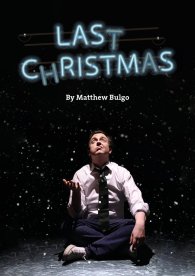
The Traverse does grown-up Christmas theatre, and we’re thankful for that. It’s not that we don’t enjoy stories for younger audiences (Philip is a children’s author, after all), but it’s good to have a little variety, and the festive season often seems a little one-note, catering only for those with youngsters in tow. Not here, though. Here we have Matthew Bulgo’s Last Christmas, a monologue about grief and love.

Welshman Tom is angry and depressed. He’s struggling to cope with his father’s death, and hates the forced jollity of the office Christmas party, especially when Suse, his despised boss, tries to make him pay actual cash for the privilege of being there. He has relationship problems too: things with his girlfriend, Nat, are moving faster than he can deal with, and he’s really not sure that he’s going to make it through the holidays. A visit home to see his mum helps him to confront his demons, and to come to terms with both his future and his past.

It’s a strong performance from Matthew Bulgo, who succeeds in taking us with him through a whole gamut of emotions. There’s no set, no props, no obvious costume. Just one man, casually dressed, talking us through a few days of his life. And it’s well done: understated and convincing. Okay, so it’s a slight tale, and there’s no moment of high drama, no resounding climax to round things off. But it’s very nicely told, and certainly worth going to see.

3.8 stars

Susan “Suse” Singfield


The Birth of a Nation

11/12/16

The Birth of a Nation arrives on our shores burdened by the weight of considerable expectation. Premiered at Sundance in January, this independent production garnered rave reviews and a record-breaking sale to Fox Searchlight pictures and, at the time, there was much talk of Oscar nominations. Since then, however, the water have been somewhat muddied by the revelation that star/writer/director, Nat Turner was accused of rape back in  1999 (although he was subsequently acquitted) and that the film, though clearly heartfelt, might not be quite as accomplished as early reviews suggested.

The title itself is also controversial, since it is shared by DW Griffith’s infamous silent movie of 1915, which made heroes of the Ku Klux Klan and had them riding to the rescue of a young white woman (played by Lillian Gish), menaced by pantomime black villains.

Turner’s based-on-true-events film tells the story of Nate Parker, a young slave raised on an antebellum cotton plantation in the deep South of America, who manages to teach himself to read and, encouraged by one sympathetic slave owner, goes on to become a preacher, travelling from plantation to plantation in order to spread the word of God to his fellow slaves. In doing this, he is helping to earn money for his repellant master, Samuel (Armie Hammer) a once powerful patriarch, now a hopeless alcoholic, obsessed with living up to the reputation of his late father. As Nate travels, he witnesses the kind of everyday brutality meted out to black people in the system (a scene where a man’s teeth are taken out with a hammer and chisel is hard to watch) and he begins to feel a sense of outrage over their predicament; but it is not till the rape of his own wife, Cherry (Aja Naomi King) at the hands of white ‘slave-chasers’ that his thoughts finally turn to bloody rebellion.

Some of the scenes depicted here will inevitably outrage any sane viewer, but the film also commits the cardinal sin of being rather dull for long stretches and there are some decidedly ill-considered moments – Turner’s occasional visions of a angel are particularly mawkish. This is by no means a bad film; indeed, as a debut, it’s more than competent, but it must be said, that it’s certainly not the masterpiece we might have been led to expect; and judging from the few bums on seats at the afternoon performance we attended, it’s not exactly pulling in the punters either.

Brutal, hard-hitting and worthy of attention – but not as assured as it could have been.

3.3 stars

Philip Caveney

Alice in Wonderland

09/12/16

Lyceum Theatre, Edinburgh

The Lyceum’s Alice is a sumptuous affair, with a gorgeously decadent design aesthetic. Of course, the imagery is all there in the source material (by which I mean both Lewis Carroll’s novel and John Tenniel’s original illustrations), but it’s beautifully realised here by designer Francis O’Connor, with a set and costumes that are at once familiar and completely new. The script focuses on some of the lesser-known scenes from the book – that is to say, those not immortalised by Disney: the duchess and the pig-baby; the mock-turtle and the gryphon – but sensibly includes the most dynamic moments too: we’re not deprived of the tea-party, nor the ‘off-with-her-head’ trial. And the special effects are truly mesmerising, with Alice’s final transformation a particular delight.

If there are problems, some of them lie with the tale itself: it’s an episodic story, famed more for its eclectic characters than for any narrative thrust. This Alice doesn’t even seem too bothered about finding her way home and, without this aim, the play is lacking any real drive; there’s just no sense of peril here. Some scenes work well anyway – giant Alice trapped in the rabbit’s house, for example – but others are somehow lacklustre, let down in part by the music, which just isn’t toe-tapping enough for a children’s show (although it might sound better if the singers were mic’d so we could actually hear the lyrics properly).

Jess Peet, making her professional debut here, is a lively and appealing Alice. And the ensemble cast work well together, convincingly populating Wonderland, although there are only nine of them. Their brief moments of audience interaction feel a little grafted-on, but all-in-all this is a decent show, and the kids in the audience certainly seem enthralled.

3.6 stars

Susan Singfield


Black Beauty

imgid90572441

08/11/16

Traverse Theatre, Edinburgh

If they gave out awards for Shows That Aren’t What You Expected Them To Be, then the Traverse’s production of Black Beauty must surely be a contender for the top prize. I  genuinely roll up to this expecting a more or less straightforward retelling of Anna Sewell’s classic novel – so I spend the first ten or fifteen minutes in WTF? mode as I am introduced to the McCuddy brothers – Big Andy (Andy Cannon) and Wee Andy (Andy Manley) who make up the front and rear end of a pantomime horse called Hamish. The boys are on their uppers, because sadly nearly all the available roles are going to pantomime cows these days (even the coveted animal role at this year’s Kings Theatre show!).

These opening sections are played for laughs and it quickly becomes apparent that the show is aimed squarely at the younger members of the audience, some of whom are so impressed with what’s going on, they decide to do a running commentary throughout, something that the actors deal with expertly.

Just as I’m beginning to think that this has absolutely nothing to do with that famous novel, the brothers reveal that the book was their late mother’s favourite read and they begin to retell the story in their own quirky style – whereupon the show settles into its stride (or should that be trot?). The staging is simple but ingenious. The horse trailer in which the brothers travel opens up like a box of mysteries to create a host of different locations – and our equine hero is portrayed by all manner of random objects – wellington boots, a handbag and sometimes even by ‘Hamish’ himself. It’s all rather charming and exerts that charm increasingly as the story progresses. There’s a lovely ‘George and Lenny’ interplay between the two brothers – Manley is particularly endearing as the man-child, Wee Andy, always being passed over in favour of his big brother – and the physicality of both performances is precise and wonderfully comedic.

There’s a final, inspired joke at the play’s conclusion, one that really is aimed at the older viewers – indeed, the kids must wonder why their parents are laughing so uproariously – and ultimately this is a lovely family production, suitable for all ages, and – once you get over that initial confusion – really rather fabulous.

4 stars

Philip Caveney

Jack and the Beanstalk

cfk-panto-beanstalk-header

30/11/16

King’s Theatre, Edinburgh

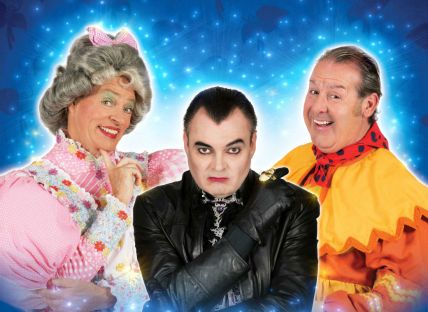
I thought I knew what to expect with this one. I’ve seen a lot of pantos in my time (and even performed in a few amateur productions when I was a kid). But I have never – NEVER – seen one as accomplished as this. The sheer scale and spectacle of it is genuinely awesome. I left the theatre feeling light as air and full of joy. And surely this is what pantomime is all about?

Allan Stewart (Dame Trot), Andy Gray (Hector) and Grant Stott (Fleshcreep) have made their collective mark as King’s Theatre panto regulars – and it’s easy to see why they’re so popular. They have an easy rapport with each other, as well as with the crowd, and they’re genuinely funny, milking the script for all its worth, as well as ad-libbing profusely to excellent effect. And the supporting cast are all good too, with no weak link among them.

It’s nice to see a pantomime that values its host city; typically, they seem to make jokes at the town’s expense, rather than celebrating its fabulousness as this one does. The good fairy, for example, is presented as ‘The Spirit of the Castle’ (Lisa Lynch), which rather obviously implies that the city itself is a protective one, with goodness at its heart. It’s a lovely touch.

The production values are very high. There’s clearly been no expense spared, and every penny has been well spent. From the superb costuming (the animals are particularly appealing) to the special effects, this is truly a spectacular piece of theatre. The giant, for example, is extraordinarily rendered, a looming monstrosity of a prop, prompting the whole audience to gasp – although even this pales in comparison to Dame Trot’s jaw-dropping beanstalk ascent.

If there’s a criticism, it’s a tiny one: the giant’s demise is perhaps a little underwhelming after everything that has gone before. But honestly, it doesn’t matter. With a show where everything – the music, the choreography, the acting, the writing, the jokes, the scenery – is this impressive, it seems churlish to criticise.

By far the best pantomime I have ever seen: a standout production.

5 stars

Susan Singfield

Mascots

26/11/16

This latest film from Christopher Guest (Spinal Tap’s Nigel Tufnel) takes a tongue-in-cheek look at the world of professional mascots, those stalwart individuals who don outlandish costumes and help to promote football teams/organisations/products around the world, usually by prancing about to a musical backing.  This is a Netflix original, but Guest’s methods seem to be largely unchanged from the likes of earlier films, Best In Show and A Mighty Wind. Like so many of his ‘mockumentaries’ this follows a bunch of random characters as they prepare themselves for the equivalent of their Oscars, the Fluffies, cutting effortlessly from scene to scene as the action unfolds.

The Mascots themselves include: young Englishman, Owen Golly Jr. (Tom Bennett), carrying on a family tradition as football mascot, Sid the Hedgehog, under the baleful glare of his dad, who formerly played the role; Mike and Mindy Murray (Zach Woods and Sarah Baker), a middle-aged couple desperately trying to rock their double act despite the fact that their marriage is falling apart; and art-obsessed Cindi Babineaux (Parker Posey), whose armadillo character seems aimed at an entirely different audience. And, of course, the judges and organisers prove to be a thorny bunch, most of them coming to the competition with their own hidden agendas. Guest himself performs a cameo as Corky St Clair, a pretentious dance trainer helping to put Cindi through her paces. British comic Kerry Godliman also makes an appearance as Owen’s delightful and supportive wife – making them pretty much the only non-dysfunctional couple in the entire movie.

This is wry, whimsical stuff, not exactly laugh-out-loud funny, but nicely judged and constantly amusing. It’s evident just how many artists – from Ricky Gervais to Larry David – have taken inspiration from the Spinal Tap model, which –  back in 1984 – was one of the first feature films to venture down the spoof documentary trail.

Mascots is right there on Netflix, and, if you’re already a customer, you’d be crazy not to check it out.

4.2 stars

Philip Caveney


A United Kingdom

maxresdefault

25/11/16

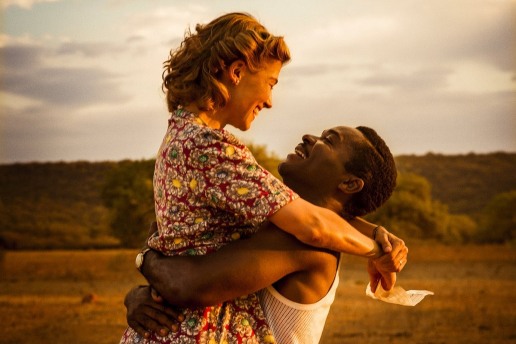
Amma Asante’s A United Kingdom tells the true story of Prince Seretse Khama of Bechuanaland (now Botswana), and the extraordinary international response to his marriage to Ruth Williams, a white, middle-class Londoner. Ruth’s father (Nicholas Lyndhurst) isn’t happy and vows to disown her; Seretse’s uncle, Tshekedi (Vusi Kenene), believes it renders his nephew unfit to rule. But their combined disapproval is nothing compared to the horror of colonial might, and the crushing forces of British and South African politics. It’s a disturbing account of late imperialism, laying bare some awful truths about our not so distant past.

David Oyelowo and Rosamund Pike are perfectly cast as the central couple, committed as much to their ideals as to each other. They are at once proud and humble, resolved and open-minded. The film’s focus on Khama’s emotional reactions personalises colonialism in a way I have never seen before, illuminating the brazen greed, hypocrisy and gross sense of entitlement of those seizing rule of lands that are not their own. Jack Davenport, as the brutal, arrogant Alistair Canning, embodies this with ease.

The post-war era is beautifully evoked, with both London and Botswana rendered real and immediate; the cinematography is very good indeed. If there’s a problem, it is perhaps in the feelgood cosiness that somehow permeates this film, despite its immersion in some very ugly deeds. Nevertheless, this is a mightily important tale, and definitely one worth going to see.

4 stars

Susan Singfield

The Cottage Kitchen

25/11/16

Logies Lane, St Andrews

We’re in Dundee for an event which finishes around midday, so we decide to call in at St Andrews on the way back to Edinburgh. It’s a crisp, bright afternoon and we arrive feeling hungry, so we decide we’ll eat first and explore later. There are plenty of ‘chain’ restaurants and cafes around, but we soon spot the Cottage Kitchen, tucked away on Logies Lane. It’s busy but we notice a small unoccupied table and make a beeline for it.

The interior is intimate, rustic and there’s a friendly atmosphere. There’s a basic menu on the table and a selection of specials on a chalkboard above the counter. We don’t want to spend ages perusing the menu, so we choose quickly, deciding that we will share the two meals between us.

These comprise a homemade Puddledub pork sausage roll and a marinated bavette steak sandwich. The former is definitely the star of the show, a generous hunk of nicely seasoned meat wrapped in flaky pastry. The steak bavette is decent too, a chunk of medium rare meat, ladled with a horseradish sauce and served on crumbly focaccia. It comes with a choice of a side salad (there are four to choose from) and we opt for the roasted chorizo and mixed pepper which is delicious going down, but is clearly destined to repeat itself later on. As it’s a chilly day, we also order an accompanying mug of tomato and lentil soup apiece, which is hearty and warming,  but a lot bigger than we bargained for. It may seem surly to complain that there is a bit too too much of everything, but we’re left far too full to investigate the selection of delicious-looking cakes and pastries (all made on the premises, I’m told), so we decide we’ll investigate them another time.

All in all, a decent lunch venue, offering something a little bit different.

4 stars

Philip Caveney

Lucy Porter: Consequences

6861.jpg

23/11/16

The Stand, Edinburgh

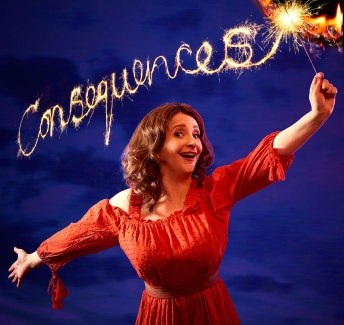
Lucy Porter’s Consequences is a slyly clever show. We’re beguiled in the first half by her friendly, chatty persona; it’s a conversational, observational three-quarters of an hour, consistently funny but never challenging, focusing on ageing, class status, and suburban family life. There are chocolates and there is port, given liberally to audience members who respond to her questions. There are some gentle comparisons between young and old (Philip is called upon to represent the old, but he’s not very good at it: he doesn’t  – it transpires – even know what an A road is). There’s wit and warmth, and it’s easy to enjoy. And then there is the second half. And that’s very different.

Because the second half interrogates all that we have heard before. The consequences, so to speak. The acknowledgement that sixteen-year-old Lucy would likely launch a blistering attack on her forty-three-year-old future self, for selling out and not living up to all of her ideals. And then an endearingly honest self-examination: what does current Lucy think she needs to change? Her attitude to trans rights, for example, is analysed and found wanting, so she educates herself, talks to people who know more: older Lucy still wants to get it right, is still prepared to learn. Oh yeah, and she’s still funny. And charming. And far more demanding than that first half led us to believe. It’s a neat conceit, and beautifully done.

4.6 stars

Susan Singfield


Paterson

20/11/16

Jim Jarmusch is one of America’s most respected indie directors. After the somewhat disappointing Only Lovers Left Alive, he’s back on more confident form with this quirky tale of a would-be poet and the daily grind which he must endure, whilst filling all of his available down-time with his cerebral scribblings.

Paterson (Adam Driver) lives in Paterson, New Jersey – in typical Jarmusch fashion, this is presented as mere coincidence. By day he’s a bus driver and the film follows a week in his life, starting each morning with him waking up beside his partner, Laura (Golshifteh Farahani) and then following him to work, sharing his bus route and after he has returned to one of Laura’s nightmarish attempts at cooking,  accompanying him on his evening walk with Marvin (the couple’s bulldog) which inevitably ends with Paterson having a beer at his local bar. If this sounds dull, rest assured, it’s not. Through Paterson’s eyes we meet a host of fascinating local characters and experience their disparate stories – and we also share Paterson’s attempts to write new poems, which announce themselves onscreen as lines of text. His poems aren’t exactly earth-shattering, (his writing hero is William Carlos Williams, and the influence is apparent) but they do show a real intellect at work, and the fragmentary quality of them is strangely beguiling. I’ve rarely seen a more convincing onscreen portrayal of the writing method.

Back at home, Laura seems completely obsessed with making it big as something – a cake maker, an interior designer, a fashionista, a country and western singer – she’s not fussy, she’ll try anything, despite the fact that she never really rises above the ‘fairly accomplished’ in each successive project she takes on; and in the end, this is essentially what Paterson is about; the way in which people nurture some particular talent they have (or think they have) as a way of dealing with the mundanity of everyday existence.

The film throws us a late googlie-ball in an incident that really is any writer’s worst nightmare.  I  wish Jarmusch had resisted signposting it quite as much as he does; although the gasps from the row behind us suggested that not everyone had seen it coming. This however, is a minor niggle. As a celebration of the creative spirit, Paterson is a little delight, and one that deserves your consideration.

4.6 stars

Philip Caveney