Theatre

Home’s First Birthday

Gutted-12Late Night Love

20th-22nd June 2016

Hard to believe, but Home – Manchester’s hub for all things creative, has already been here for one year and recently celebrated it’s millionth customer. So this weekend, they’re having a bit of a party, with all kinds of free events, live music and (I shouldn’t be at all surprised) a lot of people in the bar.

But what theatrical events have they lined up, you might ask. And I’m glad you did, because surely only Home would offer the offbeat double bill that’s currently showing in theatre 2.

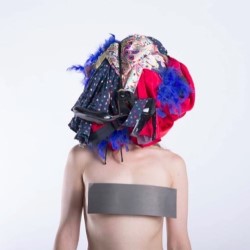
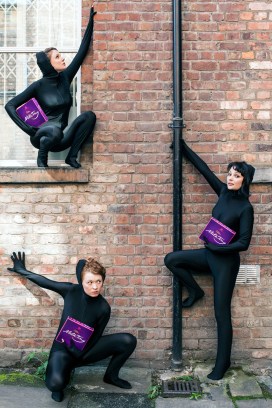
The evening kicks off with Late Night Love by Eggs Collective, a weird sort of cabaret that focuses on late-night radio romance. Three black suited actors slink around the theatre offering free chocolates, glasses of prosecco, a bit of ice sculpture and a collection of mawkish power ballads. It’s weird, engaging and a lot of fun. If you want to get involved, make sure you grab a seat at one of the tables up front.

4 stars.

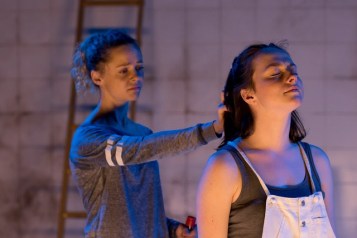
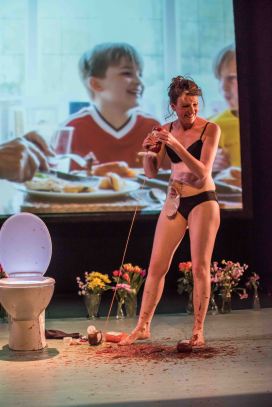
After a short interval, head back into the theatre for Gutted – a one woman show in which Liz Richardson performs a piece about ulcerative colitis. (And before you react by saying, ‘that doesn’t sound like a lot of fun,’ don’t be fooled. Richardson (who cowrote the work with Tara Robinson) offers a fearless performance, where all aspects of the condition are unflinchingly explored and where she takes on something like fifteen roles. There’s also a lot of audience participation here but there are rewards – I myself was given a bottle of ale just for reading out a greetings card! This is a moving autobiographical performance, don’t miss it.

4.2 stars.

Even if you can’t get a seat in the theatre, the thing is to be here. Home’s  first floor restaurant is well-worth a visit too. In fact, we can’t really believe we’ve waited a whole year to try it out. The dining room is sprawling and open-plan, merging seamlessly with a   bar and a performance area where a band strikes up part way through our meal. It’s a lively, convivial place, ideal for meeting up with friends. So that’s what we do. The table is ours for the evening, and we never feel rushed and the service is very good, particularly considering how busy the place is. There’s a range of pizzas and burgers, and a few house specialities; if the food is comforting rather than exciting, it doesn’t really matter very much. Portions are generous, and we’re all happy with what we have, particularly the starters, where highlights include the baked king prawns (firm, tasty and plentiful) and the smoked haddock pate (complete with a layer of clarified butter, a pleasing touch, we think). And as tonight’s a party, we imbibe more than a few drinks to mark the occasion.

3.9 stars.

So head into Manchester and bring along some like-minded pals. Home is a brilliant venue and deserves to be celebrated. Maybe we’ll see you there.

Philip Caveney & Susan Singfield

Twelfth Night

Dan Poole (Toby Belch) and Amy Marchant (Viola) in Filter Theatre's Twelfth Night - photo Mark GarvinFerdy Roberts (Malvolio) in Filter Theatre's Twelfth Night - photo by Robert Day

11/05/16

Home, Manchester

If you’re planning to do Shakespeare, you pretty much have two choices: you can play it straight, like the admirable King Lear currently coming to the end of its run at the Royal Exchange, Manchester – or you can ‘do something completely different with it.’ Filter’s production of Twelfth Night certainly fits into the latter category. I mean, when else have you seen a production of the play that includes an audience-participatory game of Butt Head half way through… a production where a lively conga line of dancing audience members is interrupted by the delivery of hot pizza? This is Shakespeare taken to the very edge, reshaped, remodelled and radically stripped back. Mostly it works well.

As you take your seats it’s clear that this isn’t going to be the usual relaxed evening at the theatre. The stage is pretty much filled by musicians and as the play begins, the house lights are left on, the better to involve the audience. Orsino (Harry Jardine) strolls on and puts the band through its musical paces, before launching into ‘If music be the food of love,’ and then we’re off at a sprint, because this is ninety minutes of energetic action with barely a pause for breath. (It helps if you have at least a working knowledge of the original play, because there’s not much here in the way of set-up.) Much of the text is delivered in the form of punky songs, actors conflate characters (Jardine plays both Orsino and Aguecheek) and some of the sub plots are simply thrown out with the bathwater.

Mind you, it’s not all gimmicks. Dan Poole gives a roistering interpretation of Sir Toby Belch, as a hapless drunkard clutching a carrier bag full of lager cans and Ferdy Roberts is a splendid Malvolio, whose transformation from a stiff-backed martinet into a yellow-stocking clad degenerate is one of the evening’s highlights. I loved the fact that Viola (Amy Marchant) borrowed her male disguise from a bloke in the audience and her interplay with a radio weather forecaster was great fun.

As you might expect with something as freeform as this, not everything in the performance is perfect. The regular recourse to the use of a tiny speaker to distort some of the actors voices occasionally makes it hard to understand what’s actually being said and one of the extended comic routines between Belch and Aguecheek goes on rather too long for comfort, even though it comes good in the end. While I don’t fully agree with Philomena Cunk’s assertion – ‘If you go to watch a Shakespeare comedy today, you’ll hear the audience laughing as though there are jokes in there, even though there definitely aren’t.’ – I understand exactly what she’s driving at. Happily, this isn’t the case here. Indeed, I can’t remember the last time I laughed quite so much at the Bard of Stratford (apart from a Macbeth I saw back in the day where the titular hero accidentally chinned himself with the handle of his broadsword).

My only regret? I should have gone on stage for one of those free shots of tequila. Now that’s something you don’t usually get to say in these circumstances! Twelfth Night is on at Home, Manchester until the 14th May, then moves on to the Theatre Royal Plymouth from the 16th to the 21st May.

4 stars

Philip Caveney

Stowaway

Unknown

Home, Manchester

06/05/16

Hidden in the wheel arch of a plane from Dubai, a stowaway falls to his death in the car park of a DIY superstore. The fall is witnessed by Andy (Steven Rae), an event that makes his own recently disrupted life begin to unravel – and when a passenger on the plane, Lisa (Hannah Donaldson), a crime writer returning from a prestigious literary festival, reads about the incident, she feels compelled to try and find out about the dead man – who was he and what brought him to such a horrible end? But even when she returns to Dubai to investigate, she finds that nobody wants to give her any answers.

The four actors that comprise Analogue Theatre’s production present a whole series of intertwined stories which serve to flesh out the tale, but also demonstrate how close proximity to a tragedy intensifies the situation. In a series of cleverly constructed flashbacks we find out more about the dead man, seeing him as a child in India with his sister and how his attempts to better his own life lead him into the construction industry in Dubai, working on glittering high rises for the super-rich, whilst being paid slave wages and made to work around the clock. Eventually his only hope of a better future is to try and escape from the awful  world into which he has unwittingly blundered.

This is a sharp and sinewy story, one that delivers more questions that it offers answers for. It’s a prescient tale and one that I would highly recommend. An after-show discussion with two of the actors and some lecturers from Manchester University also benefited from a guest spot by Gulwali Passarlay whose book The Lightless Sky is based around his own experiences as a 12 year old refugee fleeing from from Afghanistan.

Stowaway concludes tonight (7th May) at Home, Manchester, before moving on for a single performance at The Civic, Barnsely on the 12th. If you’re able to catch a performance, please do: you’ll be moved, informed and riveted by what you see onstage.

4.5 stars

Philip Caveney 

King Lear

Royal Exchange Theatre, Manchester

29/04/16

Michael Buffong’s King Lear is a tour de force: gimmick-free yet undeniably modern, a fast-paced production that manages, like all the best Shakespeare, to be at once timeless and of its time.

Don Warrington is the eponymous old man, a case-study in futile bluster, self-destructing in his anger at the ravages of old age. I like the way his impotence is emphasised here: he’s never a magnificent, raging tyrant, just an old man who commands deference only as long as he wears his crown. Pepter Lunkuse’s Cordelia is also a revelation: for the first time, I see why she is Lear’s favourite. She’s as stubborn and destructive as he is, as incapable of compromise. She’s neither sweet nor resolute in this production: she’s a headstrong teenager, with the moral certitude only youth or extreme religion can provide. I love the way her lip curls at her sisters; she’s self-righteous and scathing, a Cordelia for the modern age (maybe this is how she was always meant to be?).

It’s a grim play, one of the Bard’s bleakest, and the comic relief from the Fool (Miltos Yerolemou) and Oswald (Thomas Coombes) is most welcome. They’re witty and engaging, pushing just far enough to undercut the tension and provide those all-important shades of light and dark. While we’re on the subject of grim, the notorious blinding scene is played for horror here; there’s nothing subtle in an eye gouging that results in “vile jelly” flying out across the stage into the audience. It’s so shocking there are gasps and groans – and that’s exactly as it should be, I think.

The storm scene is perhaps a little undermined by the fact that the Exchange’s new water-feature has been enthusiastically showcased in almost all recent productions, so what should be astonishing is more, “Oh, this again.” Still, it’s effective – the lightning strikes, the thunder claps and everyone is drenched.

Lear is a dense and complex play; there’s too much of it to cover in one shortish review. Suffice to say, I loved this production: a pacy, confident interpretation that trusts Shakespeare’s words to do their magic.

4.8 stars

Susan Singfield

The Chairs

CfMn-wMW8AAu9VQ

15/04/16

The Lowry, Salford Quays

Ionescu’s The Chairs is an absurdist play, depicting the claustrophobic relationship between an Old Man and an Old Woman, excitedly preparing for the arrival of an orator. They have invited ‘everybody’ to hear the Old Man’s discovery, but the guests, when they arrive, are all invisible, and we, the audience, do not know if they are real. This, it seems, is a post-apocalyptic world, and the Old Man and the Old Woman might just be the sole survivors.

It’s an interesting premise, and the translation (by Martin Crimp) is beautifully done. The set is charming too: a dilapidated, shonky-looking research station, which reminds me, oddly, of 1980s kids’ TV. It works, creating that other-wordly vibe that the piece needs; it’s unsettling and strange.

Extant is a performing arts company of visually impaired people, and their production has some excellent features. I loved the audio recordings of stage directions, spoken by the actors, describing what they were doing as they did it. It worked: not only was it a means of “integrating access for visually impaired audience members” (director Maria Oshodi), it also added to the surreal nature of the piece.

The stand-out moment is the chair-setting scene, which sees the Old Woman bringing out chair after chair, each one more damaged than the last, until, in the end, she produces a single broken leg. The frenzied tension developed in this sequence is mesmerizing – and very funny too.

The acting is good, with Heather Gilmore (Old Woman) clearly reveling in the comedy, while Tim Gebbels (Old Man) has a calmer, more serious presence. The relationship between the two is convincing, and the dynamic is strong. Their blindness adds an extra dimension to the play: the guests’ invisibility imbued with new layers of meaning, as the whole notion of ‘what we can see’ is given prominence.

If there’s a problem with this piece, it’s that it’s all a bit one-note. It feels long and quite repetitive; the mood never really shifts. The truth is, it’s too similar to the more familiar (and slightly later) Endgame – and it’s not as good. Ionescu got there first, but Beckett did it best.

3.2 stars

Susan Singfield

I Am Thomas

I_Am_Thomas_415x800_jpg_300x200_crop_q8512615524_962903753801176_8608464594952847469_o

Lyceum Theatre, Edinburgh

06/04/16

I Am Thomas is a true ensemble piece, in production as well as performance. The list of those involved in its creation is very long (Told By An Idiot, Simon Armitage, Iain Johnstone, National Theatre Scotland, the Royal Lyceum Edinburgh, Liverpool’s Playhouse and Everyman) and it shows: this is an eclectic and dynamic mix of music and drama, a triumph of collaboration, devised theatre at its best.

It tells the tale of Thomas Aikenhead, a young Edinburgh student who, in 1696, was the last person in Scotland, to be hanged for the crime of blasphemy. Lurching appealingly between the past and the present, Aikenhead’s story is told though a series of vignettes, presenting him as a pub singer and – at one point – as Jesus Christ himself. Each member of the cast takes on the central role, the changes signified by a simple ‘I am Thomas’ slogan emblazoned on jackets and T-shirts, so that we are never in any doubt as to who is playing him. This helps, of course, to underline the ‘I am Spartacus/Je suis Charlie’ message already highlighted by the play’s title, and brings the focus – the importance of the right to free speech – into sharp relief.

The performances are uniformly strong: the cast are all musically adept, playing a range of instruments, and singing beautifully. The lyrics are witty, the music sprightly and engaging. It’s funny and warm – and tragic too. The props are deliciously silly and inventive, and the costuming a marvel of 1970s theme party kitsch. All in all, it’s really rather good.

Just one thing: what’s a prehistoric heron got to do with anything?

4.6 stars

Susan Singfield

The Herbal Bed

English Touring Theatre

The Lowry, Salford

30/03/16

The Herbal Bed: The Secret Life of Shakespeare’s Daughter takes the sparse historical details of a suit for slander and weaves them into an engaging tale. The facts are few: Susanna Hall (Shakespeare’s oldest daughter) was accused, in 1613, of having an affair with a local man, Rafe Smith. The accuser, Jack Lane, was convicted of slander, and excommunicated for his crime.

Playwright Peter Whelan extrapolates a convincing narrative from these scant details; indeed, in this version of events, Lane is telling the truth: Susanna and Rafe have indeed been intimate. But, with help from her reluctant maid, Susanna takes the moral high ground, and Lane is exposed as a spiteful liar.

It’s an interesting play, with strong performances. Michael Mears, as Vicar-General Goche, is a real delight: a perfect incarnation of lugubrious self-righteousness, revelling in the sordid details of the sin he so abhors. Matt Whitchurch, as the hapless Lane, is also very good: a brash, emphatic performance, yes, but also a convincing one, and a welcome relief in what is overall a very measured piece.

If there’s a problem with this production, it’s in the measured tone. There’s no peril here, no real tension. We know the outcome of the case; we know Susanna’s reputation – and her marriage – survive the accusations sent her way. And nobody gets carried away by emotion: apart from one brief moment of passion, Rafe and Susanna behave with sober propriety; Susanna’s husband, John Hall (Jonathan Guy Lewis) remains calm throughout. The affair, such as it is, doesn’t really seem to matter; no one’s heart is broken; no one really cares.

In the programme, director James Dacre says that Whelan “never imposes an unrealistic crisis for the sake of good drama.” And, of course, no one wants to see an unrealistic crisis in a serious play like this. But what would be wrong with a realistic crisis? It’s a fictionalised account; the possibilities are limitless. And a little excitement would go a long way.

Despite this niggle, I enjoyed The Herbal Bed. It’s intelligently conceived, and well delivered – certainly one to watch.

4 stars

Susan Singfield


The Railway Children


York Theatre Royal and the National Railway Museum

Encore Cinema Screening

28/03/16

I saw this play when it opened in 2008, and was blown away by the site-specific production: the idea of staging it inside the National Railway Museum, once realised, seemed at once audacious and really bloody obvious. The tracks made a natural traverse, and the audience, seated on the platforms either side, were closely involved with the action. It was an ingenious and engaging piece, and one I’ve talked about ever since. It was no surprise to see its run extended, year on year, nor to see it relocate to King’s Cross for London’s theatre crowd.

So today’s cinema screening was a welcome opportunity to see this production again. And it didn’t disappoint. Of course, a film can never quite evoke the immersive atmosphere of live theatre, but this was beautifully done, capturing the essence of this charming adaptation of E. Nesbit’s famous book.

The story is well known: Bobbie, Phyllis, Peter and their mother are obliged to relocate to the countryside after their father is called away; they don’t know where he has gone, but they do know that they are suddenly – and frighteningly – poor. The servants and luxuries they have grown up with have all gone, and they have to learn to live a very different kind of life. They gravitate towards the railway station, where they make friends, and come to learn a lot about themselves and others too.

In its original form, The Railway Children is a sweet – if somewhat cloying – tale; here, it is given a dash of spice, as the adult Bobbie, Phyllis and Peter reminisce, telling their story with a knowing, grown-up edge. This conceit works well; it seems natural when they engage with the audience, or point out moments that are difficult to stage. It’s humorous and witty – but still tear-jerking: the essence of the story is not diluted by the fresh approach. Is there anyone alive who doesn’t cry when – in print, on screen or on stage – Bobbie cries, “Oh daddy, my daddy”? If there is, I’ve never met them.

The performances are very good throughout (although Andrina Carroll, as Mother, did have a tendency to shout), but it’s the staging and design that are the stars of this show. Bare wooden blocks are pushed along the tracks, with simple props placed on them to evoke a range of locations. The platform and bridge are incorporated well, and the appearance of the hulking, steaming locomotive is a real wow moment.

If you haven’t seen this already, it’s certainly one to look out for.

4.2 stars

Susan Singfield


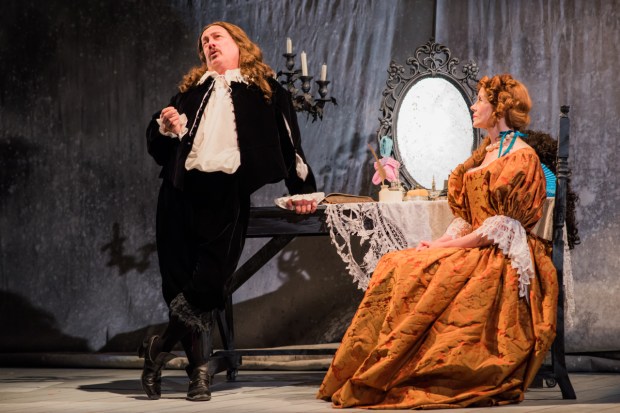
Dick Tracy

Le_Navet_Bete_Dick_Tracey_Production_Shots_Mark_Dawson_Photography_DSC0689Le-Navet-Bete_Dick-Tracey-Production-Shots_Mark-Dawson-Photography_DSC0383-1024x819

24/03/16

The Lowry, Salford Quays

Dick Tracy was, of course, the yellow-raincoat wearing star of the classic 1930s cartoon strip by Chester Gould. Over the years, the story has been adapted into many forms -it’s been a popular, long-running radio serial, it’s been filmed (most famously by Warren Beatty and Madonna) and now  the physical comedy team, Le Navet Bete offer us their take on the story, a whip-smart, endearingly funny slice of full-on slapstick that soon has the audience at the Lowry laughing at every turn. This is irresistibly silly stuff with enough jokes and pratfalls to keep everyone royally entertained.

It’s hard to believe that there are only four actors in the cast, such is the dizzying range of characters they portray, using costume, songs, masks and a whole variety of accents. At the story’s start, Alphonse ‘Big Boy’ Caprice has been slammed in the cooler after a failed attempt to kidnap Tracy’s girlfriend Tess Trueheart. When he is finally released, however, he announces that he is going ‘legit’ along with his henchmen, Flattop and Cueball. Pretty soon he has them selling lemonade and kittens. But of course, it’s all part of a fiendishly cunning plan. Caprice enlists his girlfriend, Careless Whisper (yes, really!) to frame Tracy for setting fire to an orphanage, leaving the bad guys free to weave their wicked plans for the city of Detroit.

There’s so much here to enjoy. The script, written collaboratively by the cast, contains enough zippy one liners and full-on groan-makers to please the most exacting of audiences – and the ingenious use of props never fails to delight. I particularly enjoyed the motor cycle which appeared to be made from a wheel, a pair of handlebars and a hair dryer on full blast! Annoyingly, we chanced upon Le Navet Bete towards the end of a long run of Dick Tracy – there’s just one last performance at Luton Library Theatre on the 26th March (if you’re in the area, don’t dare miss it!) and they will present a new show, their own take on The Wonderful Wizard of Oz at the Barbican Theatre, Plymouth on the 7th, 8th and 9th of April. If it’s anything like as good as DT, it will be well worth seeking out..

We arrived at the theatre tonight feeling pretty sorry for ourselves and left with great big smiles on our faces. You really can’t ask for more than that.

5 stars

Philip Caveney

The Witches

THE WITCHESCurve Theatre Leicester

21/03/16

The Lowry, Salford Quays

Looking around at the eager audience for tonight’s show, it’s evident that this isn’t really aimed at our demographic. There’s a lot of very young children in the seats and they seem to be having a whale of a time. As well they might, because this is Roald Dahl’s The Witches, a co-production between Leicester Curve and Rose Theatre, Kingston. It all begins with a jolly song, performed by the seven-strong cast, but within a few minutes, Boy (Fox Jackson-Keen, looking disturbingly like a young David Walliams) has been orphaned and gone to live with Grandma (Karen Mann) in Norway, where she tells him all about real-life witches and how to identify them.

But the educational authorities insist that Boy must return to England to continue his studies, so he and Grandma decamp to the UK and shortly afterwards, go on holiday to a hotel in Bournmouth. It is here that a convention of witches meets every year to discuss business, overseen by the Grand High Witch (a sneeringly malevolent Sarah Ingram) who has engineered a plan to turn all children in the vicinity into mice.

This is a sprightly production, that plays Dahl’s witches more for laughs than for menace. Just about everybody on stage has a go on some kind of musical instrument (Jackson-Keen even throws in a few somersaults) and the cast have quite a bit to do to flesh out a whole range of colourful characters. But there are certain elements here that don’t quite gel. As any self-respecting  Dahl fan will tell you, witches are bald and hide the fact by donning elaborate wigs – so it is somewhat confusing when the clearly hirsute witches are ordered to remove their wigs… and actually put some elaborate ones on – furthermore, the play’s big climax simply needs more bodies to get across the idea that all the witches are transforming, not just their leader. (Maybe the filmed sequences used elsewhere might have been utilised to flesh out this important scene?) Having said that, there was a rather splendid ‘how-did-they-do-that?’ moment where one character sank into a tureen of soup and Bruno (Kieran Urquhart) raised the night’s biggest laughs by denying that he had turned into a mouse, despite having ears, whiskers and a long tail. ‘You are a mouse!’ screamed one little girl, delightedly. And she was clearly right on that score.

One for the youngsters then, but perhaps lacking the nuanced layers that would have kept the parents a tad more engaged. Dahl is still one of the country’s most treasured authors (mostly because he delights in putting his young protagonists through absolute hell) and he was never one to shy away from uncomfortable scenes. A pity then, that an unremittingly  Dahl moment towards the play’s conclusion is somewhat neutered by a cheesy song straight afterwards, but hey, the kids aren’t complaining and this one is definitely for them.

3.8 stars

Philip Caveney