Theatre

Husbands and Sons

Unknown-1

23/02/16

Royal Exchange, Manchester

Welcome to the world of DH Lawrence – a world of coal and sweat, where every husband is a drunken, boorish tyrant, where every wife is a much put-upon angel, and where every mother secretly harbours an unhealthy regard for her own son.

Husbands and Sons is a curious concoction, a mingling of three early plays by Lawrence – The Daughter-In-Law, A Collier’s Night Out and The Widowing of Mrs Holroyd – all of which take place in the same village, which has allowed adapter Ben Power to overlay them, so that one piece of action appears to comment on the next. The protagonists are onstage most of the time, while the script cuts nimbly back and forth between the three households involved – the Lamberts, the Gascoignes and the Holroyds. At first, this technique is disorienting; it takes a while to settle into the rhythm, but eventually you do and things pick up.

The Exchange is famous for its sets and this one is remarkable in its ingenuity. The three households are delineated by ranks of cast iron cooking ranges, sculleries and dining tables, all balanced precariously on top of the colliery, represented by heaps of coal and a grilled floor, lit from below. It looks fantastic.

But there seems to be a lack of consistency in the style. Why, for instance, go to the trouble of creating plumbed-in taps that spout real water and cooking ranges that belch real flame, and then oblige the actors to perform a mime every time they enter a house: opening and closing invisible doors, removing and hanging up imaginary coats and hats? It just looks odd amidst all the naturalistic clutter. Another puzzling detail – two bread tins, complete with knives, are used to prise out… fresh air. In her programme notes, director Marianne Elliott claims that she wanted the audience to ‘concentrate on the people and not get bogged down in the detail of the bread or the stew or sweeping the floor,’ but the absence of these things made no sense when so many other fripperies were included. If we’re meant to concentrate on the actors, why surround them with so much paraphernalia? Or, if this level of detail is required, why not see it through consistently?

There’s no doubting the quality of the performances here. Anne Marie Duff, making her debut at the Exchange, has little to do in the first half, but really comes into her own in the second as the tragic Lizzie Holdroyd, obliged to deal with the sudden death of her boorish husband, Charles (Martin Marquez), killed in a colliery accident. Meanwhile, Lydia Lambert (Julia Ford) is trying not to feel jealous of her son’s new flame and over at the Gascoigne house, Luther (Joe Armstong) has been unfaithful to his wife, Minnie (Louise Brealy), and has got one of the neighbours in the family way. Reparation must be made, it seems but what does Minnie have to say about it?

What you feel about this production will probably depend upon how you regard the writing of D H Lawrence. There are many who think of him as a genius, a man before his time. Others simply see him as a sex-obsessed neurotic with a large chip on his shoulder. Husbands and Sons is an interesting piece that takes time to build in intensity, but we feel it is somewhat compromised by unnecessary complications, that have nothing to do with the performances or, indeed, the script.

3.5 stars

Philip Caveney & Susan Singfield


Shrek – The Musical

maxresdefaultSHREK-London-cast-Image-by-Helen-Maybanks-6

02/02/16

Lowry, Salford Quays

Unless you’ve been living under a rock for the past twenty years or so, you’ll no doubt be familiar with the runaway franchise that is Shrek. Originally an illustrated novel by William Steig, it became a hit animation for Dreamworks in 2001. It went on to spawn several (inferior) sequels and of course, in 2008, a Broadway musical. This is the original London production, which comes to the end of a two year tour in Salford, so this may be your last chance to see it for a while.

Obviously it’s a family show, aimed very much at the youngsters in the audience, but it’s slick and sharp enough to entrance their parents too and it was clear from the word go that the packed audience at the Lowry was having an absolute ball with it. The film’s wry twist on the classic fairy tale is faithfully preserved, there are eye-popping costumes and witty songs. You have to admire Dean Chisnall’s performance as the titular ogre as he performs in what looks like half a ton of latex without ever breaking stride. The supporting cast are uniformly good but I particularly enjoyed Gerard Carey’s tour de force as pint-sized villain Lord Farquaad. I’ve seen this kind of stunt done before but rarely with such exuberance and never with such laugh-out-loud chutzpah.

Fans of puppetry will be entranced by the show’s huge dragon, which swoops convincingly around the stage (whilst singing!) and had younger members of the audience gasping with wonder. Shrek – The Musical is a magical presentation in every respect and the long touring schedule means that every detail has been drilled to perfection, so despite a lengthy running time, it never loses momentum. Oh and don’t feel you have to have children in tow, because there really is something here for everyone.

Please note that the show starts at 7 pm, not 7.30 (a fact that was clearly lost on large members of last night’s audience). It’s at the Lowry until February 20th. Go, enjoy. Trust me, you’ll love it.

4.4 stars

Philip Caveney


Macbeth

Clemmie Sveaas, Jessie Oshodi and Ana Beatriz Meireles in Macbeth. Photo by Richard Hubert SmithJohn Heffernan (Macbeth) and Anna Maxwell Martin (Lady Macbeth) in Macbeth. Photo by Richard Hubert Smith (2)

Home, Manchester

02/02/16

OK, so it’s yet another Shakespeare adaptation. And it’s Macbeth too – one of my favourites, but certainly not one that’s under-performed. Its length and relative simplicity make it a school curriculum staple, so regular airings are always assured: it’s an easy one to sell out.

But it’s this ubiquity that means it’s in danger of being – dare I say it? -boring. I’ve watched and read this play so often that, unless the director is bringing a fresh eye to it, I really don’t want to see it again. Especially after the recent much-acclaimed-but-actually-rather-dull film version, by Justin Kerzel (see previous review).

Luckily, Carrie Cracknell and Lucy Guerin’s production (for Home, Young Vic and Birmingham Rep) certainly brings that fresh eye. It’s not perfect by any means – there are a few jarring moments, and some lines that seem misjudged (that long pause between ‘hold’ and ‘enough’, for example, turning the latter into capitulation instead of a defiant battle cry), but it’s dirty and dangerous, just like it needs to be – and it’s sharp and witty  too.

It’s set in a version of the present, in a stark underpass, as grim as night. There are flickering fluorescent lights, and a sense of menace prevails. The body count is high, and murder is rife; the corpses are wrapped in plastic and tossed aside quite casually. This is certainly a brutal world.

And the witches. They’re my favourite thing. They’re twisted, haunted mannequins, moving their inhuman limbs in a foul and fearsome dance. They’re genuinely frightening, like horror-story dolls – sometimes pregnant, sometimes breast-feeding – and their gruesome game of Blind Man’s Buff makes the Macduff family murder a truly awful act.

The banquet scene is nicely done; Lady Macbeth’s madness is also a high point. It’s a strong production: daring and innovative and certainly not dull.

Highly recommended – although I suspect it will divide opinion.

4.2 stars

Susan Singfield


Locus Amoenus

locus-amoenus-1

8/01/16

Studio Theatre, The Lowry

Atresbandes are a young theatre company from Barcelona and ‘Locus Amoenus’ is a term used to describe an idealised paradise, something that we all long for, even though our personal interpretations of such a paradise may differ wildly. We catch the company’s latest production towards the start of their UK tour and we’re very impressed with what we see.

The simple set represents the interior of a train and as the three actors take their seats, we’re informed, via a screen at the back of the set, that they are all going to die in a freak accident in one hour. As the action unfolds we’re horribly aware that time is rapidly running out for them. If this sounds dour, don’t be misled, because what follows is a sprightly mixture of techniques, much of it performed without dialogue and often laugh-out-loud funny. Microphones are placed around the set to emphasise sounds – a sequence where one character repeatedly zips and unzips the various compartments of her rucksack is particularly effective and much milage is made from the fact that one character speaks only English, one only Spanish and the third is bi lingual and has to act as an interpreter for the other two. The piece is beautifully precise and understated – incidents that seem at first baffling, are explained as the action progresses. As the clock ticks inexorably away, a countdown appears on the screen and the final stretch becomes almost unbearably suspenseful.

This is accomplished theatre that deserves a wider audience. Atresbandes will be at the Gulbenkian, Canterbury on the 29th January and can be seen thereafter at the Warwick Arts Centre, The Hub Leeds, Lighthouse Poole, the Square Chapel Halifax and the Derby Theatre. They will finish their tour with three days at the Camden People’s Theatre on the 3rd, 4th and 5th of March. If you’re close to any of these venues and you fancy something a little out of the ordinary, do take the opportunity to see this delightful production. You won’t be disappointed.

4 stars

Philip Caveney
Wit

Unknown

26/01/15

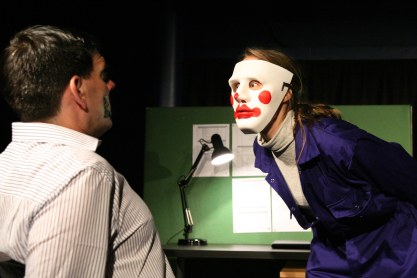
Wit is nobody’s idea of a ‘fun night out at the theatre.’

Indeed, Margaret Edson’s Pulitzer Prize-winning tale of middle aged academic, Dr Vivian Bearing (Julie Hesmondhalgh,) who discovers that she has cancer – more specifically, advanced metastatic ovarian cancer – is every bit as bleak as you might expect. I’m certainly offering no spoilers when I tell you that one of Bearing’s first observations, made directly to the audience is that she isn’t going to make it out of the story alive.

Bearing’s speciality is the work of metaphysical poet John Donne, whom she quotes and refers to throughout. She attempts to intellectualise her advancing illness, treating it as though it is something to be studied, observed and reported back on, only to ultimately discover that these things are beyond the scope of such an approach. Death is ultimately the biggest grey area and as she drifts inexorably closer to it, a sense of futility overcomes everything else.

Because of the rarity of her condition, Bearing becomes a sort of prize guinea pig for her doctors, one of whom, Dr Posner (Esh Alladi) is a former student of hers. This elicits one of the play’ss most uncomfortably funny scenes as Posner is obliged to carry out a vaginal examination of the woman who gave him a poor grade for one of his essays. Her conversations with a nurse, Susie Monahan (Jenny Platt) are the only sections where she comes close to revealing anything of herself; and for me that was a problem. In order to fully care about Vivian, I needed to know a little more about her.

In the central role, Hesmondhalgh is extraordinarily good, managing to convey her wisecracking, American character with great aplomb. She is in every scene, so much so that the other actors struggle to make a connection with the audience. I was somewhat dismayed by the fact that I didn’t make enough of an emotional connection with the material, while others around me seemed to be visibly affected by what they were watching. At the play’s (admittedly thrilling) conclusion, the audience stood en masse to give a heartfelt standing ovation – but I thought that overall, the cool, detached style of the writing detracted from the potential power of the work. It was evident that the majority of the audience would have disagreed with me on that one.

As we get up to leave, a couple of women to our right, are crying their eyes out. Perhaps they are reflecting on something that has happened in their own lives that stirs such emotions – or maybe we just weren’t on the right wavelength tonight. At any rate, dry-eyed, we head for home.

3.5 stars

Philip Caveney

The Girls

Gary Barlow, Tim Firth and the original Calendar Girls credit Matt Crockett

19/01/15

The Lowry, Salford Quays

I’ll be honest. I didn’t have high expectations for this. After all, I thought, Calendar Girls had already been a hit film and a successful stage play. The news that author Tim Firth had spent the last couple of years turning it into a musical with his friend, Gary Barlow, suggested that this particular idea had been taken just about as far as it could possibly go. So I’m surprised and delighted to say that The Girls, from its jaunty opening chords onwards, is an unqualified delight, a production that has the word ‘hit’ written all over it. Nor is it the kind of cheesy nonsense that often qualifies a show for such a description.

It’s a  very familiar true life story – how a group of Women’s Institute members in an obscure Yorkshire town, decided to raise money for a local cancer hospital by appearing in a nude calendar. But Firth has opened up the story to give it a wider scope and the wry, witty lyrics seem to have so much to say about the everyday life of ordinary people that you can’t help admiring them. This show surprised me. I hadn’t expected to laugh as hard as I did, nor had I expected to cry quite so much – there are moments here that will wring tears from the coolest people in the audience.

It’s an ensemble piece with an eighteen strong cast, all of whom deliver faultless performances. The main story focuses on the friendship between Annie (Joanna Riding) and Chris (Claire Moore), but every character has a story arc and each one is fully explored. If I have an issue, it’s with the title – the six lead protagonists aren’t ‘girls’ at all but mature women; and when was the last time you saw a musical that offered major roles to so many of them? Roles, more importantly, that treat their subjects with respect even when the women are stripping off for charity. The nudity, by the way, is handled with consummate skill, so it never feels exploitive – you are laughing with the women, not at them and that’s an important distinction.

A word too about Robert Jones’s ingenious set design. What appears at first to be haphazard heaps of painted cupboards and lockers becomes a whole variety of locations, including the hill that overlooks the village of Cracoe where the story is set and, in one memorable driving sequence, the outline of a city at night.

Gary Barlow knows a thing or two about writing a decent pop tune and here’s the proof that he can write show tunes too – you’ll most likely come out of the Lowry humming, whistling or singing one of them. The real life ‘Calendar Girls’ were in the audience for tonight’s performance and I’d say they must have been delighted with the latest incarnation of their remarkable story. Indeed, if this show doesn’t get a West End transfer soon, then I’ll be very surprised. For once, an enthusiastic standing ovation was thoroughly deserved.

Who saw that coming?

5 stars

Philip Caveney


Hangmen

Unknown-2Unknown-1

17/01/16

Wyndham’s Theatre, London

Martin McDonagh’s latest play, Hangmen, marks a significant change from his earlier, Ireland-bound dark comedies – but it shares with them an incredible ear for dialogue and an uncanny knack for finding humour in the bleakest of situations. If you thought The Lieutenant of Inishmore pushed this quality as far as it could go, then prepare yourselves to go just a little bit further. If I told you that this play begins with a man pleading for his life, just moments before his execution, you probably wouldn’t expect to be laughing out loud. But trust me, you will be. Originally a Royal Court production, Hangmen has now transferred to the Wyndham Theatre, where it’s playing to packed houses every night and it’s easy to see how it has achieved its ‘hot ticket’ status.

We start in the gaol cell of convicted murderer, Hennessy (Josef Davies), about to be despatched by Britain’s current chief hangman, Harry Wade (David Morrissey). It’s a brief and shocking scene, the humour suddenly extinguished by the brutal execution itself; and then, just as you’re starting to wonder how they will ever manage to change the setting, the entire cell – walls, floor, door and furnishings – rises majestically upwards into the flies, revealing the interior of a pub beneath. It’s a jaw-dropping transition.

It’s now two years later, 1965. Wade is the landlord of a pub in Oldham and the death penalty has just been abolished. Wade is coasting on his former reputation and is still indulging in an old rivalry with the more famous Albert Pierrepoint, also now a pub landlord in nearby Failsworth. Harry has surrounded himself with a coterie of cronies, who, if you’ll forgive the pun, hang on his every word and treat him as some kind of grotesque celebrity. They are not so much customers as his Greek chorus, commenting hilariously on the action and applauding every twisted thing he says.

Matters take a strange turn with the arrival of Mooney (Johnny Flynn), a smooth-talking Southerner, who seems to know a lot about Hennesy, who went to his death protesting his innocence. Mooney applies to lodge at the pub by exerting his charm on Wade’s wife, Alice (Sally Rogers) and, more especially, on his shy daughter, Shirley (Bronwyn James). It’s apparent from the word ‘go’ that Mooney knows something and he’s come here to make trouble – but what is his connection to the events of the past?

On the night we attend, there’s a technical fault that means the proceedings have to be briefly halted at a very suspenseful moment. We’re worried this might ruin the experience, but the cast respond brilliantly, snapping straight back into character and taking the action on again, without breaking stride. The concluding scenes wrack up the suspense to almost unbearable levels.

Hangmen is a brilliant production, that deserves every accolade that’s been thrown at it, and it confirms McDonagh as one our finest contemporary playwrights. Tickets are in very short supply, but if you can get hold of one, do so, because this is simply too good to miss.

5 stars

Philip Caveney


Theatre Bouquets 2015

Unknown-1

Unknown-1

Unknown-1

We saw some fantastic theatre in 2015. Here, in order of viewing, are our favourite productions of the year.

Unknown

The Caucasian Chalk Circle – Lyceum Theatre, Edinburgh

A production so enchanting, funny, lively and, yes, engaging (sorry) that no one in the audience could fail to feel its impact, Mark Thomson’s Caucasian Chalk Circle was Brechtian theatre at its very best.

Unknown-1

The Venetian Twins – Lyceum Theatre, Edinburgh

A farce majeure, beautifully played, timed to precision and rib ticklingly funny from start to finish, The Venetian Twins was proof indeed that farce doesn’t need to be toe-curling; it can be a thing of beauty too.

gc_home_funfair_dressr-491

Funfair – Home, Manchester

HOME’s inaugural production, Funfair by Simon Stephens, was a dazzling box of delights, a real multi-media event that employed lights, shadows, live rock music, back and front projection, masks, movement and a central turntable  used to stunning visual effect.

Unknown

The Skriker – Royal Exchange, Manchester

The Skriker was a screaming, hurtling explosion of a play. Caryl Churchill’s script was frightening, angry, funny and weird and Maxine Peake was perfectly cast as the shape-shifting fairy, inhabiting each persona completely.

2015charola_xs

Charolais -Spotlites, Edinburgh Festival

Written and performed by Noni Stapleton, Charolais was an unlikely comedy about a young Irish woman and the jealousy she felt towards a beautiful heifer. It was an unusual tale, as beautifully written as it was acted: a one-woman performance that not only made us laugh and cry, but also brought to life a horny cow.

unknown8

Lungs, Roundabout, Edinburgh Festival

On a grey, rainy day in Edinburgh, Paines Plough’s productions of Lungs by Duncan Macmillan was a breath of fresh air. The witty, sparkling script picked us up by the scruff of the neck and hurled us along in a series of perfectly created flash-forwards as the central couple argued, chattered, broke up and made up again.

unknown7

Filthy Talk For Troubled Times, Venue 106, Edinburgh Festival

Phantom Owl’s actors were seriously top-notch, and Matthew Lillard’s direction was flawless too: the choreography looked effortless but was perfectly orchestrated. The atmosphere was wonderfully tawdry and menacing – Neil LaBute’s script brought expertly to life.

6-dominic-marsh-as-macheath-in-dead-dog-in-a-suitcase-and-other-love-songs-by-kneehigh-theatre-home-manchester-11-26-sept-2015-photo-c-steve-tanner

Dead Dog In A Suitcase (and Other Love Songs) Home, Manchester

Kneehigh’s reputation precedes them: we knew before the show began that we were in for an energetic, multi-disciplined, high-octane experience, and were well-prepared to be dazzled by what we saw. We were not disappointed!

images

Golem, Home, Manchester

The story of the Golem might be traditional, but this production, by experimental theatre company 1927, was anything but. Execution was key here: the perfect meld of acting, animation and music created a surreal, dreamlike world and we could only marvel at the degree of precision that must have been required to bring this extraordinary production together.

333880_770_preview

Jane Eyre, National Theatre, London

The National Theatre’s Jane Eyre was a dynamic interpretation, eschewing the rigid formula of a period drama in favour of a more holistic view of the novel. This made for a surprisingly faithful telling of the narrative: free from the confines of a naturalistic set and strict chronology, director Sally Cookson created space for Jane’s whole story to be centre stage.

lord_of_the_flies_main-photo_johan_persson

Lord of the Flies, Lowry, Salford

A superb adaptation of a literary masterpiece,Anthony Sheader’s Lord of the Flies was a delight from start to finish. And plaudits to choreographer, Jonathan Holby, who co-ordinated the movements of the large cast flawlessly, regularly cutting between normal speed and slo-motion to display simultaneous events – building steadily to a thrilling conclusion.

Susan Singfield

The Lion, the Witch and the Wardrobe

20/12/15

The Lyceum, Edinburgh

The Lion, the Witch and the Wardrobe is a well-loved and familiar tale with a guest spot for Santa Claus; no wonder it’s become a staple family Christmas show. And the Lyceum’s production starts off wonderfully; the design (by Becky Minto) is breathtaking: the all-important transition from Britain to Narnia eliciting an audible response from the audience.

The parallels between the two worlds (and Narnia’s appeal) are highlighted by the double casting: both places are being torn apart by war but, while in the real world the children are bystanders, exiled from their home with no option but to wait things out, in Narnia they play an active role; they are no longer helpless children, sidelined and ignored.

It’s a shame, then, that some elements of the play seem almost perfunctory. Peter’s battle with Maugrim, for example, lacks any real sense of menace. Some scenes, most notably Aslan’s murder – but there are others too – are crying out for a chorus: ‘Come, every spirit, every wraith,’ chants the White Witch, played with wonderful malevolence by Pauline Knowles. But no one comes, or hardly anyone: three makes for a very sparse crowd. In Manchester, student choruses seem quite the thing; we’ve seen actors-in-training from local universities employed in several professional productions there and this might have been an idea here. The Lyceum’s Narnia would be more convincing if it were more densely populated.

The children’s delivery is a bit stage-school and declamatory for my taste; they’re not actually kids, of course, but young adults, which might account for the vocal tics as they try to make themselves sound more youthful. And I wish that Aslan were more than just a man in a fur suit.

That said, it’s still a magical show in places, with spark and vim enough to keep a young audience entranced. The final battle scene is beautifully done, all lights and ribbons and roaring sound effects. At its best, this play is very good indeed. It’s just a bit uneven, I suppose.

3 stars

Susan Singfield

Tracks of the Winter Bear

19/12/15

Traverse Theatre, Edinburgh

It’s Christmas time, and the theatres are full of pantomimes and children’s tales. And that’s fine: I love a good panto, and some of my favourite stories are written (primarily) for a younger audience. But variety is the spice of life, they say, so the Traverse’s grown-up alternative is a very welcome thing.

Tracks of the Winter Bear comprises two short plays, companion pieces exploring the themes of love and loss. They’re separate yet linked, both intrinsically Edinburgian, set in the Abbeyhill district of the city. The same pub is referenced in both (The Regent Bar), and the two protagonists (Shula and Jackie) are  both lonely, middle-aged women, trying  – in their very different ways – to make some sense of their lives.

Act 1, by Stephen Greenhorn, is my favourite of the two. Using reverse chronology, it charts the tragic love affair of Shula (Deborah Arnott) and Avril (Karen Bartke). It’s a bleak but ultimately beautiful piece, with thoughtful, nuanced performances; Arnott, in particular, seems to embody the brittle hurt of grief.

Act 2 is an altogether stranger beast, telling the tale of a mangy polar bear and a washed-up Mother Christmas, both escapees from a tawdry Winter Wonderland theme park. The bear, cast adrift and hunted in an unknown land, speaks in the voices of those she has killed. Mother Christmas, or Jackie – played with bar-room swagger by the delightful Kathryn Howden – befriends her with promises of shortbread and love, and the two embark on an unlikely journey ‘home.’ It’s a fascinating premise and it’s very well-played (Caroline Deyga’s Bear is physically compelling), but it seems a little uncertain of its way, forsaking the early, earthy humour for a less engaging attempt at profundity.

Both pieces use what is essentially the same set, a narrow, snow-covered traverse stage (ironically, this is the first time we have seen this configuration at the, ahem, Traverse theatre). It’s curtained with a light gauze, which serves both to hint at snow in the air, and to create a misty, fairy-tale-like quality. The mirror-audience, visible throughout, magnifies my own reactions; it’s the perfect staging choice for this production, I think.

Overall, then, this is definitely one to watch. It’s interesting and original, and a welcome respite from all the feel-good fare.

4 stars

Susan Singfield