Theatre

The Sound of Music

23779492316_a49369cec8_z

The Lowry Lyric Theatre, Salford Quays

There’s no other option but to own up on this one – I have always hated this musical. I appreciate that I’m in a minority here, because as blockbusters go, it’s one of the most successful of all time, with an ardent following of die hard fans, the kind of people who will happily camp out for weeks in order to secure a ticket – but I’ve always found its uneasy mix of syrupy songs, precocious children and the most unthreatening Nazis ever seen on stage or screen, somewhat hard to stomach. Just a few bars of ‘The Hills Are Alive…’ and I’m a kid again, trapped at home on a drizzly Sunday afternoon, with my parents watching the film on television and commenting on how ‘nice’ Julie Andrews seems.

So naturally, I approached this assignment with some trepidation. The Lyric theatre was packed with eager punters as the overture began and then the curtain rose and we were in a (pretty convincing) nunnery where four ladies in black habits were asking us how they could possibly solve a problem like Maria (The Voice finalist, Lucy O Byrne). The next thing we know, she’s been enlisted as governess to the seven children of war hero Captain Von Trapp (Gray O’ Brian) and is teaching them that doe is a female deer and ray, a drop of golden sun…

It’s pointless to go over the plot because unless you’ve lived as a hermit all your life, you’ll surely already know exactly what happens. And here’s the thing. Though I can appreciate how professionally this production is delivered – perfectly judged harmonies, elaborate sets that glide effortlessly into place, faultless choreography, this isn’t going to change my mind about Rodgers and Hammerstein’s greatest success. It still feels like treacle pudding with extra treacle. But neither can I reasonably criticise the way its been done (other than to observe that Mr O’ Brian was having a bit of a bad night of it in the vocal department) and neither can I deny the warmth of the standing ovation enjoyed by the cast at the end, with a particularly enthusiastic response given to Jan Hartley as the Mother Abbess, whose climactic rendition of Climb Every Mountain was delivered with enough energy to power the National Grid.

So I’ll simply say this. If The Sound of Music is already a favourite of yours, you’re unlikely to feel shortchanged by this production. If you’re coming to it with no expectations whatsoever, you may find yourself wondering what all the fuss is about.

3.5 stars

Philip Caveney

Inkheart

11/12/15

Home, Manchester

‘Tis the season of theatrical family fayre, when children’s stories are plundered for festive productions, with often mixed results.

Inkheart started life as a novel by Cornelia Funke, evolved into a successful film, and now struts its stuff as a lively Christmas play. It tells the tale of twelve-year-old Meggie (Katherine Carlton) and her father, Mo (Paul McEwan), whose ‘Silvertongue’ status means that, when they read aloud, characters step from the pages of their books, and blunder into the real world. Meggie and Mo embark upon a desperate quest to save the last copy of the eponymous book, protecting it from the villains who wish to destroy it.

The set comprises a mountain of books, with shelves and steps cunningly concealed. It rotates and tips, and is used effectively to represent a home, a library, a beach and a car; it’s really quite a lovely thing. And the production starts well: the narration (provided by Kelly Hotten) is clear and engaging, and the disruption of Meggie’s world by the appearance of the mysterious Dustfinger (Andrew Sheridan) is nicely unsettling. Carlton is uncannily convincing as a twelve-year-old, and Rachel Atkins, as Elinor, is a comic delight.

Overall, it doesn’t quite work for me though. It’s not as light as it needs to be; it’s pedestrian when it needs to fly. The fire-juggling, for example, just  isn’t spectacular enough, and the panto-villain antics of Basta and Flatnose (Darryl Clark and Griffin Stevens), while competently done, seem at odds with the general tone. The magic isn’t… magical enough, the comedy too clumsy and the scary stuff just doesn’t scare.

Of course, as two adults, we are not the target audience. There were a lot of kids watching with us tonight, and they seemed to find it an utter joy. One for the children, then, but without much to commend it to the grown-ups accompanying them…

3 stars

Susan Singfield


Into The Woods

Unknownimages

09/12/15

Royal Exchange Manchester

As Christmas draws inexorably nearer, the Royal Exchange have indulged themselves in the family-friendly epic that is Into The Woods. As ever, Manchester’s premier theatre aren’t doing things by halves. With a cast of nineteen and a running time of three hours, Stephen Sondheim’s celebrated fairytale mashup is a challenging production in every sense of the word.

I have to put my hand up at this stage and admit that Sondheim isn’t a great favourite in our household. Sure, James Lapine’s lyrics are quirky and clever but sometimes, I find myself wishing that Sondheim would just offer us a couple of great melodies, something to sing in the shower. But I’d be lying if I didn’t say that this is a superb production and that Sondheim fans (of which there are many) are going to be delighted with what’s on offer here. It’s a big step up too from the recent lacklustre movie version. Certainly the audience on the night we attended were clearly thrilled by what they saw and, little wonder, because choreographing a cast of this size in and around the compact circular stage of the Exchange requires the kind of discipline normally reserved for synchronised swimming events.

ITW is essentially an amalgamation of all your favourite fairytales – Little Red Riding Hood, Jack and the Beanstalk, Cinderella, Rapunzle… given a satirical twist. The first half of the show offers a traditional happy ending and the second, gleefully subverts that, pointing out that most situations don’t tend to fit into such a convenient format. In a strong ensemble cast it’s tough to pick out favourites but Gillian Bevan, as The Witch, certainly casts a compelling spell whenever she’s on stage, while Alex Gaumond as The Baker, is a likeable performer with a plaintive singing voice. A shout must also go to young David Moorst as Jack, who’s gormless manner garners much laughter.

There’s plenty here to delight an audience, not least the ingenious staging, which manages to make a convincing forest sprout up right in front of our eyes; and there’s a wolf-evisceration scene that genuinely made the audience gasp in a ‘how did they do that?’sort of way. Oh yes, there’s also a fleeting appearance by a golf buggy… well, why not?

This is a Christmas cracker of a show, suitable for people of all ages, even if you won’t go home singing any of the songs, because they’re just a bit too complicated for that. If you’re planning a seasonal family outing, this could be the perfect  thing to get you into the festive spirit. Book now while the going’s good.

4.2 stars

Philip Caveney

Lord of the Flies

Lord_of_the_flies_main.Photo_Johan_PerssonIMG_1706

05/12/15

The Lowry Theatre, Salford Quays

Lord of the Flies is one of my all time favourite novels, so I was excited to see this production, first shown in the open air at London’s Regent’s Park. How, I wondered, would director, Anthony Sheader, stage a story that is set in a variety of locations on a remote jungle-covered island? Well, as it turned out, quite brilliantly.

The set bears some description as it is instrumental to the success of this production. The stage is dominated by the fuselage of a crashed plane. One of its wings forms a ramp along which characters can enter and exit. The tailplane provides an upper level from which characters can stand to survey ‘the island.’ In the foreground, the detritus of the crash extends right to the feet of the audience in the front row of the stalls, almost including them in the scene. As the story unfolds, trapdoors are opened and closed to provide yet more levels in Souvenir Scenic’s ingenious set.

The script has cleverly updated the story to contemporary times – there are aborted selfie-stick moments, and even an allusion to a ‘new war’ from which the children were fleeing. Unlike the source novel, the pupils come from a variety of backgrounds – Jack and his choristers clearly hail from a top flight public school, Ralph from a mid range one and Piggy, a bluff Northerner, from a comprehensive. This all helps to emphasise the cruelty of the bullying suffered by Piggy and the other, weaker boys and makes their ultimate fate all the more compelling.

It’s pointless to single out individual actors for praise as this is a true ensemble piece, but plaudits must go to choreographer, Jonathan Holby, who manages to co-ordinate the movements of his large cast flawlessly, regularly cutting between normal speed and slo-motion to display simultaneous events. The final ‘hunting’ of Ralph, builds steadily to a thrilling climax and the sense of shame at the play’s conclusion is utterly heartbreaking.

This is a superb adaptation of a literary masterpiece. We saw it on it’s final date at the Lowry, but the show will be touring the country in 2016. If it lands anywhere near you, please ensure you grab the opportunity to see it. It’s too good to miss.

4.6 stars

Philip Caveney

The Winter’s Tale

Unknown

Kenneth Branagh Theatre Company Plays at the Garrick 

Live Cinema Screening

26/11/15

The Winter’s Tale is something of a curiosity, the work, it seems, of a playwright who was still experimenting even as he neared the end of his career. Like The Tempest, The Winter’s Tale contains romance as well as realism, and attempts to fuse the yin and yang of theatre, encompassing both comedy and tragedy. And, although this play is arguably more uneven than The Tempest, it is, nevertheless, a delight to watch, particularly when performed and directed with such poise.

Live cinema screenings are a godsend to those of us who don’t live in London, allowing us access to plays we wouldn’t otherwise get to see. But the format does have its limitations, most notable in this production in the lighting. Presumably the audience at the Garrick could see perfectly well, but the low lighting didn’t translate well to the big screen, making the whole of the first half rather difficult to discern; indeed, even the lighter, brighter second half seemed curiously muted, considering its lively and pastoral nature.

This aside, the production worked well. Branagh’s is a traditional interpretation of the play, performed with scholarly precision rather than flights of fancy, playing to the strengths of its distinguished cast and crew. Judi Dench is a fine Paulina – of course she is – and Branagh (equally predictably) makes a convincing Leontes. The contrasts – between town and country, prince and pauper, repression and ebullience – are all writ large, and there’s both charm and energy aplenty here.

Why then am I sighing or shrugging when people ask me what I thought of this? I suppose it just seems like I’ve seen it all before: this is a proficient and assured production, but there’s nothing new or exciting about the way it’s done. Maybe there doesn’t need to be; I’m sure there are many theatre-goers who would see this as a positive and, certainly, I’m not a fan of innovation for innovation’s sake. Still, it all feels just a little too familiar to stir enthusiasm.

A good production, but not a thrilling one.

3.9 stars

Susan Singfield

The Odyssey

splendid_odyssey_artworkodd_01

17/11/15

As theatrical events go, this is unusual. I’m wearing a set of goggles, a plastic poncho and a sparkly shower cap. I’m stumbling across a stage while the cast spray me with water pistols and throw ping pong balls at my head and I’m trying to get Odysseus (who is depicted by a wooden spoon with a smily face drawn on it) to the safety of a rubber ring. And I can’t complain, because I volunteered for this.

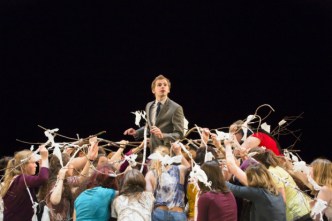
Welcome to The Odyssey as presented by Splendid Productions. When it comes to making a hoary old legend accessible for a wider audience, this team are hard to beat. The three-strong cast (Kerry Frampton, Genevieve Day and Cordelia Stevenson) depict a multitude of characters between them, switching effortlessly from role to role with aplomb and utilising  a selection of simple but ingenious costumes. Watching Kerry Frampton switch from a swaggering warrior to Penelope simply by the application of a white headscarf is an extraordinary thing, so accomplished it elicits gasps of astonishment. Meanwhile members of the predominantly young audience are enlisted to help out – a ‘storm orchestra’ periodically kicks up a rumpus, a young man in a poncho runs up and down telling the audience they’re all going to die and somebody else is called upon to keep a running tally of the carnage.  Odysseus’s epic voyage is depicted by a series of titles pegged out on a washing line. And it all works brilliantly.

I’ve rarely seen a better example of how to involve an audience in a production and I generally don’t laugh this loud when called upon to watch a Greek myth. Splendid are an appropriately named company. Catch this show at The Lowry, Salford Quays, before it sets sail for new horizons. It’s legendary.

4.8 stars

Philip Caveney

The Oresteia

The Oresteia - press pic 07 (A-702) The Oresteia - press pic 08 (B-123)

07/11/15

Home, Manchester

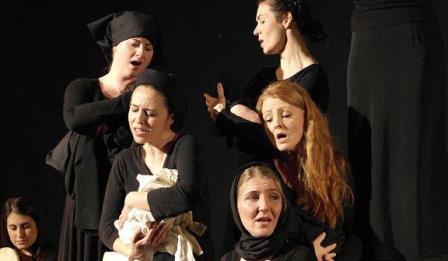
I’ve read a lot of Greek theatre (I did a Theatre Studies degree) and seen performances of some classic plays (Lysistrata and Phedra, for example) but I’ve never seen it done so… thoroughly… before, with a large chorus fully utilised, and the strophe and antistrophe physicalized on the stage. It’s like having pages of my text books brought to life, and I wish I’d seen it while I was studying.

This is a fascinating production – all modern dress and regional accents – and Ted Hughes’ adaptation of the script is as fluid and accessible as you’d expect. This very deliberate modernity contrasts spectacularly with the traditional techniques: the choral speaking, the off-stage action – and it really, really works.

Make no mistake, the story is preposterous. Of course it is. It’s all heightened over-reaction and soap-opera plot – affairs and murder and long-lost kids. While Agamemnon has been fighting in Troy, his wife, Clytemnestra, has taken Aegisthus as a lover. She wants revenge on Agamemnon because he’s sacrificed their daughter to the gods, and a bloody, convoluted family drama thus ensues, albeit with the input of Apollo and Athene.

The acting is uniformly strong, but it’s the chorus that stands out. Split into three parts (men, women and Furies), the ensemble admirably fulfils its function, narrating, commenting and advising the characters. The choral speaking is beautifully precise, an object lesson in how it should be done. The men in particular create a kind of filter for the audience; they stand in the auditorium, leaning on the stage in their jeans and trackies, like a group of blokes in their local pub, checking out what’s going on. At times they’re in the dress circle too, shouting down to the characters, deploring what they do.

It’s an accomplished piece of theatre, and excellent to watch. Do try to catch it if you can.

4.6 stars

Susan Singfield

Pomona

Unknown Unknown-1

03/11/15

Royal Exchange, Manchester

Something decidedly strange is happening on Pomona – the deserted concrete island that sits between Salford and Manchester in the middle of the river Irwell. In this dystopian future world, women are going missing in worrying numbers, while Gale (Rochenda Sandall) is taking extreme lengths to conceal what’s actually happening to them. Meanwhile, security guards Moe and Charlie, are charged with the task of guarding something hidden beneath the ground, something they don’t know anything about; and what does all this have to do with the ancient octopus-faced god, Cthulhu? It’s a good question and one I’m still not entirely sure I have the answer to.

Fresh from its success at the National Theatre in London, Alistair McDowall’s Pomona now makes its debut in the city where it’s actually set. It’s a labyrinthine tale, featuring seven disparate characters. The play’s themes: prostitution, sexuality and murder are probably intended to shock, but in truth these elements aren’t anything like as convincing as the ones that deal with Role Playing Games, something that seems to provide the main clue as to what’s actually going on here. The story isn’t told in a linear way – instead, it switches back and forth in time, so sometimes we know what’s going to happen to a character before he or she actually gets there.

The play begins with underwear-clad wheeler-dealer Zeppo (Guy Rhys) performing an extended monologue based around the climactic scene in Raiders of the Lost Ark for Ollie (Nadia Clifford) who is looking for her missing twin sister. Zeppo advises her not to look too hard, pointing out that a little knowledge can be a dangerous thing. But she goes looking anyway…

Individually, the ensuing scenes are mostly good, nicely acted and occasionally very funny – the ones featuring the hapless Charlie (Sam Swann) are particularly successful in this regard – and there are some nicely choreographed sections, where everything promises to fall into place, but never quite does. The fragmented nature of the work makes it feel more like a collection of short pieces in search of a story arc, so the overall play is somehow less than the sum of its parts, even if many of those parts offer much to admire.

Ultimately, I felt that Pomona was a little too pleased with itself for comfort – but the enthusiastic applause from tonight’s audience suggested that others found it captivating. One thing’s for sure. Here’s another play that will have you discussing its meaning long after you’ve headed for home.

3.8 stars

Philip Caveney

Golem

images images-1

07/09/15

Home, Manchester

It’s not often that you sit down in the theatre with no real expectations and witness something so unique, so unexpected, that you leave with your mind well and truly blown; but that’s exactly how I felt after watching Golem by the experimental theatre company 1927. This eye popping amalgam of live action, music and (occasionally jaw dropping) animation is the most innovative and exciting spectacle I’ve seen in years.

The myth of the Golem, is of course, one of the oldest tales in existence. A creature created out of clay to do mankind’s bidding, its most famous manifestation was in Paul Wegener’s silent movie of 1915, the imagery of which is sometimes evoked here. In this version of the story, Robert (Shamira Turner) leads a life of unremitting tedium, enacting the same sequence of events every day, working in a ‘binary backup centre’ to earn his wages and too shy to approach new employee, Joy (Rose Robinson, brilliantly conveying the antithesis of what that name suggests). But when a friend, Phil Sylocate (Will Close) launches his new business, offering Golems that will carry out the owners every whim, Robert is an eager customer. At first all goes well, but as time passes, the Golem becomes ever more assertive, until inevitably the question arises; just who is in charge here? And what happens when the original Golem is updated to the new, faster, smarter Go 2?

If the story seems familiar, it should be borne in mind that the execution is key here – the perfect meld of acting, animation and music create a surreal, dreamlike world and one can only marvel at the degree of precision that must have been required to bring this extraordinary production together. Lest you be worried that it all sounds a bit dour, don’t be fooled – there’s plenty of comedy skilfully woven into writer/director Suzanne Andrade’s witty script. Ultimately, the word that best describes Golem is ‘magical’. Though on reflection, ‘unmissable’ will do just as well.

The production is at Home, Manchester until the 17th of October.

5 stars

Philip Caveney

Jane Eyre

Unknown-3 333880_770_previewFullSizeRender

03/10/15

National Theatre, London

Jane Eyre is one of my favourite books, but I’ve been bitterly disappointed by most film and theatre adaptations, despairing of directors who interpret Jane as quiet and reserved. Thank goodness then for this collaboration between the National Theatre and Bristol’s Old Vic, devised by the company, which is by far the best I have ever seen.

It’s a dynamic interpretation, eschewing the rigid formula of a period drama, in favour of a more holistic view of the novel. This makes for a surprisingly faithful telling of the narrative: free from the confines of a naturalistic set and strict chronology, director Sally Cookson has created space for Jane’s whole story to be centre stage.

The set is functional: a series of wooden boards and platforms linked by steps and ladders. It works, each of the locations rendered believable by the way in which the actors interact with it. This is a very physical production, with actors hurtling up and down and all around. With less assured direction it could all seem chaotic; in these hands, it’s a lively, energetic delight, with all Jane’s feisty, angry, raging spirit spilling out over the stage.

Madeleine Worrall, as Jane, embodies that spirit perfectly, and Melanie Marshall’s musical Bertha, dressed in red and looming large throughout Jane’s life, is truly glorious: Jane’s inner self writ large, demanding both our attention and our care.

There is humour too. Craig Edwards’ Pilot is a triumph of physical theatre: a huge, enthusiastic, bounding dog brought convincingly to life. Laura Elphinstone’s Adele is equally engaging, a needy, sweet and funny child, just desperate for love.

But this is ensemble theatre, and the whole cast work together well. I can’t do justice here to the breadth of ideas sewn so seamlessly into this play. It’s an imaginative, exciting and innovative piece of theatre, breathing fresh life into a tale I thought I knew too well.

Do try to catch it if you can.

5 stars

Susan Singfield