Theatre

The Chairs

CfMn-wMW8AAu9VQ

15/04/16

The Lowry, Salford Quays

Ionescu’s The Chairs is an absurdist play, depicting the claustrophobic relationship between an Old Man and an Old Woman, excitedly preparing for the arrival of an orator. They have invited ‘everybody’ to hear the Old Man’s discovery, but the guests, when they arrive, are all invisible, and we, the audience, do not know if they are real. This, it seems, is a post-apocalyptic world, and the Old Man and the Old Woman might just be the sole survivors.

It’s an interesting premise, and the translation (by Martin Crimp) is beautifully done. The set is charming too: a dilapidated, shonky-looking research station, which reminds me, oddly, of 1980s kids’ TV. It works, creating that other-wordly vibe that the piece needs; it’s unsettling and strange.

Extant is a performing arts company of visually impaired people, and their production has some excellent features. I loved the audio recordings of stage directions, spoken by the actors, describing what they were doing as they did it. It worked: not only was it a means of “integrating access for visually impaired audience members” (director Maria Oshodi), it also added to the surreal nature of the piece.

The stand-out moment is the chair-setting scene, which sees the Old Woman bringing out chair after chair, each one more damaged than the last, until, in the end, she produces a single broken leg. The frenzied tension developed in this sequence is mesmerizing – and very funny too.

The acting is good, with Heather Gilmore (Old Woman) clearly reveling in the comedy, while Tim Gebbels (Old Man) has a calmer, more serious presence. The relationship between the two is convincing, and the dynamic is strong. Their blindness adds an extra dimension to the play: the guests’ invisibility imbued with new layers of meaning, as the whole notion of ‘what we can see’ is given prominence.

If there’s a problem with this piece, it’s that it’s all a bit one-note. It feels long and quite repetitive; the mood never really shifts. The truth is, it’s too similar to the more familiar (and slightly later) Endgame – and it’s not as good. Ionescu got there first, but Beckett did it best.

3.2 stars

Susan Singfield

I Am Thomas

I_Am_Thomas_415x800_jpg_300x200_crop_q8512615524_962903753801176_8608464594952847469_o

Lyceum Theatre, Edinburgh

06/04/16

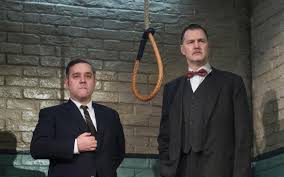
I Am Thomas is a true ensemble piece, in production as well as performance. The list of those involved in its creation is very long (Told By An Idiot, Simon Armitage, Iain Johnstone, National Theatre Scotland, the Royal Lyceum Edinburgh, Liverpool’s Playhouse and Everyman) and it shows: this is an eclectic and dynamic mix of music and drama, a triumph of collaboration, devised theatre at its best.

It tells the tale of Thomas Aikenhead, a young Edinburgh student who, in 1696, was the last person in Scotland, to be hanged for the crime of blasphemy. Lurching appealingly between the past and the present, Aikenhead’s story is told though a series of vignettes, presenting him as a pub singer and – at one point – as Jesus Christ himself. Each member of the cast takes on the central role, the changes signified by a simple ‘I am Thomas’ slogan emblazoned on jackets and T-shirts, so that we are never in any doubt as to who is playing him. This helps, of course, to underline the ‘I am Spartacus/Je suis Charlie’ message already highlighted by the play’s title, and brings the focus – the importance of the right to free speech – into sharp relief.

The performances are uniformly strong: the cast are all musically adept, playing a range of instruments, and singing beautifully. The lyrics are witty, the music sprightly and engaging. It’s funny and warm – and tragic too. The props are deliciously silly and inventive, and the costuming a marvel of 1970s theme party kitsch. All in all, it’s really rather good.

Just one thing: what’s a prehistoric heron got to do with anything?

4.6 stars

Susan Singfield

The Herbal Bed

English Touring Theatre

The Lowry, Salford

30/03/16

The Herbal Bed: The Secret Life of Shakespeare’s Daughter takes the sparse historical details of a suit for slander and weaves them into an engaging tale. The facts are few: Susanna Hall (Shakespeare’s oldest daughter) was accused, in 1613, of having an affair with a local man, Rafe Smith. The accuser, Jack Lane, was convicted of slander, and excommunicated for his crime.

Playwright Peter Whelan extrapolates a convincing narrative from these scant details; indeed, in this version of events, Lane is telling the truth: Susanna and Rafe have indeed been intimate. But, with help from her reluctant maid, Susanna takes the moral high ground, and Lane is exposed as a spiteful liar.

It’s an interesting play, with strong performances. Michael Mears, as Vicar-General Goche, is a real delight: a perfect incarnation of lugubrious self-righteousness, revelling in the sordid details of the sin he so abhors. Matt Whitchurch, as the hapless Lane, is also very good: a brash, emphatic performance, yes, but also a convincing one, and a welcome relief in what is overall a very measured piece.

If there’s a problem with this production, it’s in the measured tone. There’s no peril here, no real tension. We know the outcome of the case; we know Susanna’s reputation – and her marriage – survive the accusations sent her way. And nobody gets carried away by emotion: apart from one brief moment of passion, Rafe and Susanna behave with sober propriety; Susanna’s husband, John Hall (Jonathan Guy Lewis) remains calm throughout. The affair, such as it is, doesn’t really seem to matter; no one’s heart is broken; no one really cares.

In the programme, director James Dacre says that Whelan “never imposes an unrealistic crisis for the sake of good drama.” And, of course, no one wants to see an unrealistic crisis in a serious play like this. But what would be wrong with a realistic crisis? It’s a fictionalised account; the possibilities are limitless. And a little excitement would go a long way.

Despite this niggle, I enjoyed The Herbal Bed. It’s intelligently conceived, and well delivered – certainly one to watch.

4 stars

Susan Singfield


The Railway Children


York Theatre Royal and the National Railway Museum

Encore Cinema Screening

28/03/16

I saw this play when it opened in 2008, and was blown away by the site-specific production: the idea of staging it inside the National Railway Museum, once realised, seemed at once audacious and really bloody obvious. The tracks made a natural traverse, and the audience, seated on the platforms either side, were closely involved with the action. It was an ingenious and engaging piece, and one I’ve talked about ever since. It was no surprise to see its run extended, year on year, nor to see it relocate to King’s Cross for London’s theatre crowd.

So today’s cinema screening was a welcome opportunity to see this production again. And it didn’t disappoint. Of course, a film can never quite evoke the immersive atmosphere of live theatre, but this was beautifully done, capturing the essence of this charming adaptation of E. Nesbit’s famous book.

The story is well known: Bobbie, Phyllis, Peter and their mother are obliged to relocate to the countryside after their father is called away; they don’t know where he has gone, but they do know that they are suddenly – and frighteningly – poor. The servants and luxuries they have grown up with have all gone, and they have to learn to live a very different kind of life. They gravitate towards the railway station, where they make friends, and come to learn a lot about themselves and others too.

In its original form, The Railway Children is a sweet – if somewhat cloying – tale; here, it is given a dash of spice, as the adult Bobbie, Phyllis and Peter reminisce, telling their story with a knowing, grown-up edge. This conceit works well; it seems natural when they engage with the audience, or point out moments that are difficult to stage. It’s humorous and witty – but still tear-jerking: the essence of the story is not diluted by the fresh approach. Is there anyone alive who doesn’t cry when – in print, on screen or on stage – Bobbie cries, “Oh daddy, my daddy”? If there is, I’ve never met them.

The performances are very good throughout (although Andrina Carroll, as Mother, did have a tendency to shout), but it’s the staging and design that are the stars of this show. Bare wooden blocks are pushed along the tracks, with simple props placed on them to evoke a range of locations. The platform and bridge are incorporated well, and the appearance of the hulking, steaming locomotive is a real wow moment.

If you haven’t seen this already, it’s certainly one to look out for.

4.2 stars

Susan Singfield


Dick Tracy

Le_Navet_Bete_Dick_Tracey_Production_Shots_Mark_Dawson_Photography_DSC0689Le-Navet-Bete_Dick-Tracey-Production-Shots_Mark-Dawson-Photography_DSC0383-1024x819

24/03/16

The Lowry, Salford Quays

Dick Tracy was, of course, the yellow-raincoat wearing star of the classic 1930s cartoon strip by Chester Gould. Over the years, the story has been adapted into many forms -it’s been a popular, long-running radio serial, it’s been filmed (most famously by Warren Beatty and Madonna) and now  the physical comedy team, Le Navet Bete offer us their take on the story, a whip-smart, endearingly funny slice of full-on slapstick that soon has the audience at the Lowry laughing at every turn. This is irresistibly silly stuff with enough jokes and pratfalls to keep everyone royally entertained.

It’s hard to believe that there are only four actors in the cast, such is the dizzying range of characters they portray, using costume, songs, masks and a whole variety of accents. At the story’s start, Alphonse ‘Big Boy’ Caprice has been slammed in the cooler after a failed attempt to kidnap Tracy’s girlfriend Tess Trueheart. When he is finally released, however, he announces that he is going ‘legit’ along with his henchmen, Flattop and Cueball. Pretty soon he has them selling lemonade and kittens. But of course, it’s all part of a fiendishly cunning plan. Caprice enlists his girlfriend, Careless Whisper (yes, really!) to frame Tracy for setting fire to an orphanage, leaving the bad guys free to weave their wicked plans for the city of Detroit.

There’s so much here to enjoy. The script, written collaboratively by the cast, contains enough zippy one liners and full-on groan-makers to please the most exacting of audiences – and the ingenious use of props never fails to delight. I particularly enjoyed the motor cycle which appeared to be made from a wheel, a pair of handlebars and a hair dryer on full blast! Annoyingly, we chanced upon Le Navet Bete towards the end of a long run of Dick Tracy – there’s just one last performance at Luton Library Theatre on the 26th March (if you’re in the area, don’t dare miss it!) and they will present a new show, their own take on The Wonderful Wizard of Oz at the Barbican Theatre, Plymouth on the 7th, 8th and 9th of April. If it’s anything like as good as DT, it will be well worth seeking out..

We arrived at the theatre tonight feeling pretty sorry for ourselves and left with great big smiles on our faces. You really can’t ask for more than that.

5 stars

Philip Caveney

The Witches

THE WITCHESCurve Theatre Leicester

21/03/16

The Lowry, Salford Quays

Looking around at the eager audience for tonight’s show, it’s evident that this isn’t really aimed at our demographic. There’s a lot of very young children in the seats and they seem to be having a whale of a time. As well they might, because this is Roald Dahl’s The Witches, a co-production between Leicester Curve and Rose Theatre, Kingston. It all begins with a jolly song, performed by the seven-strong cast, but within a few minutes, Boy (Fox Jackson-Keen, looking disturbingly like a young David Walliams) has been orphaned and gone to live with Grandma (Karen Mann) in Norway, where she tells him all about real-life witches and how to identify them.

But the educational authorities insist that Boy must return to England to continue his studies, so he and Grandma decamp to the UK and shortly afterwards, go on holiday to a hotel in Bournmouth. It is here that a convention of witches meets every year to discuss business, overseen by the Grand High Witch (a sneeringly malevolent Sarah Ingram) who has engineered a plan to turn all children in the vicinity into mice.

This is a sprightly production, that plays Dahl’s witches more for laughs than for menace. Just about everybody on stage has a go on some kind of musical instrument (Jackson-Keen even throws in a few somersaults) and the cast have quite a bit to do to flesh out a whole range of colourful characters. But there are certain elements here that don’t quite gel. As any self-respecting  Dahl fan will tell you, witches are bald and hide the fact by donning elaborate wigs – so it is somewhat confusing when the clearly hirsute witches are ordered to remove their wigs… and actually put some elaborate ones on – furthermore, the play’s big climax simply needs more bodies to get across the idea that all the witches are transforming, not just their leader. (Maybe the filmed sequences used elsewhere might have been utilised to flesh out this important scene?) Having said that, there was a rather splendid ‘how-did-they-do-that?’ moment where one character sank into a tureen of soup and Bruno (Kieran Urquhart) raised the night’s biggest laughs by denying that he had turned into a mouse, despite having ears, whiskers and a long tail. ‘You are a mouse!’ screamed one little girl, delightedly. And she was clearly right on that score.

One for the youngsters then, but perhaps lacking the nuanced layers that would have kept the parents a tad more engaged. Dahl is still one of the country’s most treasured authors (mostly because he delights in putting his young protagonists through absolute hell) and he was never one to shy away from uncomfortable scenes. A pity then, that an unremittingly  Dahl moment towards the play’s conclusion is somewhat neutered by a cheesy song straight afterwards, but hey, the kids aren’t complaining and this one is definitely for them.

3.8 stars

Philip Caveney


The Merry Wives

TheMerryWivesimage

15/03/16

The Lowry, Salford Quays

The Merry Wives of Windsor must be one of Shakespeare’s most rumbustious comedies. Northern Broadsides, as the name might suggest, have their own unique take on the play. Set somewhere in the north of England, complete with regional accents (not a spot of RP in sight) and with a delightful 20s setting, this is like the immortal bard crossed with a Brian Rix farce. It’s fast, furious and laugh-out-loud funny – indeed, as an object lesson in making Shakespeare accessible to a contemporary audience, it’s hard to imagine how it could be bettered.

There’s surely little need to explain the plot. Suffice to say that lascivious blowhard, Sir John Falstaff, sets his amorous gaze on a couple of married ladies and they decide to exact a complicated revenge on him. There are a few small adjustments to the script. The fat woman of Brentford becomes the fat woman of Ilkley and I swear I heard mention of a marriage in Skipton, but otherwise this is pretty much the text, as written.

Broadsides veteran Barrie Rutter takes on the role of Falstaff with great relish, managing to make him a buffoon, but also evoking sympathy for his ultimate humiliation. As the wives themselves, Beckly Hindley and Nicola Sanderson are delightfully mischievous, while as Mistress Quickly, Helen Sheals seems to be channelling the late, great Hylda Baker. A word too about Jos Vantyler, who manages to portray feckless ninny, Abraham Slender in a style that would have made Rix suitably envious.

But it’s important to note that there are no weak links here. The eighteen strong cast are rock solid as they move smoothly from scene to scene and the play’s running time seems to just fly by. In what is the 400th anniversary of Shakespeare’s death, here is a cracking example of why his work still speaks so eloquently across the ages. If you think you’ve seen every possible variation on Shakespearian comedy, think again.

This really is an absolute delight.

5 stars

Philip Caveney

The Crucible

The-Crucible-Production-Image-3-Ensemble-Photo-credit-Drew-Farrell-700x455

08/03/16

Lyceum Theatre, Edinburgh

Arthur Miller’s classic play is deservedly acclaimed and because it’s such a popular production, over the years I’ve seen it in many guises: decked out in Armani suits and set in an open plan office, dressed 50s style to mirror the McCarthy anticommunist blacklists that Miller’s play so cunningly alludes to…. and, most recently,  at Manchester’s Royal Exchange, where some of the events were startlingly framed in the midst of a pool of rising water. So it’s oddly refreshing to witness the Lyceum’s no-gimmicks production, the simple set and period costumes supporting rather than overwhelming Miller’s dazzling text.

And it does dazzle, despite its familiarity, taking off with an incisive, urgent tone that never loses pace as it motors along to its tragic conclusion. The ensemble cast, some twenty actors in total, never put a foot wrong. It’s hard to single out individuals, but Meghan Tyler shines as Abigail Williams, Philip Cairns is perfectly cast as John Proctor and Irene Allan is utterly convincing as poor, doomed Elizabeth Proctor. I liked the simplicity of Michael Taylor’s set with the grey outlines of a forest forever in the background, hinting at the pagan world that surrounds this little outpost of Christianity; and I got chills, exactly as I should, when John Proctor finally refuses to give his name to the document that will save him from hanging.

If you think you’ve already seen everything The Crucible has to offer, think again. When it’s performed with this much panache it’s almost like seeing if for the first time.

4.4 stars

Philip Caveney

In The Vice Like Grip Of It

Unknown

27/02/16

Lowry Studio Theatre

This two-hander created by Ivo in conjunction with Routes North, takes a long, paranoia-drenched look at the subject of surveillance and the ways in which it can infiltrate contemporary life. ‘Him’ (Leigh Kelly) and ‘Her’ (Jo Tyabji) move into a new apartment and set out their furniture. They talk about some unspecified ordeal they have been through (there are allusions to the London bombings, but it’s never really pinned down). Electronic music creates an atmosphere of tension throughout, though it occasionally overpowers the dialogue in some of the early scenes. There are several slo-mo/fast forward sequences, matched to pulsing light and projection effects, which, though initially appealing, are somewhat overused.

As the couple’s life together progresses, ‘he’ becomes increasingly proprietal, watching ‘her,’ recording her, asking questions about how she’s spent her day, becoming ever more intimidating. This clearly refers to those recent cases of undercover police officers becoming intimate with the women they have been assigned to watch, but once again, it’s never clearly pinned down and in the end, I felt this was the main problem with In the Vice Like Grip Of It – it’s a play that deals in generalisations, rather than actualities. It alludes to real life happenings but never fully identifies them and the result is an unevenness of tone that prevents the story from fully gripping the viewer.

In the end, I was left wanting more information than I actually received. There were some nice moments here but not enough to hold my attention throughout and ultimately, what is the play’s central message? That surveillance can be bad? That for a relationship to succeed there needs to be mutual trust? Surely these are universal truths, already widely known – and this play doesn’t really offer any new insights to aid our understanding.

2.8 stars

Philip Caveney
Endgame

Endgame - pic 14 (0499)Endgame - pic 03 (0126)

26/02/16

HOME, Manchester

Endgame is a bleak play – by any standards. “The end is in the beginning – and yet you go on,” says Hamm, with a fatalistic, morbid acceptance of his looming demise. The script is deft, funny and thought-provoking – of course it is; it’s Beckett; his place in the theatrical canon is patently deserved – and the acting and direction here are pretty top-notch too.

Let’s deal with the elephants in the auditorium: Roy Cropper and Peter Barlow. It’s true – actors David Neilson and Chris Gascoyne are both well-known for their parts in Coronation Street. And it’s a fame that the promoters have been keen to exploit: on the publicity posters for this play, the men are instantly identifiable as their TV counterparts; on stage, however, they are barely recognizable. I’ve never really understood why people are confounded by an actor’s ability to perform a different role; it’s kind of in the job description, isn’t it? And these two are very good indeed.

If anything, it’s Beckett who feels over-familiar, not the actors performing him. The audacity of his ideas has been diluted – by time as well as exposure. And yet this production is still well worth seeing: it’s a masterclass in precision and control. Chris Gascoyne’s Clov is a perfect clown, a physical embodiment of futility and despair. There is humour here too, in the repeated movements and the spiteful asides, and comic timing of the very best. David Neilson is equally skillful: his Hamm is a raging, wasted, tragedy of a man, whose cruelty is wrought from desperation; I felt a glimmer of sympathy for Hamm tonight, and I never have before. Peter Kelly and Barbara Rafferty (as Nagg and Nell) give strong performances too; indeed, the saddest moment in the play is theirs, I think: roused briefly from the dustbins where they are living out their final years, they reminisce, recalling the April afternoon they went out rowing on Lake Como. “We had got engaged the day before!” “You were in such fits that we capsized.” The dreadful contrast between this happy memory and their current circumstances encapsulates the agony that underpins Endgame. They are us, aren’t they? And still we go on.

4.6 stars

Susan Singfield

20/01/20

Please note this superb show is now showing at the Old Vic theatre in London. Tickets can be booked here.

https://seatplan.com/london/old-vic-theatre/.