Theatre

Emily Wilson: Fixed

09/08/22

Pleasance Courtyard (Beneath), Edinburgh

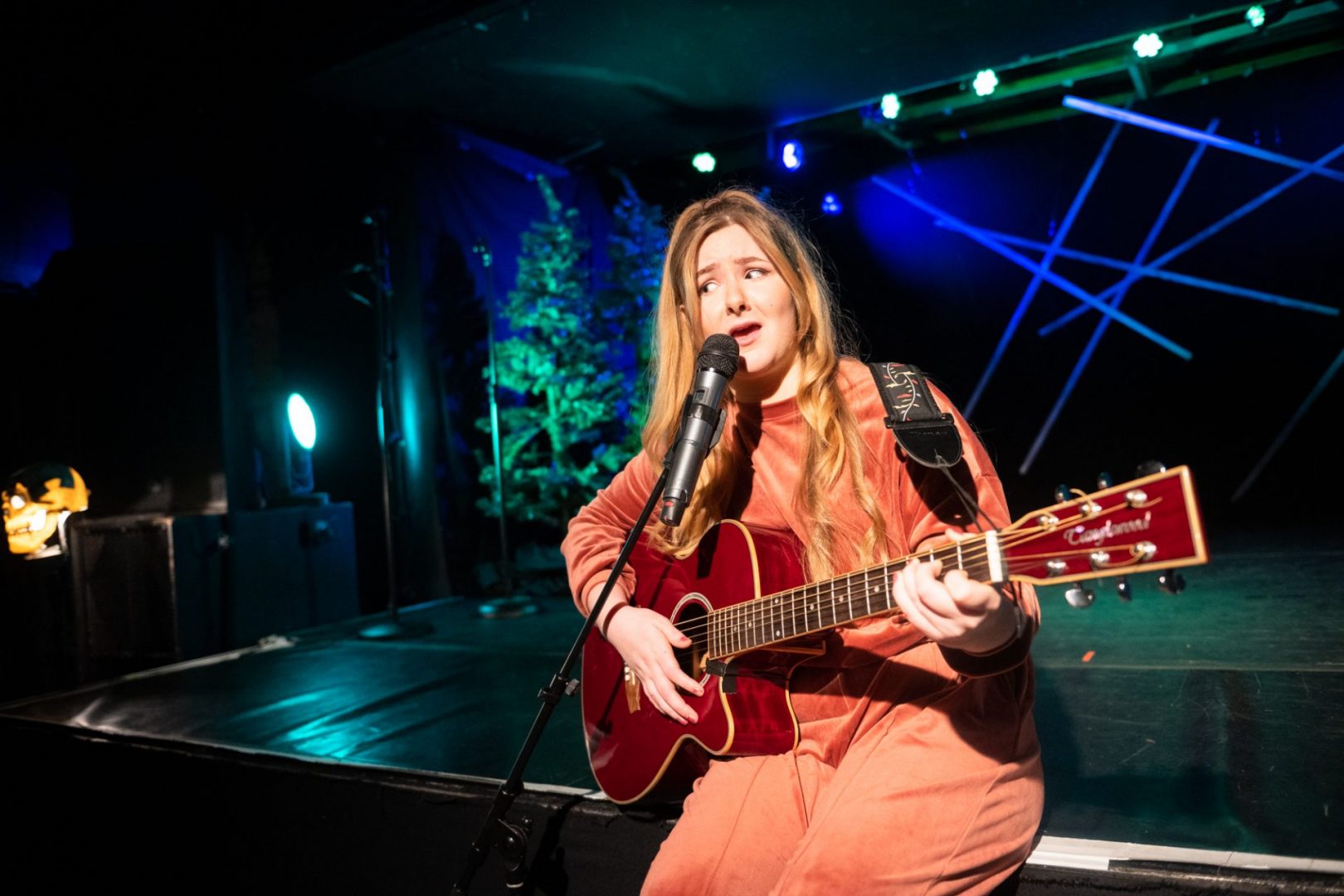
Emily Wilson’s Fixed is part musical, part stand-up and part catharsis. Clearly a born performer, Wilson takes us on a tour of her youth, from beaming toddler to broken teen. It’s all been chronicled, of course: she’s 26 years old, a whole lifetime of phone recordings and insta-chats and YouTube videos. Oh, and primetime national TV too.

That’s the crux of the story: Wilson appeared on The X Factor USA in 2011, as one half of the earnestly named duo, Ausem. “Because my best friend’s called Austin, and my name’s Emily, so together we’re Ausem!” She thought her dreams had come true: she was 15 and destined to become a star. But then they hit a snag. The judges decided they liked Austin, but not Emily…

Wilson’s tale, co-written and directed by Sam Blumenfeld, is compelling. She’s a vivacious, funny, talented woman – and, while she’s disarmingly self-deprecating, she’s justifiably pissed off. The X Factor nearly destroyed her. How is a child supposed to process such public humiliation? How do the powerful adults in charge legitimise hurting her for viewing figures, for more dollars in their bulging bank accounts? Do the haters on social media sleep well at night, knowing they’ve made a young girl cry?

The past is detailed via a series of video clips and diary entries, interspersed with stand-up and original songs revealing Wilson’s current perspective. What emerges is a thoughtful commentary on fame, ambition and exploitation, and it’s riveting.

Oh, and she really can sing. Whatever Nicole Sherzinger says.

4.6 stars

Susan Singfield

Flesh

09/08/22

TheSpace@SurgeonsHall, Edinburgh

The names Burke and Hare are infamous in Edinburgh – and I’m not referring to the lap-dancing club that (chillingly) chooses to name itself after two of history’s most prolific serial killers. Their story is fascinating (indeed, I’ve featured the duo myself in my novel, Seventeen Coffins). The Fringe has always offered a platform to am-dram theatre groups and it’s gratifying to see this ambitious musical version of the tale selling out the spacious venue on a Tuesday afternoon.

Co-written by John Montgomery and Derek Batchelor, Flesh relates the story in flashback, explaining how two Irish navvies, working on the digging of the Union Canal, came to murder sixteen people and sell their bodies for dissection. Billy Burke (Jeremy Frazer) was outwardly affable and charming, while his associate, William Hare (Roddy McLeod), was the complete opposite. How they came to work with the well respected anatomist, Dr Robert Knox (Frank Burr), would seem far-fetched if it weren’t absolutely true and, while a little bit of poetic licence has been used here, the story sticks pretty much to the facts. And how apt that the show appears at Surgeon’s Hall, where much of the subterfuge occurred.

References to contemporary tropes – Netflix, zero-hours contracts and luxury cruises all receive a namecheck – are at first jarring but, once the idea beds in, I begin to appreciate the writer’s intentions.

This is a big cast by Fringe standards – fifteen actors in all – so there’s a lot of stage traffic, and this isn’t always well-managed. Scene changes are a real issue: there are too many extended blackouts disrupting the flow (the design of the venue doesn’t help, with props – and sometimes bodies – being dragged off through the central curtains into a clearly lit backstage). Incorporating the transitions into the scenes would improve this enormously.

Niggles aside, everyone involved in the show gives one hundred percent. I particularly enjoy Alison Henry as Burke’s long-suffering partner, Nell (her rendition of No-one Was Listening is delightful) and Tegan Gourlay’s dancing is also a standout.

But this, of course, is a musical version of the story and, happily, the songs are the show’s strongest suit, ranging from poignant ballads to swaggering Celtic rock that sometimes recalls Thin Lizzy at the peak of their considerable powers.

The applause at the show’s conclusion is enthusiastic and heartfelt and I find myself humming the infectious chorus of Sailing to America as I leave. Those who’d like to take home an extra pound of Flesh are invited to purchase a CD of the soundtrack. And why not? They’re cracking tunes.

3 stars

Philip Caveney

The Twenty-Sided Tavern

08/08/22

Pleasance Dome, Bristo Place, Edinburgh

The Twenty-Sided Tavern is billed as experiential entertainment, “destined to delight everyone, from hardcore fans of D&D to those just dipping a toe into the world of role-playing games”. It doesn’t quite live up to this promise. As a toe-dipper, I find it baffling and a little dull. But I’m an outlier here: the show is a sell-out, and the bulk of the audience clearly falls into the former category. Their laughter is raucous; they’re having a whale of a time.

The premise is simple: it’s a choose your own adventure with added dice. We’re in a tavern, and there are three players onstage (Carlina Parker, Mateo Ervin and Madelyn Murphy), as well as a game master (David Andrew Greener Laws) and the tavern keeper (Sarah Davis Reynolds). We’re asked to access their website via a QR code and, from thereon in, it’s interactive insofar as we are allocated a team, then asked to choose which of three characters each player adopts, and to vote between two options at various points along the way. A couple of people are brought onstage for panto-style audience-participation moments, where they’re told to role a dice or throw balls into a pot. And there are a couple of riddles to answer.

But the game-play is more complex, and – to the uninitiated – rather confusing. When they roll a dice, they call the number, but then add other numbers for no reason I can discern (we’re here with two family members who love a good table-top role-playing game, and they explain it to me later). I can see that it would be fun to actually play, if I were inhabiting a character, and was actively involved in shaping the storyline. However, I don’t really enjoy watching it, especially as the players don’t seem to explore their roles beyond a few surface characteristics.

It feels rushed too; indeed, it over-runs by ten minutes, which is a no-no at the Fringe, where audiences and venues have tightly-managed schedules. There’s too much to fit into seventy minutes. It doesn’t help that the tech isn’t working properly (the wifi isn’t strong enough), so a lot of the voting is done in the old ‘analogue’ way – which team can cheer the loudest?

It’s a good idea, and it’s clearly pleasing a lot of people, so I can’t dismiss this out of hand. But I’d file this under ‘for the fans’.

2.5 stars

Susan Singfield

The Anniversary

08/08/22

Pleasance Dome

Jim (Daniel Tobias) and Barb (Clare Bartholomew) are eagerly preparing for their 50th wedding anniversary but they’re not always in control of things and some of the items in the finger buffet might better be avoided. Still, they stubbornly insist that every last detail must be just right for their guests. As the clock counts steadily down to party time, the problems become harder to deal with…

This handsomely mounted helping of slapstick from Australian company, Salvador Dinosaur, features no real dialogue, just gibberish and the occasional mention of each other’s names – but the soundtrack is far from silent. It’s essentially a piece about the indignities of ageing, replete with references to forgetfulness, dodgy bowels and the ill-advised over-application of both prescription drugs and prunes. It ought to be tragic but it’s somehow horribly funny.

There’s a delightfully constructed set, a central corridor using forced perspective to make the place seem bigger than it actually is, and cleverly constructed props, designed to fall apart at inappropriate moments. A (mostly) hidden technician takes care of the show’s other ‘performers’ – a cat, a rat and a cuddly rabbit. Tobias and Bartholomew throw themselves into the clowning with gusto. We’ve seen and been impressed by both performers at the Fringe before, Tobias in The Orchid and the Crow in 2015, and Bartholomew in The Long Pigs in 2019.

What begins as silly slapstick metamorphoses steadily into something darker. The weather deteriorates and soon there’s a full-blown thunderstorm and rising flood waters to contend with. There’s a charming scene where Jim improvises a song about his long suffering wife – some Elvis styled mumbling with the occasional ‘Barb’ thrown in for good measure – and Barb’s headlong tumble onto a table laden with food actually makes me gasp. While you can spot some of the gags coming a mile off – put a rabbit and a liquidiser into the same space and the result is both inevitable (and inedible) – The Anniversary nevertheless has me laughing pretty much from start to finish.

If the conclusion is undeniably OTT, it still reinforces the fact that a couple who have been together for fifty years are always going to stick it out to the bitter end, even if some of that sticking involves kitchen knives. Those who relish clowning should give this a go. But be warned, if Jim offers you a taste of his pâté, perhaps you’d best say you’ve already eaten.

4 stars

Philip Caveney

Ruckus

07/08/22

Cairns Lecture Theatre, Summerhall, Edinburgh

Louise is a confident, vivacious character: an ambitious young primary school teacher with a kick-ass attitude. But her best mate’s impending marriage spells the end of their flat-share, and Lou finds herself adrift. When she meets Ryan, he’s funny, sweet and considerate; he seems like the answer to all her problems. Sure, he’s a bit possessive, but that’s just because he’s insecure, and, yeah, it’s a shame he’s not more welcoming when her mum comes to visit, but he doesn’t get on with his own family, so it’s difficult for him. Lou shrugs off these early warning signs; she wants the relationship to work. And slowly, drip by inexorable drip, Ryan exerts his control…

A one-woman show, Ruckus, written and performed by Jenna Fincken, explores this horribly toxic relationship in unflinching detail. And when I say ‘horribly toxic’, I mean ‘depressingly familiar’ and ‘all too common’, because we’ve all at least known someone who’s experienced something like this; we’ve all shuddered at the red flags, even if we’ve been luckier in our own entanglements.

It’s a cleverly crafted piece: the writing is both bold and nuanced. We hear the story from Lou’s point of view, so even though we recognise that things aren’t right, it takes some time to realise just how bad they really are. Standout moments include the tragic irony of Lou supporting an at-risk child at school, then coming home to face a similar situation.

The change is gradual and unsettling; its unfolding is beautifully handled by director Georgia Green. By the end, there’s not much of Lou’s spark left; she’s a shadow, who has to ask permission to see her friends, who doesn’t have her own money or even her own door key.

The simple set comprises an empty white stage with a small raised platform, but it transforms into myriad places (a nightclub, a car, a house, a school), thanks to the sound and light design (by Tingying Dong and Simeon Miller respectively), which really help to create a disorienting and sometimes dangerous atmosphere.

If I have a quibble, it’s a very minor one, and it’s with the countdown clock. I like the idea of including the days, of building tension by letting us know how far we are from an unknown-but-definitely-scary climactic event, but the numbers are too big, and I find them hard to hold in my mind, which makes it difficult on occasion to know where I am in the timeline as it shuttles back and forth. I think it would be less confusing if, instead of 832 days, it said 2 years, 9 months and 3 days, for example, because it’s easier to keep track of that.

But that’s a small thing, and definitely not a game-changer.

Fincken’s performance is remarkable; she retains absolute control throughout, and the piece seems almost choreographed. She mimics rather than inhabits the minor characters, so that it’s always Lou’s impression of Whiny Briony, or Lou’s impression of her over-anxious mum. These impersonations are often funny, and provide welcome shafts of light, as well as reminding us of the life Lou could have had, who she still is inside.

Matthew Durkan voices Ryan (we hear him a lot, although we never see him). He has a gentle Mancunian voice; he always sounds reasonable, likeable, which is another clever touch.

Ruckus is a timely, artful piece of work, and Jenna Fincken is a name to watch.

4.7 stars

Susan Singfield

The Tragedy of Macbeth

07/08/22

Assembly Roxy, Edinburgh

We first encountered Flabbergast Theatre at the Fringe in 2018 with their wonderfully immersive project, The Swell Mob, a site-specific evocation of a Victorian drinking den. Now the company returns to the Fringe to take on one of the bard’s most celebrated plays and we’re really excited to see what they do with it. Let’s face it, we’ve all seen Macbeth in its various shapes and guises – but I think it’s fairly safe to say we’ve never seen it quite like this.

When we enter the venue, the eight-strong cast are already reeling around the stage, plastered in mud and raving and flailing around like demented beings. After all, this is a play about the madness brought on by the seductive power of hubris, so it feels entirely appropriate. The lights go down and, one by one, the players slip into their roles, switching effortlessly from character to character, but that sense of lunacy is always lurking at their sleeves, ready to take over at any moment.

I don’t need to relate the plot, because it’s ingrained into most people from high school onwards – but this raucous, visceral reimagining of the story captures the essence of the piece more eloquently than pretty much any other production I’ve seen.

It explodes, it capers, it struts its fretful stuff upon the stage and signifies plenty, while the austere stone arches of The Roxy provide the perfect setting for its excesses.

Simon Gleave gives a powerful performance in the lead role and Briony O’Callaghan’s Lady Macbeth is also extraordinary. But Flabbergast are essentially an ensemble troupe and every single member of the cast gives one hundred percent to this, with the volume dialled up to eleven. My initial fears that, with such ferocity, the piece could become one-note are neatly sidestepped, with a brilliantly clownish diversion from Dale Wild in the role of the Porter – and, after an explosive climax, there’s a delicate, musical a cappella song to bring everything gently back to earth.

The Tragedy of Macbeth ends with a heartfelt standing ovation from the crowd and it is fully deserved. Don’t miss this, it’s a wonder to behold.

5 Stars

Philip Caveney

Jake Cornell and Marcia Belsky: Man and Woman

06/08/22

Assembly George Square Studios (Studio 4), Edinburgh

Jake Cornell and Marcia Belsky play “Jake” and “Marcia”, two narcissistic actors determined to change the world. Jake’s certain he’s written a masterpiece, finally giving women the voice they’ve been denied for so long, and Marcia is thrilled she’s got the chance to showcase her skills. In an introductory speech, Jake mansplains what women need, while Marcia gamely smiles and tries to elbow her way in to the conversation. It’s very funny.

And then we get to the show-within-a-show, a histrionic tale of doomed love and misery – with lots of blood and shouting. The characters are called Man and Woman because, you know, they represent the whole of humanity. The hubris is delightfully drawn, and Jake in particular is a wonderful creation: we all know a Jake (although, thankfully, we don’t all have to work with him).

Cornell and Belsky are both effortlessly droll, and I find myself laughing a lot at the silliness and audacity of Jake’s ambition, and the way it’s always undermined by his lack of profundity. Marcia’s no feminist saviour either: she’s just paying lip-service to Jake’s professed ideals because she wants to be a star, and doesn’t realise until it’s too late just how doomed the project is.

For me, this piece works best when we’re with “Jake” and “Marcia”, so I’d like to see more of this and less of Jake’s creation, entertaining though it is.

This is an engaging and likeable show, poking fun at wannabe radicals as well as worn theatrical tropes.

3.8 stars

Susan SIngfield

Autopilot

06/08/22

Pleasance Courtyard (Forth), Edinburgh

Rowan (Cassie Bradley) is a geospatial engineer, working on the development of a driverless car. Nic (Hannah van der Westhuysen) is a freelance illustrator, who is struggling to forge a career in a notoriously difficult field. Autopilot chronicles the history of their relationship, from tentative beginnings to bittersweet conclusion. Playwright Ben Norris relates the two women’s history in a series of non-chronological episodes that cleverly entwine with each other.

This could so easily be baffling, but the story is expertly told, and it only takes a short while to connect with what’s happening. As the hidden truths about both characters are gradually revealed, so the story becomes ever more intriguing. Rowan and Nic, it becomes clear, are products of their respective upbringings, unable to shrug off the shackles that have claimed them since childhood – and each of them is concealing things from their partner for very different reasons.

I love the simplicity of the staging here, the two actors pacing restlessly around an empty stage with only light and sound to indicate the abrupt switches in time and place. Bradley and van der Westhuysen offer impressive performances, handling their roles with authority and somehow managing to convey the most intimate moments without ever physically touching. And I love the fact that ‘Alexa’ is somehow a third character in this story, ever present and presiding over the action as the tale unfolds.

Deceptively simple, but emotionally charged and ultimately compelling, Autopilot is well worth your attention.

4.5 stars

Philip Caveney

The Ultimate Pickle

06/08/22

Roundabout at Summerhall, Edinburgh

The Ultimate Pickle is our first show of Fringe ’22 (previews and showcases aside), and it’s a corker, albeit intended for an audience many decades our junior. Touring theatre company Paines Plough is dedicated to new writing and, as we’ve come to expect, this latest offering is a lively, imaginative and thought-provoking piece, played deftly and with precision.

This play, by Laura Lindow, is ostensibly for children, but there’s plenty here to keep us entertained. Princess Khumalo plays Dill Pickleton, an almost-eleven-year-old whose life is turned upside down when her granddad – or Gran-Ted – dies. Her mum (Sara Hazemi) goes to pieces and, before long, the duo are facing a financial crisis, necessitating a move from Gran-Ted’s beloved ‘lighthouse’ by the sea. For Dill, this also means a new school, and she struggles to keep a lid on her feelings. And then the wolf (Samuel Tracy) emerges from her story book, and Dill’s adventures really begin…

It’s a simple tale, and the metaphor isn’t exactly subtle, but that doesn’t matter because it’s beautifully told. Paines Plough’s “pop-up, plug-and-play” theatre, Roundabout, is well-equipped with state of the art LED lighting (Rory Beaton) and surround sound (Roly Batha), and so the tech does a lot of the heavy lifting: there’s no set and very few props, but we always know exactly where we are, and the atmosphere is vibrant.

The three actors play the parts with sincerity and commitment: these are endearing performances that don’t trivialise Dill’s feelings. It’s too easy for children’s shows to talk down to their audiences; this one, directed by Eva Sampson, respects them, and I think any similarly-troubled young person watching it would feel understood rather than patronised.

The Ultimate Pickle is funny and moving – and perfectly-pitched for the whole family to enjoy. This trio of actors are also performing in two other (not-for-children) plays, and I’m looking forward to seeing more of their work.

A lovely reminder of the joy of Fringe, and of how much we’ve missed it for the past few years. What a way to herald a new beginning! Bravo.

4.5 stars

Susan Singfield

Prima Facie

21/07/22

NT Live, The Cameo, Edinburgh

It is a truth universally acknowledged that Jodie Comer is a formidable talent, and I am more than happy to add my voice to the fangirl choir. Not only is she a chameleon, she’s also bristling with charisma, and she’s perfectly cast to play this complex, demanding role. The only difficulty is in believing this is her stage debut – because she seems born to it. She is a theatrical tour de force.

Prima Facie is, essentially, a feminist polemic, and a much-needed one. Art, as Aristotle sort of said, is multi-purpose, and can be used to educate as well as simply entertain. And boy, do we need educating. In the UK, a shocking 99% of reported rapes don’t even make it to court, and – of those that do – fewer than a third lead to a guilty verdict. When we take into consideration the enormous number of sexual assaults that are never reported at all (an estimated 83%), there’s only one conclusion to draw: the system isn’t working. Rape is a horrendous crime, but it’s one you’re likely to get away with.

Australian playwright Suzie Miller is on a mission to address this. She used to be a criminal defence lawyer, specialising in human rights, and she realised then that something was amiss. The law, she says, is built on assumptions that don’t acknowledge the realities of rape, without any real understanding of what consent looks like in practice, nor of how a victim might present. And so Prima Facie, directed by Justin Martin, comes howling into the void, forcing us to consider the urgency of change. The sold-out run at London’s Harold Pinter theatre, and the packed live-streamings at cinemas across the land, suggest there’s a lot of support for the idea (as well as a lot of Killing Eve fans, of course).

Comer plays Tessa, a brilliant young woman, who’s made it against the odds. Her first battle – as a state-educated Scouser – was getting into Cambridge law school; her second was graduating; her third becoming a barrister. She’s on the up, winning, sniggering at a young wannabe who asks of a rapist, ‘But is he guilty?” – because objective truth isn’t what she seeks. It’s “legal truth” that matters, which lawyer is best at playing the game. And she’s a fine player, one of the best. Lots of accusees are walking free because of her.

Until, one day, Tessa is raped. It’s a messy, complicated case, the type she knows she’ll never win. She was drunk; she’d had sex with the perpetrator before; she hasn’t any evidence. The whole legal edifice – the thing she’s dedicated her life to – comes crumbling down; the scales fall from her eyes. Her rapist will get off scot-free, thanks to someone like her, just doing their job. And the change in her is utterly and devastatingly believable. She’s always been determined. This might be a losing battle, but she’ll go down fighting.

The staging (by Miriam Buether) is an interesting blend: the piece opens in the naturalistic confines of a stuffy, traditional chambers, but the tables are soon being utilised as a courtroom, the chair as a toilet; costume changes happen slickly, on stage: Comer is her own dresser, as well as her own stage hand. Out on the street, after the assault, rain falls almost literally on her parade, washing away her former swagger. The lights change, the stage becomes a suffocating black box, and a projected calendar reveals the shocking truth of just how many days it takes to get your case to court. Years are lost.

The score, composed by the ever-fabulous Self-Esteem (Rebecca Lucy Taylor) perfectly complements the piece – it’s an intelligent marriage of art forms.

I won’t reveal whether Tessa wins; you can consider the statistics and place your bets. What she does do is deliver a final speech that, while it isn’t necessarily believable, is a perfect piece of wish-fulfilment. It’s all the conversations she’s had in her head during the three years she’s been waiting; it’s her fantasy moment, raising her voice and finally being heard.

This is a call to action that walks the walk, directly supporting The Schools Consent Project, “educating and empowering young people to understand and engage with the issues surrounding consent and sexual assault”. It’s also a powerful, tear-inducing play.

More, please.

5 stars

Susan Singfield