

Author: Bouquets & Brickbats

Frankenstein

25/10/25

Filmhouse, Edinburgh

Guillermo del Toro was always going to make his version of Frankenstein one day – the seeds were sown in his 1992 Spanish-language film, Cronos, the first of his features that I ever saw in the cinema and the one that convinced me he had a big future ahead of him. 

Now he’s finally got around to doing the job properly, courtesy of Netflix, who stumped up the $120m budget. For a while it looked as though there wouldn’t be any chance of seeing it in an actual cinema before the transfer to streaming. This would have been a crime because del Toro’s adaptation of the tale looks absolutely sumptuous on the biggest screen at Filmhouse and I’m delighted to see that the auditorium is  pretty busy for a Saturday afternoon showing.

Frankenstein is, of course, one of the most filmed books in history, but it’s probably fair to say that only a handful of the 423 movie adaptations (not to mention the 287 TV episodes – yes, I did Google it) have come anywhere close to capturing the essence of Mary Shelley’s seminal horror story. While del Toro does throw in a few original twists of his own (of course he does!), he sticks fairly close to Shelley’s narrative – indeed, he’s even credited her as his co-screenwriter. The tale is told in three distinct parts.

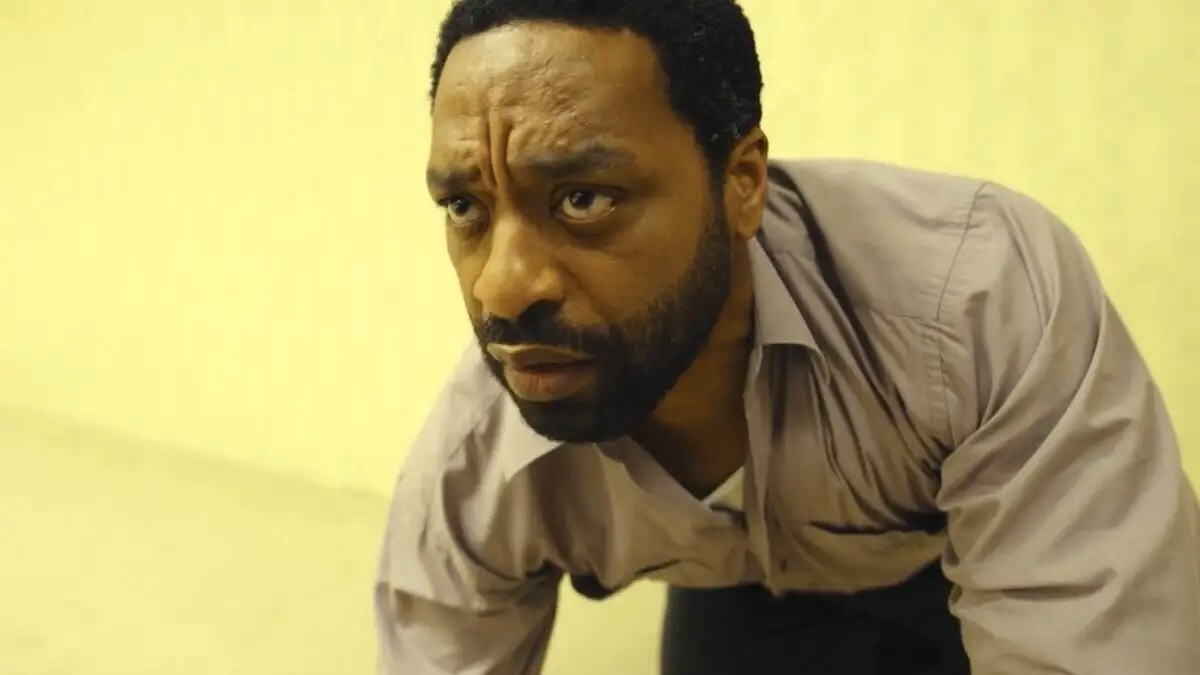
In the opening Prelude, we join Captain Andersen (Lars Mikkelsen) and the crew of his sailing ship, who are stranded on the ice in remote Arctic waters. There’s a sudden explosion nearby, from which the crew rescue Victor Frankenstein (Oscar Isaac), who has been pushed almost to the point of death by a monstrous assailant. After witnessing The Creature (Jacob Elordi) plunging into icy waters, they carry Victor onto the ship – but, once revived, he assures Andersen that his pursuer will not actually be dead and will surely come for him…

Before that happens, he needs to tell his story.

Victor then narrates The Creator’s Tale and we flashback back to his childhood where, under the rule of his despotic father, Leopold (Charles Dance), Young Victor (Christian Convery) first becomes obsessed with life and death. Keen-sighted viewers may spot something familiar about Victor’s barely-glimpsed mother, Claire. Something distinctly Oedipal is happening here.

We then cut to some years later. A grown-up Victor is causing controversy at medical school in Edinburgh with the grisly experiments he’s conducting on cadavers (and I get to revisit some of the sets that were evident around my home city in September 2024). We are introduced to Victor’s younger brother, William (Felix Kammerer), and his fiancée, Elizabeth (Mia Goth). We also meet Harlander (Christophe Waltz), a character created for the film, a wealthy man who, for clandestine reasons, is perfectly happy to finance Victor’s attempts to take his experiments all the way.

But Victor’s account is later contrasted with The Creature’s Tale, where we learn of the years when the monster and his creator were apart: how The Creature lived in a barn alongside a kindly blind man (David Bradley); how he mastered the art of speaking (with a distinctly Yorkshire accent); and how he slowly began to realise how shabbily he’d been treated…

It’s not just because I’m a devout Guillermo del Toro fan that I think this film is a million times better than every other Frankenstein-generated movie I’ve watched down the decades. Isaac is a revelation in the title role, nailing both the character’s sense of privilege and his fatal short-sightedness. Elordi, meanwhile, offers a fresh take on the Creature that really brings out his innate vulnerability and his desperate need to relate to others, something that’s been attempted before with much less success. 

The film is packed with sumptuous locations and thrilling action set-pieces, that have it hurtling through its lengthy running time. Cinematographer Dan Lausten captures every scene with an almost luminous intensity, Kate Hawley’s costume designs are exquisite, and there’s a beautiful score courtesy of Alexander Desplat. If I have a minor niggle it’s that the CGI-generated wolves in one long sequence aren’t quite as convincing as they need to be – and perhaps both Mia Goth and Felix Kammerer might have been given a little more to do?

But these are nitpicks. As ever in these situations, I’m urging people not to wait for this to drop onto streaming, because this level of filmmaking deserves to be watched on the biggest, brightest screen available, one of – dare I say it? – monstrous proportions.

I’ll get my coat.

4.8 stars

Philip Caveney

Little Women

24/10/25

Bedlam Theatre, Edinburgh

First, a plea to the good people of Bedlam: for the love of all little women, good wives and little men, PLEASE stop leaving the fire exit door open during your productions. Christopher Columbus! It’s cold enough in this unheated theatre without letting in a blast of late October air! I wasn’t expecting to identify quite so closely with Amy after her fall through the ice, “shivering, dripping and crying” until she’s wrapped in blankets in front of a fire.

But, to quote Louisa May Alcott, “there is always light behind the clouds” and EUTC’s Little Women, directed by Lauryn McGuire and Meri Suonenlahti, is a case in point: a bright, sparky production, perfectly encapsulating the wholesome vivacity of the nineteenth-century New England classic.

Not a lot happens in Little Women – the coming-of-age novel is character rather than plot-driven – so the play’s success relies on the actors’ embodiment of the four sisters. Liv De Pury excels as Alcott’s alter-ego, Jo, the irrepressible second child, who rails against the constraints of her gender and burns with ambition to become a writer. De Pury imbues the popular heroine with sass and drive, creating an engaging protagonist for us to root for. Sophie Davis’s Meg is a softer, sweeter young woman than Jo, but no less likeable, her warmth and kind nature almost palpable. Elsie Frith, as Beth, captures the girl’s gentleness and fragility, while Rachel McLaren shines as Amy, the melodramatic baby of the March family, eliciting much laughter from tonight’s audience.

The set (managed by Azalea Drace) works well, making the most of the small stage. A raised area represents Jo’s garret, with the rest of the performance space given over to the March family’s living room. The trusty green Chesterfield is back (it’s made an appearance in almost every show we’ve see in this venue), its period style especially appropriate for this piece. I also like the fact that the sisters actually play the old upright piano, rather than relying on recorded sound.

The costumes (managed by Millie Franchi) are similarly effective, making clever use of corsets to convert simple modern skirts into clear approximations of 1800s fashion.

The production as a whole works well. Dylan Kaeuper (Laurie) and Theodore Casimir-Lambert (John Brooke) provide excellent support as the love interests, while Roni Kane (Marmee), Hunter King (Father) and Rufus Goodman (Old Mr Laurence) are all impressively convincing as characters much older than themselves. Watching events play out, I feel transported back into the cocoon of my childhood, curled up in bed reading about these faraway adolescents and their travails.

I can’t urge you to buy a ticket because there’s only one performance left and I know that it’s sold out. But I can congratulate EUTC on another delightful production, allowing this good wife to indulge in a little nostalgia and leave the theatre with a great big smile on her face.

4.4 stars

Susan Singfield

Batshit

23/10/25

Traverse Theatre, Edinburgh

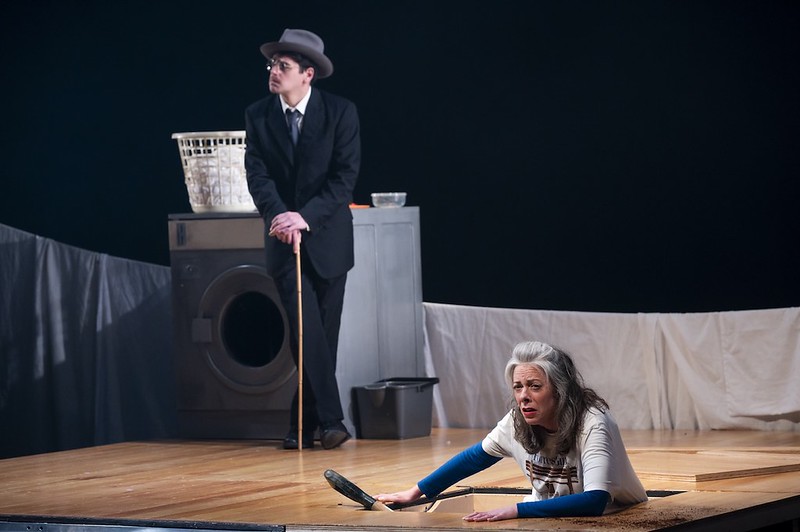
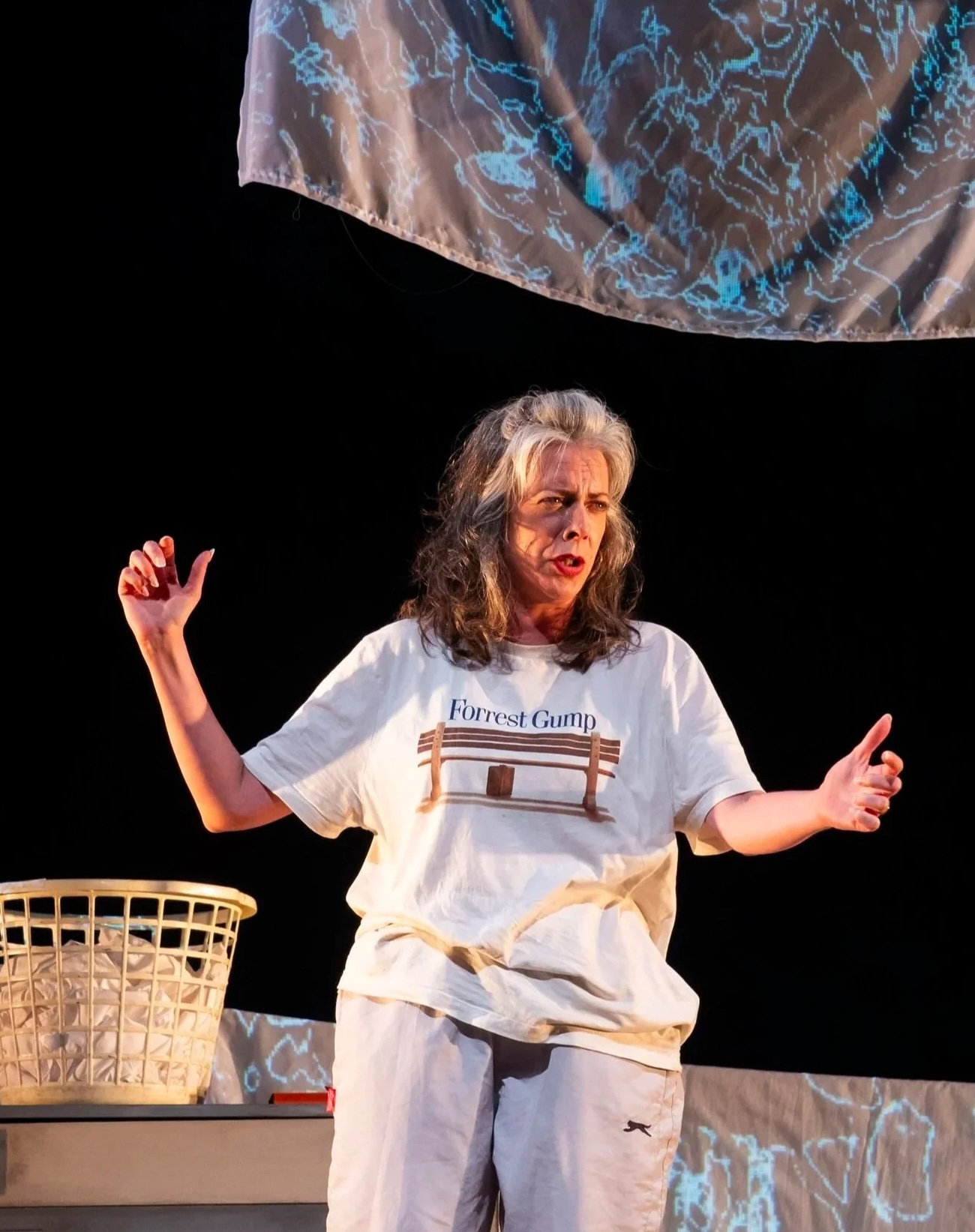
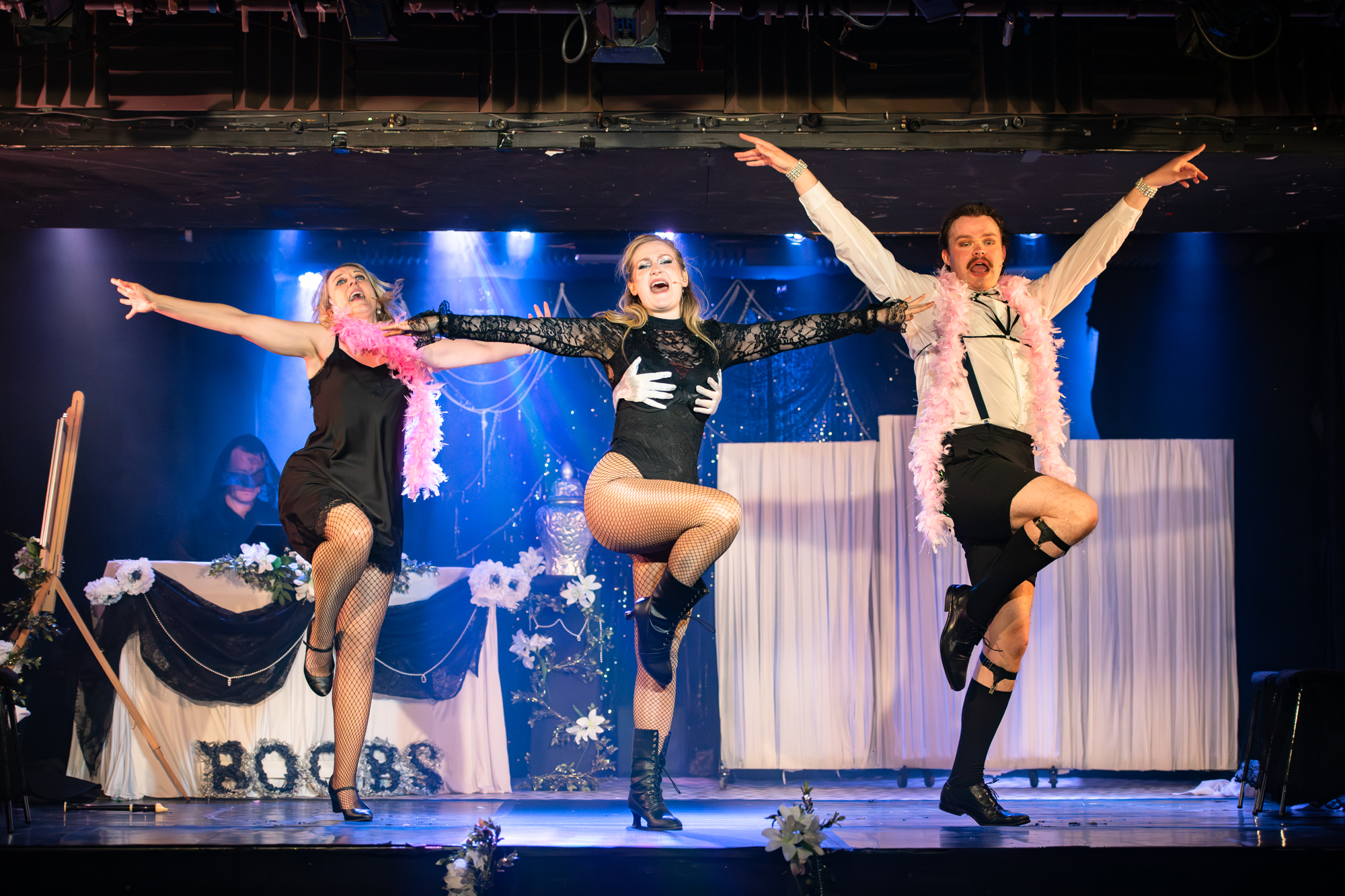
Leah Shelton’s Batshit explores the prevailing notion of madness as a female malady, where women’s physical and emotional states are pathologised and othered, deemed peculiar because they differ from the ‘norm’, i.e. the male.

Equal parts cabaret, polemic and eulogy to Shelton’s grandma, Gwen, this clever one-woman show brings its disparate strands together with absolute precision. It’s a demanding piece, blending the personal and the political with compelling sincerity. 

Gwen’s story is the microcosm, neatly illuminating the bigger picture. In the 1960s, following a miscarriage, she announced she didn’t want to be a housewife any more. Crazy, eh? Her husband certainly thought so and, backed up by a male-dominated medical profession, managed to have her sectioned. Despite many months of incarceration, drugged to the eyeballs and under constant surveillance, Gwen didn’t change her mind. She must be really, really cuckoo, right? Maybe repeated sessions of ECT might encourage her to listen to reason? Spoiler: they did. Turns out that people say what you want them to if you torture them enough…

Shelton is a talented physical performer, contorting her body to mirror her characters’ contorted thoughts. The movements are exaggerated and often grotesque, but delivered with such charm and gravitas that they never seem absurd. The metaphors are writ large – there’s nothing subtle about a straight jacket or a gag – but they’re incredibly effective, reminding us that we need to be vigilant even in these so-called enlightened times. Women’s freedoms have been hard-won and we take them for granted at our peril. Have you ever heard an angry or frustrated man being dismissed as ‘hysterical’?

Directed by Ursula Martinez, Batshit is a dazzling firework of a production, its message lingering in a trail of sparks that keep me thinking long after the applause has died away. These three nights at the Traverse (23-25 October) mark the end of the UK tour, so be sure to catch it while you can!

4.3 stars

Susan Singfield

The Seagull

15/10/25

Lyceum Theatre, Edinburgh

Sometimes a particular production of a play can be a revelation. The Royal Lyceum’s The Seagull is a good case in point. Chekhov famously insisted that his plays were actually comedies – yet every time I’ve gone along to see one, I have been presented with something ponderous and rather miserable.

This inspired interpretation of the Russian’s best-known play, adapted by Mike Paulson, finally sets the record straight. While it’s indisputable that the story has a tragic conclusion, the journey there is spirited and so chock-full of acerbic humour that, from the opening lines, I’m laughing.

In the first act, the elderly and infirm Pyotr Sorin (John Bett) is entertaining his family and their friends at his country estate. His younger sister, former actress Irena Arkadina (Caroline Quentin), has brought along her son, Konstantin (Lorn McDonald), who is deeply in his mother’s thrall and has aspirations to be a playwright. Irena is also accompanied by her lover, Trigorin (Dyfan Dwyfor), a fêted young writer, though it’s clear he derives very little pleasure from his success.

Although unnerved by Trigorin’s presence, Konstantin presses ahead with a performance of his latest project. He’s enlisted the help of an aspiring actress, Nina (Harmony Rose-Bremner), who lives on a neighbouring estate. He claims to be seeking a ‘new theatrical form’ and he’s devastated when his mother airily dismisses the monologue as ‘incomprehensible.’ He’s even more upset when Nina (who he clearly adores) seems much more interested in talking to Trigorin than to him.

Meanwhile, Masha (Tallulah Greive), the daughter of the estate’s boorish steward, Shamrayev (Steven McNicholl), is hopelessly in love with Konstantin, though he seems barely aware of her existence. She views the fact that shy local schoolteacher, Medvendenko (Michael Dylan), is in love with her as something of a major irritation.

In such a tangle of unfulfilled longing, it’s inevitable that tragedy is waiting somewhere in the wings…

There’s so much to enjoy here and not just Quentin’s perfectly-judged performance as the conceited, self-aggrandising Irena, intent on making every conversation all about her. The gathering of disparate characters is well-realised, with Bremner excelling in the role of the increasingly-unsettled Nina, whose obsession with becoming an actress threatens to lead her headlong into madness. Dylan generates a goodly share of the laughs as the hapless and self-critical Medvendenko, in particular during his pithy exchanges with the local physician, Dr Dorn (Forbes Masson), who seems to have brought along enough laudanum to put everyone out of their misery.

I’m entranced by Anna Kelsey’s autumnal set design, particularly in the first act where Konstantin’s outdoor stage has an ethereal beauty. Director James Brining brings out all the nuances of Chekhov’s witty script and the piece seems to zip along, buoyed by what I assume is the simple intention of making this one of the most accessible Chekhovs you’re ever likely to see – an aim that is accomplished with élan.

4.5 stars

Philip Caveney

Maybe Tomorrow

14/10/25

Traverse Theatre, Edinburgh

Glamour and strife! Bigger than life!”

Siân Silver (Liz Ewing)’s showbiz career is careering towards the end of Sunthorpe-on-Sea’s dilapidated pier, where the seventy-five-year-old singer is gamely touting her outmoded razzle-dazzle to ever-smaller audiences for a measly £250 a week. It’s a long way from the stardom she dreamed of, but at least she’s still on stage, performing – until the theatre manager tells her she’s no longer required. Siân doesn’t know who she is if she’s not sparkling in the spotlight. What’s left when even the dregs she’s settled for are so cruelly stripped away?

Forced to confront her failure, Siân is visited by the ghost of Siânny past (Julia Murray). Young Siânny is brimming with hope and vitality, urging her future self to embody the spirit of her long-time heroine, Little Orphan Annie. Instead of bemoaning her hard-knock life, Siânny thinks Siân should focus on making the most of the years she has left. “Maybe now it’s time…”

At first, Siân’s having none of it but she soon realises she has nothing to lose. Why not step into the plucky red-head’s ankle socks and Mary Janes? After all, why should little girls have all the fun? The role of Annie is wasted on a ten-year-old! If she has to bow out, then she’ll do it on her own terms…

Written by Hannah Jarrett-Scott with music and lyrics by Brian James O’Sullivan, Maybe Tomorrow is a decidedly quirky piece of musical theatre, rife with heart and humour. The songs work well, paying homage to Charles Strouse’s original score without allowing it to overwhelm this play. Under Lesley Hart’s direction, Ewing shines as the protagonist (and not just because of her sequinned costumes), imbuing the fading performer with pathos. Siân is talented but unappreciated: of course she’s resentful; of course she’s angry at her producer-ex, who promised her centre-stage but left her in the wings. Murray provides excellent support, not only as the vivacious Siânny, but also as a series of minor male characters, with an impressive range of hats, accents and, um, farts.

An ageing Annie-fan myself, I enjoy this show immensely. It’s undeniably absurd, but somehow rather beautiful. It feels like the start of something that could easily evolve into a full-length musical production, where both themes and characters would have more space to breathe. Why not pop along to the Traverse this week and see for yourself? “You’re gonna have a swell time.”

4 stars

Susan Singfield

The Lost Bus

13/10/25

Apple TV+

A new release from Paul Greengrass is always worth further investigation, even though The Lost Bus, financed by Apple TV+, was only granted a fleeting cinematic release, so we’re obliged to catch it via streaming. Loosely based on a true story, it’s centred around the 2018 Camp Fire – a strangely innocuous name for what was actually the deadliest fire in Californian history, which claimed the lives of 84 people and destroyed hundreds of homes.

Matthew McConaughey, looking like a walking personification of the word ‘grizzled’, plays Kevin McKay, a down-on-his-luck school bus driver, based in the ill-named town of Paradise. Struggling to look after his invalid mother, separated from his wife and failing to communicate with his teenage son, Shaun (Danny McCarthy), Kevin has acquired something of a bad reputation. He is the driver who’s always running late, who often fails to fill out in his paperwork on time, and who’s constantly at odds with his dispatcher, Ruby (Ashlee Atkinson).

But when a deadly wildfire erupts in the California hills and high winds disperse the flames across a wide area, a class of twenty-two children and their teacher, Mary (America Ferrara), find themselves stranded at their elementary school. Ruby puts out a desperate call for someone to go to their aid – and the only person available to collect them is Kevin.

Sensing an opportunity for redemption, he heads for the school and picks up his passengers. But getting them to safety is no easy matter…

Greengrass sets out his stall from the opening scenes, presenting the fire’s inception. An electrical cable, pulled from a high tower by the rising wind, ignites the surrounding brush. From that point onwards, the blaze is presented as a hungry predator, rushing back and forth across the landscape, searching out its next target. It’s an inspired approach to the subject, one that inspires dread.

Just one day after watching the terrifying A House of Dynamite, I find myself once again plunged headlong into the realms of Stressville. But this being a true story, I can at least have the reassurance that there’s going to a happy ending… right?

Greengrass, who co-wrote the screenplay with Brad Inglesby, certainly keeps me guessing for a lot longer than is comfortable. His expert handling of the wildfire scenes, fuelled by Pål Ulvik Rokseth’s immersive cinematography, makes for exhilarating viewing as Kevin steers his rickety bus through what increasingly resembles the seventh circle of hell. (Note: no children were harmed in the making of this film. Honestly.)

McConaughey and Ferrara make an interesting chalk-and-cheese double act and, while some of the kids are allowed to be cute, they are never too shmaltzy. My only niggle is with the dialogue from the scenes featuring the fire team who are trying to handle the disaster, which veers uncomfortably close to exposition – but that’s a nitpick. The steadily mounting chaos keeps me on tenterhooks for the film’s entire two-hour running time.

All in all, this is an assured piece of action filmmaking, which highlights many of Greengrass’s distinctive hallmarks. I just wish I’d had an opportunity to view it on the big screen.

4.2 stars

Philip Caveney

A House of Dynamite

12/10/25

Filmhouse, Edinburgh

It’s been quite some time since we saw anything from Oscar-winning director Kathryn Bigelow, but A House of Dynamite signals an auspicious return to the fray. This Netflix-financed epic will be streaming soon, but meanwhile it’s been granted a limited theatrical release. It’s big, glossy and features a host of well-known actors in relatively small roles, in a whole series of convincingly-recreated sets. It’s also one of the most utterly terrifying films I’ve ever seen.

At Fort Greely, Alaska, Major Daniel Gonzalez (Anthony Ramos) and his team detect the unannounced launch of an intercontinental ballistic missile, heading towards the United States. Moments later at the White House Situation Room in Washington DC, Captain Olivia Walker (Rebecca Ferguson) sees the incoming projectile on a giant screen and watches appalled as the terrifying statistics unreel. The missile’s current trajectory has it aimed squarely at the city of Chicago and – if unimpeded – in just eighteen minutes’ time, millions are going to die.

An attempt can be made to intercept the missile in the air but, as one observer comments, it will be “like trying to hit a bullet with a bullet.” And, should that fail, the only thing to be determined is the severity of the response. With no country claiming responsibility for the launch – indeed both Russia and North Korea are denying it – the decision must lie entirely with the POTUS (Idris Elba), who is in the middle of making a speech to a high school basketball team somewhere in the city.

And that eighteen minutes is ticking away…

Anyone expecting an exciting drama where a lantern-jawed hero runs athletically into view with a perfectly-timed maverick plan to save the world is going to be severely disappointed with A House of Dynamite. This is simply not that film. Instead, it’s the kind of story you watch with clammy palms as the threat steadily rises: the kind where you begin to realise that there really isn’t going to be any way of evading the devastating conclusion. There will be not scenes of relieved people hugging each other and fist-pumping beneath the Stars and Stripes as they realise the threat has been miraculously defused.

Instead we have human beings staring into the abyss as they see their hopes and dreams turning to smoke. And the realisation that this is the world we now live in, where one mistake can have cataclysmic consequences. Writer Noah Oppenheim opts to show the same eighteen minutes of the missile’s trajectory from three different perspectives. It’s only in the final third that we actually get to see the POTUS, as it dawns on him that he is going to have to select his country’s response to the situation from a handy booklet presented to him by an aide – a sort of IKEA manual for disaster – and that the repercussions of that decision will live with him forever. (Despite his helplessness, I find myself wistfully wishing that Idris Elba actually were the President of the US instead of the man who currently has his hands on the nuclear codes…)

This is a tough watch. I honestly cannot remember being so profoundly affected by a film since I first saw Peter Watkins’ film, The War Game, back in 1966. While I cannot in all honesty claim to have enjoyed watching A House of Dynamite, I believe it’s an important and brilliantly-directed film, with a powerful and important message at its core. I would urge everyone to see it and have a long, hard think about the awful truth it clarifies: that we as a species have built the unstable dwelling of the title – and that we are forever doomed to live with that knowledge unless we do something to change it.

5 stars

Philip Caveney

Urchin

11/10/25

Cineworld, Edinburgh

Actor Harris Dickinson makes an assured directorial debut with this intriguing story, which concentrates on the misadventures of young man called Mike. Frank Dillane gives a beguiling performance in a role that has already won him the Un Certain Regard prize at this year’s Cannes Film Festival. Dickinson also wrote the screenplay, which immediately evokes my sympathy for its troubled, self-destructive protagonist.

The film opens with Mike wandering the streets of London, feverishly strung-out on drugs and constantly searching for ways to procure money to pay for his next fix. He clashes with Nathan (Dickinson), another young man in a similar situation and, after a fight between them, passer-by Simon (Okezie Morro) attempts to help Mike, offering to buy him a meal. Mike accepts the offer – and then punches Simon unconscious before stealing his designer watch, which he sells for a measly £40. Shortly afterwards, he’s arrested and sent to prison.

We don’t see anything of his time in captivity but, some months later, he’s released back into the community, given a temporary place in a hostel and sent to work in the kitchen of a down-at-heel hotel under the direction of Chef (Amr Waked). Mike is off the drugs now and determined to make a fresh start, but he is told that part of the process will include him sitting down with Simon and expressing regret for what he’s done…

It’s a simple premise, with a deeper subtext. Dickinson’s script has the brutal smack of realism and Dillane is extraordinarily compelling. There’s something innately likeable about Mike, something so utterly helpless that I watch this on tenterhooks, dreading every step he takes in the wrong direction. The film has the verité quality of Ken Loach, cinematographer Joseé Deshaies filming in long, naturalistic takes, mostly on the streets. But every so often, the scene shifts to a mysterious, labyrinthine setting, an underground cavern, as though we’ve been granted access to somewhere deep within Mike’s psyche: a strangely tranquil place, where all his woes are momentarily forgotten.

But we’re only in there for short intervals, before being wrenched rudely back into reality, where Mike’s slow slide to oblivion continues. Dickinson is a chameleon of an actor, who has a whole range of disparate characters to his credit, so it’s perhaps unsurprising that he displays this same quality as a director. Urchin is one of those hard-to-quantify features, a unique and impressive first foray.

If the acting work ever dries up, Dickinson clearly has another talent to explore.

4.4 stars

Philip Caveney
I Swear

10/10/25

Cineworld, Edinburgh

I Swear follows a tried and tested feel-good formula. You know the one: a vulnerable protagonist struggles to live with a misunderstood condition until their saviour arrives in the shape of a kind and unassuming friend, allowing them to flourish. So far, so seen-it-all-before. But writer-director Kirk Jones gives the format a kick in the baws with this tale of grit and humour in the face of great adversity.

The film is elevated by two things: an extraordinary true-life story and a stellar cast. The central character is John Davidson, an MBE-decorated Scottish activist, who lives with Tourette syndrome and campaigns to raise public awareness. Played here by Scott Ellis Watson (as a teenager) and Robert Aramayo (as an adult), he lights up the screen, his frustration and sadness leavened by his innate sweetness – and the undeniable funniness of his inappropriate comments and sweary outbursts. “I’m a paedophile,” he says at a caretaking job interview, when informed that the role includes setting up a hall for youth groups to use. The same prospective employer asks him about his tea-making skills. “I’m good,” John assures him, “I use spunk for milk.”

Despite the jocularity, Jones’ screenplay never mocks John, never laughs at him or belittles what he has to deal with every day. Instead, it’s an honest account of a young man floundering in a hostile world, rescued from despair by finding acceptance. John’s protector is his pal’s mum, Dottie (Maxine Peake), a mental health nurse with a terminal cancer diagnosis, who takes John in. While his own mum, Heather (Shirley Henderson), is uptight and puritanical, embarrassed by his language, making him sit apart from the family to eat because of his tendency to spit, Dottie ignores his tics and profanity, welcoming him at her kitchen table, telling him not to apologise for things he can’t help. She encourages him to see a future for himself: one where he can hold down a job and live independently.

Another positive influence in John’s life is his janitor boss, Tommy (Peter Mullan), who champions his young assistant, serving as both mentor and father figure. It’s Tommy who tells John he needs to raise awareness of his syndrome: “The problem isn’t Tourette’s; it’s people not knowing about Tourette’s.” It’s Tommy who stands up for John in court, when the judge seems ready to penalise him for contempt, unable to accept that his shouting is involuntary.

At the end of the movie, we see the real-life John, a familiar figure to those of us old enough to remember the 1989 BBC documentary, John’s Not Mad, which featured the sixteen-year-old Davidson. I’m a little confused as to why this influential TV programme is never mentioned in the film, as it must have made him something of a local celebrity and changed the way he was perceived. Still, he’s been spreading the word ever since, organising conventions, giving presentations to school kids and police officers, making sure that everyone knows about Tourette syndrome. We’ve no excuse for condemning those living with it to the years of misery John himself endured.

Engaging, enraging and hilarious, I Swear is something of a triumph.

As John himself might say, “Fuck off to the cinema and watch it, ya wankers.”

4.3 stars

Susan Singfield

Black Hole Sign

08/10/25

Traverse Theatre, Edinburgh

There’s a great big metaphor hanging over the unnamed hospital where this dark comedy takes place. A hole has appeared in the roof of A&E and water is dripping down onto the floor. As the story progresses, so the problem steadily worsens, the ingress ever more destructive. 

But senior charge nurse Crea (Helen Logan) and her team can only soldier on regardless, doing their best for their patients, no matter what. Crea has phoned for help about the roof only to be told (by a recorded voice) that she is number 74 in a queue. Her team include her right-hand woman, Ani (Dani Heron), currently doing a bit of soul-searching about her own future; affable porter, Tommy (Martin Docherty), who has long carried a torch for Crea; and Lina (Betty Valencia), an almost cartoonishly helpless student nurse, who arrives chewing gum to ‘help her anxiety’ and who seems incapable of walking past a litter bin without knocking it over.

It’s clearly going to be a tricky night. Mr Hopper (Beruce Khan), a former alcoholic, is admitted with the fatal condition that gives the play its title, an inoperable affliction of the brain that is going to keep deteriorating and will cause his death in a matter of hours – but there’s no sign of anybody visiting him. Meanwhile, octogenarian Tersia  (Ann Louise Ross) is suffering from a urinary infection and is causing havoc as she experiences hallucinatory episodes that make her think that she is at a 1970s disco. The silver glittery shoes she’s wearing are all too real though.

At various points the play keeps cutting to an enquiry, some time later, where the members of staff have been called as witnesses and we learn that something really bad happened on that fateful night, resulting in a tragic death. It’s all too clear that somebody is going to have to pay the ultimate price for this disaster.

Playwright Uma Nada-Rajah is herself a staff nurse, who works in critical care, so it’s little wonder that, despite the sometimes slapstick levels of humour on display, the piece feels authentic, clearly inspired by events that the writer has actually experienced. It’s not the eviscerating howl of despair I came in expecting but then, such grim polemics can sometimes make for difficult viewing, so here the bitter pill has been sweetened with a shot of humour. Amidst the laughter, important points are being driven home.

It’s clear from the outset that tonight’s audience is on board with this fast-moving production, cleverly directed by Gareth Nicholls, though I must confess to being somewhat puzzled by a lengthy blackout, which – considering how little has changed when the lights come back up – seems unnecessary.

This niggle aside, the hearty applause at the play’s conclusion suggests that everyone present is in agreement with the story’s subtext. The National Health Service – one of the greatest institutions of modern times – is on its last legs and anything that forces this pressing concern into the spotlight is more than worthy of our attention.

4 stars 

Philip Caveney