Andrew Panton

The High Life

07/04/26

Festival Theatre, Edinburgh

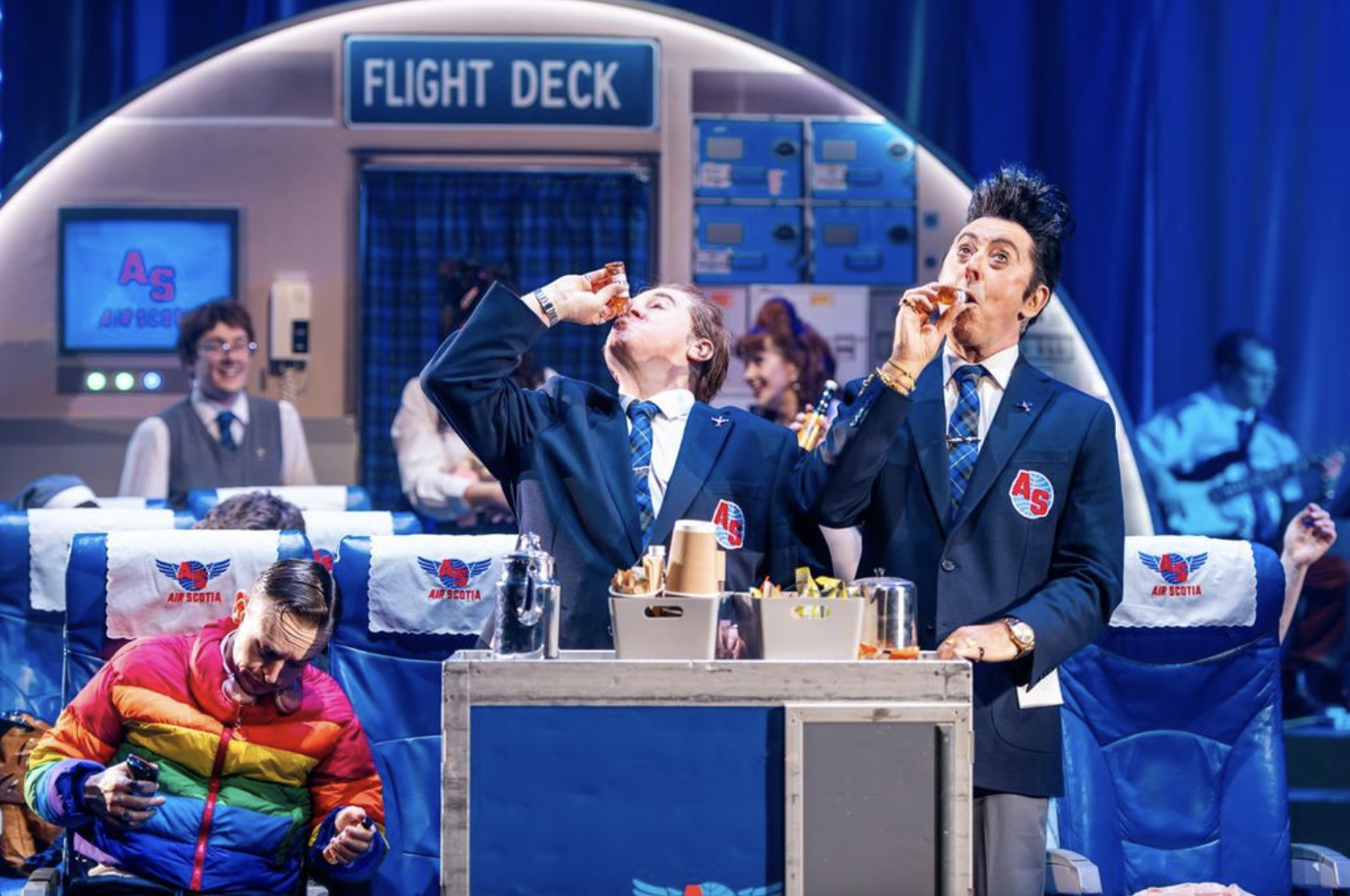
Way back in 1994, a seven-part television series aired on the BBC. The brainchild of actors Alan Cumming and Forbes Masson, it offered a surreal blend of Scottish whimsy and outrageous musical routines. Cumming played Sebastian Flight and Masson was Steve McCracken, two flight attendants working for the fictional airline, Air Scotia. These were men for whom sarcastic asides came fitted as standard. A second series was planned but never came to fruition but, over the years, The High Life achieved a sizeable cult following. Who could have foreseen that three decades later the two originators would team up with Johnny McKnight to create a stage musical inspired by that very series? And who could have predicted that it would star four members of the original cast and would be presented by The National Theatre of Scotland, no less?

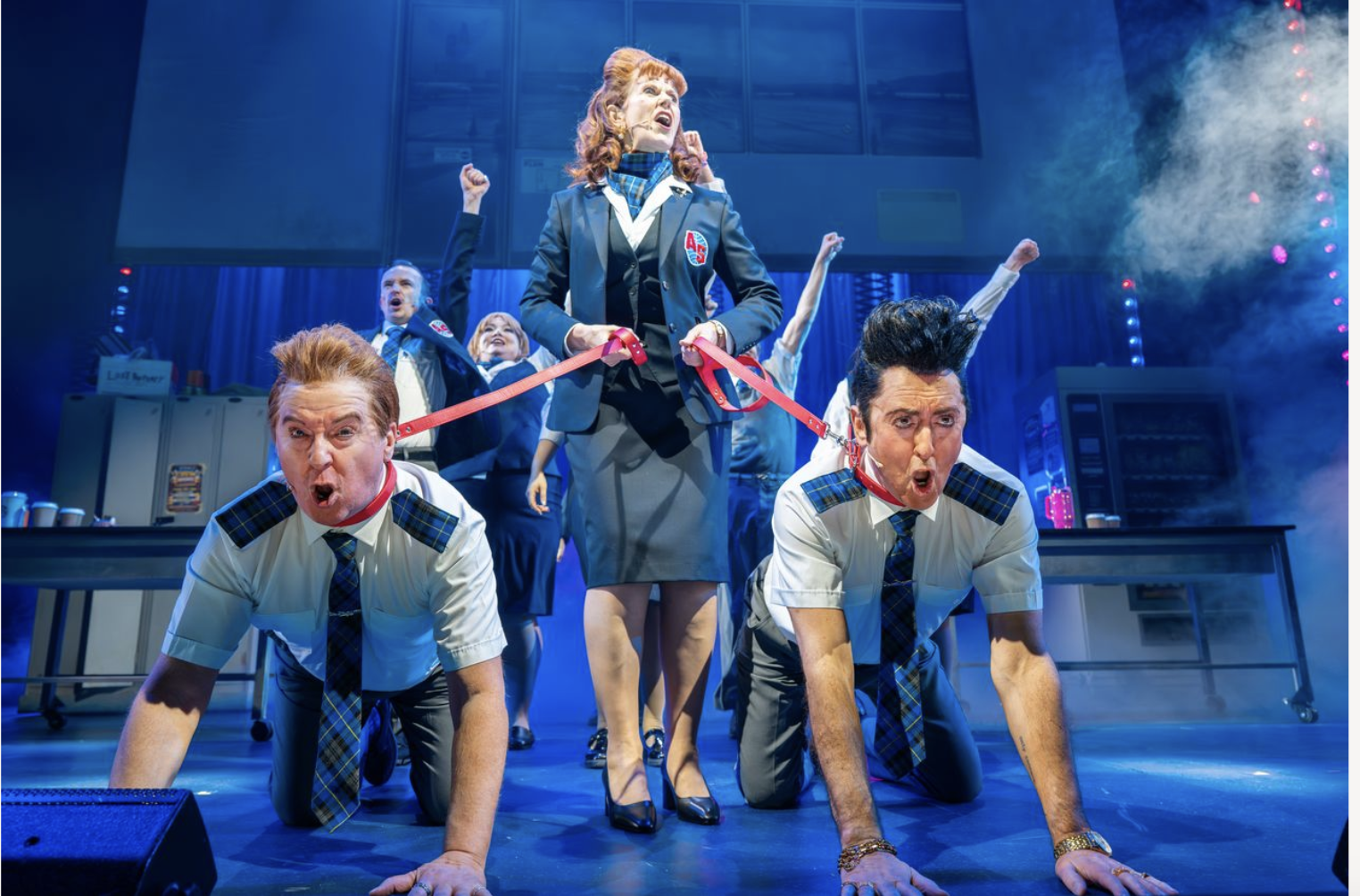
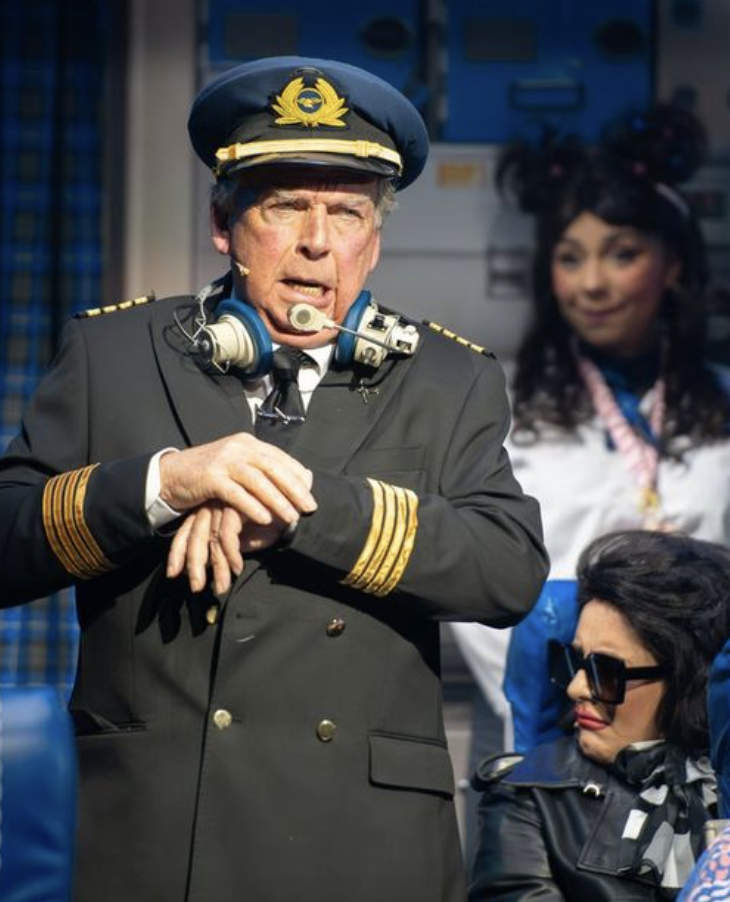
But the proof is right here on the stage of the Festival Theatre, as Sebastian and Steve prepare for take off once more. Suffice to say, their old adversary, Shona Spurtle (Siobhan Redmond), is still prowling the aisle ‘like Mussolini in micro-mesh,’ keeping our two heroes well and truly under her thumb, while Captain Hilary Duff (Patrick Rycart) can always be depended on to wander in at inappropriate moments, making rambling observations about whatever happens to be on his mind. Not the flight, that’s for sure.

The sense of affection from the packed auditorium is palpable and the staunch fans’ reactions to familiar references are loud and appreciative. As somebody who has never seen the TV series, I must admit that these allusions go right over my head – but it doesn’t really matter. This is, more than anything else, utterly devoted to unbridled silliness in all its exquisite forms. The script is packed with superb one-liners and up-to-the-minute political references. The lead players demonstrate that they really can turn their boundless skills to just about any genre – and the supporting cast are (nylon) uniformly excellent. Kyle Gardiner is particularly impressive in the role of new recruit Mylie, while Rachael Kendall Brown is utterly adorable as Kylie, the stewardess who has been secretly carrying a candle for Shona.

Colin Richmond’s set and costume design are suitably ingenious, taking nylon to places it’s never been before, while Emily Jane Boyle’s slick choreography keeps the 11-strong cast striding, dancing (and occasionally crawling) across every inch of the massive stage. Director Andrew Panton handles all the rampant mayhem with commendable skill and the pace never flags for a moment.

The first act culminates in a sudden and startling manner. During the interval, Susan and I speculate about what might await us in the second. It speaks volumes that both of us are half-right and simultaneously, completely wrong about where Flight 123 is ultimately headed. The High Life goes to places most other airlines dare not venture and it’s fun to travel with them. My advice would be to get yourselves down to the Festival Theatre before this show jets off on tour.

4.2 stars

Philip Caveney
The Glass Menagerie

07/11/25

Royal Lyceum Theatre, Edinburgh

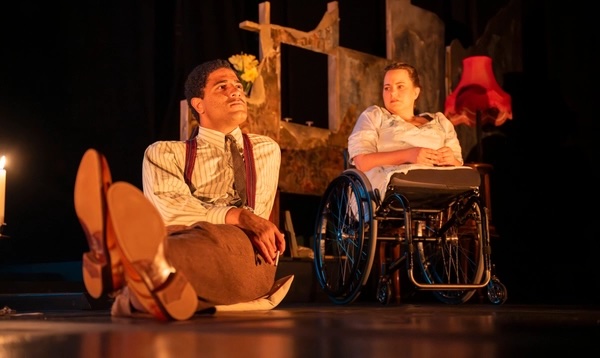
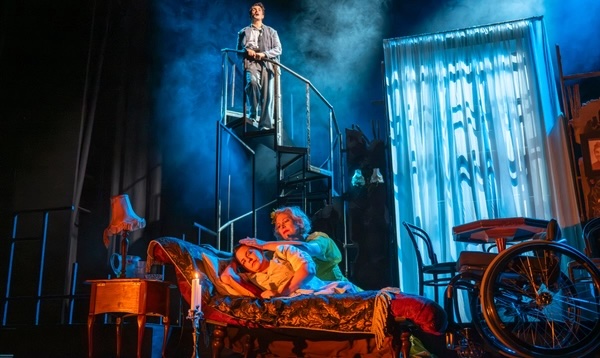
Directed by Andrew Panton, this production of The Glass Menagerie (from Dundee Rep, Citizens and the Royal Lyceum) is an altogether gentler and less histrionic affair than other interpretations I have seen – and all the more compelling for it. Emily James’ barely-there set echoes the characters’ fragility, underscoring the narrator’s opening assertion that the play “is not realistic.” The overt theatricality – the fourth-wall breaking; the exaggerated miming as the family eat a meal – paradoxically emphasises the underlying authenticity, the idea that this is “truth in the pleasant disguise of illusion”.

The time: 1937. The place: St Louis, Missouri. Our narrator is Tom Wingfield (Christopher Jordan-Marshall), and it’s no coincidence that he shares his initials with the playwright. The Glass Menagerie was described by Tennessee Williams as “a memory play,” a loosely autobiographical attempt to pin down his relationship with his emotional past – so it makes perfect sense that Tom should be an aspiring writer, desperate to escape the clutches of a dead-end job in a broken economy. He is consumed by the need for freedom in all its guises – creative, personal, sexual – bitterly resentful of his mother’s insistence that it is his duty to stay at home and provide for her and his sister.

His mother, Amanda (Sara Stewart), is the kind of fading Southern belle Williams is famous for, but – at least in this iteration – she’s less monstrous than Blanche DuBois or Maggie the Cat. This Amanda reminds me more of Austen’s Mrs Bennett: a woman made ridiculous by her desire to find a husband for her daughter, even though her zealotry makes perfect sense in a society where women are financially dependent on men. Stewart imbues Amanda with warmth and likability, while also making clear exactly why Tom finds her so intolerable.

Amy Conachan’s Laura is irresistible. She is Tom’s older sister, but a combination of shyness and disability means that she is far less worldly-wise than him. In fact, they are opposites in almost every respect. While Tom finds the city too small and claustrophobic, Laura is agoraphobic, too terrified even to open the front door, let alone build a life for herself outside the home. Tom rails against his situation but Laura has ruefully accepted her lot in life, successfully side-stepping Amanda’s attempts to set her up on dates and dedicating herself to the care of her collection of delicate glass ornaments. So it’s all the more heartbreaking to see her open up to Tom’s kindly friend, Jim (Declan Spaine), only to have her hopes dashed by his smiling comment that he’d love to have a sister just like her. Exquisitely acted, the extended duologue between this pair is a real highlight for me.

The dreamy nature of the play is further emphasised by the music, liltingly performed by Spaine as the story unfolds, and Simon Wilkinson’s light design perfectly complements the ethereal atmosphere, at times illuminating the characters’ faces in such a way as to almost create cinematic close-ups, so that we’re forced to focus on their pain and misery.

This beautifully-realised production of The Glass Menagerie has only one more showing at the Lyceum, so you’ll have to be quick if you want to get yourself a ticket for tonight’s performance.

4.6 stars

Susan Singfield

No Love Songs

31/10/24

Traverse Theatre, Edinburgh

No Love Songs is a sweetly bleak piece of gig theatre, at once an unflinching exploration of post-natal depression and a testimony to the power of, well, love.

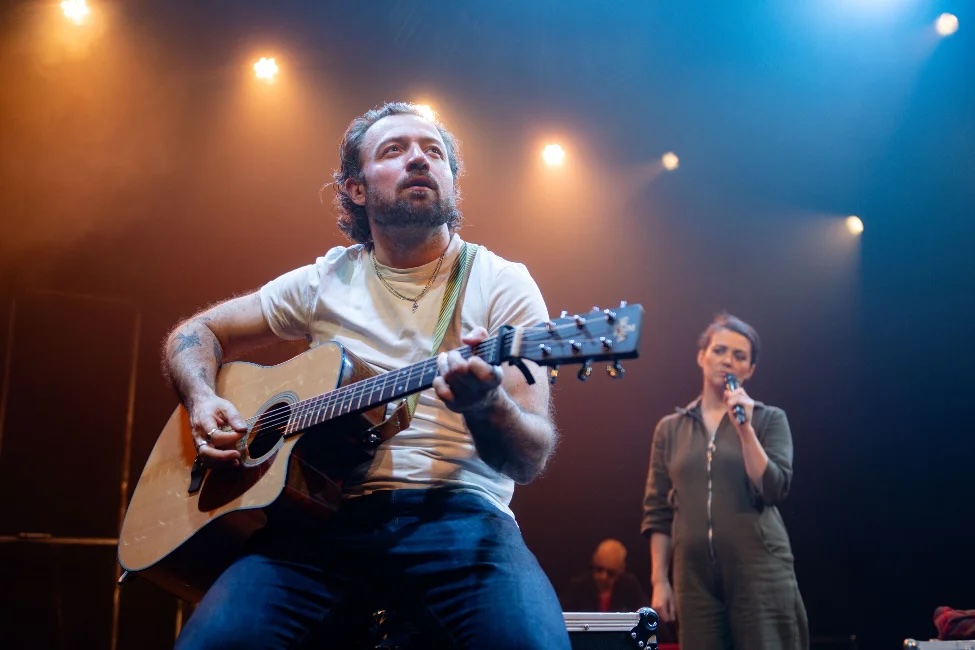
With music by The View’s frontman, Kyle Falconer – lifted from his solo album, No Love Songs for Laura – the book comes courtesy of the titular Laura (Wilde), his partner, and Johnny McKnight and is based on their real-life experiences.

Jessie (John McLarnon) is a musician. Sure, he’s mostly playing weddings and sweaty Dundee dive bars, but he has big dreams. Lana (Anna Russell-Martin), newly arrived in town to embark on a fashion course at the college, is full of creative ambition too. Together, they think, they can take on the world. When Lana becomes pregnant, they’re excited about their shared future.

But reality can be a bitch, and Lana – like one in five new mothers – struggles with post-natal depression. In a master-stroke of bad timing, Jessie is offered a big break: the chance to go on tour in America. Not only is this important for his musical career, it’s also an opportunity for him to earn some proper money for his family. If all goes well, they might even be able to buy a house.

“You have to go,” says Lana. It’s only a couple of months, right? She’ll be fine.

But Lana is not fine and a gulf opens up between the pair, as Jessie embraces his new life while Lana spirals into despair. What’s wrong with her? Why isn’t she ‘yummy’ like all the other mummies out there? She’s humiliated by her failure.

Jessie’s role as a musician means that the songs fit seamlessly into this play, with the conceit that we are witness to their creation: they are being written in response to the events as they unfurl. There’s a wide variety of styles, ranging from poppy to plaintive, and there’s some real emotional heft here too. I’m not much of a crier, but there are definitely tears in my eyes at moments tonight.

Directors Andrew Panton and Tashi Gore create a gentle, natural tone: there’s a relaxed ease between McLarnon and Russell-Martin that makes them convince as a couple. It could be argued that their obvious affection undermines the tension, suggesting from the start that everything is going to be okay. But I don’t mind that: the subject matter is so dark that it helps to know that there is a glimmer of light on the horizon.

As heart-warming as it is heart-wrenching, No Love Songs is – despite its title – a lyrical musing on the very notion of love.

4.4 stars

Susan Singfield

Chess: The Musical

30/03/17

Festival Theatre, Edinburgh

Of all the big West End musicals, Chess is a bit of an anomaly. Based around an idea by lyricist Tim Rice, with music by Bjorn Ulvaeus and Benny Andersson (who, let’s face it, know more than a thing or two about composing a catchy song), it was initially a concept album, before being adapted into this theatrical version. It’s a real ensemble piece that presents a considerable challenge to anybody reckless enough to mount a production. Luckily, the Royal Conservatoire of Scotland is more than up to the task and they thrill a packed audience at the Festival Theatre with a skilful display of all things theatrical that is breathtakingly good. Indeed, I have to keep reminding myself all the way through, that I’m watching the work of students here – albeit from one of the most famous theatre schools in the world – because this demonstrates degrees of professionalism that would rival many of the biggest names in theatre.

Inspired by the real life story of chess grandmasters Bobby Fischer and Boris Spassky, it’s the story of American chess player Freddie Trumper (Barney Wilkinson) and Russian player Anotoly Sergievsky (Jamie Pritchard) – and a rivalry that extends beyond the game, when Freddie’s long time muse, Florence Vassay (Daisy Ann Fletcher), becomes romantically entangled with Anotoly. Based around two world championships and presided over by The Arbiter (Emma Torrens) the stage is set for some human life subterfuge that mirrors the complexity of the central game.

It’s all masterfully done – the three lead actors sing brilliantly, there’s some incredibly complex and sophisticated choreography (often incorporating the real time use of video cameras, à la Katie Mitchell) and choral singing that sends chills down the spine. If there’s a criticism, it’s simply that during the first half of the show, the overall volume is occasionally a little too loud, but this is sorted by the second half, which features the show’s best known songs (including, of course, the sublime I Know Him So Well, with Daisy Ann Fletcher harmonising effortlessly with Hayley VerValin as Anatoly’s Russian wife Svetlana).

All-in-all, this is a fabulous show, and director Andrew Panton and choreographer Darragh O Leary can both take a well-deserved bow – and, to be honest, you won’t find a weak element in any department of this marvellous show. It all makes for a brilliant night at the theatre.

5 stars

Philip Caveney

The Broons: Maggie’s Wedding

01/11/16

The King’s Theatre, Edinburgh

The Broons are a much-loved Scottish institution. It’s hard to believe that, as a popular comic strip,  they have featured in The Sunday Post since 1936 – which makes this theatrical celebration an 80th anniversary event. Written by Rob Drummond and directed by Andrew Panton, it was originally commissioned and developed by Sell A Door Theatre Company and as you might expect, given the subject, there’s a robust cartoonish feel to the show. Maw and Paw Broon (Joyce Falconer and Paul Riley) preside over their working class family in the fictional town of Auchentogle, with real pride and plenty of love. As the title might suggest, the events of the play lead up to the marriage of Maggie (Kim Allan) to the (unseen) Cameron. But Maw doesn’t much like the idea of her little princess leaving the family home – and when she finds out that other members of the family are also planning to move away, she quickly takes steps to ensure that such a thing will never happen…

I’ll be the first to admit that having only recently moved to Scotland, I really don’t have much of a backstory with these characters and consequently, many of the ‘in’ jokes (which elicited roars of appreciative laughter from tonight’s audience) went completely over my head; but there was still much to enjoy here, particularly Laura Szalecki’s portrayal of the man-hungry Daphne and Duncan Brown as the monumentally thick Englishman, Jock Badge, who thinks the term ‘4 to 6 years’ on a jigsaw puzzle is an indication of how long it might take him to put it together.

As events scamper joyfully along,  the actors slip effortlessly from character to character and, since this is a play with music, just about everyone bashes out a tune on some kind of musical instrument at various points in the proceedings. The overall effect is charming and though I don’t really agree with the play’s ultimate message – that it’s better to stay with what you know than to seek out new experiences – it certainly chimes with a story that has remained totally unchanged for so very long. And who could fail to enjoy the rousing singalong at the conclusion that pays tribute to a whole host of Scottish talent from The Waterboys to The Bay City Rollers?

If you’re a fan of these fictional folk, you certainly won’t want to miss this; and, if you’re merely curious as to what the fuss is all about, you’ll still be in for an entertaining night.

4 stars

Philip Caveney