
24/08/26
theSpace@Surgeon’s Hall, Edinburgh
I’ve said this before: it’s mind-blowing to think that Frank Wedekind’s Frühlings Erwachen was written way back in 1890, when Kaiser Wilhelm II ruled the Deutsches Reich, Queen Victoria was on the British throne and Robert Gascoyne-Cecil was our PM. Not that anyone was brave enough to stage it right away – it wasn’t until 1906 that the transgressive play premiered at Berlin’s Deutsches Theater.
A whole century later, Steven Sater and Duncan Sheik’s musical adaptation opened on Broadway – and this is the version we’re seeing today. You might think a contemporary adaptation would go further than the original, but it’s actually not the case. Yes, there’s more swearing, but there’s a softer ending – and no rape or masturbation scenes.
Nonetheless, this still feels like a bold piece for a school to take on. The very fact that I find myself thinking They must have a really progressive head teacher and I wonder if all the parents are on board just proves how relevant the play’s themes still are. These students are the same age as the characters, and Wedekind’s whole point was to illustrate the dreadful consequences for young people of silence, censorship and repression.
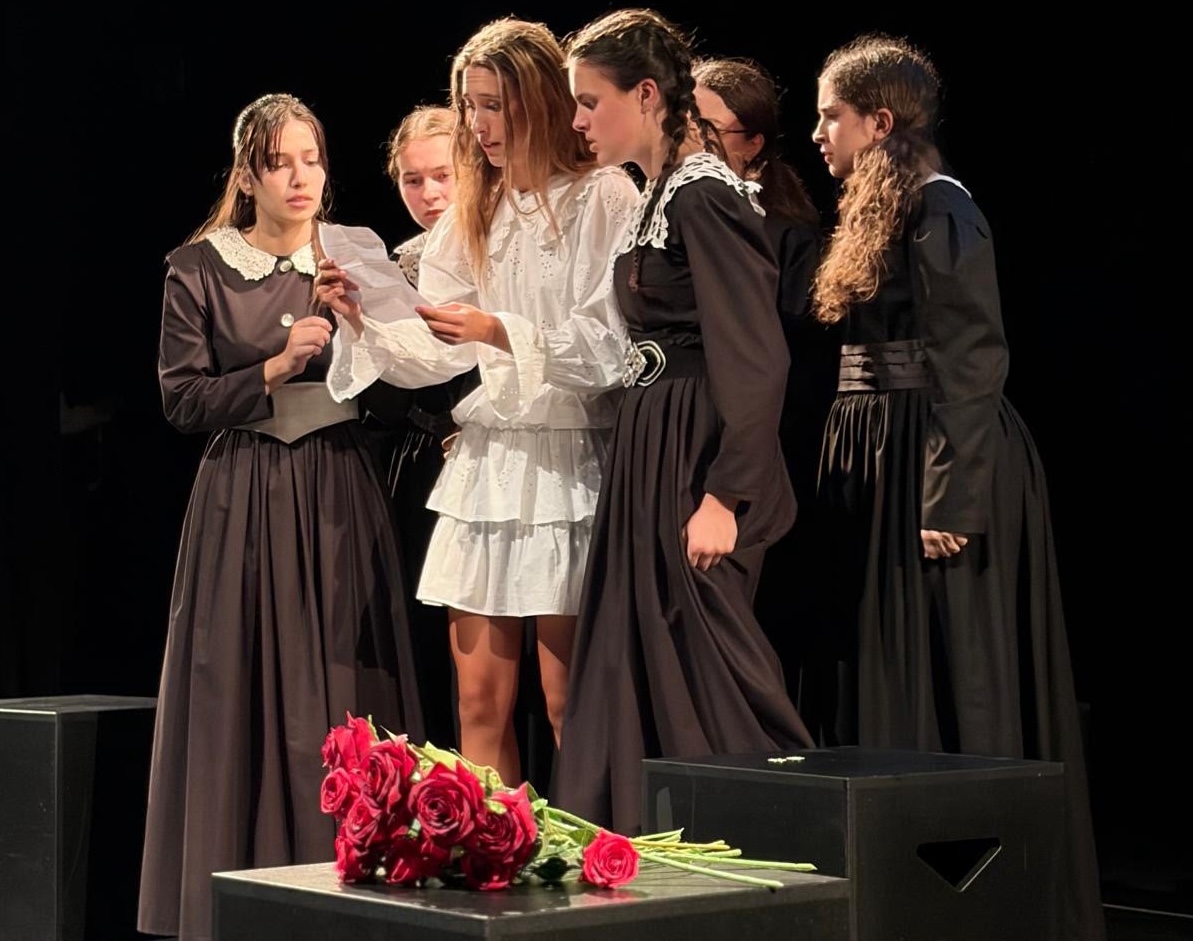
Set in Germany, in a conservative provincial town, Spring Awakening tells the story of a group of teenagers, forced to abide by a very strict set of rules that no one ever explains. Wendla (Melody Moppett) asks her mother (Alice Davidson) to tell her how babies are made, but Mrs Bergmann is too embarrassed to explain. “You have to love your husband,” she tells her daughter, leaving her horribly ill-equipped to deal with her burgeoning sexuality. Wendla finds herself drawn to Ilse (Minna Williams), who ran away from her abusive home at fourteen and now appears to enjoy a bohemian lifestyle in an artists’ colony. What Wendla doesn’t know is that Ilse’s freedom carries a heavy price.
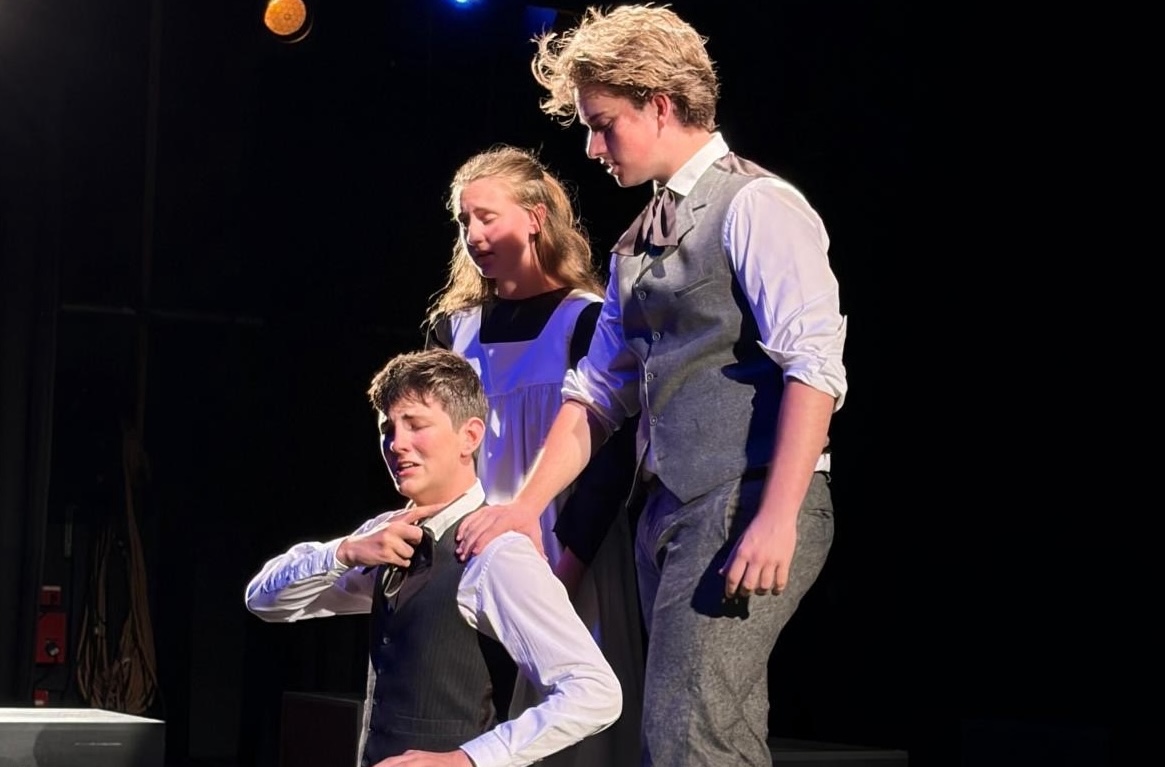
Meanwhile, Moritz (Greg Cameron) is struggling to keep up with his studies, working day and night, unaware that his fate has already been decided. “There are only sixty places in the final year,” says Headmaster Knochenbruch (Rufus Pilcher). There’s no room for Moritz, whatever grade he achieves – but his father won’t forgive him if he fails. What’s a boy to do?
Hänschen (Alexander Christie) and Ernst (Joe Ridley) have their own problems: they know how they feel about one another, but they’ve been taught that homosexuality is a sin. Still, as ever, love and lust prove stronger than societal disapproval. They might just be the happiest characters in the play.
On the surface, Melchior (Jasper Simmons) is better off than the others. His mum (Davidson) is relatively open-minded; she’s raised her son as a free-thinker and taught him about sex. As a result, he’s seen as the fount of all knowledge by the other boys. He’s also a thorn in the side of the Headmaster, and an easy scapegoat when things go horribly awry…
This is a very ambitious project and, for the most part, Kingston Grammar School’s KGS Theatre Company pulls it off. Meg Christmas’s direction is impressive: there are a lot of bodies but the stage traffic and choreography run like clockwork – no mean feat in a performance space without any wings, just an awkward opening upstage centre. I also like the simple set: stage blocks are positioned in regimented formation, with cleverly-concealed pockets behind them, holding microphones and minimal props.
Musical director Mark Laflin provides keyboard accompaniment, augmented by cast members Williams, Ridley and Catherine O’Shea on acoustic guitars.
The whole cast work well, both in their individual roles and as an ensemble, but the standouts for me are Moppett and Williams, who both have beautiful singing voices and imbue their very different characters with strength and vulnerability. Allegra Kelly also offers a strong performance, evoking our sympathy as the maltreated Martha.
If you’re looking for a lively, provocative start to your day, I recommend you take yourself to the Surgeon’s Hall for this high-octane, fearless production of Spring Awakening.
4 stars
Susan Singfield