23/05/26
Cineworld, Edinburgh
I’m going to start this review with a controversial statement: Star Wars is possibly the most overrated franchise in cinema history. Having written this, I can imagine stalwart fans virtually foaming at the mouth at my impudence. But before moving on to the latest offering, let’s examine the evidence.
I do have some history with the series. I can still vividly remember going to the Empire Leicester Square – forty–nine years ago – to watch George Lucas’s Episode IV: A New Hope – and I remember looking up at what passed for a giant screen in those days, and feeling suitably thrilled by what I was seeing, even if I did emerge thinking that what I’d just witnessed was essentially a kind of Space Western. In 1980, The Empire Strikes Back was a palpable step-up and I began to see what all the fuss was about.
But 1983’s Return of the Jedi was the first in a long line of disappointments, mainly because I didn’t really care for the cuddly Ewoks, who felt like nothing more than a callous attempt to sell more merchandise – and was I supposed to cheer (internally) every time they were blown up?
From here it was essentially a case of diminishing returns. I doggedly sat through Lucas’s three humourless prequels, wondering what had gone wrong – and, some years later, really appreciated Simon Pegg’s angry tirade in Spaced, where he excoriated a bunch of school kids for daring to call these turgid efforts ‘good films.’ The prequels were followed by a mixed bunch of releases from other filmmakers, attempting to push the format beyond its original humble ambitions. Of these releases, JJ Abrams’ The Force Awakens (2015) was the most convincing, mainly by virtue of the fact that it felt like a ‘greatest hits’ package, featuring slight variations on the best bets from the first couple of movies. But don’t even get me started on The Rise of Skywalker!
So, over a 49-year run, it’s hardly a great innings.
The Mandalorian and Grogu is of course, based on a TV series of which, I have to confess, I have not viewed a single episode – and indeed, this spin-off film, directed and co-written by Jon Favreau (with Dave Filoni and Noah Kloor) was originally destined to be shown on the small screen. Does it have the necessary clout to make the difficult transformation to IMAX?
No.
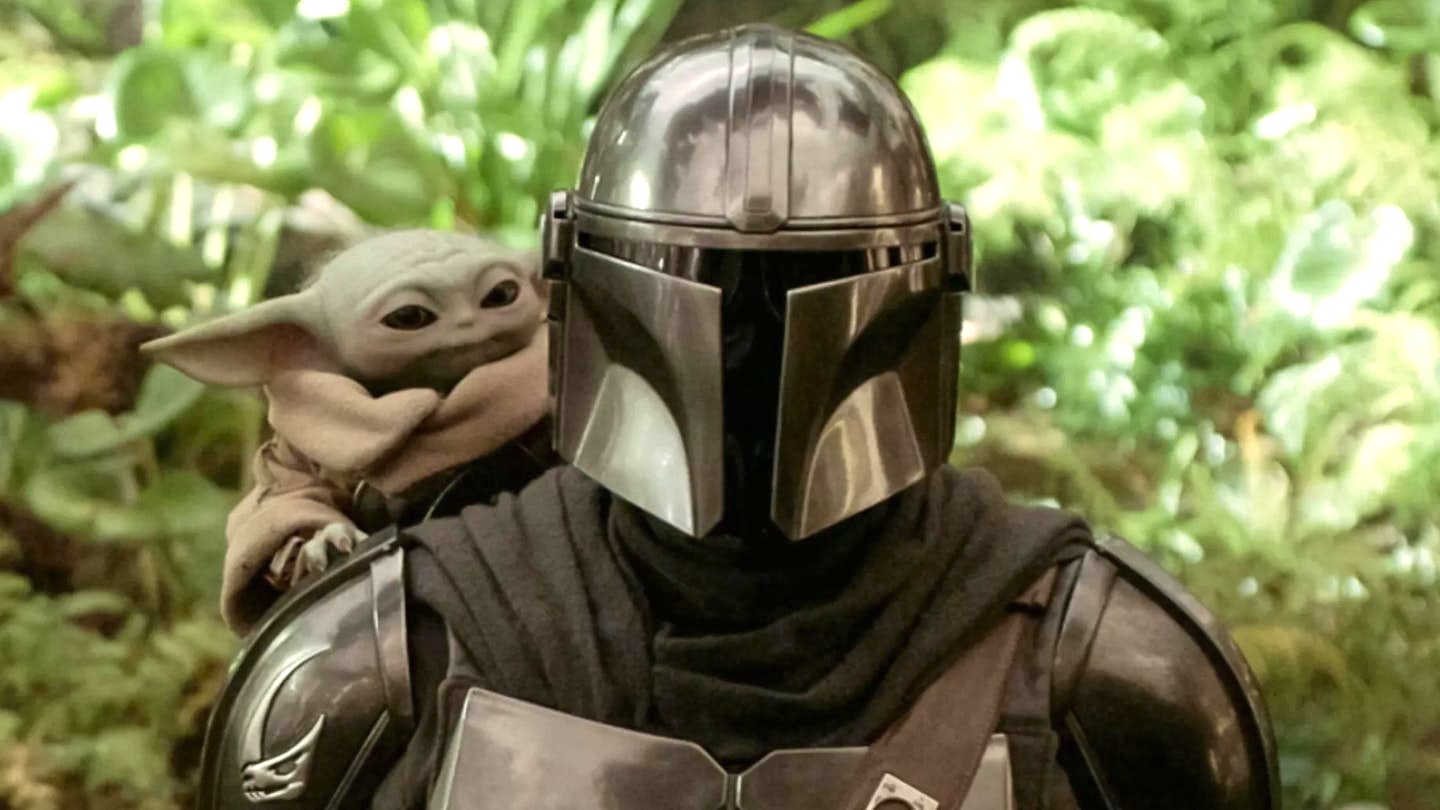
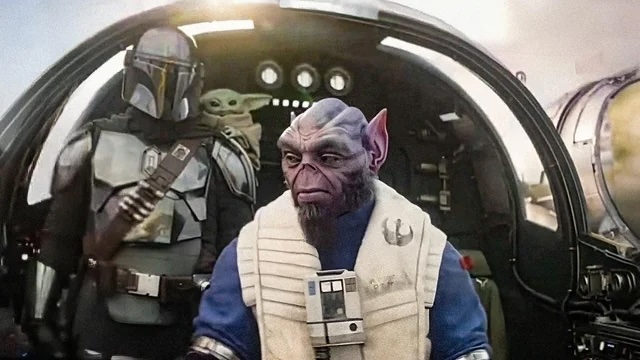
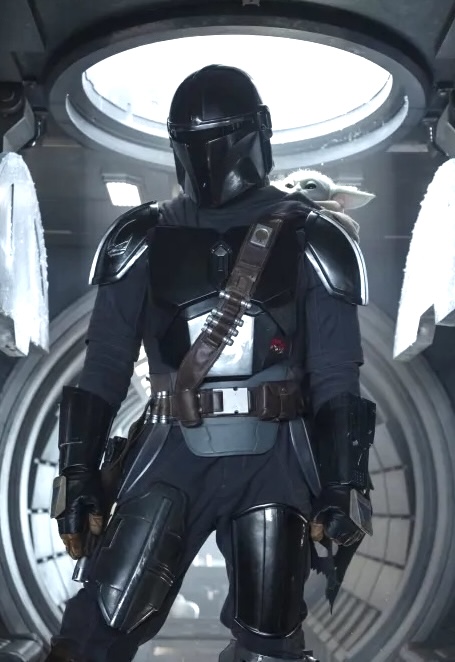
And not because the film doesn’t look fabulous – the model work and special effects here are off the scale – but because, for all the millions of dollars that have been expended on it, the resulting movie completely fails to compel me, mainly for one ridiculous reason. The Mandalorian never takes off his helmet and this has a curious distancing effect. We all recognise the distinctive voice of cinema’s busiest actor, Pedro Pascal, but only see his face for something like ten minutes, when his captors forcibly remove the headgear. It’s surely no coincidence that this brief section turns out to be the best part of the film. (The helmet also means that two other performers can don the Mandalorian costume, while Pedro’s off filming something else.)
As for Grogu, he’s little more than a glove puppet and though he occasionally does something cute, its hard to convince an audience that he’s anything but another opportunity to sell merch. And how is he capable of doing such incredible things, when his puppeteers fail to even make him walk convincingly?
The thin plot has the mismatched duo sent off by Colonel Ward (Sigourney Weaver) in search of Rotta (son of Jabba) the Hut . Rotta is voiced by Jeremy Allen White, though really it could be anybody – and he’s been abducted by his scheming grandparents, who have realised that he is the rightful successor to his late father but fancy keeping the kingdom for themselves. The resulting storyline is entirely concerned with the long search for Rotta, the finding of him, the losing of him, the finding of him again and… well, you get the general idea.
There are a LOT of endlessly protracted battles that often push against the boundaries of the 12A certificate, but somehow also manage to feel distanced. To be honest, I soon get bored with them and keep hoping there might be something more substantial on offer – but no luck. Mando and Grogu fight a whole succession of giant lizards, giant centipedes, giant apes, giant dogs and giant creatures composed of equal bits of all of those species. Coming out of the crowded screening, I walk alongside a large crowd of kids who are loudly extolling the film’s virtues to each other. ‘The bit where Mando blew the giant snake’s head off!’ ‘The part where Mando chopped the giant spider’s legs off!’ ‘The part where Rotta fell on that guy and squashed him to death!’
And maybe, when all is said and done, this is exactly the audience that Favreau and co are aiming for. For me, it feels like the last gasp of a franchise that’s been pulled further than it was ever meant to stretch. The final ironic straw is to witness Martin Scorcese (who has been so vocal in his criticisms of this kind of filmmaking) voicing Hugo Durant, a four-armed chimp running a burger franchise. What’s the old adage? Oh yes. If you can’t beat ’em, join ’em.
Sorry, not sorry: this is the worst Star Wars yet. And it was already a pretty low bar.
2 stars
Philip Caveney