Robert De Niro

Killers of the Flower Moon

22/10/23

Cineworld, Edinburgh

A quick glance at IMDB informs me that I first watched a Martin Scorcese movie way back in 1976 – Taxi Driver – and that I have seen pretty much every film he’s directed since. So naturally I am eager to see Killers of the Flower Moon, though somewhat apprehensive at its prodigious running time of three hours and twenty-six minutes. 

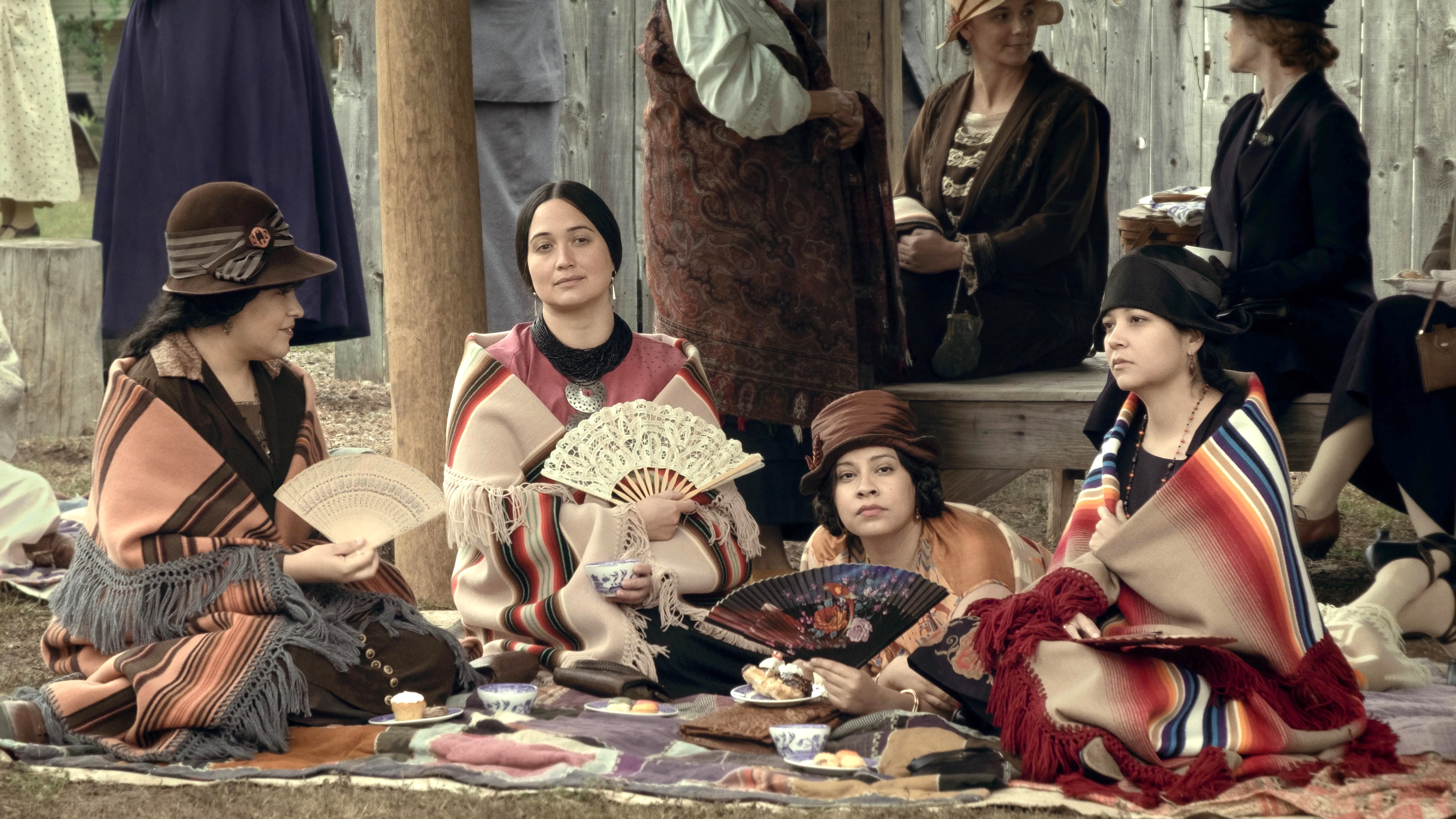
Set in the early 1920s, it tells the story of the Osage tribe, native Americans who, after being shunted unceremoniously from their Kansas homeland to a reservation in the wilds of Oklahoma, subsequently discover that the land they have been allocated contains vast quantities of crude oil – and that they are now the richest people per capita in the USA.

Of course, this being America, it’s complicated. For one thing, the Osage can’t just be allowed to own their own money. The very idea! In most cases, they must have a white guarantor to enable them to have access to it. And naturally, there are plenty of unscrupulous people in the vicinity, who are eager to put their hands on that wealth – even if it means arranging for the regular liquidation of certain members of the tribe. Suspicious deaths among the Osage are all too common, and such crimes are rarely even investigated.

Chief among the white opportunists is rancher ‘King’ William Hale (Robert De Niro), who purports to be the tribe’s greatest friend and has even learned to speak their language, but who secretly wheels and deals to ensure that large amounts of Osage money keeps flowing in his general direction. When his nephew, First World War veteran Ernest (Leonardo DiCaprio), arrives looking to make a new start, Hale ensures that he crosses the path of Osage woman, Mollie (Lily Gladstone), telling Ernest that this will be an opportunity for both of them to make a killing…

There’s no doubt that this true story, based on the book by David Gran, makes for compelling viewing – and the film’s two-hundred-million dollar budget ensures that Scorcese’s evocation of the era is beautifully realised. Many of the great director’s touches are in evidence here: the matter-of-fact quality of the murders; the chilling depictions of everyday cruelty and avarice; and, as ever, there’s Scorcese’s uncanny ability to choose the perfect music to accompany any given scene.

There are also three extraordinary performances to savour. Di Caprio as the sullen, selfish and frankly not-very-bright Ernest may be a career-best display of acting. He plays the role as a kind of arrested adolescent with a constantly glum expression, as though he’s being admonished for something he’s done (or maybe hasn’t done). Old hand De Niro is horribly oleaginous as Hale, a man so utterly devious, it’s a wonder he can manage to walk in a straight line. And Gladstone is terrific as Mollie, managing to convey so much with a withering look, a shrug, a silence. Her calm presence is somehow this turbulent story’s anchor.

The film’s first and concluding thirds, the set-up and pay-off – when FBI man Tom White (Jesse Plemons) arrives to initiate a long-awaited investigation –  easily hold my attention, but that middle section feels decidedly baggy and and the constant stream of viewers nipping out for a judicious toilet break is really distracting. It prompts the inevitable question: does the film need to be so long? In my opinion, no. Trimmed back by an hour, this could have been even more satisfying. I can’t help but think wistfully back to the likes of Lawrence of Arabia and Doctor Zhivago, epic films that always included an intermission around the halfway mark for this very reason.

That said, I love Killer’s ironic coda, which presents an account of what we have just seen as a soapy ‘true crime’ vintage radio recording, and which also features a cameo from Mr Scorcese himself. But the film fails to mention the fact (which I read about elsewhere) that the heinous conditions that the Osage tribe suffers in this film persist to this day. They are still being stiffed by the oil companies, who have brazenly commandeered the ‘black gold’ that continues to bubble up from beneath their reservation. And their demands for justice remain unheard.

Land of the free? Don’t make me laugh.

4.2 stars

Philip Caveney

The Batman

04/03/22

Cineworld, Edinburgh

Director Matt Reeves’ modest ambition for The Batman was to make ‘the best Batman movie yet.’

Well, he hasn’t done that – but he’s certainly made the longest. Weighing in at a bum-numbing two hours and fifty minutes, it brings to mind the conviction that while ‘less’ is often ‘more’, ‘more’ usually equals ‘less’ when it comes to movies. And, while this just about scrapes four stars in its present bloated form, it would have scored much higher with some judicious editing. I mean, like, excising fifty minutes.

What is it about Batman that makes directors keep returning to that oft-plundered well? The fact that this is a comic-book hero who doesn’t have any super powers is always appealing, and there’s that delicious interplay between the vigilante who takes the law into his own hands and those misguided fools who see him as a hero. In this regard, The Batman feels a lot more nuanced than many of its predecessors, but it’s also sobering to think that the best film of the franchise is the one that he doesn’t even feature in.

Joker, thanks for asking.

Mind you if you thought Christopher Nolan’s depiction of Gotham City was dark, prepare to turn the palette down several notches. Reeves’ Gotham (shot in studios all over the UK) is filmed in tones of obsidian and anthracite. In this Gotham, it never seems to stop raining and the city is ruled by corrupt public officials, who gleefully take bribes and exploit the working classes for their own enrichment. (Remind you of anywhere?)

It’s Hallowe’en and a masked villain called The Riddler (brilliantly played by Paul Dano, though we don’t actually see his face until late on in the proceedings) is gleefully murdering those in power, who have allowed their standards to slip. Batman/Bruce Wayne (Robert Pattinson), though hated by most of the police force, is invited to investigate the crimes by Commissioner Gordon (Jeffrey Wright), the only cop who trusts him.

The Riddler is leaving cryptic clues at the scenes of the crime and Batman is good at deciphering them. In the course of his investigations, he comes into contact with Selina Kyle (Zoe Kravitz), crime kingpin, Carmine Falcone (John Turturro), and The Penguin (an unrecognisable Colin Farrell, hidden beneath layers of latex and sounding for all the world like Robert De Niro).

As the proceedings unfold, it becomes clear to Bruce that his own father, whose murder initiated Bruce’s transition into the Caped Crusader, might not have been as innocent as his son has always supposed. Batman also comes to realise that there are many people out there who follow his vigilante tactics with relish – and who would really like to be him.

And, as loyal butler, Alfred (Andy Serkis) is quick to point out, Bruce’s father might have done the wrong thing – but for very sound reasons.

There’s a lot here that I really like. It offers a much more interesting vision of DC’s premier hero than we’re used to seeing – but too much time is spent wandering along dark alleyways that don’t advance the plot enough. It’s only as I’m starting to grow impatient with the film that it finally coalesces and ramps up the suspense, as it heads into a vaguely apocalyptic climax that is weirdly prescient and also, in a strange way, uplifting. Reeves has already proven his worth with the likes of Cloverfield and his astute retooling of the Planet of the Apes trilogy – but, inevitably, The Batman just feels too long for its own good.

This is a shame because Pattinson really works in the lead role (for once, I actually believe that nobody would suspect his Bruce Wayne of being Batman, since the two personas are so different). Kravitz is also compelling in the Catwoman role, and I fully expect to see her return to it. A nifty coda shows us exactly where Reeves plans to go next and, given the projected casting for the next lead villain, I have to confess I’m suitably intrigued.

But please, Matt, next time around… can we just have a bit less?

4 stars

Philip Caveney

Midnight Run

28/03/20

Since new cinema releases are hard to come by, we’ve decided to take a fresh look at some old favourites and reappraise them through a contemporary lens. Are they still as good as we thought they were? First out of the (DVD) box is Midnight Run (1988), directed by Martin Brest.

I first saw this film on its cinematic release (so in Manchester, I guess) and I went to it with no real expectations. Brest was, at that time, best known for his work on Beverly Hills Cop, a big-hitting feature for Eddie Murphy, and I pretty much thought it would be just another genre piece. But it’s much more than that, largely because of the wonderful chemistry between Robert De Niro and Charles Grodin, which turns this comedy crime caper into what used be known as a ‘buddy movie.’

De Niro plays Jack Walsh, former cop turned bounty hunter, working for bails bondsman, Eddie Moscone (Joe Pantoliano.) Moscone has recently put up the bail for accountant, Jonathan Mardukis (Grodin), who has stolen two million dollars from mafia big wig Jimmy Serrano (Denis Farina), money which he has promptly donated to charity. Serrano is eager to have his revenge and, meanwhile, the FBI, led by Agent Alonzo Mosely (Yapphet Kotto), are also very interested in talking to Mardukis. Can Walsh find his quarry and bring him in for trial before violent retribution catches up with him?

Of course, Midnight Run has all the genre tropes you’d expect from a film like this – hair raising shoot-outs, extended car chases and bruising punch ups  – but it’s in the developing relationship between Walsh and Mardukis that the film really shines. This, of course, features De Niro when he was still at the top of his game, able to convey so much with just a look and a shrug. Watch the heart-wrenching scene where Walsh is suddenly confronted by the teenage daughter he hasn’t seen in nine years and you are witnessing a masterclass in understatement. Grodin, meanwhile, plays his polar opposite, a calm and relaxed character, somehow nurturing despite his invidious position as the man who everybody wants to kill.

The witty screenplay by George Gallo fairly bristles with memorable one liners (I’m delighted to find that I can still remember most of them after all these years) and there’s also a hilarious turn from John Aston as dim-witted rival bounty hunter, Marvin Dorfler. The extended running ‘punch’ gag between him and Walsh is perfectly played throughout.

What seems particularly weird when viewing this from a contemporary perspective is all that gratuitous smoking – characters enjoy cigarettes on planes, trains, in offices, on the subway… just about everywhere you can think of. And of course, there are no mobile phones, so there are countless scenes of people talking from phone booths or running into bars just in time to pick up a receiver.

But these idiosyncrasies aside, Midnight Run stands time’s acid test. It’s still hugely enjoyable. Martin Brest had a few more successes waiting for him down the line, not least guiding Al Pacino to his Oscar win for Scent of a Woman in 1992, but this remains his most satisfying piece of work, the perfect choice for a locked-down life.

4.6 stars

Philip Caveney


The Irishman

16/11/19

Martin Scorcese is one of our greatest living film directors. The partnership he’s forged with Robert de Niro – from Mean Streets and Taxi Driver, through to King of Comedy and Raging Bull, right up to Casino in 1995 – has produced some of the most unforgettable moments in cinema history. So it beggars belief to learn that the only studio with pockets deep enough to finance their latest based-on-real-events collaboration is TV streaming service, Netflix. Happily, Edinburgh’s Filmhouse has the rights to show it on the big screen, and it is no great surprise to see this Saturday afternoon showing jammed to the rafters.

The Irishman in question is Frank Sheeran (De Niro), World War II veteran turned hitman, mob player and influential labour union official. When we first meet him, a tracking camera finds him sitting in a care home, white haired and frail, talking about his experiences, perhaps to Charles Brandt, on whose book this is based. Sheeran explains how, as a younger man, he met up with powerful mobster, Russell Bufalino (Joe Pesci) and was taken under his wing; how he ‘painted houses’ for Bufalino (a code term for performing executions); how he was eventually handed a key role in the powerful Teamster’s Union, where he became a close friend and confidente of the union’s President, Jimmy Hoffa (Al Pacino).

Scorcese’s film is a study of the innocuous nature of evil, how truly heinous people exert their influence upon society, and how their bloodstained hands are in evidence upon the political landscape. It also demonstrates how, in this Machiavellian world, no one can truly trust anyone, because there will always come a time when that trusted person will be surplus to requirements. The film regularly features onscreen credits detailing the eventual demise of these players: shot in the head, shot in the back, knifed, bludgeoned and in some cases ‘disappeared.’ Very few manage to live to old age.

It’s a delight to see De Niro finally back in a role worthy of his talents. His Frank Sheeran is a stolid, strangely humble figure, who says little but shows so much through his troubled gaze. The acting throughout is totally naturalistic and there’s unexpected humour to be found in the deliberate clumsiness of the dialogue. The much discussed ‘de-aging’ technology is flawless; after the first transition from old De Niro to middle-aged De Niro, I forget it’s happening and am just happy believe that I’m watching a feature shot over decades. It’s also lovely to see De Niro and Pacino working together for the first time since Heat, and to see the great Joe Pesci exercising the kind of acting chops we haven’t seen since Good Fellas.

This is a man’s world. The female characters don’t get an awful lot to do here and it’s irksome to see Anna Paquin, as Sheeran’s troubled daughter, Peggy, reduced to seven words of dialogue. Maybe Scorcese’s point is that women were generally excluded from meaningful conversation in this era, but I wanted the catharisis of seeing her properly confront her father for what she’s witnessed over her childhood. It’s my only real criticism – but an important one, I think.

A word of warning. The film weighs in at a bladder-challenging three hours and thirty-five minutes and the problem is, there’s no obvious point to slip away to the loo. Could it be shorter? Yes, undoubtedly – but it’s to the film’s great credit that I manage to stay in my seat right to the final poignant frame. Those with a decent sized telly and a subscription to Netflix can watch it, with toilet breaks, from next week.

But if you can see it on the big screen, grab the opportunity. And all credit to Netflix for making this happen.

4.6 stars

Philip Caveney


Joker

05/10/19

Joker arrives in the UK amidst a deluge of controversy. To some minds, it’s a work of genius. To others, it’s a dangerous and divisive polemic that invites troubled souls to indulge in their darkest, most dangerous fantasies. To my mind, the film belongs fully in the former slot, but it would be naïve to suggest that it’s not a searing indictment of American society, and that it doesn’t feel suspiciously like a call to arms. Though the names of a couple of films on a cinema marquee place the action in 1981, make no mistake: this is all about the America of today – and it’s not a pretty picture. The rich corporations rule this Gotham while the poor, the sick and the dispossessed are marginalised and brushed under the carpet.

Joaquin Phoenix puts in an extraordinary performance in the central role. He’s Arthur Fleck, a scrawny, malnourished loser, living with his ageing mother, Penny (Frances Conroy), in a dilapidated apartment in Gotham City. Arthur dreams of being a successful comedian, but lacks the ability to understand jokes or even deliver the routines he writes, since he suffers from a condition that makes him laugh involuntarily at random intervals. He earns a crust as a street-clown and children’s entertainer but, even in these roles, he’s beset by problems, picked on by street gangs and openly mocked by his fellow clowns. Meanwhile, he fantasises hopelessly about his neighbour, Sophie (Zazie Beets), and fills the empty hours watching his chat show idol, Murray Franklin (Robert De Niro), on TV. But the cruelty he experiences on an almost daily basis is building something uncontrollable deep within him… something that will eventually inspire others to follow him.

Director and co-writer Todd Philips, previously best known for lame buddy comedy The Hangover, has really struck a powerful chord here. His reimagining of the Joker’s origin story is bleak but compelling stuff and, despite Phoenix’s dazzling starburst at the film’s core, the supporting characters are all well drawn and the hellish cityscapes in which the story unfolds are strikingly shot. Throw in a brooding musical score by Hildur Guönadóttir and you have a movie that grips like a vice from start to finish. The influences are evident and clearly not accidental. Martin Scorcese’s Taxi Driver and The King of Comedy are both openly referenced, and eagle-eyed film fans will also spot a brief homage to Sidney Lumet’s Network. It’s lovely also to see De Niro in a serious role for the first time in what seems like ages.

It’s ironic to note that this film goes straight to the top of my favourite DC movies, particularly as it doesn’t feature a superhero of any description – unless you count a glimpse of the infant Bruce Wayne, who will of course grow up to be Joker’s main adversary – and, doubly ironic, when you consider that my previous favourite was The Dark Knight, which also featured a memorable Joker in Heath Ledger. I guess the simple truth is that the Joker has overshadowed Batman in most of the films they’ve featured in together; he’s just a more interesting character.

Joker is a must-see: a brilliant evocation of an American city at flashpoint. The central message may trouble you – indeed, it really should trouble you – but this is giant steps ahead of most of the superhero stuff that’s currently out there.

5 stars

Philip Caveney


Our Boys

13/08/18

PQA Venues, Riddle’s Court, Edinburgh

In the ward of a military hospital, a group of injured soldiers are recuperating from a variety of injuries. Keith (Christopher Lowry) is suffering from mysterious leg pains which the doctors seem unable to correctly diagnose. Ian (Michael Larcombe) has been so badly injured by a sniper’s bullet, he can barely form words. Parry (Charlie Quirke) has lost some toes, Mick (Alastair Natkiel) has recently been circumcised for ‘health reasons’, while Joe (Declan Perring), the longest serving inmate, sees himself as the wheeler-dealer of the group, forever wangling perks for the others, forever pulling strings on their behalf – and we do not learn what has actually happened to him for quite some time…

Into this powder keg limps Posh (Nick Seenstra), a young trainee officer currently suffering from the indignity of a pilonidal abscess. He is immediately seen as an outsider, a threat to the squaddies whose space he will now be sharing. Playwright Jonathan Lewis has first hand experience of the situation, having spent time himself in a military hospital in Woolwich.

This is an intensely masculine drama, where at times the levels of testosterone bubbling away onstage threaten to explode into the audience. Though it deals with the very serious issues of PTSD and the callous way in which disabled squaddies are casually tossed onto the scrapheap, it’s also periodically very funny. A sequence spoofing Robert De Niro’s The Deerhunter is hard to resist and so is the scene where the lads lay on a birthday party for Ian, only to discover – well, I won’t spoil it for you. It’s certainly not all laughs though. When somebody tips off the authorities about the presence of illegal alcohol on the ward, suspicion inevitably falls on Posh; of course he’s going to revert to type – he’s a would-be officer, right? But is he really to blame?

The performances here are all pretty good, though Natkiel’s Mick is a particular delight, forever managing to say the wrong thing at the wrong time in a wheedling Brummie accent. Be advised, this important play’s hard-hitting conclusion will surely send you out into the night with a lump in your throat and a tear in your eye.

4 stars

Philip Caveney

Joy

Unknownimages

29/12/15

David O Russell seems to have the knack of creating great films from fairly unpromising material – Silver Linings Playbook and American Hustle are two movies that rose far above their IMDB outlines. On paper, the true life story of Joy Mangano, the woman who invented the ‘Miracle Mop’, might suggest that the average viewer should take along a pillow in order to sleep comfortably through the whole experience. But Joy is actually a riveting slice of cinema, made especially enjoyable by a luminous central performance by Jennifer Lawrence.

When we first meet Joy she’s a child, obsessed with building imaginary worlds out of scraps of paper; but very soon, she’s grown up, stuck in a dead end job, and divorced from her husband Tony (Edgar Ramirez) who still lives in the basement and shares parental responsibility for their young children. Joy’s soap-opera-obsessed Mother, Terry (Virginia Madsen) refuses to leave her room, while her wayward husband Rudy (Robert De Niro) has just insisted on moving back into the family home after breaking up with his latest partner. All-in-all, this has to be one of the most dysfunctional families in America and Joy is the one tasked with making everything run as smoothly as possible.

In the midst of the chaos, she gets an idea for a self-wringing mop and persuades the rest of the family, plus Rudy’s hard headed but minted new girlfriend, Trudy (Isabella Rossellini) to back her invention with hard cash. But the path to bringing it to reality is not an easy one and there are shady business people out there queuing up to steal her idea. Joy soon discovers that if she’s going to take her dream to fruition, she’s going to have to be as tough as the sharks she’s sharing the water with…

Russell’s take on the story is quirky, assured and never loses its sense of pace. There are great supporting performances from the ensemble cast (how lovely to see De Niro finally getting a decent role after a string of one-note cameos) and Bradley Cooper also shines as QVC pioneer, Neil Walker. But make no mistake, this is Lawrence’s movie and she makes the most of it. The camera loves her in this and you will too.

4.6 stars

Philip Caveney