Marianne Elliott

NT Live: Les Liaisons Dangereuses

25/06/26

Dominion Cinema, Edinburgh

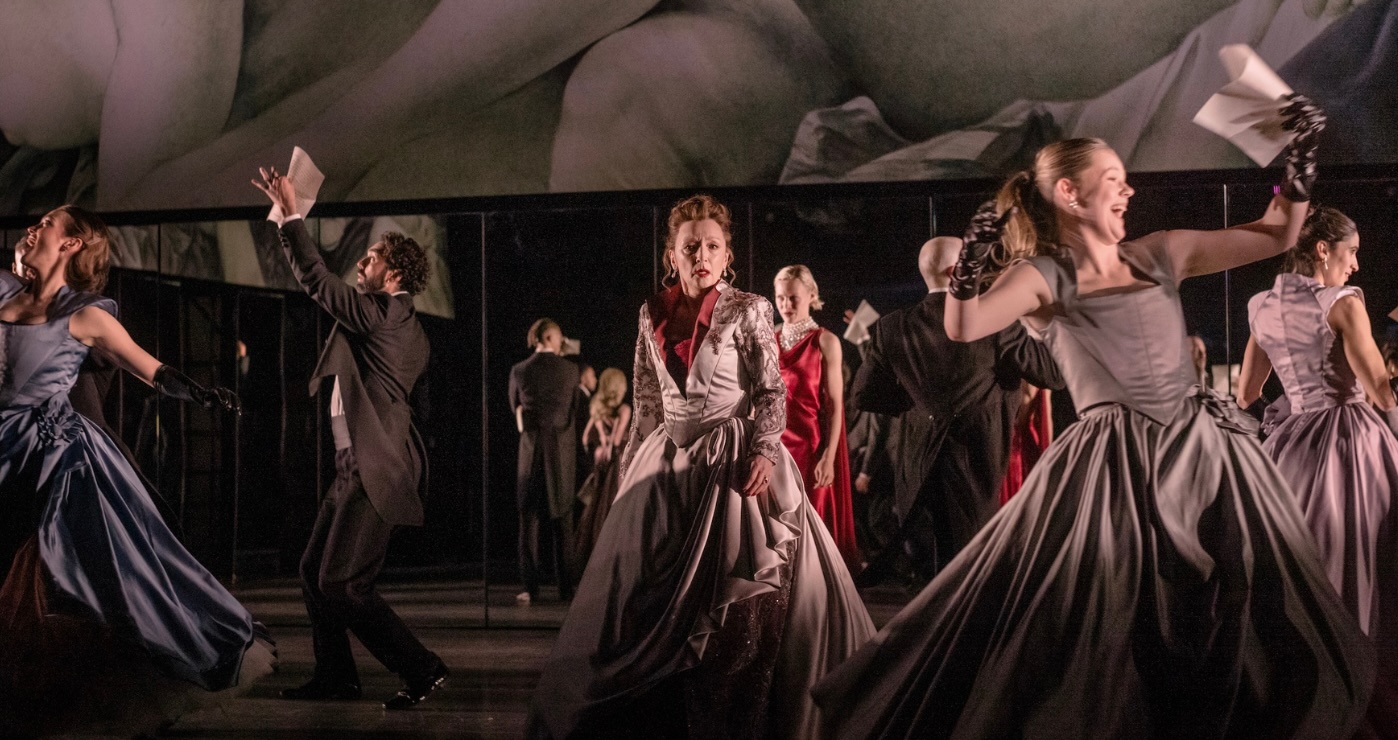
The latest offering from NT Live has arrived in cinemas and there’s only one venue in Edinburgh swish enough to do it justice. We book a reclining sofa at The Dominion and settle down, prepared to be blown away – and we most certainly are. This stunning adaptation of Christopher Hampton’s 1985 play (based upon the 1782 novel by Pierre Choderlos de Laclos) incorporates Hampton’s wonderfully witty and unflinchingly brutal dialogue punctuated by stirring dance sequences where everyone – including the leads – hoofs up a storm. Marianne Elliott directs the huge cast with consummate skill, while choreographer Tom Jackson Greaves has the lavishly costumed performers prowling, spinning and leaping around Rosanna Vize’s extraordinary set, where scores of mirrored doorways reflect the action like a kaleidoscope of intrigue.

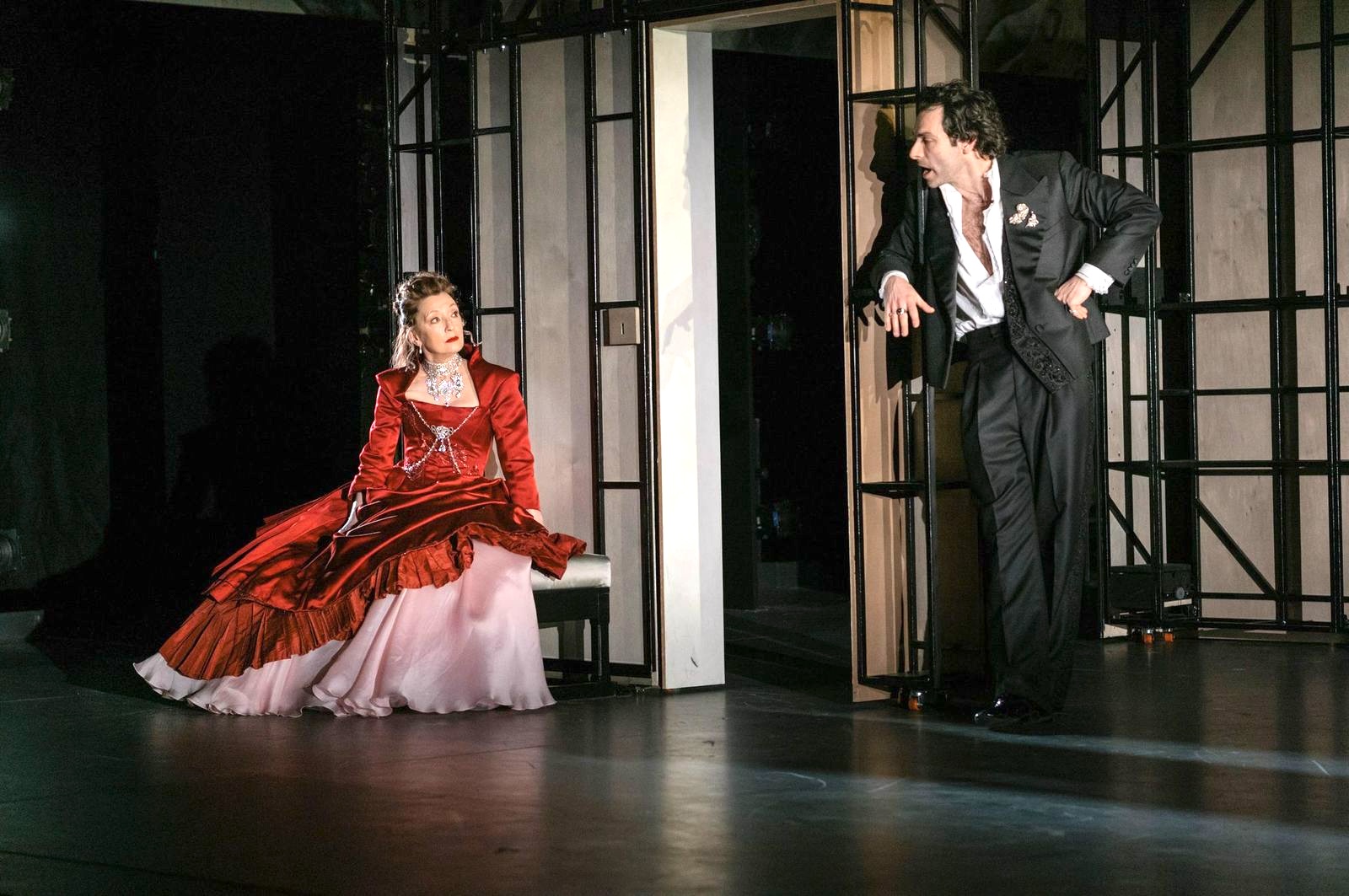
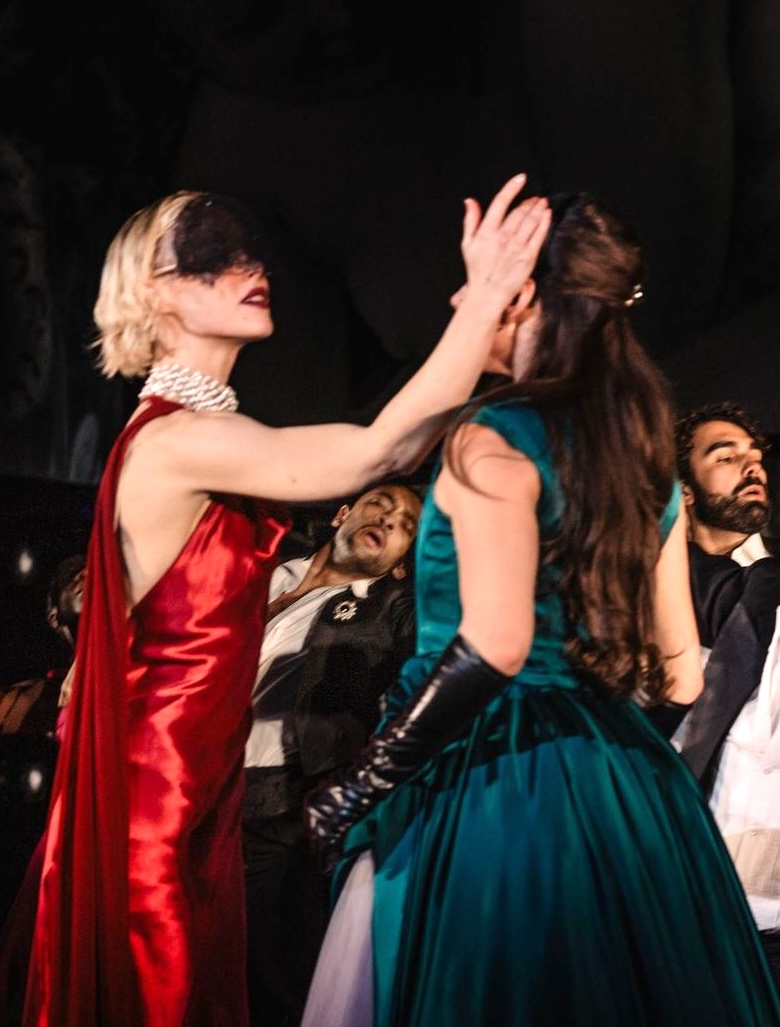
The Marquise de Merteuil  (Lesley Manville) and the Vicomte de Valmont (Aidan Turner) are old acquaintances. Once lovers, they are now notorious philanderers, who spend their time seducing, exploiting and humiliating virtually everyone they encounter, taking delight in the chaos they create. It’s clear that Valmont still carries a torch for Merteuil so, when she makes a wager with him, he quickly accepts the challenge. She will spend one more night with him, but only if he can manage to seduce two women: the virtuous wife, Madame de Tourval (Monica Barbaro), and Cécile de Volanges (Hannah van der Westhuysen), an innocent young girl, currently infatuated with her music tutor.

Valmont sets to work, mercilessly exploiting both women without a thought for the destruction he is wreaking – and little realising that Merteuil has elaborate plans of her own…

All the leads play their roles with absolute conviction, Turner relishing his characterisation of a brutish, swaggering hedonist without a single qualm about the cruelty he inflicts on his targets. Manville matches his arrogance with a sly, smiling assurance that tells us she has his measure and knows exactly how to handle him. (It’s fascinating to note that back in 1985, Manville played Cécile de Volanges on Broadway.)

Barbaro, meanwhile, is utterly compelling as a God-fearing woman, struggling to resist her inner demons and utterly destroyed when they finally overcome her. Van der Westhuysen also excels as an ingénue, blissfully unaware that she is destined to inherit all the guiles of those who have used her so cruelly.

But the ensemble are much more than bit-players: every performer on the stage gives the show their all. If the first half is sensational, the second – as all the carefully-layered plot threads come hurtling to their inescapable conclusion – is utterly thrilling.

A seat for this show in London’s West End, would cost you hundreds of pounds, but here’s your opportunity to make your own dangerous liaison closer to home at a more affordable price.

5 stars

Philip Caveney
The Salt Path

08/07/25

Update

In the aftermath of the bombshell dropped by Chloe Hadjimatheou in this weekend’s Observer, where she exposes the lies this story is based on, it feels right to reassess our original response to the movie. Our opening sentence included the words “raised eyebrows”. Perhaps we shouldn’t have been so gullible.

But we’re in good company, including Penguin Random House, Number 9 Films and more than two million readers worldwide. Chivalrous Jason Isaacs, sitting next to Raynor Winn on The One Show sofa, gently corrects her when she says it all began when she and her husband “got into a financial dispute”. “You were conned out of everything you had,” he says sympathetically. “You might not be able to say it but I can.”

The Winns’ audacity is breathtaking. According to Hadjimatheou, the real con-artist is Raynor, aka Sally Walker. Aka embezzler of £64k from her employer; aka borrower of £100k to pay back her ill-gotten gains and thus avoid a criminal trial. When their house was repossessed, it wasn’t because a good friend betrayed them; it wasn’t a naïve business investment gone wrong. It was the simple calling-in of an unpaid debt, ratified by the courts. Did Walker and her husband Ti-Moth-y really believe the truth would stay buried as they appeared on national television to publicise their untruths?

So how gullible were we, really? Like many, we believed the basic premise. Why wouldn’t we? Sure, it was clear that the exact circumstances of the couple’s slide into destitution were being glossed over, and of course their story was shaped into a neater narrative than real life provides. But we had no reason to doubt the fundamentals. (How could anyone have guessed they had a ‘spare’ property in France?) In fact, my interest piqued by the movie, I went on to read Winn’s books. I liked The Salt Path, although I was disappointed not to learn more about the calamitous investment. I found books two and three (The Wild Silence and Landlines) less interesting: just more of the same, but – now that the couple were housed and embracing successful careers – without the jeopardy. In these sequels, the focus shifts to Moth’s terminal illness, corticobasal degeneration, and the miraculous curative effect that hiking has for him. While the first book tentatively suggests that strenuous exercise might be beneficial for those with this rare condition, by the third we’re deep into dubious ‘wellness’ territory, with Winn’s ‘own research’ supposedly trumping anything a neurologist might purport to know.

Still, we won’t be taking down our review (you can read it in full below). We stand by it as a reaction to a well-acted and nicely-crafted film that we enjoyed. Of course, its message of grit in the face of adversity doesn’t have quite the same potency it did, now that we know the protagonists are a pair of grifters, but, if we can steel ourselves to view it as a work of fiction, it’s an affecting and moving piece.

Susan Singfield and Philip Caveney

01/06/25

Cineworld, Edinburgh

I’ve often remarked that real-life stories, depicted as fiction, would more often than not be the case for raised eyebrows. Take the case of Raynor and Moth Winn, for example: a married couple who, after a badly-judged business investment went tits up, found themselves evicted from their family farm, unable to obtain any financial help, bar a paltry £40 a week benefit. Around the same time, Moth was diagnosed with a rare (and inoperable) degenerative brain condition. Their response? To set off to walk the South West Coastal Path, a trip of hundreds of miles, telling themselves that if they just kept walking, something was sure to turn up…

Okay, so in a move they could surely never have anticipated, the book that Raynor wrote about the experience eventually went on to sell two million copies… but it would be a hard-hearted reviewer who begrudged them this success.

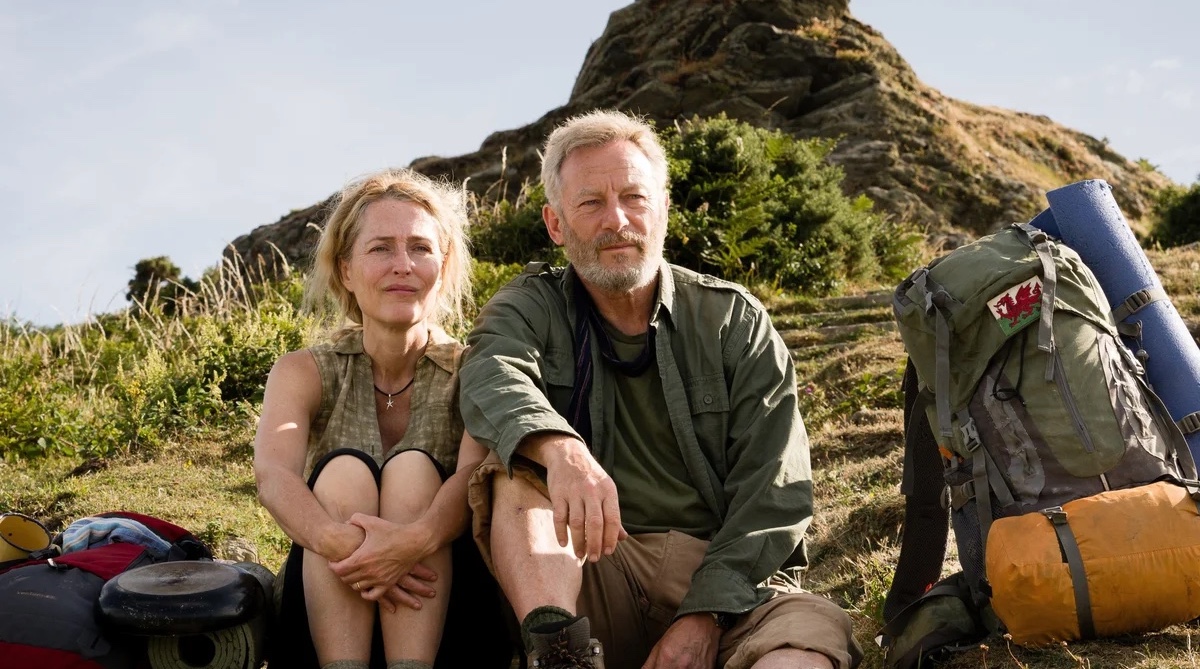
In this adaptation by Rebecca Lenkiewicz, we first encounter Raynor (Gillian Anderson) and Moth (Jason Isaacs) as they fight to save their last real possession – a small tent – from the ravages of the incoming tide. The couples’ back story is told in a series of fragmentary flashbacks, though director Marianne Elliott is less interested in the events that brought the couple to this sorry situation, than exploring the possibilities of what their newfound freedom brings them.

As the two of them progress on their journey, struggling at first but gradually adapting to a different kind of life, it becomes clear that there is something to be said for casting off the familiar shackles of a home and a mortgage. The couple find an inner strength they didn’t know existed and, along the way, they rediscover what drew them together in the first place. This could easily have been overly -sentimental but manages to pursue a less obvious route.

The story takes the duo across some jaw-dropping locations around Cornwall and Devon and the majesty of the scenery is nicely set against Chris Roe’s ethereal soundtrack. Anderson and Isaacs make a winning duo, conveying the real life couple’s indomitable spirit and genuine devotion to each other, while the various situations they stumble into range from the comical to the deeply affecting.

The film’s final drone sequence cleverly encapsulates its central message in one soaring extended shot. There have been some mean-spirited early reviews for The Salt Path but I find it genuinely moving and a cinematic journey worth sharing.

4.2 stars

Philip Caveney and Susan Singfield

Angels in America


09/09/17 and 14/09/17

Thank heavens for NT Live. The National Theatre’s 2017 revival of Angels in America sold out within a few short hours. Of course it did! And, although there’s always the tempting possibility of day tickets (available for same-day performances from 9.30am in person from the box office), they’re only really practical if you’re based in London. We are certainly never going to travel from Scotland on the off-chance we might procure a couple of seats. But NT Live means we can experience this landmark production anyway – even though we’re too busy to see the actual live screening in July, the fact that it’s been committed to film bypasses the ephemeral nature of theatre, and gives us the opportunity to catch up with an encore showing at Edinburgh’s Festival Theatre, a short walk from our apartment.

Okay, it’s not as good as actually being there, sharing a space with the actors in real time. There’s none of the intimacy or jeopardy of live theatre, but it’s a pretty decent second best and we’re very grateful for it. The Festival Theatre is an excellent venue for such a venture: I’ve only seen these screenings in cinemas before, but being in a theatre adds a level of authenticity, and the screen is huge, the sound quality excellent.

It’s a bit of a marathon, this play, even spread over two evenings. But, my word, it’s worth it. In just under eight hours, Tony Kushner’s script offers us a “gay fantasia on national themes” – a sprawling, painful and searingly funny depiction of New York in the 1980s, fractured and ill-prepared to deal with the AIDS epidemic.

The protagonist is Prior Walter, played here by Andrew Garfield in an eye-opening performance: he is, we discover, an actor with real range. Prior is dying and he’s afraid; his boyfriend, Louis (James McArdle), can’t cope and so he leaves. While Louis weeps and beats his breast with useless, futile public expressions of guilt, Prior begins hallucinating, having visions. He’s visited by an angel and by his long-dead ancestors. And, in his dreams, he collides with another tortured soul, Harper Pitt (Denise Gough), the mentally ill Morman whose husband, Joseph (Russell Tovey), is secretly gay. It’s a convoluted, complex plot, difficult to summarise, but eminently watchable: it all makes perfect sense when it unfolds before our eyes.

I’ve read the play, of course (I’m a theatre studies graduate), and I’ve seen the 2003 mini-series starring Meryl Streep, Emma Thompson and Al Pacino. But this production, directed by Marianne Elliott, is something else: it’s genuinely stupendous. Susan Brown’s performance, for example, is impeccable; she plays six roles with utter conviction. And I find myself especially delighted by Amanda Lawrence’s Angel; she’s mesmerising, and beautifully supported by the Angel Shadows, six black-clad actors, who control her wings as well as performing the lifts and balances that make her seem airborne.

The set is a thing of wonder too, although I’d like to see more long shots in the filming, to help me envisage what the piece looks like as a whole; instead, there are a lot of mid shots and close-ups, which allow me to see the actors clearly but don’t give me a true sense of the space. Still, it’s obviously spectacular, all rotating cogs and zooming rooms, a whole world contained within the confines of the stage.

I’m delighted to have had the chance to see this play; it’s a truly iconic piece, challenging and thought-provoking and entertaining to the end.

5 stars

Susan Singfield