Lucianne McEvoy

Sweat

28/05/26

Lyceum Theatre, Edinburgh

There are many people in the UK who look at what’s currently happening in Trump’s America and ask themselves what seems like a perfectly reasonable question:

“Why?”

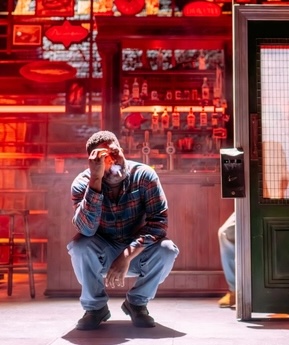
Lynn Nottage’s 2015 play, Sweat, offers a compelling explanation. Set in the blue collar community of a steelworks in the fictional town of Reading, Pennsylvania, the story begins in 2008. We meet two young men, recently discharged from their respective spells in prison and here to talk to parole officer, Evan (Ako Mitchell). They are Jason (Lewis MacDougall), a sullen, introspective youth with neo-Nazi tattoos on his face – and Chris (Rudolphe Mdlonwa), who has emerged from his incarceration with utter faith in the Holy Bible and a determination to put the past behind him.

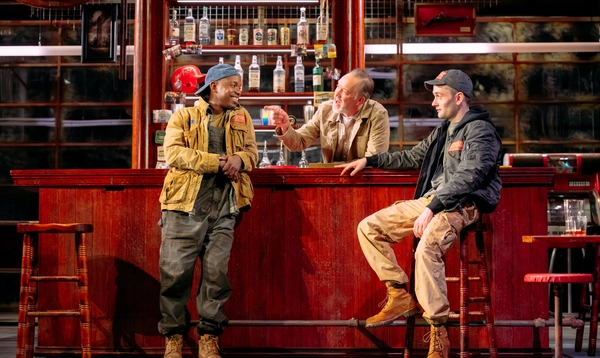
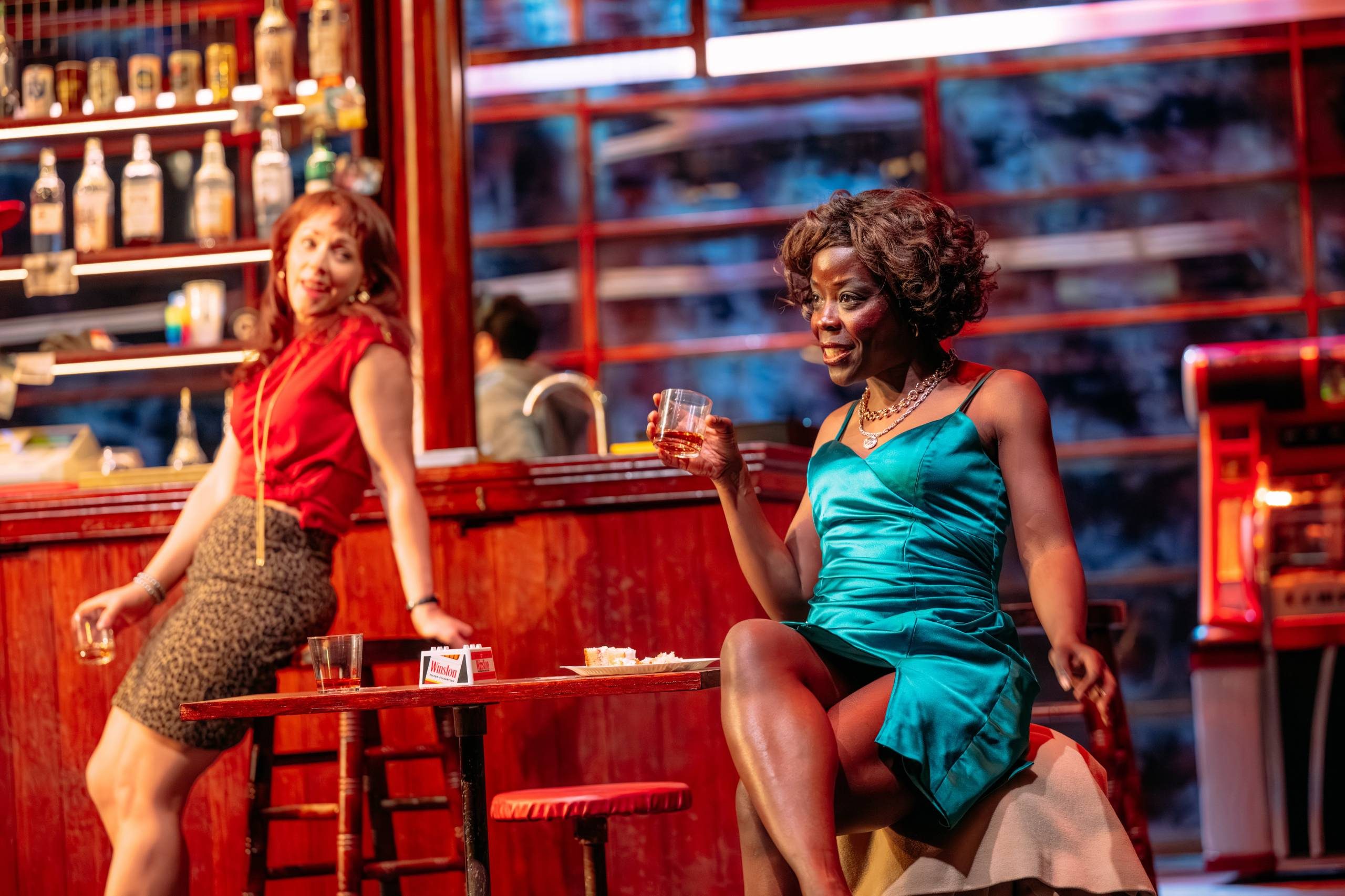
We are then transported back to the year 2000 and a local bar, where Stan (Christopher Middleton) rules the roost, plying his customers with shots, but knowing exactly when to warn them they’ve had enough. He’s assisted by Oscar (Manuel Pacific), a Columbian-American, who rarely speaks and is treated with cool indifference by the regular patrons. Chief among them are a trio of women, Jessie (Laura Cairns), Tracey (Lucianne McEvoy) and Cynthia (Debbie Horley). The latter pair are respectively the mothers of Jason and Chris, who at this stage in the story are best friends.

Change is afoot in the steelworks where the women have worked since their teens. There’s talk of cutbacks in salaries and equipment being mysteriously relocated elsewhere. Stan keeps warning them that they could all wake up tomorrow to find that their jobs have been moved to Mexico. Meanwhile, both Tracey and Cynthia have applied for the same management role and when Cynthia is accepted for the position, it inevitably drives a wedge between them.

And then those rumoured cutbacks start to kick in – and, as the pressure steadily rises, it’s clear that something bad is coming…

Sweat is an important play with plenty to say about the societal divisions sewn by Reagan that have led us to Donald Trump. A cleverly constructed scene when the TV in the bar appears to show a whole succession of American Presidents uttering the same empty rhetoric is key. Perhaps for the first time in my life, I begin to appreciate the impulses that have driven disenfranchised communities to seek change at any cost (I’m looking at you, MAGA and Reform). Don’t get me wrong, I don’t agree with them, but I do begin to comprehend their collective rage. And it’s a rare play that can sway me to such a degree.

Sweat boasts a pressure cooker of a script, everything building to an inevitable violent catharsis. Joanna Bowman handles the direction with considerable skill, coaxing strong performances from every member of the cast – and I’ve rarely been so impressed by the talents of a set designer. Francis O’Connor opens with a stunning scene on the factory floor, where literal sparks are flying, before cutting to the stark floodlit interior of the prison, where Derek Anderson’s lighting comes into its own. And then the various elements that comprise Stan’s bar glide magisterially down from the rafters to create an utterly convincing American drinking hole.

The play’s abrupt and tragic conclusion leaves me suitably shattered – and the long silence before the audience applauds is testament to its power. It’s not what you’d call an easy watch, but it is a potent and eloquent piece, well worth your time and money.

4.6 stars

Philip Caveney

So Young

04/08/24

Traverse Theatre, Edinburgh

A new play by Douglas Maxwell is always a treat. He’s an insightful playwright, able to walk that precarious tightrope between hilarity and tragedy with absolute authority. So Young is up there with his best work.

The play opens in the bedroom of married couple Liane (Lucianne McEvoy) and Davie (Andy Clark). They are in flagrante delicto and it appears to be going well – all four minutes of it. We know it’s that long because Andy has been timing it on his phone. In the afterglow, he wistfully talks about the years when their couplings could last the entire day, but there’s little time to linger on such details because the couple are already running late. They’re due to meet up with their friend, Milo (Nicholas Karimi), who they have known for years – in Andy’s case since they were best mates at school.

Liane is somewhat dismayed when Davie casually mentions that Milo is planning to introduce them to a new female friend. Both Davie and Liane are uncomfortably aware that Milo lost his wife, Helen, to COVID only three months earlier. The new friend turns out to be Greta (Yana Harris), just twenty years old and a former pupil at the school where Liane teaches. When she mentions that she and Milo are now engaged, Liane cannot help reacting badly to the news. After all, Helen was her best friend in the world and, thanks to the pandemic, there still hasn’t been a proper funeral service. 

As glasses of wine are consumed, it’s clear that there’s going to be a confrontation…

Maxwell always creates utterly believable characters. McEvoy is terrific as the caustic, fearless Liane, who has the ability to nail any target with a few well-chosen phrases and does so with abandon. She also manages to provoke a spontaneous round of applause for her discourse on the importance of female friendship. Gray, meanwhile, is brilliantly funny as the hapless Davie, at one point managing to have the entire audience convulsed with laughter, with nothing more than a series of exasperated looks and the repetition of the words, ‘Three months?’ Karimi has perhaps the trickier task of conveying Milo’s world-view, the difficulties of carrying on alone when his partner is gone. Harris is convincingly bright-eyed and resolute as Greta, fielding Liane’s dismissal of her as a child who knows nothing.

Having got his four characters into such strife, it’s left to Maxwell to conjure a conclusion that satisfies the audience and, once again – ably assisted by director Gareth Nicholls – he manages it with considerable panache. So Young is a perfectly-pitched drama that keeps me hooked throughout.

4.8 stars

Philip Caveney

Ulster American

21/02/19

Traverse Theatre, Edinburgh

We missed Ulster American at the Fringe last year, but we couldn’t miss the buzz surrounding David Ireland’s latest play: the high praise and the damning criticism, the controversy, the hype. So we’re delighted that it’s back at the Traverse for a ten-day run. Now we can see for ourselves precisely what the fuss was all about.

Right from the start. we know we’re in the ‘high praise’ camp. Darrell D’Silva swaggers into action as Jay, an alpha-male Hollywood star, expecting deference and devotion, used to being fêted but in denial about his privilege. He’s visiting Leigh (Robert Jack), a mild-mannered London theatre director, who’s clearly desperate to please the celebrity who’ll ensure his latest project is a sell-out. As they await the arrival of Ruth (Lucianne McEvoy), the Northern Irish playwright in whose drama Jay will take the lead, the two men make conversation, with Jay predictably dominating proceedings. His intense, naval-gazing prattle discomfits Leigh, and the scene is genuinely hilarious – as well as shocking.

The humour here derives mainly from Jay’s lack of self-awareness, and from Leigh’s awkward attempts to disagree without offending him. Jay’s a self-proclaimed nice guy; he loves women. He refuses to see how reductive his hypothetical rape questions might be, and Leigh is no better, colluding as he eventually does. I find myself perplexed by critics who’ve condemned the piece for joking about rape. I’m a feminist; I’m primed to bristle. But the joke is never about rape. It’s about two deluded men and their blind spots, about their tone-deaf ignorance. Jay’s forcefulness juxtaposed with Leigh’s nervy twitching is a fascinating dynamic, and the performances heighten these characteristics to great effect.

When Ruth arrives, their hubris is further exposed. Her play – which both men claim to love – is about the Troubles in Northern Ireland, and its protagonist is a Unionist terrorist. American Jay, despite identifying as an Irish-Catholic, has never actually been to Ireland, and is having trouble grasping the basic details. What does Ulster mean, exactly? And what’s a Fenian? It soon becomes clear that he has accepted the part without understanding it, and that he’s not at all happy about the themes that Ruth reveals.

From here, mayhem ensues, as the three pursue their own disparate agenda. Ruth and Jay are at loggerheads, while Leigh is stuck in the middle, tying himself in knots to appease them both, and failing miserably. He claims he’s a feminist, that women’s voices need to be heard, but misses the disconnect between these assertions and his constant interruptions and shushing of Ruth; his mansplaining, “What she really means is…”; his rebuttal of her declaration that she’s British (“She’s not.”).

Still, neither man is wholly repugnant: Jay, despite his bombast and bluster, is well-meaning really; Leigh is weak and obsequious, but he’s not unlikeable. Nor is Ruth a stainless heroine; she’s more than capable of using the situation to further her own ends. But she is the only one with a clear sense of who she is – and it’s she who drives the play to its shocking conclusion. McEvoy portrays her as a force to be reckoned with, all jaw-clenched determination and self-assurance. It’s a remarkable performance.

This is a visceral, explosive piece of drama, reminiscent of early Martin McDonagh with its bloody violence and dark humour, and the direction (by Gareth Nicholls) is flawless. The fights (choreographed by EmmaClaire Brightlyn) are the most horribly convincing I’ve ever seen, forcing me to watch through my fingers, and gasp in revulsion. (I see this as a positive.) All three actors are compelling in their roles; the tension between them is palpable.

We leave the theatre talking about the issues raised, and we’re still discussing them  hours later. This is riveting stuff and an important addition to the #metoo dialogue.

5 stars

Susan Singfield