Liam Neeson

The Naked Gun

01/08/25

Cineworld, Edinburgh

Yes, I know, it’s Fringe 2025 and I appreciate that in August that generally takes precedence over movies – but damn it, this is the reboot of The Naked Gun, which I’ve been eagerly awaiting since they released the trailer several months ago. 

For those of you who weren’t around for the original way back in 1988, some back story may be appropriate.

Inspired by the TV series, Police Squad, The Naked Gun starred Leslie Neilsen as Detective Frank Drebin, a useless cop with a predilection for landing himself in the worst kind of trouble possible.The first film, directed by David Zucker (who also gave the world Airplane!), was a palpable hit and two decent sequels followed (in 1991 and 1994 respectively). The films also gave Neilsen’s co-star Priscilla Presley an opportunity to shine – and sharp-eyed viewers may spot her in a brief cameo here. The trilogy were outrageous spoofs of the hardboiled detective genre and Nielsen’s approach was to act the central role with the kind of gravitas an actor might apply to Hamlet, completely oblivious to the madness exploding all around him. It was an approach that created comedy gold.

This reboot, directed by Akiva Schaffer, centres around Drebin’s son (played by Liam Neeson, who seems an intelligent choice for the part). He’s clearly a chip off the old block, though – unlike his dad -Frank Junior has the combative skills of a Ninja warrior, as is proved in the opening scene in which, initially disguised as a schoolgirl, he single-handedly takes on a gang of vicious bank robbers and beats the crap out of them. (This isn’t a spoiler: anyone who has seen the trailer will know this, as it pretty much shows the entire sequence.)

For the most part, Neeson adopts his predecessor’s approach, ignoring the general chaos and his own stupidity in his single-minded approach to getting the job done by any means possible. Presley’s role is taken by Pamela Anderson, as novelist Beth Davenport, a woman with her own personal axe to grind. (Anderson actually auditioned for the original film back in the day so it’s nice to see her finally getting to grips with the part.) Paul Walter Hauser plays Frank Jnr’s sidekick, Ed Hocken Jnr.

Their adversary this time out is the oleaginous Richard Cane (Danny Huston), a tech-billionaire who has built his massive fortune on a range of electric automobiles – hmm, I wonder where they got that idea from? It’s revealed early on that Cane has come up with an evil – and quite frankly loopy –  plan to achieve world domination….

The plot is, as you might expect, utter nonsense, a thinly-veiled excuse to link together a seemingly endless stream of slapstick routines and dumb one-liners, which is pretty much the object of the exercise. Okay, so if I’m being scrupulously honest, The Naked Gun 2025 rarely rises to the inspired heights of its progenitor, but much of that might be that the world has changed irrevocably since the 1980s and the audience’s appetite for this kind of rampant stupidity has inevitably waned. There are attempts here to incorporate new elements into the proceedings – a fantasy sequence set during a skiing weekend and featuring a magical snowman seems to have wandered in  from a different genre entirely, but it still manages to make me laugh.

Neeson and Anderson provide the heart of this film and, if recent rumours are to be believed – that the pair of them genuinely have become a couple – well, that’s nice to hear. Whether this film can make a big enough dent on the box office to justify a sequel remains to be seen. But, overall, I enjoy it and I suspect there are plenty of others out there who will feel the same.

Oh, and those of you who are prepared to sit through the lengthy credits till the very end will be rewarded with… ah no, you’ll have to see for yourselves.

4 stars

Philip Caveney

In the Land of Saints and Sinners

07/04/24

Netflix

In recent years, Liam Neeson’s film output seems to have evolved into a series of geri-action brawls, so In the Land of Saints and Sinners comes as something of a breath of fresh air. Not that it doesn’t feature plenty of action – it does. But it’s also a deceptively gentle, almost pastoral, sort of film that has the good sense to show us enough about its many characters to make us care what happens to them.

Written by Mark Michael McNally and Terry Loane, the story takes place largely in the tranquil setting of Glencomcille, County Donegal. It’s 1976 and Finbar Murphy (Neeson) is a pillar of the community, kind, gentle and always ready to help anyone in trouble. He’s best friends with the local garda officer Vinnie (Ciarán Hinds) and enjoys a chaste but tender relationship with his neighbour, Rita (Niamh Cusack). But like many freelancers, Finbar has hidden depths.

Since the death of his wife, he’s worked for local crime kingpin, Robert McQue (Colm Meaney), helping to rid him of his enemies by taking them to a tranquil nook, despatching them with his trusty shotgun and burying them deep. He always plants a tree to commemorate each shooting and there are a lot of saplings in evidence.

But his latest victim (another contract killer)’s final words strike a chord with Finbar and make him think wistfully about abandoning this lucrative sideline and doing something less stressful. He asks McQue to pass on his cleaning-up duties to eager young hotshot, Kevin (Jack Gleeson), and McQue reluctantly agrees. But it isn’t long before the actions of nasty piece of work, Curtis June (Desmond Eastwood), recall Finbar to his former endeavours. Curtis is the brother of Doireann (Kerry Condon), a member of the provisional IRA, who, with two other members of her unit, is currently hiding out in in Glencomcille after fleeing a bombing incident in Belfast. Doireann is a force to be reckoned with and it’s clear that the tranquility of this sleepy suburb is soon to be rudely interrupted…

Though the ever-present threat of violence does inevitably build to a bloody conclusion, what really works for the film are the moments that lead up to it. Neeson is great here, as a kind, caring and avuncular character, always ready to do what has to be done when the situation demands it. He’s surrounded by the cream of Irish talent, not least Condon (a recent Oscar-winner, lest we forget, for The Banshees of Inisherin), who imbues Doireann with a fierce and unrelenting determination to destroy anyone reckless enough to stand in her way. Gleeson’s Kevin is also a revelation, a kid who’s never been treated kindly and who nurtures a hopeless ambition to go to California where, he’s been told, peace and love are currently in the air. Mind you, all the characters in this drama have the resonance of real people and that’s one of the elements that makes it work so effectively.

Director Robert Lorenz uses the majestic landscape of Donegal to the film’s advantage, counterpointing scenes of stark violence with the beauty and serenity of nature. It all makes for something far more nuanced than I’d normally expect to find in this genre – and ensures that the tragedy of its brutal conclusion is all the more affecting.

4.2 stars

Philip Caveney

Honest Thief

12/05/21

Amazon Prime

A Liam Neeson thriller is, by usual standards, an all too familiar commodity. We know what to expect, don’t we? Big Liam will play a nice, easygoing sort of feller who is calm and controlled until somebody causes harm to his wife/daughter/grandma/kitten (tick as appropriate), whereupon he calls upon the various talents he’s learned in his past – lock-picking/mountain climbing/paragliding (tick as appropriate) to exact a brutal and wince-inducing revenge upon those who have angered him.

Blood flows, teeth fly in many directions and the end credits roll. Job done.

To give Honest Thief all due credit, it does its level best to vary up the established formula, offering more nuance and characterisation than we’ve seen in previous efforts. Here, Big Liam plays Tom Dolan, the ‘honest thief’ of the title. Better known as the ‘in and out bandit’ (a monicker he loathes) he’s been responsible for robbing a whole string of banks over the past six years and has amassed a fortune of nine million dollars, which he keeps tucked away in a storage facility. But his life changes when he meets Annie Wilkins (Kate Walsh) and it isn’t too long before he’s pledged his adoration and asked her to marry him. However, those ill-gotten gains don’t sit too comfortably with his plans for the future, so he determines to approach the FBI and offer them a deal – he’ll return all the money – that’s right, he hasn’t spent a penny of it – in return for a lighter sentence with visiting rights. In just a year or so, he and Annie can be together as man and wife. Lovely.

But, of course, the prospect of being handed a cool nine million bucks in a cardboard box is enough to tempt even an FBI agent into straying off the path of law and order – and how easy would it be to simply pin all the blame on Tom, who isn’t denying the fact that he stole the money in the first place? Therein lies the rub.

For the film’s first half, there’s barely a glimpse of the Big Liam of old. Tom’s relationship with Annie is actually rather charming and there’s also a measured performance by Jeffrey Donovan as FBI agent Sean Meyers, a man whose recent marital breakup has caused him to reassess his life. He’s also accompanied by a ridiculously cute dog. Jai Courtney and Anthony Ramos are two junior FBI men, who are tempted by the prospect of easy millions and who are prepared to go to any lengths to achieve their objective.

In the second half, we’re back in more generic territory, as somebody is foolish enough to harm Annie and Tom calls upon his talents (as an accomplished thief) to bring down the necessary retribution – but even here, the shootings, beatings and explosions are reined back to a respectable level and the various plot twists are ingenious enough to keep me thoroughly entertained.

This was never going to be a cinematic masterpiece, but as a slice of solid, fast-paced action, it’ll do nicely until the next one comes along.

3.8 stars

Philip Caveney

Ordinary Love

16/12/19

Written by Owen McCafferty and directed by Lisa Barros D’Sa and Glenn Leyburn, Ordinary Love is a poignant, heartfelt film, detailing the extraordinary ordinariness of dealing with a serious illness. Joan (Lesley Manville) and Tom (Liam Neeson) are the ‘normal people’ of the original title, a middle-aged couple who’ve been together all their adult lives. It’s a decade since their daughter died, and they’re coping, kind of, although they seem to have retreated into their dark, quiet, Northern Irish coastal home. They’re on auto-pilot really, muddling through and getting on.

But then Joan is diagnosed with breast cancer, and everything looks different – and yet somehow just the same. Life goes on: there’s still the supermarket shop to do, the gentle bickering about how much beer is too much beer, the nightly walks to feed the Fitbit. It’s just that, now, there are chemotherapy appointments too – and hair loss and existential fear. Their loneliness is cleverly revealed: ‘We’re both suffering,’ insists Tom, anguished, but Joan’s the one who can’t stop vomiting. ‘No, we’re not! This is happening to ME.’

Neeson is terrific in this role. He plays alpha-male ‘revenge dads’ so often that it’s easy to overlook his ability to inhabit subtler, more nuanced characters. His pain is palpable, his reserve convincing. Manville is less of a surprise – she’s superb, as you’d expect. I like the brittle, chin-up attitude she conveys, the doubt and terror just discernible. The supporting cast do a good job too, particularly David Wilmot as Peter, the primary school teacher with a terminal diagnosis, in whom Joan finds a confidante.

The movie is a timely reminder, too, of how much we need the NHS. A cancer diagnosis is stressful enough; grumbling half-heartedly about having to pay for hospital car parking ‘even when you’re a patient’ is the extent of the financial worries that add to Tom and Joan’s burden.

In the end though, it’s the mundanity that makes this film so heartbreaking. There’s no big cathartic moment, no dramatic revelation. But there is hope and there is love. Of the extraordinary, ordinary kind.

4.4 stars

Susan Singfield

The Ballad of Buster Scruggs

19/11/18

The release of a new Coen Brothers movie is always something to look forward to but, in what is fast becoming a trend, this classy anthology of Western-themed stories has gone directly to Netflix. Early talk of a simultaneous theatrical release doesn’t seem to be much in evidence and, ironically, if ever a Coen Brothers’ film deserves to be viewed on the big screen, this is the one. With its gorgeous location photography and scenes that pay homage to veteran directors like John Ford and Sergio Leone, The Ballad of Buster Scruggs is a veritable feast for the eyes and is hardly done justice by the modest screen we have at home.

Still, this being a Coen Brothers movie, we aren’t going to let the opportunity to see it pass us by, even if we’re obliged to watch it on an iPad.

The Coens have always proudly displayed their evident love of the Western genre. There is, of course, True Grit, a superb remake of one of John Wayne’s most successful oaters; but even the likes of Hail Caesar and The Big Lebowski have gleefully sported cowboy characters, strangely at odds with the times in which the action is set – and what is No Country For Old Men but a contemporary Western, replete with violent gunplay and frantic chases across arid landscapes?

The conceit of TBOBS is that it’s presented as a book of short stories, each one complete with an accompanying Frederic Remington-style illustration that directly refers to the action. The stories vary greatly in tone: from the titular, singing-cowboy spoof, in which Tim Blake Nelson portrays a kind of psychopathic Roy Rogers, to the dour and savage Meal Ticket, in which limbless actor, Harrison (Harry Melling), struggles to make a living as he tours his oratory skills around a succession of frontier towns, while his impassive minder (Liam Neeson) watches and draws up his merciless plans for survival.

If the stories have a theme in common it’s that all of them deal with different aspects of death. There’s also the overriding conviction that most characters in the old West were ruled by cold-blooded self-interest. Even The Gal Who Got Rattled, the closest this film has to offer us in the way of a love story (and arguably the most compelling of the six tales), is haunted by a powerful sense of tragedy.

This is one of the Coens’ finest achievements, a brutal, bloody compilation laced with a thread of the darkest humour imaginable. And, if I’m being honest, who knows how well this would have fared at the cinema, where six part Western anthologies are as rare as hen’s teeth and where, so often, it’s mediocrity that succeeds in putting bums on seats?

That said, if you should be lucky enough to live near a cinema that’s actually screening this little gem, mosey on down there and grab yourself a Stetson-full. Or just go to Netflix. The simple truth is that whatever sized screen you end up viewing it on, this is filmmaking of the highest calibre.

4.6 stars

Philip Caveney

Widows

07/11/18

If I’d ever been asked to predict what Steve McQueen, director of 12 Years a Slave, might choose as his next project, there’s no way I’d have come up with the suggestion that a reboot of a Lynda La Plante TV series from the 1980s might be the perfect fit. But nevertheless, here it is: a big, brash, swaggering crime drama, bearing scant resemblance to the original series, other than its initial set up. For one thing, the story, adapted by McQueen and bestselling author Gillian Flynn, has been ripped from its English roots and relocated to the city of Chicago. For another, this is rather more than just a criminal potboiler  – it’s a nuanced, amoral tale that incorporates a whole bevy of dazzling twists and turns.

McQueen sets out his stall with incredible chutzpah, whizzing us through the opening sequence at an almost breathless pace. We meet Veronica (Viola Davis), loving wife of hyper-successful career criminal, Harry Rawlings (Liam Neeson). We encounter Linda (Michelle Rodriguez), rather less happily married to a gambling-addicted member of Harry’s gang; and we glimpse Alice (Elizabeth Debicki), struggling through an abusive relationship with yet another of these charmers. We also witness Harry’s attempt to steal five million dollars from rival criminal, Jamal Manning (Bryan Tyree Henry), watching agog as it all goes spectacularly tits-up, transforming Harry, the stolen money and his gang into a pile of ashes – and the three women we’ve just met into the widows of the title. And that’s just the opening ten minutes. Phew!

No sooner is the funeral out of the way than Veronica gets a visit from Jamal, who tells her, in no uncertain terms, that he wants his money back and she has just a week to get it for him. Veronica is understandably terrified. She’s not a criminal, she’s a former representative of the Teacher’s Union. How is she going to find the necessary funds? And then she discovers that locked away in his regular hideout, Harry has left detailed plans for yet another audacious robbery…

As the story stretches out, more characters enter the scenario. There’s Colin Farrell as dodgy politician Jack Mulligan, running against Jamal for re-election as a local alderman and trying to shrug free of the embrace of his racist father and political predecessor, Tom (Robert Duvall). There’s Jamal’s terrifyingly brutal henchman, Jatemme (Daniel Kaluuya), tasked with the job of retrieving the stolen money that his boss was planning to use to finance his own political ambitions. And then there’s Belle (rising star, Cynthia Erivo), Linda’s muscular babysitter who is drawn into the ensuing heist when Veronica, Linda and Alice realise they need somebody to drive a getaway vehicle.

It’s all so confidently woven together that there’s barely time to appreciate McQueen’s storytelling skills – though a scene where Mulligan and his assistant drive several blocks in a car is a particular stand-out. The two characters talk off-camera whilst the audience’s gaze remains resolutely fixed on the scenery, making us appreciate what a short drive it is from the poverty stricken community that Mulligan represents to his palatial residence, just a few blocks away.

But this is only one sequence in a film that fairly bristles with invention and one where every character – politician, priest or passing person – comes complete with a hidden agenda and where nothing can be taken at face value. The action sequences are compellingly handled, and there’s a shock reveal half way through proceedings that actually makes me gasp out loud. With so much happening, the running time of two hours and nine minutes fairly gallops by, leaving me vaguely surprised when the closing credits roll.

Okay, you might argue, let’s not get carried away. After all, at the end of the day, it’s still just a crime drama, but one thing’s for certain: if other films in the genre were as assured as this one, chances are I’d be watching a whole lot more of them.

Go see.

4.7 stars

Philip Caveney

The Commuter


15/01/18

Since 2008’s Taken, Liam Neeson has expended much of his onscreen energy trying to sell himself as an ageing action hero. While the first film was something of a guilty pleasure, the two sequels weren’t anything like as sure-footed, but Neeson (who, I feel compelled to remind you, once starred in Schindler’s List) clearly isn’t a man to give up on an idea. In The Commuter he lends the daily trip to and from the office a whole new dimension. As the opening credits unfold, we see him taking his regular journey in all weathers and in all types of clothing. The sequence is so nicely put together, it lulls us into thinking that this will be a classier film than we’ve come to expect from Mr Neeson, of late – but, sadly, that feeling is rather short-lived.

Neeson plays Michael McCauley, former cop turned insurance salesman. Happily married to Karen (Elizabeth Montgomery), he gamely takes the train to work every day, just as he has for the last ten years. But things take a turn for the worse when he arrives at work one morning to discover that the bank has decided to let him go. What is he to do? He’s sixty years old, for goodness sake! He has two mortgages and his teenage son is planning to go to a fancy college! Over a few beers he confides in his old pal, Detective Alex Murphy (Patrick White), and then hurries off to the station to catch the train home.

Once on route, he encounters the mysterious Joanna (Vera Farmiga), who offers him a very strange way out of his current predicament. Somebody on the train doesn’t belong there, she tells him. All McCauley has to do is work out who it is, stick a miniature tracker on the guilty party and receive a massive cash payout in return, enough to solve all of his worries. At first, he’s intrigued enough to start looking for this unknown person but, as the labyrinthine plot unwinds, he begins to realise it’s going to be a lot more messy than he’d anticipated…

This, I’m afraid, is the point where the film starts to go (if you’ll forgive the pun) right off the rails. The premise is so ridiculous, so downright complicated, it’s hard to hold back hoots of disbelief. Okay, so the action sequences do generate some excitement, but a whole raft of worrying questions start to prey on the viewer’s mind. How have the villains managed to contrive such an intricate plot? How is it that not one tiny element of the plan ever lets them down? More worryingly, how does a man who has spent the last ten years selling insurance contrive to be so good at beating people up, leaping on and off trains and crawling into inaccessible places? Yes, he’s a former cop, but doesn’t that consist mostly of eating doughnuts?

As the train (and the plot) thunders relentlessly on, we are treated to needlessly extended punch-ups (a scene where Neeson belabours an unfortunate man with his own electric guitar invites whoops of derision rather than the thrills it is surely aiming for) and there’s a late ‘shock’ plot reveal that will frankly surprise precisely nobody. All this is a shame, because Neeson is an accomplished actor and he deserves better material than this. Did I mention that he was in Schindler’s List? Oh yes, I did.

Okay, fans of thick-ear movies will find things to relish here. And I’m aware of the ‘so bad it’s good’ contingent who make these films bankable. But I’m unable to suspend my disbelief enough to let this one go by. Keep an eye out for some interesting faces amidst McCauley’s fellow-passengers, though. Isn’t that Jonathan Banks (Mike Ehrmintraut of Breaking Bad)? And her with the pink hair and the sneer – surely that’s rising star Florence Pugh from Lady MacBeth?

Little wonder she looks dazed… she’s doubtless wishing she’d taken an earlier train.

3.4 stars

Philip Caveney

Silence

03/01/17

If I were ever asked to nominate somebody as ‘Greatest Living Film Director,’ Martin Scorcese would be a serious contender for the title. He has an exceptionally strong and eclectic body of work, which includes bona fide masterpieces like Taxi Driver, Raging Bull and Good Fellas –and even occasional misfires like The Last Temptation of Christ are never less than interesting. Silence is a film he’s been trying to make for something like thirty years. Based on a novel by Shusaku Endo and co-written by Scorcese with his old collaborator, Jay Cocks, it’s essentially a meditation on the power of belief – and the lengths to which people will go to in order to observe their chosen religion.

In seventeenth century Portugal, two young Jesuit priests, Father Rodrigues (Andrew Garfield) and Father Garrpe (Adam Driver), set themselves a difficult mission – to travel to Japan in search of their old tutor, Father Ferreira (Liam Neeson), who disappeared whilst trying to convert the locals to Christianity. Rumour has come back that Ferreira has ‘apostatised’ – renounced his faith – and is now living the life of a Buddhist under the watchful gaze of his captors. The young priests refuse to believe that this can be the case and they set off on the perilous journey to Japan, knowing that from the minute they arrive they will be in grave danger. Christians are hated there and are cruelly tortured and executed in large numbers. But that’s not to say that the film is necessarily pro (or anti) Christian; indeed, questions are raised about the very nature of missionary work, and the religious zeal that prompts people to try to force others to accept their ‘truth’.

Silence is a powerful slow-burner of a film, that certainly won’t be to everyone’s taste. It takes a while to unfold an intriguing story and with a running time of two hours and forty-five minutes, it will undoubtedly test the patience of many; but there’s a great deal here to enjoy – the ravishing cinematography of Rodrigo Prieto, Dante Feretti’s costume design and a superb central performance by Andrew Garfield, clearly delivering on a role that’s a bit of a stretch from his earlier turn as Spiderman. Liam Neeson, now the go-to guy for any performance requiring gravitas, delivers his cameo role with aplomb and I particularly like Yosuke Kubozuka as the Jesuit’s guide, Kichijiro, a would-be Christian who continually betrays his chosen faith only to come scrabbling back seeking forgiveness through the act of confession.

There are also some scenes of terrible violence here; the unflinching depictions of the barbaric treatment meted out to those who refuse to renounce their faith are not for the faint-hearted. People are burned alive, crucified and drowned all in the name of religion.

As to the film’s central tenet – is there a God? – Scorcese (who himself trained as a priest before deciding to seek his absolution through celluloid) is wise enough to resist offering a definitive answer. In the end, it is left to the individual viewer to decide. But I would urge you to go and see this film. It may have taken a very long time to bring it to the screen, but in my opinion at least, it has been well worth the wait.

4.2 stars

Philip Caveney

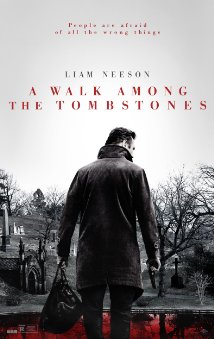
A Walk Among The Tombstones

MV5BMTQ3NzY2MTg1M15BMl5BanBnXkFtZTgwODY2Njk4MTE@._V1_SX214_AL_

21/09/15

Annoyingly, I missed this one at the cinema and it’s taken me far too long to catch up with it on the small screen. Based on a novel by Lawrence Block, it’s a dour slice of American grunge, featuring Liam Neeson as former detective and alcoholic, Matt Scudder, now plying a precarious trade as a private detective. Given Neeson’s relatively recent incarnation as everyone’s avenging Daddy of choice, it’s good to see him in a role where he actually carries a badge in order to justify his brutality, even if the badge in question is no longer valid. A pre credit sequence which shows him in his former incarnation, involved in a shootout with three bad guys, carries an entirely different accusation – that of crimes against fashion.

Now clean shaven and sans loon pants, Scudder receives a frantic phone call from drug trafficker, Kenny Kristo (Dan Stevens, demonstrating just how far he is able to depart from his Downton image when necessity calls.) Kristo’s wife has been kidnapped and despite him paying a hefty ransom, she’s been murdered anyway. Now he wants revenge and feels that Scudder is just the man for the job. Despite his reservations, Scudder undertakes the job and soon finds himself pitted against a ruthless duo of sociopaths who have enacted the same routine over and over. It’s quickly demonstrated that the bad guys are such scumbags that any retribution rained upon them will be richly deserved. A scene where Ray (David Harbour) espies his latest victim, a young girl dressed in a Little Red Riding Hood style, is the film’s most powerfully repellent set piece. Other scenes depicting the torture of the murderer’s female victims, stray very close to the line between powerful and gratuitous, so this certainly won’t be for everyone.

Written and directed by Scott Frank, AWATT is a powerful crime drama, though its stygian look can be a little dispiriting and its demonstration of the depths to which the human psyche can descend makes for grim viewing.

3.8 stars

Philip Caveney