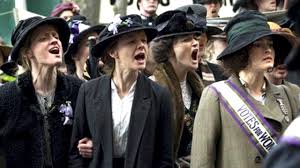
Carey Mulligan

Suffragette

Unknown-3 Unknown

17/10/15

Suffragette feels like an important – and timely – film. There’s a bit of a feminist backlash going on at the moment, with cries of “feminazi” and “what about the men?” drowning out the fact that all feminists have ever really asked for is equality, which shouldn’t be too much to ask.

Suffragette brings to the screen the stories of the unknown women who fought the cause. The casting of Meryl Streep as Emmeline Pankhurst cleverly highlights this shift in focus: the most high-profile actor has a cameo role, as does the figurehead of suffrage. This film is all about the less-exalted stars of the women’s movement: working-class washerwomen like Maude and Violet (Carey Mulligan and Anne-Marie Duff) and middle-class professionals such as Edith, a pharmacist (Helena Bonham Carter). Their lives are tough and unforgiving, and they have little control over anything. Their husbands own their property, their children. No wonder they want something more, or at least the right to have a say.

But, as ever, change is difficult to effect: the beneficiaries of the status quo are reluctant to let go, and others are afraid to rock their fragile boats. Here, we see Maude vilified and reviled as she begins to speak up for herself, and the reality of what she’s lost hits home – both for the character and the audience – when we see her son adopted because her now-estranged husband, Sonny (Ben Whishaw) thinks she will corrupt the boy. Sonny is bereft too: he’s threatened and undermined by Maude’s assertion of her rights; he’s a decent man who doesn’t understand. His tragedy is real as well. Everyone’s trapped by the rigidity of societal norms: Brendan Gleeson’s Inspector Arthur Steed feels some sympathy for the women, but that doesn’t stop him locking them up or allowing them to be force-fed.

Abi Morgan’s script is well-balanced: dispassionate and informative as well as emotive and personal. It’s a truly moving tale of the past with a message for the future: as Maude says, speaking tentatively to Lloyd George, “This life… I thought there might be a better way to live it.”

4.7 stars

Susan Singfield

Far From The Madding Crowd

MV5BMTQzNjE5Mjk5MV5BMl5BanBnXkFtZTgwMzQ3NDMwNTE@._V1_SX214_AL_

11/05/15

Thomas Vinterberg is a brave man – brave enough to take on Far From The Madding Crowd, in the certain knowledge that it is going to be compared to John Schlesinger’s 1967 masterpiece and inevitably found wanting. But perhaps I’m being unfair. Julie Christie, Alan Bates, Terence Stamp – these are all names that belong to another era and will mean very little to young cinema fans – and there’s no doubt that Carey Mulligan’s take on the tempestuous Bathsheba Everdean is as accomplished as you could reasonably want, even if some of her costumes – (the leather riding jerkin in particular,) don’t quite convince as being of the period.

Thomas ‘Chuckles’ Hardy is of course, a writer who excels in miserable stories and few come glummer than this tale of thwarted love and desire. Bathsheba is an orphan, who works as a farm labourer. The neighbouring farm is owned by handsome but taciturn shepherd, Gabriel Oak (Matthias Schoonaerts.) Gabriel takes a shine to Bathsheba and asks her to marry him, but she’s not quite ready to settle down yet and declines his offer. Shortly afterwards, as it is wont to do in Hardy novels, disaster strikes, robbing Gabriel of his livelihood and obliging him to move away. Bathsheba does rather better for herself, inheriting a farm when her Uncle dies unexpectedly. By a twist of fate, (or massive coincidence, whichever you prefer) she finds herself as Gabriel’s employer and is subsequently lusted after, both by her rich neighbour, Mr Boldwood (Michael Sheen) and by a rakish soldier, Sergeant Troy (Tom Sturridge.) Gabriel remains in the background, her ever watchful guardian angel. But which man will she end up with? And how many gallons of tears will be shed along the way?

Vinterberg, who came up through the Danish Festen cinema movement, makes a pretty good fist of this quintessentially English tale. The rolling landscape of Dorset is handsomely portrayed, the performances are all pretty much spot on (Sheen is in particularly good form as the tragic, obsessive Boldwood) and though the Sergeant Troy ‘reveal’ is handled far better in the Schlesinger version, it’s hard to fault such a meticulously rendered production. Hardy fans will perhaps feel that this version is more about Gabriel’s story than Bathsheba’s, but that seems to me a minor quibble. This is superior filmmaking and the results are well worth catching.

4.2 stars

Philip Caveney