
John Schlesinger

The Day of the Locust

15/06/26

Pleasance Courtyard (Attic), Edinburgh

Published in 1939 by Nathanael West and set in LA, The Day of the Locust is widely considered to be one of the great American novels – a treatise on the insatiable hunger for fame. It was also memorably turned into a feature film by John Schlesinger in 1975. Sprawling, visceral and strangely apocalyptic, it’s an ambitious subject for a monologue and I’m intrigued to see what storyteller Calum Patrick Hughes can make of it in the claustrophobic confines of the Pleasance’s Attic. 

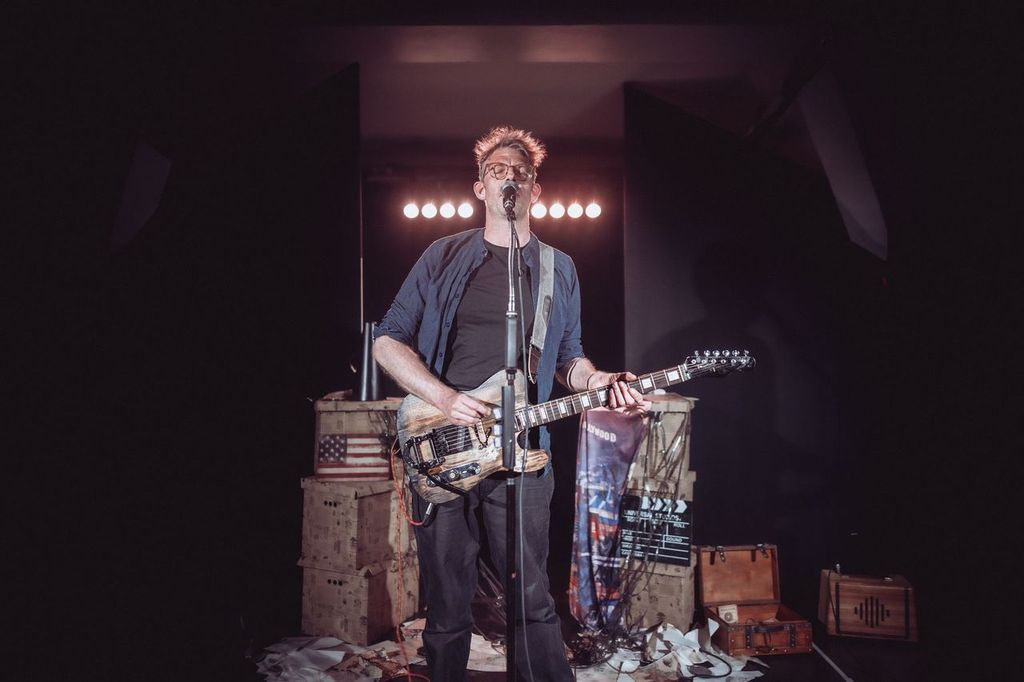
He manages to weave a beguiling tale with just his voice (occasionally boosted by a microphone) and atmospheric layers of sound, courtesy of an electric guitar fed through various loop and drone pedals, to create haunting soundscapes. Though he’s done a moderate amount of updating to the story – there’s mention of mobile phones at one point and also a couple of scenes where security forces have morphed into ICE agents – what’s interesting is how convincingly these elements gel with what was essentially a depiction of 1930s Hollywood. The avarice and greed remains undiminished; there’s the same propensity for people to exploit each other for personal gain.

Perhaps less successfully, Hughes has also retained the brutish sexual politics of the era in which the book was written, and I find myself wondering if those aspects too could be reappraised. Just a thought.

Hughes embodies all the familiar characters convincingly, varying his voice just enough to identify each of them in turn, and his descriptions of Hawthorn’s startling images create an atmosphere of steadily-rising tension throughout, until we are slammed headlong into the novel’s infamous climax. 

All in all, this is an experiment that has yielded a powerful and thought-provoking monologue. You don’t have to be a fan of the original – or even familiar with it – to enjoy this performance.

4 stars

Philip Caveney 

Midnight Cowboy


25/06/17

Following hard on the heels of The Graduate, comes this beauty, shown as part of the Cameo Cinema’s Dustin Hoffman season. Released in the UK the year after Mike Nichols’s Oscar winner, this searing evocation of the grimy underbelly of life on the streets of New York was another of the late 60s film that fuelled my early interest in cinema. I first saw it forty-eight years ago and over the intervening period, it has lost none of its considerable powers.

Joe Buck (Jon Voight, eerily displaying the distinctive facial characteristics that his daughter, Angelina Jolie would make famous years later) is a troubled young dishwasher from the ass-end of Texas, who decides to reinvent himself as a cowboy-styled stud and travels to New York city with the intention of earning a living by seducing rich young women for money. Of course, the reality of the situation is quite different from his expectations. After what looks like an initial success, Joe ends up paying the first woman he ‘seduces;’ and things don’t improve when he meets ‘Ratso’ Rizzo (Dustin Hoffman), an impoverished huckster who volunteers his services as Joe’s ‘manager.’ Ratso cons money out of Joe on their first meeting, but when they meet up again, the two men move into a filthy derelict building where an uneasy alliance begins to develop.

As with The Graduate, what strikes me here is how edgy and uncompromising this film is and yet it was a huge mainstream hit, back in the day, winning three Oscars and receiving countless nominations for the performances of Voight and Hoffman. It steps fearlessly into territory that hadn’t really been seen in the cinema before, so much so that Nichols famously advised Hoffman not to take the role of Ratso, believing that it would kill his career. The evocations of Poverty Row New York are brilliantly rendered and there’s also an extended sequence set in an Andy Warhol free party that vividly depicts the burgeoning anti-establishment movement of the period. Filmed with an impartial eye by English director John Schlesinger, it expertly nails the shallow, consumer-obsessed tawdriness of America in ways that few native-born directors could hope to achieve.

Fears that the film would be exploitative are largely unfounded. The dominant theme here is the deepening relationship between the two male protagonists and how in the midst of grinding poverty, both of them are fuelled by impossible dreams. This is a triumphant film, from its hard-hitting opening to its poignant conclusion. If you get the chance to see this on the big screen, don’t let it pass you by.

4.8 stars

Philip Caveney

Far From The Madding Crowd

MV5BMTQzNjE5Mjk5MV5BMl5BanBnXkFtZTgwMzQ3NDMwNTE@._V1_SX214_AL_

11/05/15

Thomas Vinterberg is a brave man – brave enough to take on Far From The Madding Crowd, in the certain knowledge that it is going to be compared to John Schlesinger’s 1967 masterpiece and inevitably found wanting. But perhaps I’m being unfair. Julie Christie, Alan Bates, Terence Stamp – these are all names that belong to another era and will mean very little to young cinema fans – and there’s no doubt that Carey Mulligan’s take on the tempestuous Bathsheba Everdean is as accomplished as you could reasonably want, even if some of her costumes – (the leather riding jerkin in particular,) don’t quite convince as being of the period.

Thomas ‘Chuckles’ Hardy is of course, a writer who excels in miserable stories and few come glummer than this tale of thwarted love and desire. Bathsheba is an orphan, who works as a farm labourer. The neighbouring farm is owned by handsome but taciturn shepherd, Gabriel Oak (Matthias Schoonaerts.) Gabriel takes a shine to Bathsheba and asks her to marry him, but she’s not quite ready to settle down yet and declines his offer. Shortly afterwards, as it is wont to do in Hardy novels, disaster strikes, robbing Gabriel of his livelihood and obliging him to move away. Bathsheba does rather better for herself, inheriting a farm when her Uncle dies unexpectedly. By a twist of fate, (or massive coincidence, whichever you prefer) she finds herself as Gabriel’s employer and is subsequently lusted after, both by her rich neighbour, Mr Boldwood (Michael Sheen) and by a rakish soldier, Sergeant Troy (Tom Sturridge.) Gabriel remains in the background, her ever watchful guardian angel. But which man will she end up with? And how many gallons of tears will be shed along the way?

Vinterberg, who came up through the Danish Festen cinema movement, makes a pretty good fist of this quintessentially English tale. The rolling landscape of Dorset is handsomely portrayed, the performances are all pretty much spot on (Sheen is in particularly good form as the tragic, obsessive Boldwood) and though the Sergeant Troy ‘reveal’ is handled far better in the Schlesinger version, it’s hard to fault such a meticulously rendered production. Hardy fans will perhaps feel that this version is more about Gabriel’s story than Bathsheba’s, but that seems to me a minor quibble. This is superior filmmaking and the results are well worth catching.

4.2 stars

Philip Caveney