13/06/26
Home, Manchester
Emma Rice Company’s Malory Towers is billed as a “UK” tour. As a Welsh woman living in Scotland, I feel the need to point out that this is actually an “England” tour. Luckily, Phil’s daughter lives in Manchester and, although she and her husband are too young to be Blyton aficionados, they’re always up for a bit of theatre. Which means we get the bonus of spending quality time with them – as well as having somewhere to stay.
It’s more than a decade since Phil and I have been to Home, but the venue is as vibrant as ever. The audience for this particular show is an odd mix, comprising mainly kids (some of them dressed up in Malory Towers school uniforms) and middle-aged women like me. It makes sense, I guess. For the latter group, it’s nostalgia for the books of our youth. For the former, it’s the more immediate joy of a children’s adventure story, presumably re-popularised by the recent (excellent) CBBC series.
But, look. I was never going to miss this musical. I’d have travelled much further afield if I’d had to. The combination of Blyton and Rice was always going to be too potent for me to resist. Blyton’s boarding school stories have a special place in my heart, and Rice is my favourite theatre maker, so yeah. This is a must-see.
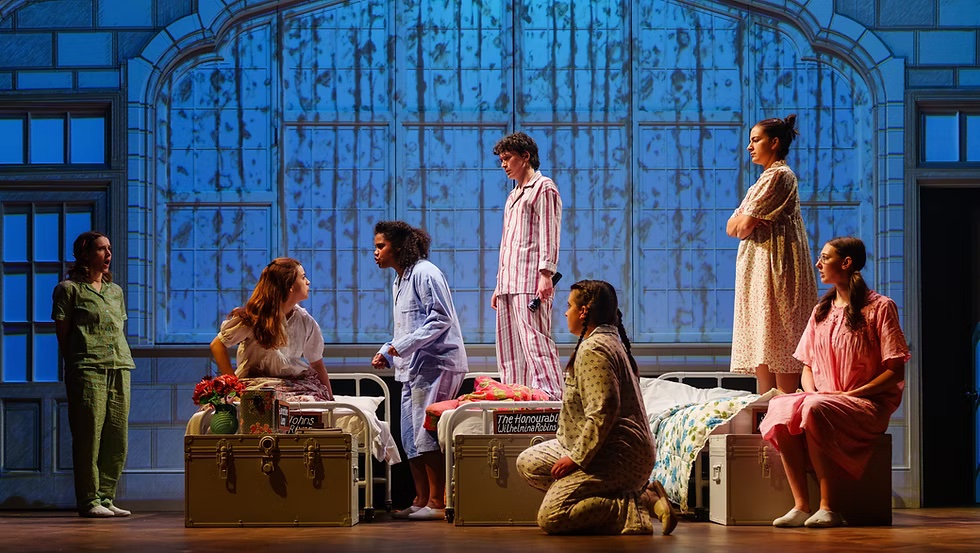
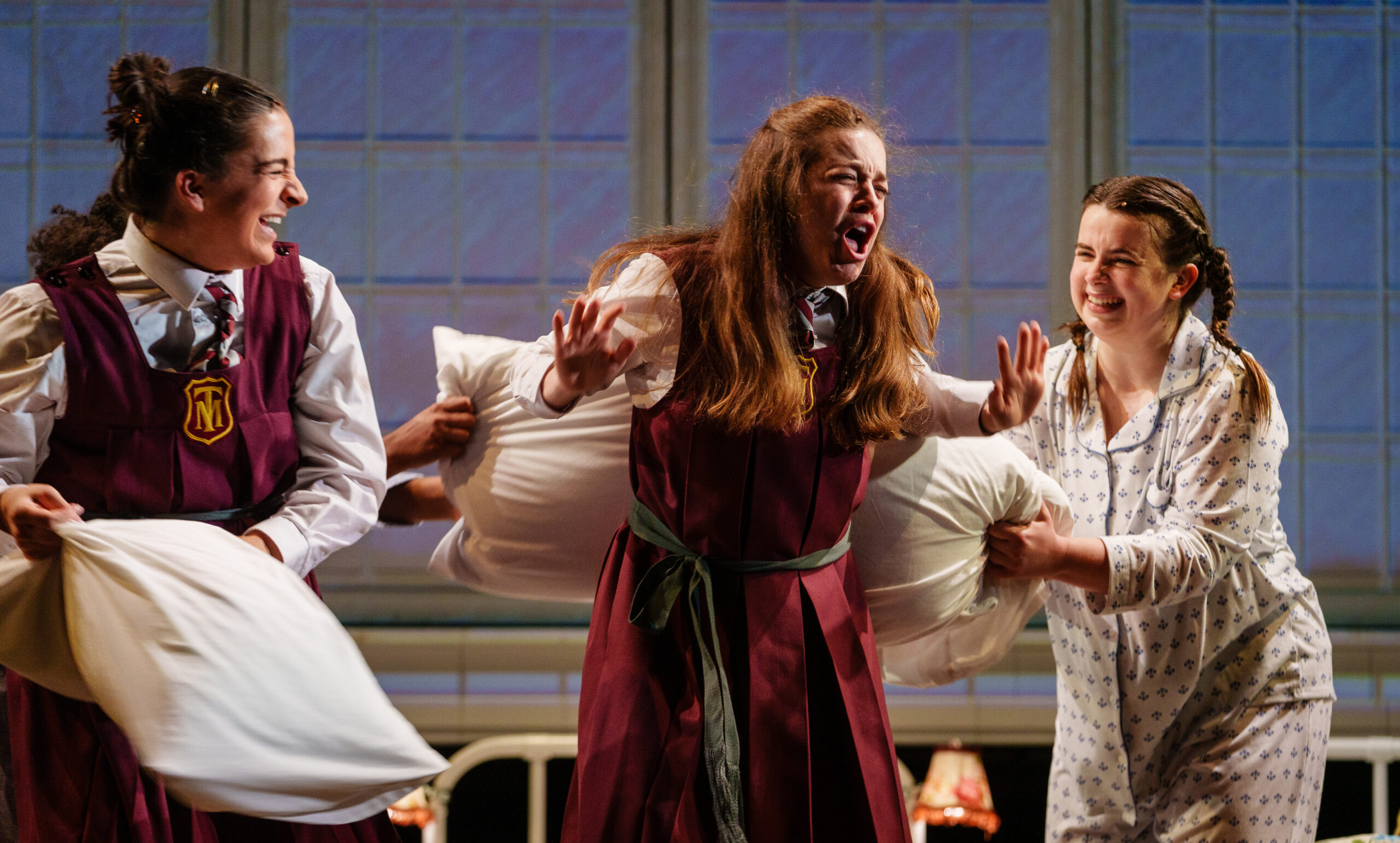
Somehow, with just eight performers – the actors also provide the music – Rice manages to evoke the atmosphere of a busy, bustling school. Of course, some characters have been amalgamated, others missed out altogether. But the main players are present and correct.
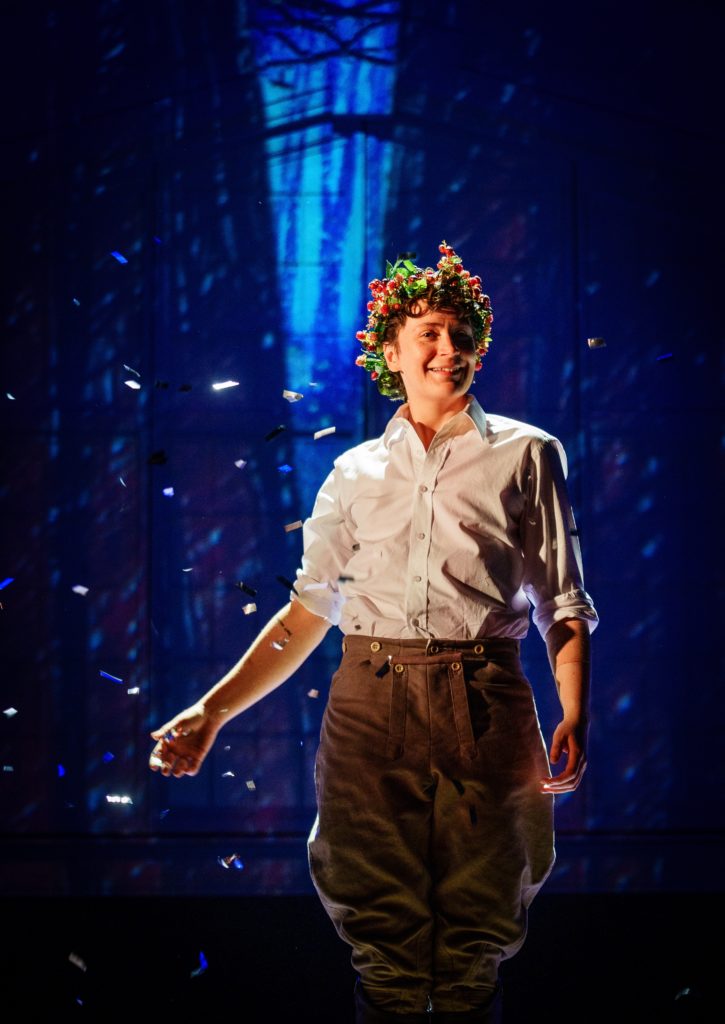
Step forward, Darrell Rivers (Robyn Sinclair), as flawed and fabulous as ever, determined to be the kind of girl to make her school proud, but hamstrung by a feisty temper that gets her into all sorts of scrapes. Gwendoline Lacey (Rebecca Collingwood) is played less as a preening princess and more as an out-and-out psychopath, complete with murderous intentions. It’s not true to the original, but it does make for some great drama! Alicia (Molly Cheesley) – notorious trickster – is merged with Connie, who can’t keep up with her lessons, and is frustrated by falling behind. The combination works. MD Stephanie Hockley plays, appropriately, musical prodigy Irene, who – for some reason – is given the French teacher’s surname and nationality. Meanwhile, Sensible Sally is played by Bethany Wooding, and horse-loving Bill by Zoë West. But it’s Eden Barrie’s Mary-Lou who’s the standout, her loveably gawky character the centre point, as she learns to overcome her timidity and stand proud of who she is.
Rice’s direction is as quirky as ever, and her inventive set-pieces are what really make this production. Miss Grayling is a silhouette projection, voiced by Sheila Hancock, a conceit that cleverly distances the head teacher from the girls’ everyday lives, while reminding the audience that they are being looked after. The swimming scene is a particular highlight, with puppets jumping from cartoon cliffs before the actors emerge from the ‘sea’, shivering and spitting water. Best of all is the opening to the second act, the inevitable clifftop rescue. I won’t reveal here how it’s done; suffice to say the entire audience is in paroxysms of laughter.
Is it all a little too spoofy? It is, for my taste at least. I understand why Rice has taken this route. Blyton’s characters are easy to mock: they’re painted with broad strokes, each with her own standout trait; their concerns and adventures so trivial and trite. But – and I know it’s a different beast entirely – I think the CBBC series manages this better, treating the girls’ adolescent struggles with respect and empathy rather than as a joke. In contrast, this production has a very adult perspective, and almost everything is played for laughs. The one exception is the scene where Gwendoline receives bad news. The poignancy of the moment is beautiful – and intensely emotional.
I like the overt reminders about the second world war. Blyton never mentions it but, as Rice reminds us here, the series was published between 1946 and 1951. The girls have lived through the war; their fathers, uncles, brothers will have fought in it. No wonder the pupils are so excited about midnight feasts: they’re used to rationing and shortages. This backdrop adds another dimension to the story, which works really well.
Overall, this Malory Towers musical is something of a mixed bag. But am I glad I’ve seen it? Rather!
4 stars
Susan Singfield

