Robyn Sinclair

Malory Towers

13/06/26

Home, Manchester

Emma Rice Company’s Malory Towers is billed as a “UK” tour. As a Welsh woman living in Scotland, I feel the need to point out that this is actually an “England” tour. Luckily, Phil’s daughter lives in Manchester and, although she and her husband are too young to be Blyton aficionados, they’re always up for a bit of theatre. Which means we get the bonus of spending quality time with them – as well as having somewhere to stay. 

It’s more than a decade since Phil and I have been to Home, but the venue is as vibrant as ever. The audience for this particular show is an odd mix, comprising mainly kids (some of them dressed up in Malory Towers school uniforms) and middle-aged women like me. It makes sense, I guess. For the latter group, it’s nostalgia for the books of our youth. For the former, it’s the more immediate joy of a children’s adventure story, presumably re-popularised by the recent (excellent) CBBC series. 

But, look. I was never going to miss this musical. I’d have travelled much further afield if I’d had to. The combination of Blyton and Rice was always going to be too potent for me to resist. Blyton’s boarding school stories have a special place in my heart, and Rice is my favourite theatre maker, so yeah. This is a must-see. 

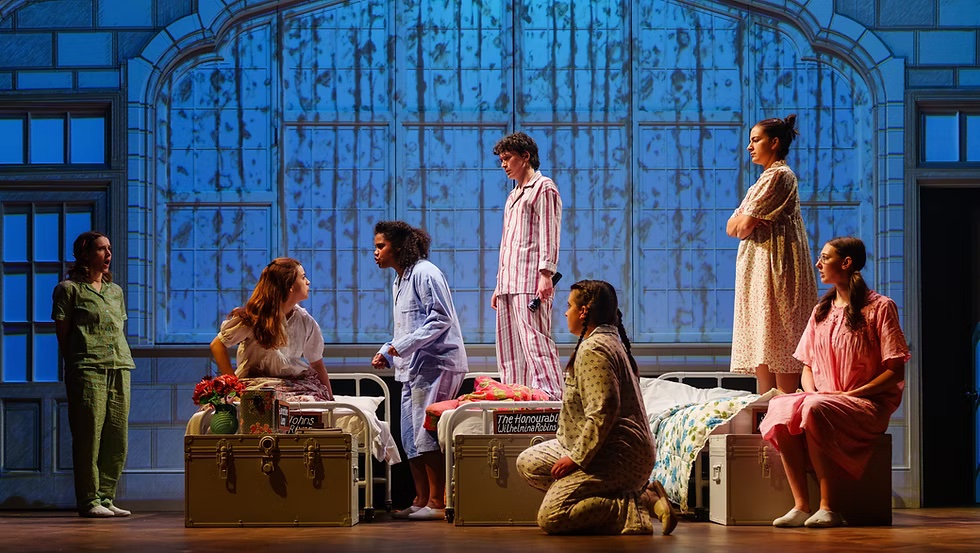
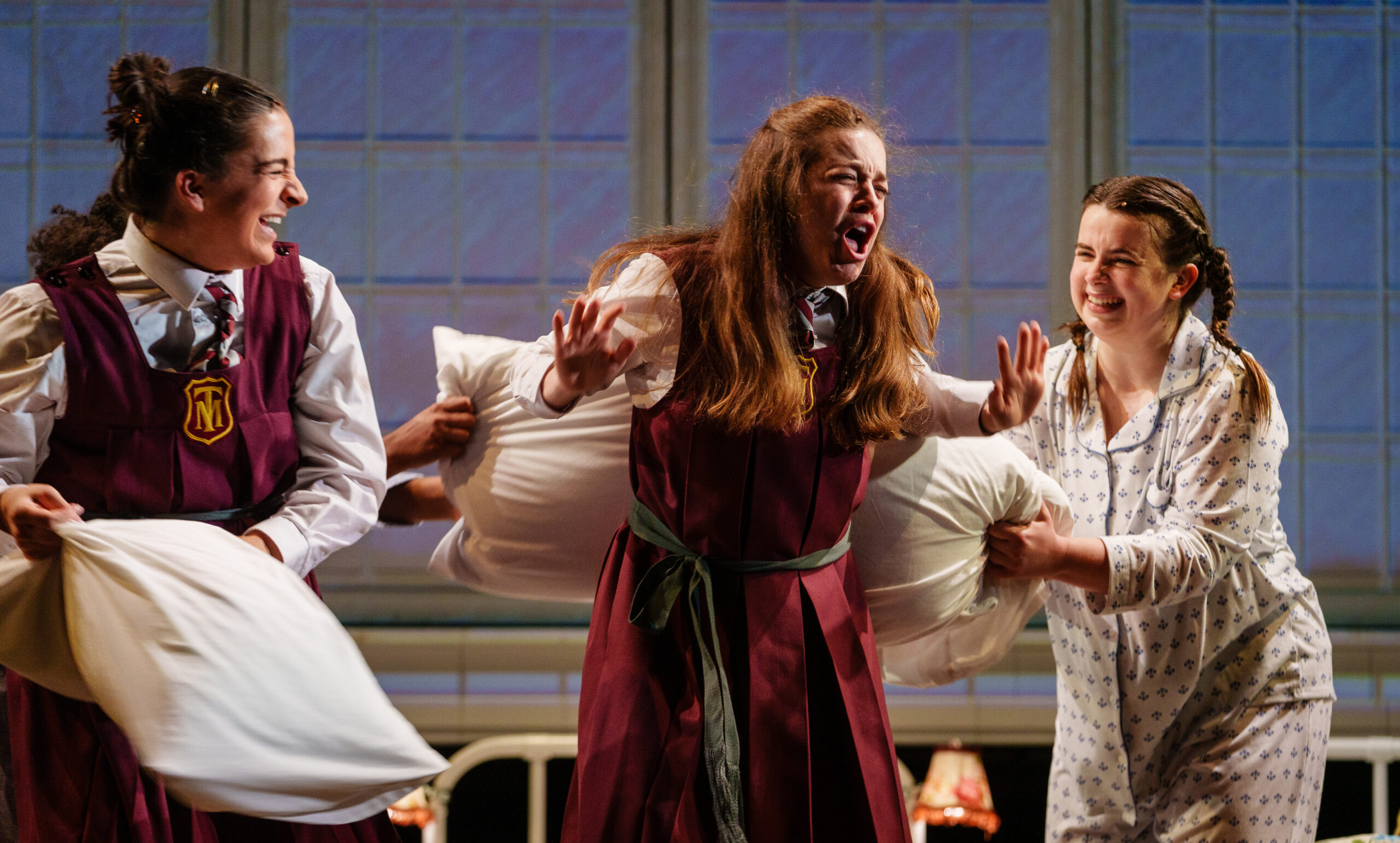
Somehow, with just eight performers – the actors also provide the music – Rice manages to evoke the atmosphere of a busy, bustling school. Of course, some characters have been amalgamated, others missed out altogether. But the main players are present and correct.

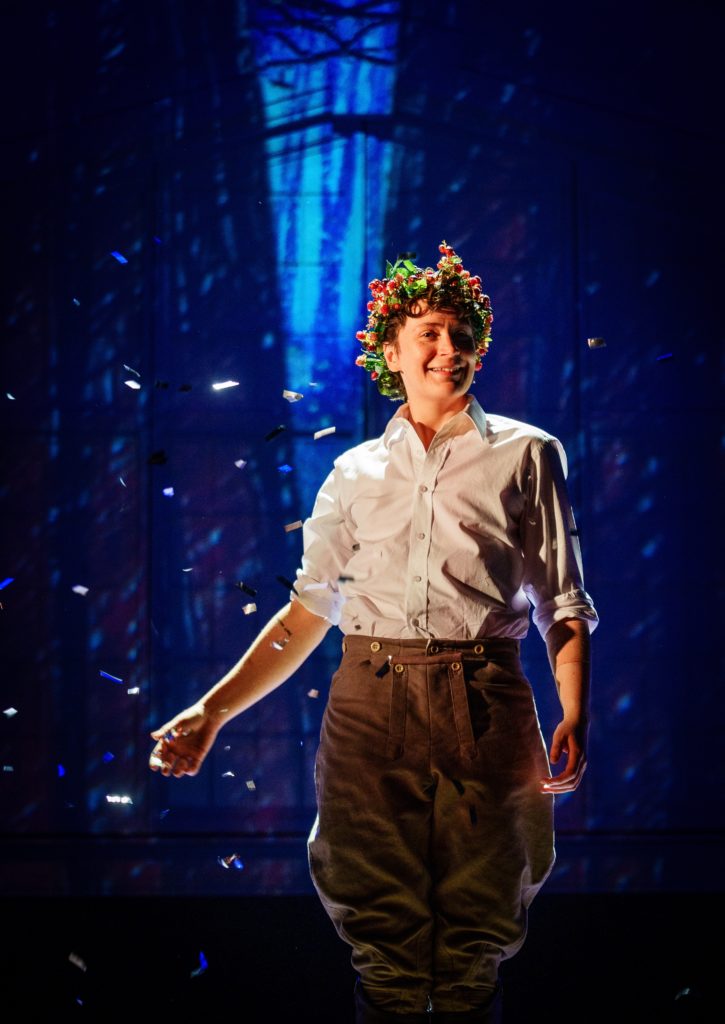
Step forward, Darrell Rivers (Robyn Sinclair), as flawed and fabulous as ever, determined to be the kind of girl to make her school proud, but hamstrung by a feisty temper that gets her into all sorts of scrapes. Gwendoline Lacey (Rebecca Collingwood) is played less as a preening princess and more as an out-and-out psychopath, complete with murderous intentions. It’s not true to the original, but it does make for some great drama! Alicia (Molly Cheesley) – notorious trickster – is merged with Connie, who can’t keep up with her lessons, and is frustrated by falling behind. The combination works. MD Stephanie Hockley plays, appropriately, musical prodigy Irene, who – for some reason – is given the French teacher’s surname and nationality. Meanwhile, Sensible Sally is played by Bethany Wooding, and horse-loving Bill by Zoë West. But it’s Eden Barrie’s Mary-Lou who’s the standout, her loveably gawky character the centre point, as she learns to overcome her timidity and stand proud of who she is. 

Rice’s direction is as quirky as ever, and her inventive set-pieces are what really make this production. Miss Grayling is a silhouette projection, voiced by Sheila Hancock, a conceit that cleverly distances the head teacher from the girls’ everyday lives, while reminding the audience that they are being looked after. The swimming scene is a particular highlight, with puppets jumping from cartoon cliffs before the actors emerge from the ‘sea’, shivering and spitting water. Best of all is the opening to the second act, the inevitable clifftop rescue. I won’t reveal here how it’s done; suffice to say the entire audience is in paroxysms of laughter. 

Is it all a little too spoofy? It is, for my taste at least. I understand why Rice has taken this route. Blyton’s characters are easy to mock: they’re painted with broad strokes, each with her own standout trait; their concerns and adventures so trivial and trite. But – and I know it’s a different beast entirely – I think the CBBC series manages this better, treating the girls’ adolescent struggles with respect and empathy rather than as a joke. In contrast, this production has a very adult perspective, and almost everything is played for laughs. The one exception is the scene where Gwendoline receives bad news. The poignancy of the moment is beautiful – and intensely emotional. 

I like the overt reminders about the second world war. Blyton never mentions it but, as Rice reminds us here, the series was published between 1946 and 1951. The girls have lived through the war; their fathers, uncles, brothers will have fought in it. No wonder the pupils are so excited about midnight feasts: they’re used to rationing and shortages. This backdrop adds another dimension to the story, which works really well.

Overall, this Malory Towers musical is something of a mixed bag. But am I glad I’ve seen it? Rather!

4 stars

Susan Singfield

Blue Beard

15/03/24

Royal Lyceum Theatre, Edinburgh

I’m a massive fan of writer/director Emma Rice – and also of fairytales. I even wrote my own version of Blue Beard some years ago, a short story currently languishing in the proverbial drawer where unpublished fiction goes to die. So, co-produced by Wise Children, Birmingham Rep, HOME Manchester, York Theatre Royal, and – of course – Edinburgh’s Royal Lyceum, this adaptation promises to be a delight. It doesn’t disappoint.

We all know the story. Blue Beard is a charming villain: rich, handsome and very popular. Sure, he’s had more wives than Henry VIII, but he doesn’t pretend to be a saint, and it’s no surprise when a naïve young woman agrees to marry him. The surprise comes later, when he gives his new bride a key but prohibits her from using it, placing a temptation in her way that he knows she can’t resist. When, inevitably, she opens the forbidden door, she finds the dismembered corpses of his previous wives and understands immediately that she is next. Luckily, she has brothers, and they come riding to the rescue. And then – spoiler alert! – she lives happily ever after.

Naturally, things pan out a little differently here. Rice embraces the anarchic heart of the fairy tale, while simultaneously tearing it apart. The result is as chaotic and brash as anyone who knows her work will expect: maximalist and frantic and as unsubtle as the protagonist’s cerulean facial hair. I love it.

The music (by Stu Barker) is integral to the piece. It’s enthralling, and beautifully performed by the impressive cast, all of whom turn out to be quadruple-threats, not only dancing, singing and acting with aplomb, but also playing a range of instruments and, in the case of Mirabelle Gremaud, adding gymnastics and contortion to the mix.

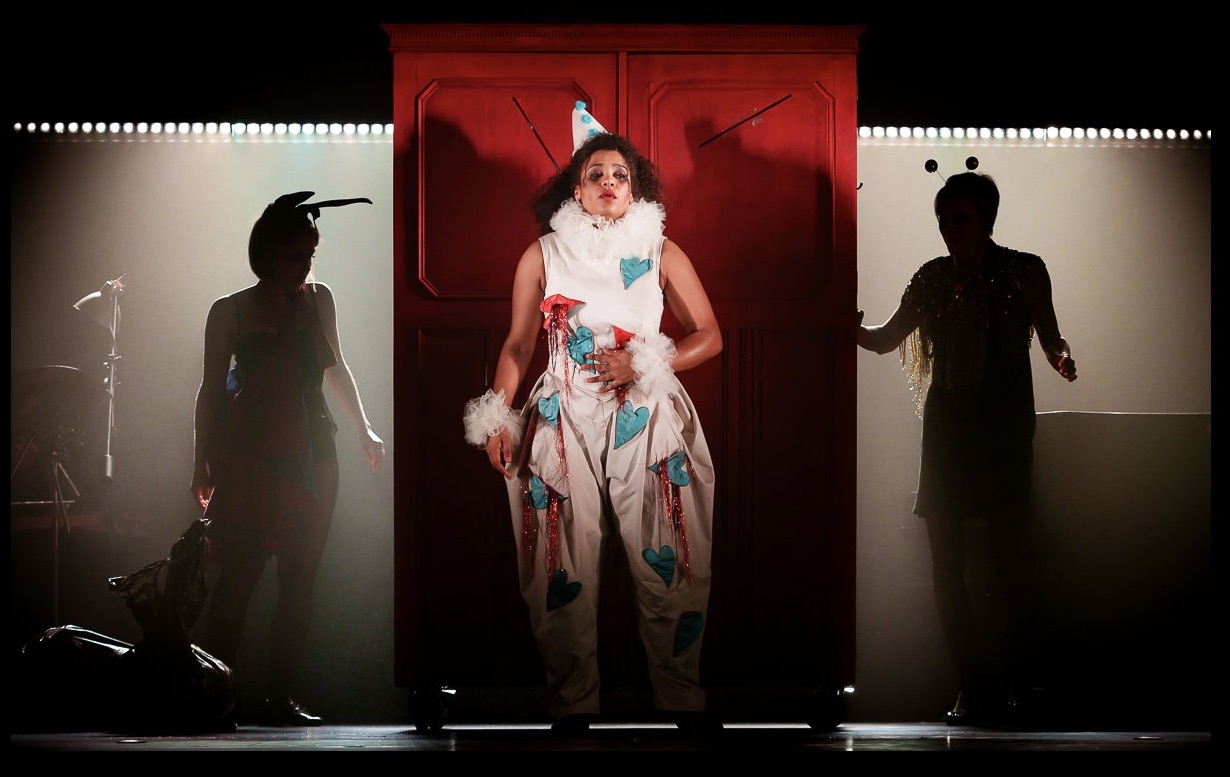
Vicki Mortimer’s ingenious set comprises boxes within boxes: indeed, the whole play is a magic show, all dazzling mirror-balls and sleights of hand. The cabaret glitz enhances the plot: no wonder Lucky (Robyn Sinclair) finds Blue Beard (Tristan Sturrock) spellbinding; he’s a magician, after all; illusions are his stock-in-trade. The thrilling, illicit pleasure draws us in: we too are seduced by Blue Beard’s ostentation and flair; excited as he conjures a horse race from nowhere; throws knives at his assistant (Gremaud); saws Lucky in half. This first act is all about the seductive allure of darkness, the impulse that makes us devour murder-mysteries and glamourise the bad guys.

But Rice’s Blue Beard comes with a warning, in the form of Mother Superior (the fabulous Katy Owen), whose Convent of the Three Fs reminds us that real women – as opposed to their fairytale counterparts – are at once fearful, fucked and furious. She’s both narrator and chorus, veering between humour and rage, first undercutting the tension with a perfectly-placed “fuck off”, then skewering Blue Beard’s dangerous pomposity.

The second act draws all the disparate strands together. Lucky doesn’t have brothers who can rescue her, but she does have Treasure and Trouble, her mum and sister (Patrycja Kujawska and Stephanie Hockley), and Blue Beard is no match for this formidable trio.

Out in the real world, the Lost Sister (Gremaud) is not so lucky. A screen showing black and white CCTV footage of a man following a woman is a theatrical gut-punch, less visceral than the slo-mo, gore-spattered, cartoon battle we’ve just enjoyed, but much more chilling. The auditorium, which just a moment ago was a riot of whoops and claps, is silent, aghast. The Lost Brother (Adam Mirsky) weeps; the Mother Superior sheds her habit. The smoke clears; the illusion breaks.

This is theatre with a capital T.

5 stars

Susan Singfield

The Lion, the Witch and the Wardrobe

08/02/22

King’s Theatre, Edinburgh

And, we’re back!

After the disappointment of seeing the King’s Theatre close its doors shortly after the launch of the Christmas pantomime, it’s wonderful to return once more to the stalls of the ‘Old Lady of Leven Street’ – and what a fabulous offering to kick things back into motion! I’ve seen several adaptations of CS Lewis’s celebrated book over the years, but few have handled the material quite as skilfully as in this powerful show, directed by Michael Fentiman and based upon Sally Cookson’s original production.

The four Pevensie children – Susan (Robyn Sinclair), Lucy (Karise Yansen), Peter (Ammar Duffus) and Edmund (Shaka Kalokoh) – are sent away from home as evacuees and, in a brilliantly staged opening , find themselves whisked off by train to a remote house somewhere in the wilds of Scotland. Here they meet their host, Professor Kirk (Johnson Willis), the owner of a curious cat and an ancient wardrobe that provides a convenient portal to the forever-winter world of Narnia…

From the outset here is a production that dazzles with enchantment. There’s a big cast, all of whom are given their chance to shine as they dance, play music and slip from character to character with apparent ease. This isn’t so much a full blown musical as a play with songs and the occasional burst of foot-tapping music. Of course, all the familiar faces are in place. There’s the imperious white witch (Samantha Womack), the messiah-like lion (Chris Jared), the flute-tootling faun (Jez Unwin) and the two of rebellious beavers (Sam Buttery and Christina Tedders), intent on returning Narnia to the way it used to be, before the snow began to fall.

There are several moments here that actually make me gasp in surprise: simply but effectively staged flying sequences; genuinely mind-twisting magical effects; and a brilliantly engineered set, where circular panels move smoothly aside to reveal fresh wonders, looking for all the world like Renaissance paintings. The audience sits spellbound as the performers leap and whirl across the stage in a riot of sound, colour and spectacle. The character of Aslan, simultaneously a real actor and a huge puppet, is an absolute masterstroke.

If you’ve been missing the buzz of live theatre, The Lion, the Witch and the Wardrobe offers a feast of delights for all the family – and, if you’ve been waiting for just the right production to lure you back, this must surely be the one to do it.

4.6 stars

Philip Caveney

Electrolyte

14/05/19

Traverse Theatre, Edinburgh

Electrolyte is not so much a musical as an extended piece of performance poetry set to music – what has recently come to be termed ‘gig theatre.’ I’ve only occasionally seen examples of it and, to be honest, I’ve rarely seen it done as convincingly as it is here by Wildcard Theatre’s six-strong cast of actor/musicians. It’s enervating stuff, full of fire and emotion, a blitzkrieg of sound and light that barely pauses to take a breath, yet never allows all that energy to get in the way of telling a powerful and important story.

It’s the story of Jess (Olivia Sweeney), a young, would-be artist living a hedonistic lifestyle with her friends in Leeds, and trying as best she can to shrug off a recent family tragedy. At one particular party, she hooks up with Allie Touch (Robyn Sinclair), a charismatic singer/songwriter whose star is clearly on the rise. She invites Jess to be her guest at a showcase she’s doing in London and Jess gleefully goes along for the ride, partly because she’s a little bit obsessed with Allie, but mostly because she’s anxious to reconnect with someone who lives there, someone she hasn’t seen in a while…

It would be wrong of me to give any more of the plot away; suffice to say that Jess is not the most reliable of narrators, but – as personified by the hyperactive Sweeney – we’re with her every step of the way, willing her to succeed as she careers headlong towards her goal.

But this is more than just a showcase for the lead performer – all the actor musicians in the ensemble have plenty of opportunities to shine and the whole piece is expertly knitted together, encompassing a whole range of musical genres and moods. The script, by James Meteyard, is terrific: witty, playful and occasionally devastating, taking in genuine emotional moments, whilst never allowing itself to wallow in sentimentality.

At this point, I’d usually be urging the citizens of Edinburgh to run out and grab tickets but, sadly, this was a ‘one night only’ appearance at the Traverse. However, Electrolyte is still in the early stages of a ten-week tour of the UK and, chances are, somewhere between now and early July, it could well be coming to a venue near you. If it does, and you miss your chance to book for it, you’ll only have yourselves to blame.

5 stars

Philip Caveney