A Play A Pie and A Pint

Ship Rats

19/09/23

Traverse Theatre, Edinburgh

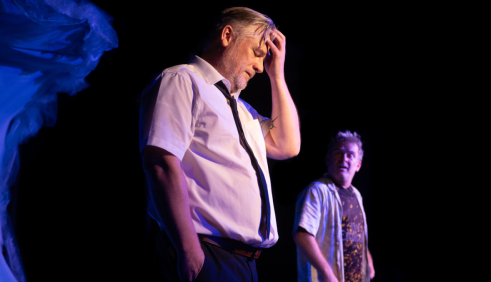
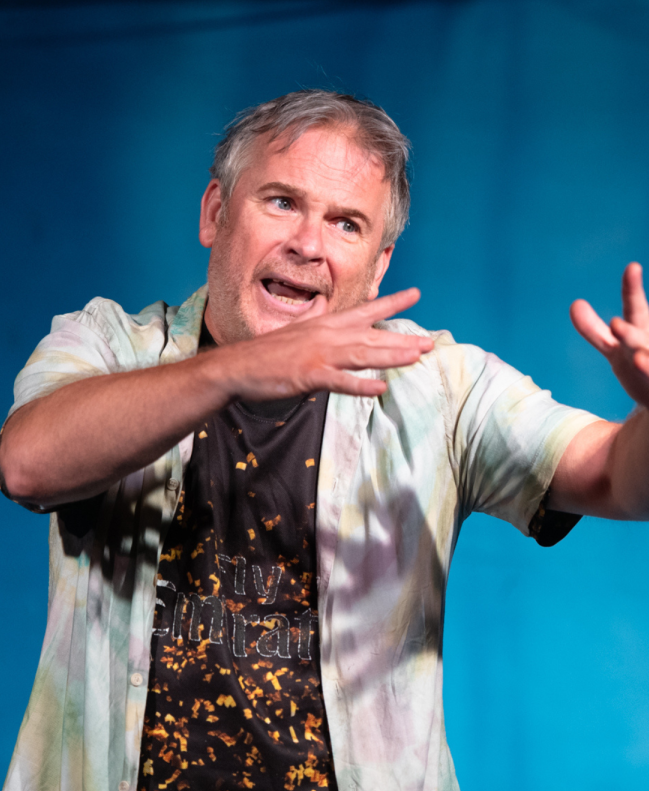
It’s the year 1880 and Jessie (Madeline Grieve) is in big trouble. She’s just murdered her husband and she’s covered in his blood. He’s the captain of the ship she’s currently aboard, a cruel tyrant who recently condemned an innocent cabin boy to fifty lashes for stealing a biscuit. He probably had it coming, but still, his crew are unlikely to be sympathetic.

To make matters worse, Jessie has sought refuge in the cabin of the ship’s Chinese cook, Jin Hai (Sebastian Lim-Seet), a man with probelms of his own. Shunned by the other members of the crew, he is planning a daring escape from the ship – but, try as he might, he cannot find the box of matches he needs in order to make his departure go with a bang.

When the inevitable hue and cry kicks off, Jessie and Jin Hai realise that they’ll have to ignore their respective differences and hide out together. In doing so, they begin to realise that they actually have quite a bit in common. Their conversation takes in a range of subjects: colonialism and Chinese medicine; murder and morning sickness; ginger and gunpowder.

Alice Clark’s spirited two-hander, a co-production between Òran Mór and the Traverse Theatre, is inspired by the adventures of the playwright’s own great-great-grandmother, a seafaring lass with a colourful backstory. The fact that the two protagonists in Ship Rats speak like contemporary Glaswegians out on the lash is initially jarring but, once I settle into the rhythm, it makes for a fun-filled fifty minutes, even if the tone is sometimes relentlessly frenetic.

Grieve offers a rollicking turn as the amusingly foulmouthed Jessie, while Lim-Seet makes an astute foil for her bawdy barrage of invective. If occasionally Jessie and Jin-Hai seem to possess the kind of insight that really only comes with the advantage of historical perspective, well that’s acceptable, given that this wants more than anything else to be a commentary on the toxic nature of Empire.

Director Laila Noble keeps the action propulsive enough to ensure that the pace never flags and Ship Rats has me entertained right up to the final scene.

3.4 stars

Philip Caveney

The Spark

04/04/23

Traverse Theatre, Edinburgh

It’s hard to believe it’s taken until now – the 2020s – for the term ‘perimenopause’ to enter popular discourse, although, ironically, my computer has just underlined it in red, signalling an unknown word – so maybe we’ve still got a way to go. Nevertheless, we’re moving inexorably away from hushed murmurings about ‘the change’ and oblique references to ‘hot flushes’, and instead naming all of the physical and mental symptoms of this life-altering process. It turns out it’s not just your periods petering to a halt. No such luck. Instead it’s some or all of the following: joint pain, exhaustion, menstrual cramps, decreased (or increased) libido, mood swings, anger, vaginal dryness, brain fog… it’s quite the gut punch. Almost literally.

In The Spark, playwright Kathy McKean explores the impact of the perimenopause on a politician. Robin (the brilliant Nicole Cooper) is struggling in a system that seems designed to constrain her. And whereas, in her younger years, she might have bitten her lip and done what needed to be done in order to get ahead, she’s at ‘that age’ now, and the fuck-it factor has set in. No, she won’t stand by while a group of men harass a young girl at a bus stop. No, she won’t deliver the anodyne presentation her speech-writer, James (Johnny Panchaud), has concocted – a bowdlerised version of her own from-the-heart first draft. No, she won’t accept that she’s powerless to affect change. Because otherwise, what’s it all for?

Directed by Gordon Barr, the three actors effortlessly illuminate the chaos inside Robin’s head, as her adversarial discussions with both James and her long-suffering GP, Maggie (Beth Marshall), build to a cacophony. Maggie’s got enough problems of her own – and she blames Robin for some of them. After all, Robin was, until recently, the minister for health. She knows how over-worked the nation’s doctors are; how can she possibly think Maggie has time to deal with what seems on the surface like a pretty bog-standard set of symptoms? Except that Robin’s menopausal heat seems to manifesting itself outside her body, and who knows where that will end…

The writing here is sharp and the delivery fast-paced and engaging. The Spark seems like a fitting finale to what has been a particularly strong season of A Play, a Pie and a Pint. It’s not perfect – it’s a simple idea that builds well at first, but doesn’t deliver the shocking crescendo it perhaps should, and maybe takes aim at the wrong target (I can think of many institutions more deserving of a middle-aged woman’s ire than the parliament at Holyrood). But it’s good to see this subject aired, and in such a witty, thought-provoking way.

4 stars

Susan Singfield
Variant

28/03/23

Traverse Theatre, Edinburgh

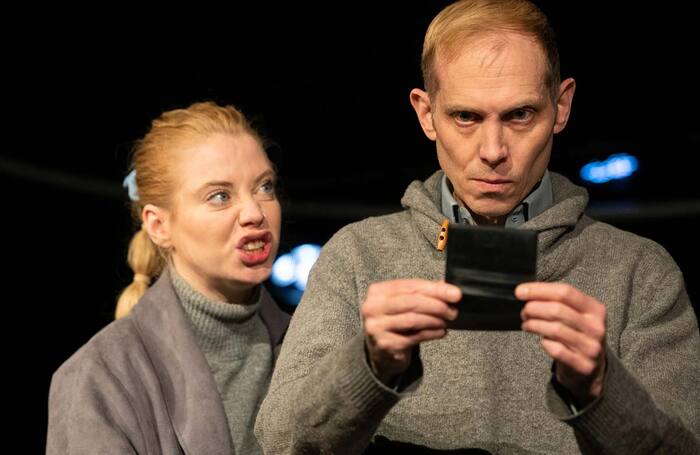
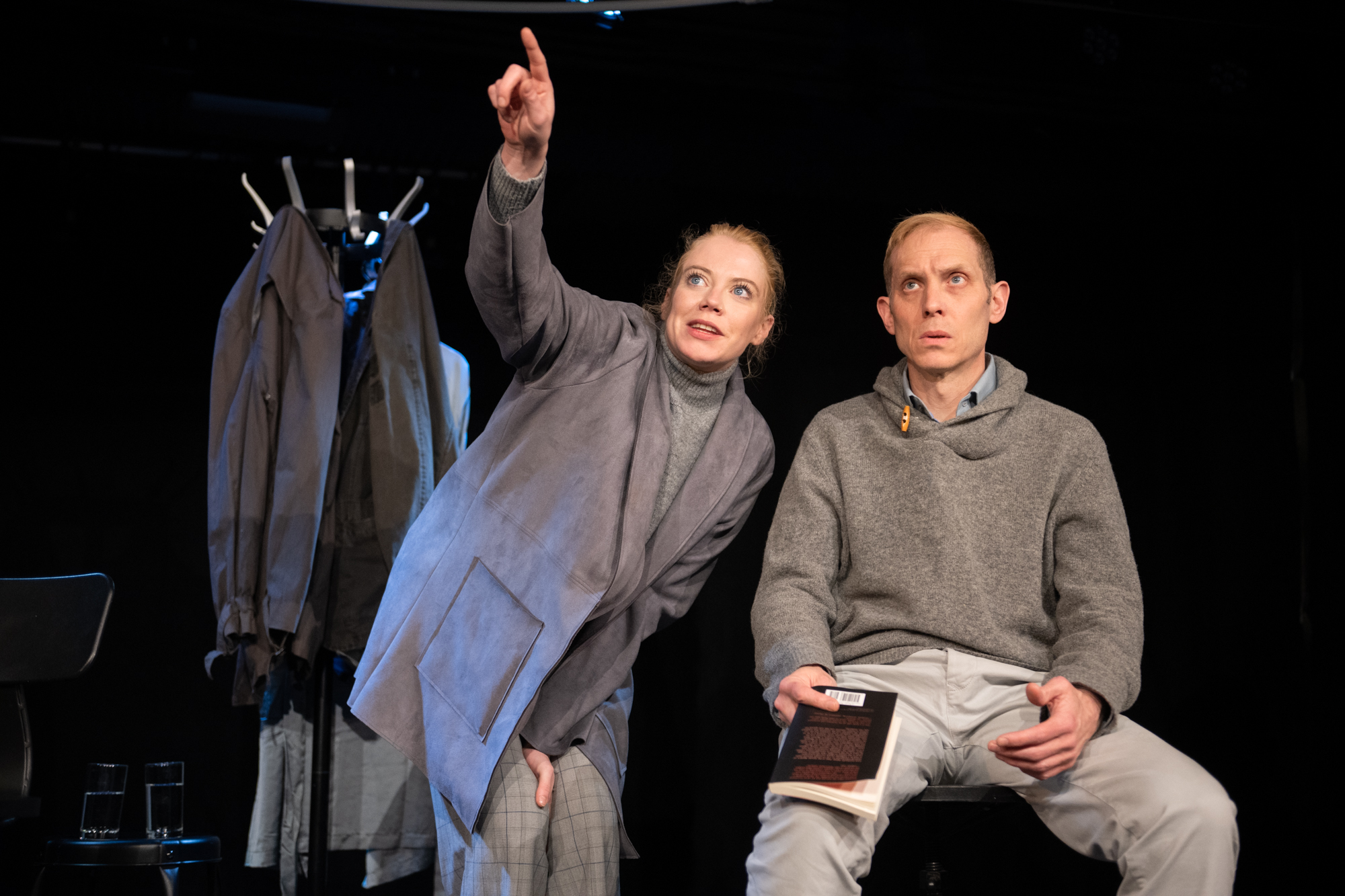
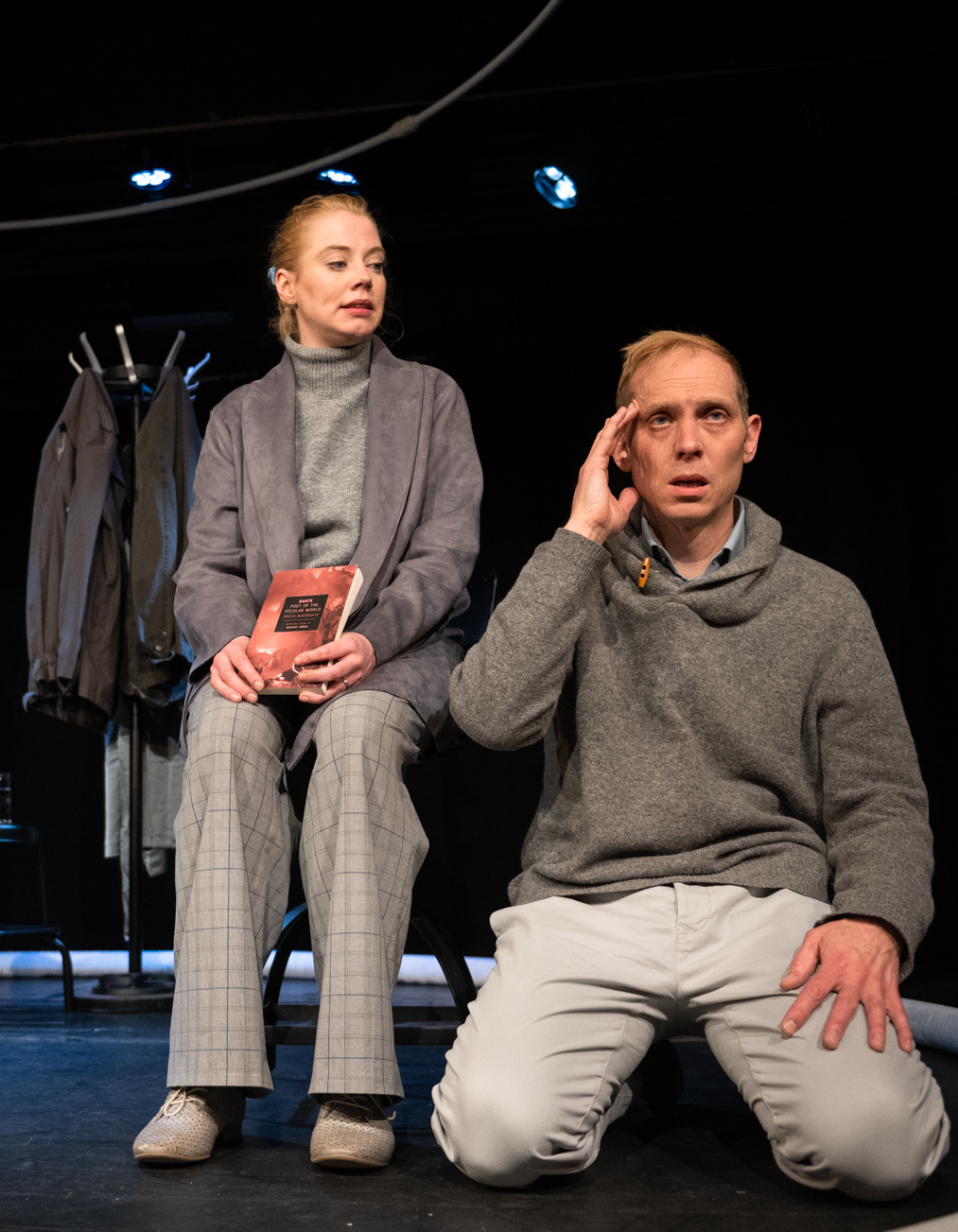
The latest in this A Play, A Pie and A Pint season is Variant, written by Peter Arnott and directed by Kolbrún Björt Sigfusdöttir. It’s a distinctly Beckettian slice of absurdist theatre, a slippery two-hander that seems to question the very essence of identity. Who are we? Are we who we really think we are? And are the people we believe we are closest to, actually who they appear to be? Such heavy questions are just the tip of the iceberg in this taut and unsettling play.

A woman (Meghan Tyler) and a man (Simon Donaldson) saunter into the circular performance space, dressed in muted tones that perfectly match the simple setting. The woman begins to write in a notebook, the man reads a novel, but the silence is almost immediately broken by the arrival of a fly, buzzing annoyingly around the man’s head, interrupting his reading. He kills it. And then he pauses to make a remark to the woman.

‘I see you’ve changed your hair.’

But she quickly questions what he means by this. Was there something wrong with her hair before? Does he approve of what she’s done to it? Or would he have preferred something else? What’s wrong with her hair?

At first the conversation seems innocuous, the bickering of a long-married couple – but as it progresses, it becomes increasingly complicated, loaded with allusions to other things. I find myself asking questions. Are the two people actually married? Because isn’t this beginning to feel distinctly like an interview? And why does the woman keep steering the conversation into darker waters? Why are the images she refers to so violent?

Arnott’s play is cleverly constructed, raising many questions but offering no answers, and – just as we’re beginning to think we have a handle on it – the piece resets itself, and pursues another line of thought, steering us in a different direction. All credit to Tyler and Donaldson, who inhabit their complicated roles with absolute authority. If I’m not always entirely convinced that the piece has as much substance as it has ambition, it’s still nonetheless an engaging, and wryly amusing play, weighing in at a taut forty-five minutes, during which it switches back and forth like a cerebral rollercoaster. 

Did I like the play? Well, let me ask you something. What do you mean by the word ‘like’? Are you asking if it entertained me? Or puzzled me? Or even baffled me? Do you think I should review it? But then, what is a review? And perhaps more to the point, who’s writing this one? Oh, hang on a minute. I think it must be me. Whoever I am.

3.8 stars

Philip Caveney

Write-Off

21/03/23

Traverse Theatre, Edinburgh

The A Play, A Pie and a Pint season continues its cracking run with this intriguing two-hander, written by Aodhan Gallagher and directed by Irene McDougall. It’s a play about writers and writing, so naturally I’m fascinated to see what it has to say about the subject – and, as it turns out, it has plenty. What’s more, I’m delighted to note how many unexpected twists and turns are packed into a brisk fifty-minute running time.

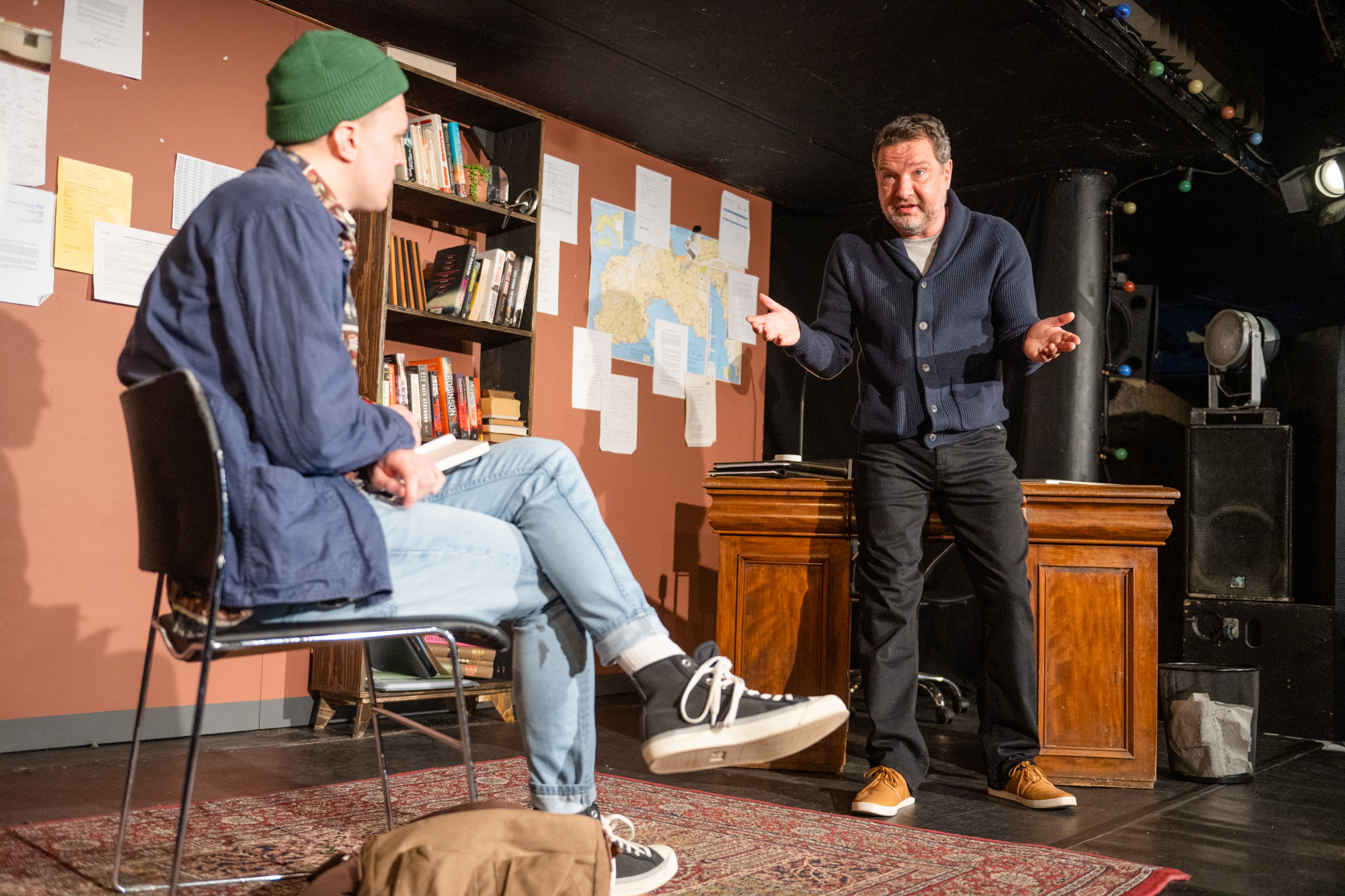
Freddie (Richard Conlon) is a long-established fiction writer, currently preparing to start work on a new novel – most of which is already a stack of crumpled notes in his wastebasket. He’s never seen the necessity for incorporating elements from his own life into the gritty psychological thrillers he’s made his reputation on. These are brutal tales filled with violence and action. But lately, Freddie’s publishers have become a little twitchy, pointing out that his earlier work is increasingly being perceived as ‘problematic’. 

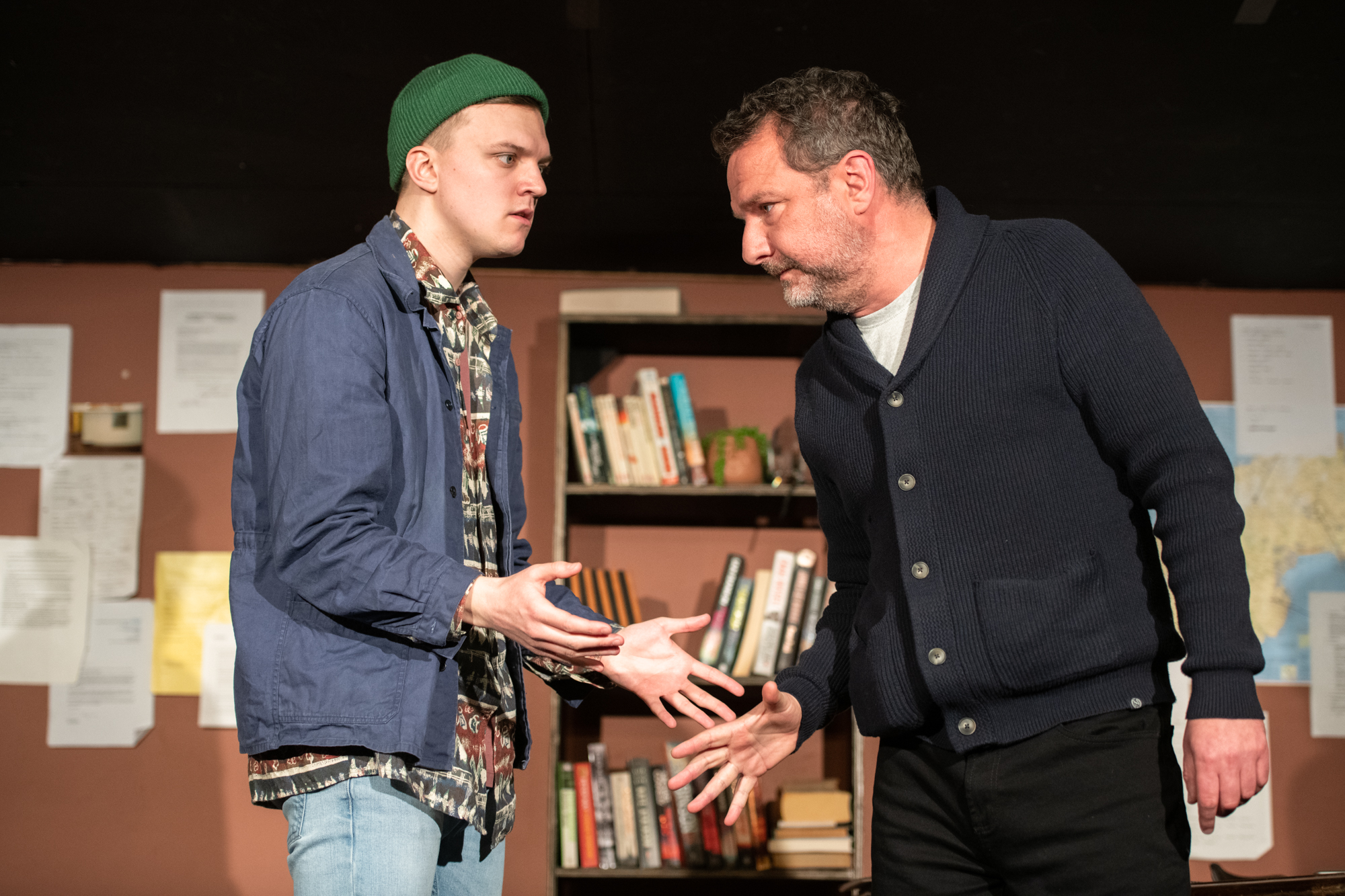
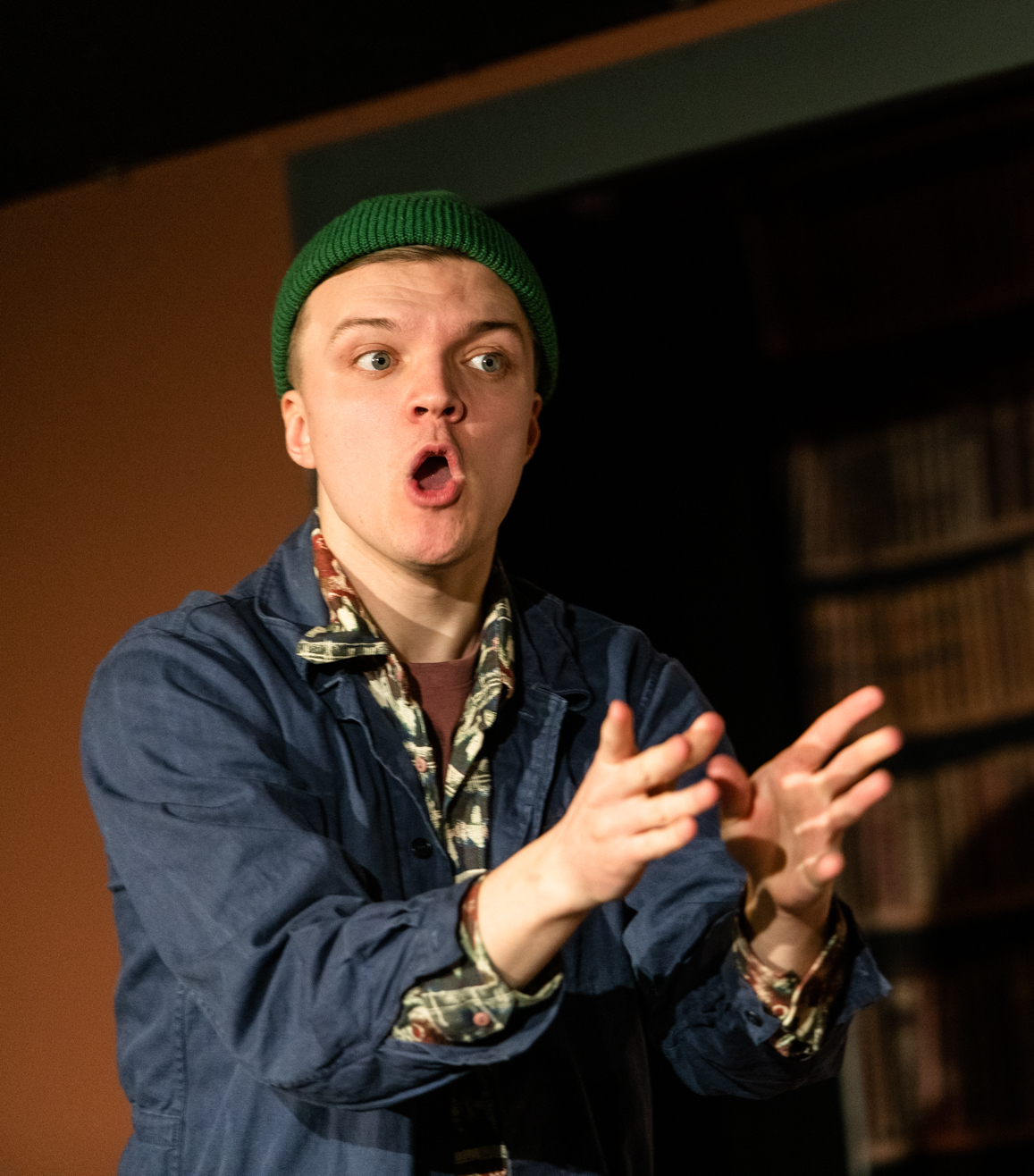
With this in mind, they’ve suggested that this time around, he might want to employ a ‘sensitivity reader’, somebody more attuned to contemporary issues. Enter Ben (Bailey Newsome), the promising student of one of Freddie’s literary acquaintances. Ben is young, gay and confidently in touch with the zeitgeist. He sports a beanie hat and trendy footwear. He also has an unpublished novel of his own that he’s very keen to get noticed…

Write-Off’s acerbic dialogue hooks me from the get-go and my sympathies bounce from character to character as the two men, by turns adversaries and allies, discuss their respective ambitions, beliefs and motives. One moment I’m laughing out loud at Freddie’s caustic observations, the next I’m gasping at some new revelation from Ben, which I genuinely haven’t seen coming. Can these two men ever hope to settle their differences enough to work together on a project?

The performances of the two actors are utterly believable and while it could be argued that this is a piece that’s completely predicated on its quickfire dialogue – and might work just as effectively as a radio play – it’s nonetheless a compelling and challenging production that maintains its propulsive edge right up to the final scene.

I head straight from the play to The National Library of Scotland where – inevitably – I’m working on my new novel. Who says life doesn’t imitate art?

4 stars

Philip Caveney

Babs

14/03/23

Traverse Theatre, Edinburgh

This week’s A Play, A Pie and A Pint is the pithily titled Babs by Morna Young. We’ve enjoyed Young’s work before – Lost at Sea and Aye, Elvis are both excellent examples of Scottish theatre – so we arrive at the Traverse this Tuesday lunch time with high expectations. The set, by Gemma Patchett and Jonny Scott, doesn’t give much away: there are a few fir trees, some pipes, a couple of skulls and a ukelele – an eclectic mix, promising something unusual.

We’re not disappointed.

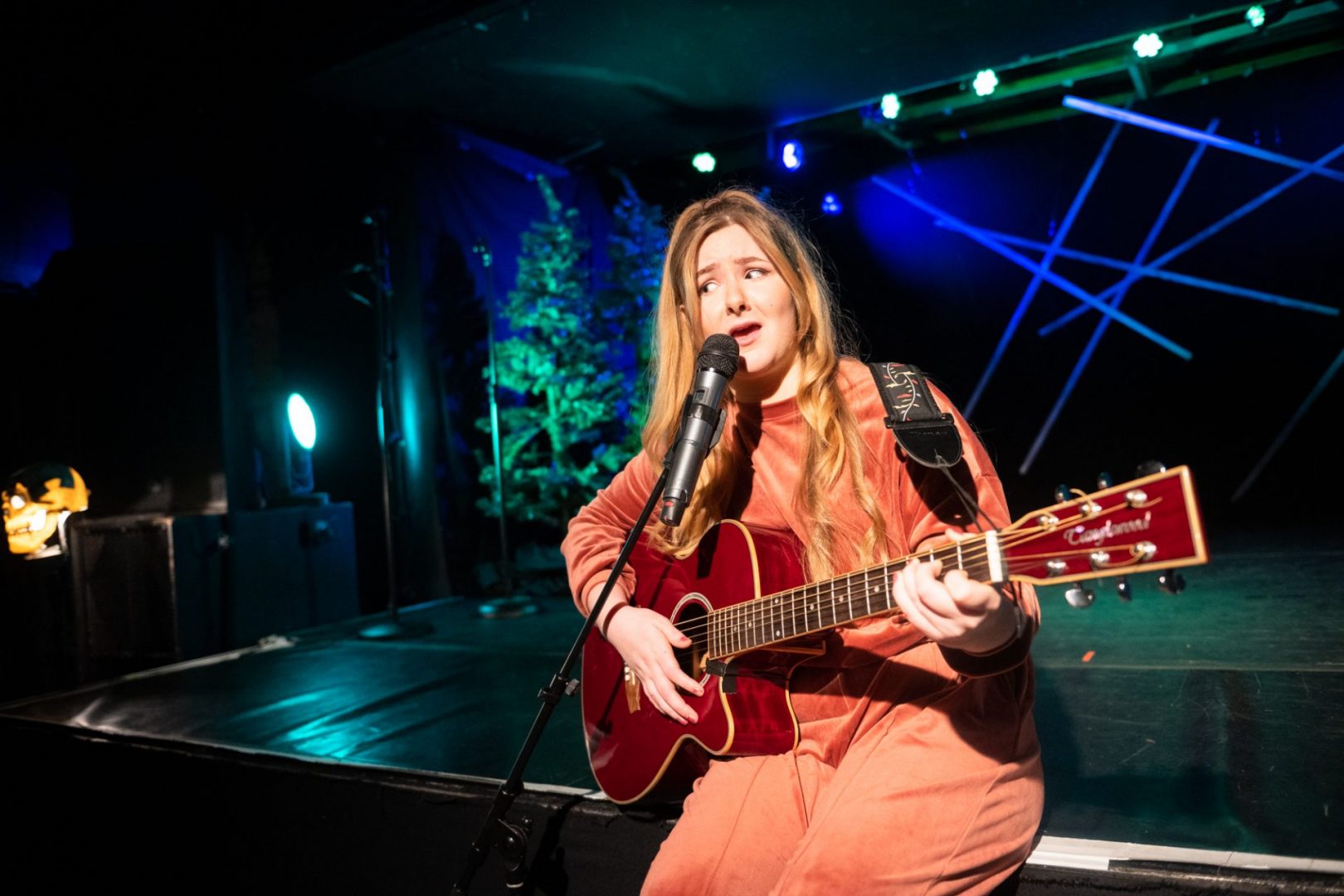
Bethany Tennick plays Lisa, a troubled young quine from Aberdeen, who lives for her annual holiday with her best pal, Shelley. Apart from that, all Lisa has is her guitar, her tunes and a truckload of attitude. So when Shelley decides she’d rather go away with her new boyfriend, Gareth, Lisa is raging. How dare Shelley ditch her? Desperate and drunk, she signs up for a solo retreat, which turns out to be life-changing, because ‘Babs’, the mysterious host, is none other than Baba Yaga – she of the iron teeth and chicken-legged house… Why has she invited Lisa here?

Young’s decision to write the piece in Doric dialect gives it an urgent authenticity, underscoring Lisa’s need to be true to herself, even as she searches for a new identity. She is a bold, in-your-face character, and Tennick imbues her with such spark and vim that it’s impossible not to warm to her, even when she’s being completely unreasonable. The songs (composed by Tennick) add an extra dimension, showing us that Lisa has the potential to be more than ‘a sheep’, even if she can’t yet see it herself. The plaintive ode to her mother is especially emotive.

Despite its dark themes, Babs is essentially a comedy, and I spend much of the fifty-minute running time laughing at Lisa’s disproportionate outrage, or at her renditions of the other characters who populate the tale. Director Beth Morton keeps the pace snappy, and every joke lands well with the audience.

I’m fair-tricket to say this is another winner from 2023’s first PPP season.

4.2 stars

Susan Singfield
Burning Bright

07/03/23

Traverse Theatre, Edinburgh

This latest season of A Play, A Pie and A Pint promises to be a good ‘un. Hot on the heels of last week’s sprightly Until It’s Gone comes Burning Bright, Áine King’s apocalyptic depiction of the climate crisis engulfing us. It’s no surprise to learn that this play won the 2022 David MacLennan award: it’s evocative and visual, a big story told in small fragments, as economical as poetry.

We are presented with three disparate narratives, linked by an over-arching theme of environmental collapse. Suzanne Magowan is a TV journalist desperately chasing a story about Australian wildfires, more interested in saving her career than in saving the earth. Hannah Jarrett-Scott plays a grief-stricken young woman with an eco-tourism business, taking rich adventurers on her boat, The Ice Princess, to see the polar ice caps before they’re gone. And Adam Buksh is a survivor: he’s escaped floods and tigers in his native India, and now he’s navigating racism on his Glasgow street.

The performances are all strong, the characters compellingly portrayed, and the writing is gorgeously cinematic – the image of a blazing horse, for example, is horribly mesmerising. Roxana Haines (director), Gemma Patchett and Jonny Scott (designers) achieve astonishing things with a tiny stage and a minimal set, so that it’s easy to suspend my disbelief and accept that I am, simultaneously, in the Arctic, Australia, Scotland and India, witnessing fire, floods and melting ice caps.

The conceit works to emphasise the ubiquity and urgency of climate breakdown. Even these characters, closer to the epicentres of disaster than most of us, are each only aware of one aspect of the problem. But here in the audience, we are shown the cumulative effect: their monologues are tangled and entwined, so that we see their interdependence and the extent of the catastrophe that’s looming over us. The image is there throughout, cleverly captured in the juxtaposition of the encroaching wave of plastic waste that dominates the set, and the tiny dinghy representing our precarious position.

Burning Bright is a superbly accomplished piece of theatre, skilfully illuminating why climate change is an issue we can’t afford to ignore.

4.7 stars

Susan Singfield
Until It’s Gone

28/02/23

Traverse Theatre, Edinburgh

This sprightly two-hander packs a lot into its fifty-minute running time. Until It’s Gone is the first of 2023’s A Play, a Pie and a Pint offerings, and it’s a corker: Alison Carr’s tight and cleverly-crafted script imagines a future where all of womankind have disappeared, and men are left to make the best of a world without them. In stark contrast to Charlotte Perkins-Gilman’s Herland, where women have created a female Utopia, this male-only Scotland is a dystopian mess, its citizens desperate for the women to return from their unspecified and unexplained exile.

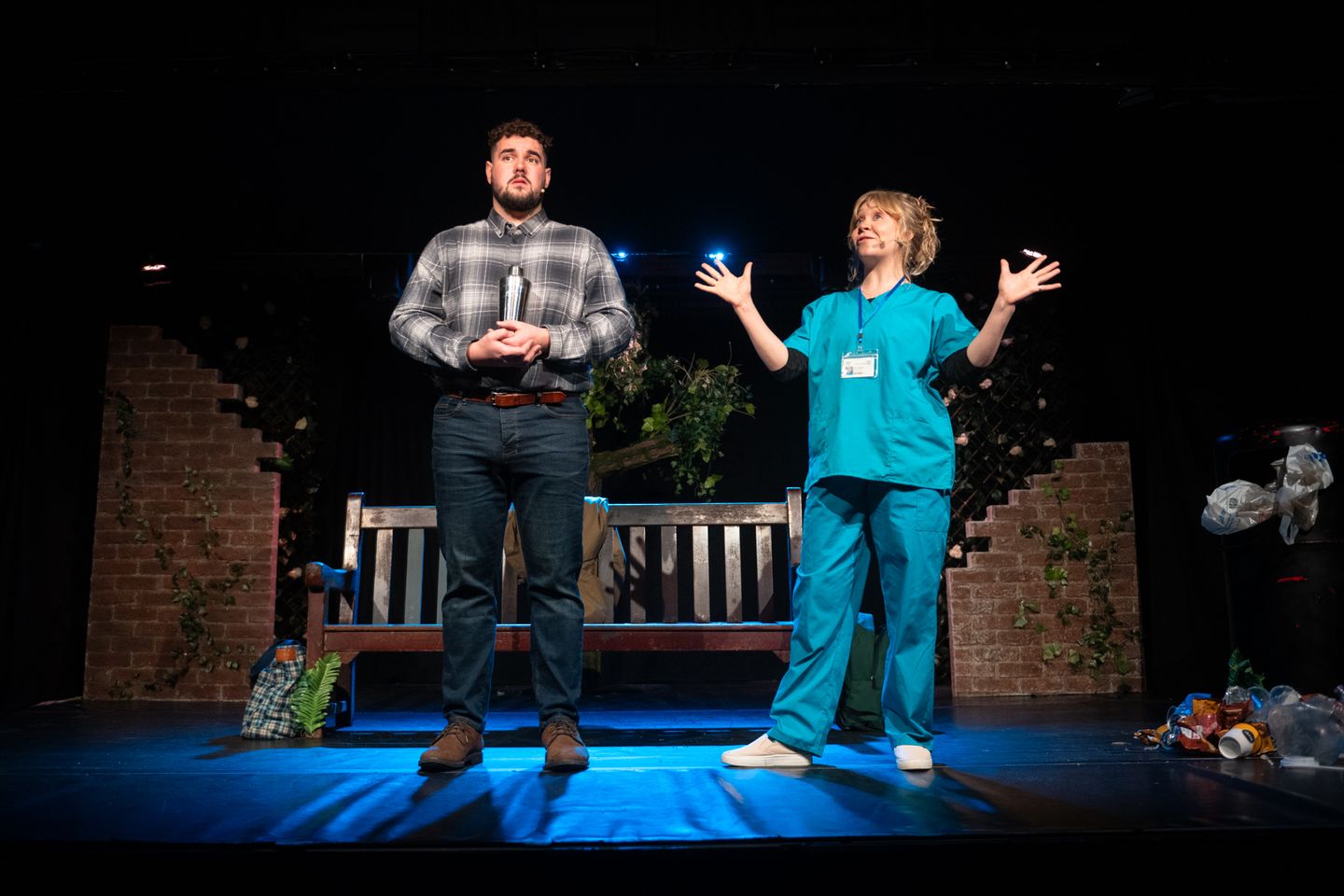
We’re offered a glimpse into this terrifying scenario through a simple park-bench, chalk-and-cheese set-up: a meeting between an eager young man of twenty-five (Sean Connor) and a gruff older one (Billy Mack). They’ve been matched by a supposedly ‘world-beating’ app, but this is not a date – or at least, not a conventional one. They are two avowedly heterosexual, cis-gendered men, following a strict government mandate to ‘connect’ – because things aren’t sustainable as they are. Through this smallest of microcosms, Carr seeds just enough information into the men’s darkly comic dialogue to allow us to envisage the bigger picture, the tortured society in which they live, where schools are closed, most interactions happen online, and everything feels wrong.

The characters are beautifully realised, played with warmth and humour by Connor and Mack, even as they expose the men’s real pain. The generational divide is deftly managed, the initial chasm between them narrowing as they talk and share confidences, slowly realising that they’re more alike than not, that their shared fate should bind them rather than pull them apart.

Under Caitlin Skinner’s assured direction, the play’s political points are clearly made without ever feeling intrusive. I like the cheeky use of tableaux and blackouts to mark the passage of time at the beginning, and the set – by Gemma Patchett and Jonny Scott – is modest but strikingly effective. I’m especially drawn to the myriad images of women adorning the tumbledown walls, and find myself wondering if they are ‘missing’ posters or simply photos, there to remind the men of what they’ve lost. 

Because, of course, you never know until it’s gone…

4.4 stars

Susan Singfield
Jinnistan

08/11/22

Traverse Theatre, Edinburgh

Jinnistan, directed by Niloo-Far Khan, is the last of this season’s PPP productions, and – in a break with the norm – it’s in the ‘big theatre’, aka Traverse One. This seems fitting, as the play’s parameters are bigger than normal too, encompassing not just the world as we know it, but the spirit realm as well. The Jinnistan of the title co-exists with Pakistan – but relations are strained, to say the least.

Malik (Taqi Nazeer, who also wrote the script) moved from Scotland to Pakistan a year ago. His wife, Layla (Avita Jay), and teenage daughter, Asiya (Iman Akhtar), have followed him there. Asiya’s not happy, and neither is Malik. She wanted to stay at home with her pals. and he – well, he isn’t saying. I guess it isn’t easy to tell your family that it’s your destiny to be a genie-fighter, and that there are annual rituals you need to perform in order to save lives.

This is essentially a low-fi horror, and all the genre’s tropes are in evidence here. Spooky graveyard? Check. Family secret? Check. Wayward teenage girl possessed by an evil spirit? Check. Nazeer keeps things fresh by transposing the action to a different culture, seamlessly blending Arabic and English to give a clear sense of place. The setting is enhanced by special effects, which – though obviously constrained by budget – are serviceable enough, conveying a feeling of unease.

Akhtar delivers an impressive performance, imbuing Ayisa with a convincing mix of swagger and insecurity. The sound design (by Niroshini Thambar) is also excellent: the jinn’s voice truly seems to emanate from somewhere beyond the here and now.

I do have some quibbles: the script is a little uneven, for example, and there are jarring moments of humour that undermine the building tension, so that – ultimately – the stakes are never really raised. The recorded voices, though well-delivered, are over-used: all too often, I find myself listening to a block of exposition, while looking at a blank or static stage.

Nonetheless, Jinnistan is an entertaining piece of lunchtime theatre, and a fitting end to this round of PPP’s lunchtime offerings.

3 stars

Susan Singfield

Made in China

11/10/22

Traverse Theatre, Edinburgh

Janet (Jo Freer) lives in Wishaw, near Glasgow. Her daughter Tash’s birthday is fast approaching and Janet is frantically trying to procure the weird selection of fripperies Tash says she simply ‘has to have’ if her party is to be a success. When she demands some novelty lights in the shape of… er, aubergines, who is Janet to argue with her? She obligingly opens the Amazon app and clicks through her order.

Meanwhile, in China, Hui Ting (Amber Lin) is working long shifts at a factory, where such dubious items are produced and packaged, before being shipped all around the world. She has much to contend with, struggling to meet her targets and constantly being fined for trivial matters – even, in one case, for having her period at an inconvenient time. But she has a powerful motive for working around the clock: she doesn’t want her daughter to end up in the same position.

And then Janet discovers a scrap of paper in her latest order, something that Hui Ting has scribbled in a rare free moment and accidentally dropped into the box. Janet decides that she needs to find out what the note means. It takes her a while but, once she has an answer, she’s compelled to reappraise the way she lives her own life…

Made in China is a deceptively simple two-hander, the latest offering from A Play, a Pie and a Pint. On a stage festooned with cardboard boxes, the women appear to work side-by-side, their lives intertwined, even though they never interact. Playwright Alice Clark cleverly draws out the fascinating parallels between the two, and shows the kind of ripple effect that can be initiated by even the most innocuous form of Western consumerism. Both Freer and Lin make their characters utterly believable. I love Janet’s snarky, self-deprecating tone and I love too that Hui Ting is not presented as saintly, but as somebody who has her own agenda and is quite prepared to bend the rules in order to achieve her goals.

Clark’s eloquently written play alternates between harsh reality and the enduring allure of dreams. Philip Howard’s direction brings this prescient piece to a satisfying conclusion. As polemics go, it’s one of the best I’ve seen in quite a while.

4.1 stars

Philip Caveney

The Lottery Ticket

26/09/18

Traverse Theatre, Edinburgh 

We’re always being told that theatre should be as accessible as possible. Few initiatives exemplify this ideal more successfully than the Traverse Theatre’s A Play, a Pie and a Pint seasons. For just £13.50, punters can enjoy an original hour-long piece of theatre, a tasty snack and a drink of their choice. During a grey Edinburgh lunch hour, it’s certainly gratifying to see the auditorium packed with eager theatre-goers, making the most of the opportunity.

The Lottery Ticket, by Donna Franceschild, has the air of a whimsical contemporary fable. Two homeless men wake up after spending the night in somebody’s garden bin shed. They have been violently ejected from a shelter the night before and one of them has sustained serious injuries in the altercation. They are Salih (Nebli Bassani), a Turkish/Kurdish asylum seeker and his friend, Jacek (Steven Duffy), a Polish handyman, now suffering from a couple of broken ribs. Both of them desperately need money  – Jacek to send home to his loved ones and Salih to facilitate his return to his homeland – but neither of them can see a way to solve their respective predicaments.

When Jacek discovers that a current lottery ticket has mysteriously found its way into his pocket, the fervently religious Salih decides that this is a sign from Allah that their luck is about to change for the better. But then they are discovered by house owner, Rhona (Helen Mallon), who has a very pressing need of her own. She’s in desperate need of a plumber but it’s a Saturday and she can’t get anyone to come out to deal with the issue. If only she could find somebody to fix the problem…

Watching this wry and sometimes challenging story play out is a rewarding way to spend an hour. Bassani and Duffy are charismatic performers who make an engaging double act, while Mallon’s character is more acerbic and adds a little acid to the mix. As the two men struggle with the intricacies of her overflowing toilet, we learn more about their backgrounds: about the circumstances that have brought them to where they are today – and we come to appreciate that good fortune can appear in many different guises.

This is a charming and immensely likeable slice of theatre. As I head for the exit afterwards, I can’t help thinking that all lunch times should be as fulfilling as this one.

4 stars

Philip Caveney