A Play A Pie and A Pint

The Lottery Ticket

26/09/18

Traverse Theatre, Edinburgh 

We’re always being told that theatre should be as accessible as possible. Few initiatives exemplify this ideal more successfully than the Traverse Theatre’s A Play, a Pie and a Pint seasons. For just £13.50, punters can enjoy an original hour-long piece of theatre, a tasty snack and a drink of their choice. During a grey Edinburgh lunch hour, it’s certainly gratifying to see the auditorium packed with eager theatre-goers, making the most of the opportunity.

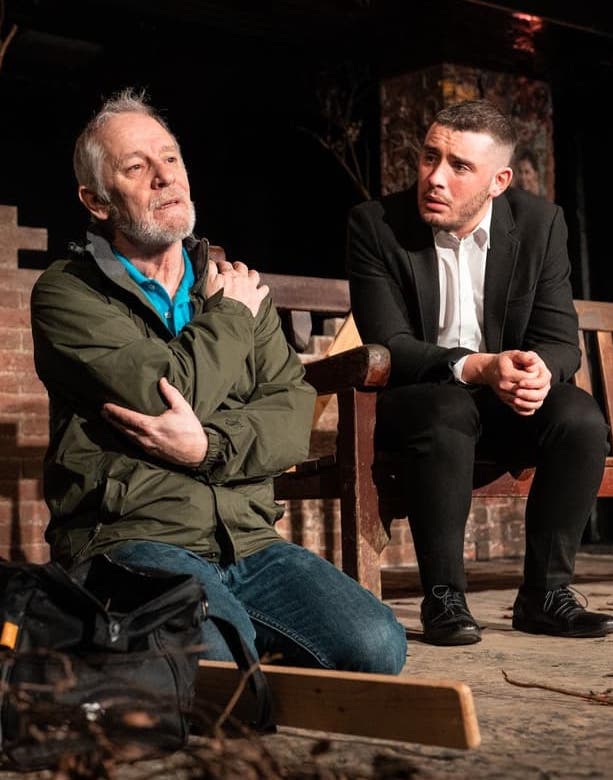
The Lottery Ticket, by Donna Franceschild, has the air of a whimsical contemporary fable. Two homeless men wake up after spending the night in somebody’s garden bin shed. They have been violently ejected from a shelter the night before and one of them has sustained serious injuries in the altercation. They are Salih (Nebli Bassani), a Turkish/Kurdish asylum seeker and his friend, Jacek (Steven Duffy), a Polish handyman, now suffering from a couple of broken ribs. Both of them desperately need money  – Jacek to send home to his loved ones and Salih to facilitate his return to his homeland – but neither of them can see a way to solve their respective predicaments.

When Jacek discovers that a current lottery ticket has mysteriously found its way into his pocket, the fervently religious Salih decides that this is a sign from Allah that their luck is about to change for the better. But then they are discovered by house owner, Rhona (Helen Mallon), who has a very pressing need of her own. She’s in desperate need of a plumber but it’s a Saturday and she can’t get anyone to come out to deal with the issue. If only she could find somebody to fix the problem…

Watching this wry and sometimes challenging story play out is a rewarding way to spend an hour. Bassani and Duffy are charismatic performers who make an engaging double act, while Mallon’s character is more acerbic and adds a little acid to the mix. As the two men struggle with the intricacies of her overflowing toilet, we learn more about their backgrounds: about the circumstances that have brought them to where they are today – and we come to appreciate that good fortune can appear in many different guises.

This is a charming and immensely likeable slice of theatre. As I head for the exit afterwards, I can’t help thinking that all lunch times should be as fulfilling as this one.

4 stars

Philip Caveney

Walking On Walls

walking-on-walls

19/10/16

Traverse Theatre, Edinburgh

Walking On Walls by Morna Pearson is part of the Traverse’s latest ‘A Play, A Pie and A Pint’ season. There are five plays, each one shown at 1pm from Tuesday to Saturday, with one later performance on a Friday evening. It’s a successful concept and clearly very popular; today’s show is sold out. And really, what’s not to like about a £12.50 theatre ticket that also includes a savoury pie and a pint of ale (wine or soft drinks are also available)?

We’ve extolled the virtues of the Traverse and have invited friends to join us today, so we’re extra keen for this one to be good. And (quite by chance) Philip met one the actors at an event in Glasgow, last night, which adds another level of pressure; he wants to be able to offer genuine praise!

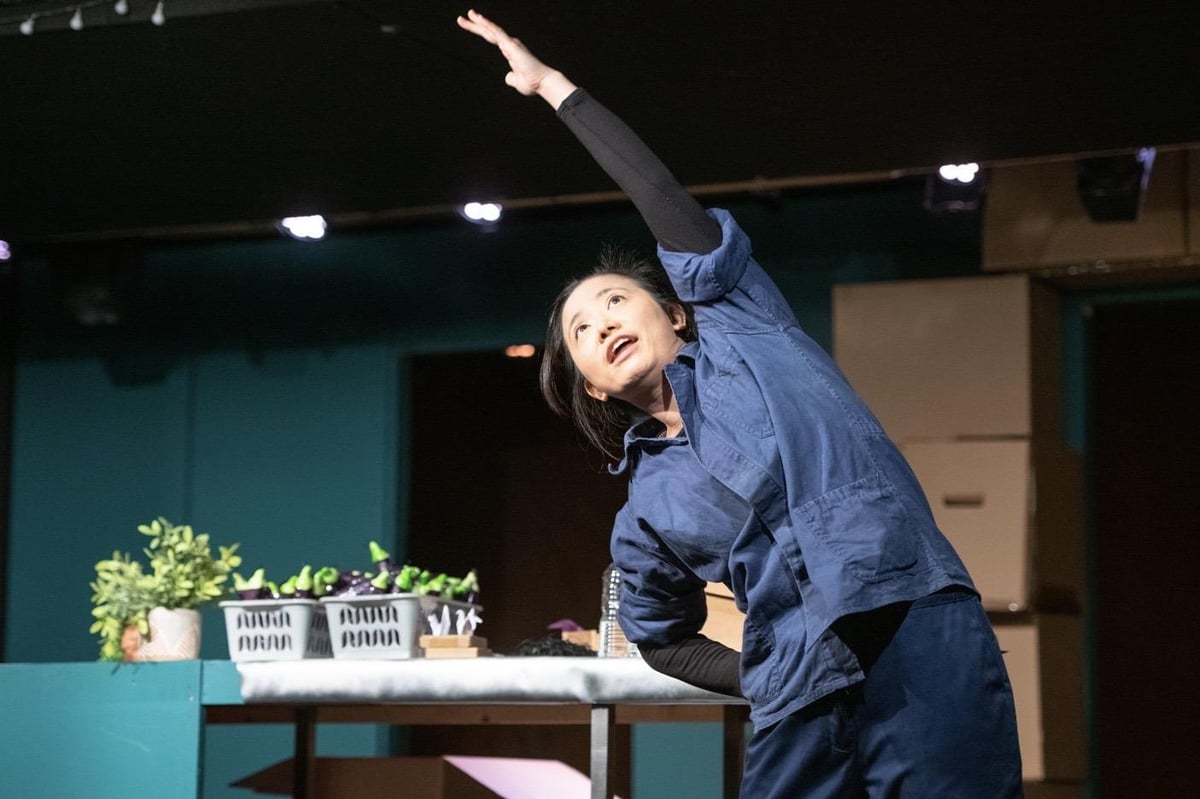
Luckily, we’re not disappointed. Morna Pearson’s script is sharp and liberally laced with dark humour. It tells the tale of Claire, a young woman still traumatised by the bullying she experienced at school. Her solution is to become a masked vigilante; after work each evening, she stalks the city’s streets, looking for people to help and reporting ‘criminals’ to the police.

As the lights go up, she is keeping an eye on her latest project: a man, bound and gagged, sits listening to her, growing more and more agitated. She’s called the police, she says; they’ll be here soon. But we quickly learn more about Fraser and how his past interconnects with Claire’s.

It’s a simple two-hander in a black box studio, with minimal props and a basic set (two desks, two  chairs, a scattering of stationery). But the simplicity absolutely suits the piece.  Both actors (Helen Mackay and Andy Clark) inhabit their characters convincingly. Their relationship – with all its tensions and revelations – is deliciously  uncomfortable, but there are plenty of laughs amid the heartache and despair.

It might be tough to get a ticket for this, but I do urge you to try. It’s a cracking little play – and the pies are pretty good too.

4.3 stars

Susan Singfield

Broth

Unknown-1 Unknown

Traverse, Edinburgh

The Traverse Theatre’s A Play, A Pie and A Pint is a fabulous idea: for a mere £12, punters can treat themselves to a warm lunch, a convivial drink, and – of course – some entertainment. It’s a clear attempt to thwart theatre’s (often unfair) elitist reputation; to render play-going a simple, unpretentious event.

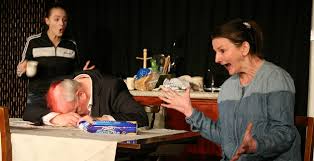
Let’s begin with the play. This one (the last in PPP’s Spring season), Broth by Tim Primrose, starts very well indeed: three women, a kitchen and a blood-soaked man. The man is Jimmy, a terrifying patriarch, husband, father and grandfather – respectively – to Mary, Sheena and Ally. It seems that Mary has, for once, fought back: Jimmy is unconscious, maybe even dead, and his blood is everywhere – all over the table cloth, the kettle, his clothes and his face. The three women unite as they try to work out what to do.

The premise is strong, and the characters convince. Their voices are appealingly authentic, the Scots dialect employed with knowing wit and a lightness of touch. The performances rarely falter, and the relationships are beautifully flawed. It’s funny too: that raw, black humour that epitomises domestic tragedies such as this. It’s hard to single out an individual actor for praise; this is a real ensemble piece, and they work together to create a fully-realised world.

Unfortunately, the plotting doesn’t seem as strong as the other elements: after a tight forty minutes, the story starts to waver, becoming repetitive and unfocused. It’s still enjoyable, but there’s no peril left, and the half-hinted at idea of the metaphysical (‘It hurt when you killed me’) is never really developed, so that it feels like a wasted concept – a strange red herring that adds nothing to the play.

Still, it’s well worth seeing, and would work well away from a traditional theatre setting too: this is a play that would translate effectively to a school hall or a community centre or a working men’s club. It’s a welcome slice of kitchen-sink – and at its best when its not trying to be anything else.

Oh – and the pie was lovely.

3.2 stars

Susan Singfield