Little Shop of Horrors

LSOHPosterWebsiteNoText

Royal Exchange Manchester

9/12/14

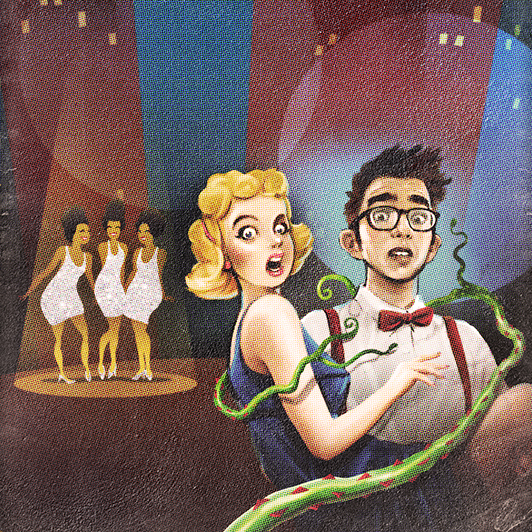
As guilty theatrical pleasures go, Little Shop of Horrors is right up there with the very best of them. I first saw Howard Ashman and Alan Menken’s musical in the early 80s at Manchester’s Library Theatre and I’ve been a devout fan ever since. To my mind, it’s the perfect blend of great songs, weird humour and 50s-style science fiction (and let’s face it, you don’t find many of those!) While it might seem an unusual choice for a Christmas Production – where’s the tinsel, where’s the saccharine? – the Royal Exchange are on to a winner with this superlative show and if the idea of a Christmas musical is to create joy, then this does so in spades. It had the audience securely wrapped in its tendrils from the opening bars onwards and never let go.

Seymour Krelborn (Gunnar Cauthery) is an orphan, working at Mushmik’s Florists on New York’s notorious Skid Row. Shy, much put-upon by the florist’s scheming owner, Mr Mushnik (Sevan Stephan) Seymour quietly carries a flame for his co-worker, Audrey (Kelly Price), but she, unfortunately, is going out with sadistic dentist, Orin Scrivello (Ako Mitchell) who treats her as his personal punchbag. As a business, Mushnik’s isn’t exactly flowering; indeed, it’s on the verge of withering up completely. That’s when Seymour reveals his secret project, a strange and unusual plant which he chanced upon (as you do) during a total eclipse of the sun. He’s named it Audrey Two, in honour of his beloved and he soon realises that the plant only thrives on one kind of food. Human blood. However, despite this inconvenience, the arrival of Audrey Two has an unexpected effect on business. Things at Mushnik’s are on the up and up. But, as with any Faustian pact, there is always a terrible price to be paid somewhere down the line…

LSOH is, of course, ubiquitous, beloved of school drama and amateur dramatic societies alike. There’s a reason for that. Most musicals have one or two memorable songs, but in this, every song is memorable. It’s so expertly put together that it’s hard to make a really bad version of it (little wonder that Ashman and Menken were soon snapped up by Disney.) The Royal Exchange have come up with a note-perfect production, cleverly staged and directed with brio by Derek Bond. The role of Audrey is pivotal and Kelly Price makes this her own, her superb voice ranging from delicate and plaintive in ‘Somewhere That’s Green,’ to strident and soaring in the show-stopping, ‘Suddenly Seymour.’ There’s wonderful support from the 10-strong role-swapping cast (at times, it seemed that there must be thrice that number.) The fact that the musical is played ‘in the round’ means that the various manifestations of Audrey Two require onstage puppeteers, but it matters not a jot – in fact, special mention must go to head puppeteer Nuno Silva, who as well as manipulating the (eerily convincing) ‘mean green mother from outer space’ also provides him with a voice that would do Levi Stubbs proud.

Of course, there has to be a big ending and trust me, this production has one. It would be unfair to reveal any more than that but suffice to say that the usually austere Royal Exchange crowd made their feelings known, leaping to their feet to deliver an enthusiastic standing ovation to a clearly delighted cast. The musical’s run has been extended by two weeks and I’m told there are still a few tickets available, so if you can get hold of some, I would urge you to do so. This is unadulterated theatrical joy and like most of the audience, I came out singing. Simply the best Christmas production involving a man-eating plant from outer space that I have ever witnessed. Miss it and weep.

5 stars

Philip Caveney
The Love Punch

MV5BMTcyNjAyOTMxMV5BMl5BanBnXkFtZTgwMTM5NDc3MTE@._V1_SX214_AL_

6/12/14

Sometimes in cinema, you encounter a bit of fluff. And other times, you encounter double fluff with extra fluff and i suppose this is the file to which you would safely consign The Love Punch. This light comedy featuring more mature actors than you’d normally expect to see in this kind of story was probably aimed at the same audience that The Exotic Marigold Hotel mined so effectively, but it’s nothing like as assured and it has to be said, it’s profoundly silly, to boot.

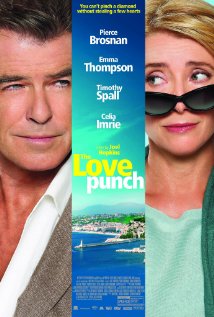
Pierce Brosnan plays Richard, an affable chap who works for a multi-national company (in what capacity, we’re never entirely sure.) He’s divorced from Kate (Emma Thompson) with whom he maintain an affable friendship (cynics will mutter that we’re already straying into the realms of the unbelievable.) When the company is purchased by a ruthless asset-stripper, the pension scheme into which Richard and most of his staff have bought, (Kate too, as it happens) is rendered entirely worthless. The head asset-stripper decamps to Paris in order to get married and publicly purchases a ten million dollar diamond necklace for his beloved, whereupon Richard and Kate hatch a plan to pop across the channel and nick it (as you do.) They also enlist the help of their plucky neighbours, Penelope and Timothy (Celia Imrie and Timothy Spall) and with a confidence that belies their humble origins, the foursome set off to take on the bad guys.

The problem is, that the characters manage to assay their chosen mission with such aplomb everything seems faintly unbelievable. And more fatally, there’s never any real sense of danger, no fear that something might go wrong for them, even when Richard and Kate find themselves in the back of a van perched on the edge of a cliff. Obviously, the veteran actors all make the most of this meagre material and the film’s enough to pass an undemanding hour or so, but nothing more than that. This is perfunctory film-making at best. You’ll have forgotten the details before the credits have finished rolling. And will Richard and Kate get back together? Who cares?

2.8 stars

Philip Caveney

The Crucible

Unknown

4/12/14

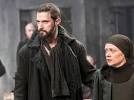
The Old Vic theatre company, as directed by Yoel Farber, takes on Arthur Miller’s near legendary play and arranges to have it beamed to a cinema screen near you. What’s not to like? Particularly when the interpretation is as compelling as this version, which stars Richard Armitage as a brooding, macho John Proctor and Anna Madely as his much put-upon wife, Elizabeth. The play of course, centres on the Salem witch trials, a device that Miller originally employed as an allegory about the McCarthy witch hunts of the 1950’s. Here the characters are compelled to talk in strong Lancastrian accents – possibly to evoke comparisons with the fate of the Pendle witches, or perhaps to point out that witch hunts can happen just about anywhere? I’m not entirely sure of the reasons behind the decision, but the fact is that it works brilliantly, making Miller’s ageless dialogue sing in a way I’ve never heard it before.

In a note perfect cast, it’s hard to single out highlights but Adrian Schiller’s take on the difficult role of beleaguered cleric, Reverend John Hale,  is a particular delight; and how amazing to see William Gaunt as the white-haired and irascible Giles Corey, evoking fond childhood memories of watching him play a young superhero spy in The Champions; what a decade-spanning career that has been! The standout scenes are the ones in which the ‘possessed’ girls, under the tutelage of Abigail Williams (Samantha Colley) crank the volume up to eleven. It’s powerful stuff this, and time has not dulled its cutting edge. Proctor’s final ‘confession’ is frankly the stuff of heartbreak and a demonstration of the way in which religion can be turned to support the forces of evil. A superb production and a rare opportunity to see the Old Vic in all its glory without paying for train tickets to London and a night in a hotel.

4.6 stars

Philip Caveney

Paddington

MV5BMjE1Mzc3NTk3NF5BMl5BanBnXkFtZTgwOTMzNTk4MjE@._V1_SY317_CR0,0,214,317_AL_

30/11/14

For what is ostensibly just another children’s movie, Paddington arrives surrounded by controversy. It has a PG certificate (mildly ridiculous when you think of the kind of big budget carnage that generally acquires a 12A) and others have complained that this new cinematic manifestation features a bear (voiced by Ben Whishaw) that is decidedly ursine and not at all like Michael Bond’s original teddy bear creation. At the end of the day all this matters little. The film is a real delight, cleverly put together and featuring plenty of content to appeal to the more mature viewer. In fact, it might be true to say that much of it will be wasted on really young viewers and there are a couple of scenes here (mostly those featuring evil taxidermist, Millicent (Nicole Kidman)) that may actually traumatise them.

The film begins with an origins story (something that Bond never bothered with) which shows a family of rare bears in ‘darkest Peru’ that are discovered by British explorer Montgomery Clyde (Tim Downie.) From him they learn to speak English and acquire a liking for marmalade. When he departs, he leaves them with an open invitation to visit him in London. But it takes a tragedy (an earthquake) to galvanise young Paddington into heading for England.  At Paddington station, he meets the Brown Family – Hugh Bonneville as an uptight insurance broker and Sally Hawkins as a much more free-thinking book illustrator. The Browns and their two children take Paddington in as a guest and much hilarity ensues…

And it does ensue, most convincingly. In fact, the script by Paul King, never puts a paw wrong, milking the slapstick sequences for enough laughs to keep a young audience entertained, whilst delving into more wistful pastures for older viewers. There’s a wonderfully inventive feel to the film – a host of Heath Robinson-esque inventions, some really appealing visual tricks (a repeated trope of the Brown’s home depicted as a doll’s house is a particular pleasure) and of course Ms Kidman’s character which introduces a touch of menace that the original story lacked. Despite so many doubts, the film makers have done credit to Michael Bond’s original creation (he himself has said that he can ‘sleep easy’ after viewing it) and have successfully ‘opened it up’ to create a satisfying family entertainment, that only the grumpiest viewer will find fault with. A well-deserved hit for the festive season.

4.6 stars

Philip Caveney

What We Do In The Shadows

MV5BMTQwMTg1NjQxM15BMl5BanBnXkFtZTgwMTU5NzEzMTE@._V1_SY317_CR130,0,214,317_AL_

26/11/14

You might have thought that as a genre, the vampire movie was pretty much played out. But then along comes a low budget gem like What We Do In The Shadows and you realise that there’s still a few drops of fresh blood left in the old corpse. Set in Wellington, New Zealand and brought to you by the team that gave the world, Flight Of The Conchords, this clever little moc-doc follows the lives of three flatmates who just happen to be vampires.

Vladislav (Jemain Clement), Deacon (Jonathan Brugh) and Viago (Taika Waititi), spend as much time arguing about the washing-up rota as they do harvesting the blood of virgins (a running gag exploits the impossibility of ever finding such a thing in Wellington.)  The vampire gang also keep Nosferatu lookalike Petyr in the cellar (he’s actually quite scary) and have occasional run-ins with a bunch of werewolves, led by alpha male Rhys Derby, who are going to extraordinary lengths to control their anger management issues. ‘We’re werewolves not swear wolves!’ But when new recruit, Nick (Cori Gonzalez Macuer) gets ‘turned’ and starts telling everyone he meets what has happened to him, including his perplexed best friend, Stu (Stuart Rutherford), things are bound to go a bit wrong…

This movie delights from the very first shot, as a hand comes groping out of a coffin to switch off a noisy alarm clock, and it maintains its momentum throughout, so that when you’re not laughing out loud, you’re sniggering and when you’re not sniggering, you’re smiling as you anticipate the next joke. Film buffs will enjoy the occasional movie reference and the three leads give likeable performances. At just 86 minutes, it doesn’t outstay its welcome and given that it’s ultimately a piece of throwaway fluff, it ticks all the boxes for a fun night out. Anyone looking for an antidote to Twilight – the series comes in for a fair bit of stick here – would be well advised to check this one out before it flaps away into the night.

4.1 stars

Philip Caveney

Tracks

MV5BOTkyMjIzOTQ4MV5BMl5BanBnXkFtZTgwOTkzMDM1MTE@._V1_SX214_AL_

23/11/14

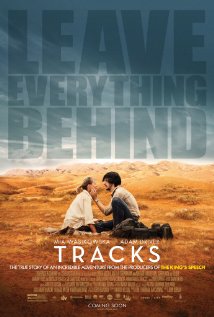
This film came and went at the cinema without making much of a splash. Catching up with it on DVD, I found myself wishing I’d managed to see it on the big screen, because its dazzling depictions of the Australian outback are one its strongest features and there are scenes here that are genuinely jaw dropping.

It’s based on the autobiography of Robyn Davidson, who as a teenager in the 1970’s, decided to walk across the Australian desert, (a trip of some 1,700 miles which took her nine months to complete), with just four camels and a dog for company. Quite why she chose to do so remains something of a mystery, as Davidson, as portrayed by Mia Wasikowska, remains something of an enigma throughout, a young woman who shuns the company of her peers and clearly possesses incredible courage and determination. Her only human company for the trip are encounters with aborigines and the occasional meeting along the route with photo journalist, Rick Smolan (Adam Driver). His interest in the trip obtained Davidson’s funding from National Geographic and he is required to provide photographic evidence, but apart from one furtive sexual encounter in the desert, he’s mostly treated with the general contempt she doles out to everyone else.

There’s not much of a story arc here. The film unfolds slowly, almost hypnotically, as Davidson walks further and further into the wilderness, suffering thirst, sun burn, hallucinations  and a series of flashbacks based around her troubled childhood. To its credit, it never palls and by the conclusion, you do feel as though you’ve been on the trip yourself. A series of photographs that accompany the credits show just how realistic the film is, with both Wasikowska and Driver looking uncannily like their real life counterparts.

4.2 stars

Philip Caveney

The Homesman

MV5BMTQ4NTkxOTEyMl5BMl5BanBnXkFtZTgwOTI1NzcwMzE@._V1_SY317_CR0,0,214,317_AL_

22/11/14

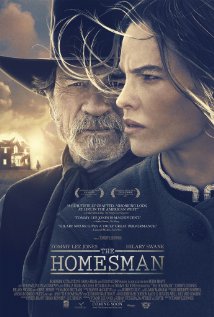
I’ve always had a bit of a soft spot for a decent western, but in this day and age they are rare beasts indeed and they seldom draw much attention from the media (the honourable exception being the Coen Brothers’ True Grit, a strong Oscar contender back in 2011.) Veteran actor Tommy Lee Jones has co-written and directed this downbeat story, based on a novel by Glendon Swarthout and while it’s occasionally rather bleak, there’s nonetheless plenty here to enjoy, even if the movie doesn’t really deserve the ‘feminist western’ tag it’s been er… saddled with. Yes, there’s a strong female central character, but there are also three women who have been driven mad by their inability to cope with life in the wilderness, whilst their respective husbands seem to be getting along just fine – so while it might be considered feminist in the sense that it centres on a woman’s story, it’s hardly a tale of empowerment.

Mary Bee Cuddy (Hilary Swank) is a spinster, hacking out a living for herself as a homesteader in the brutal environs of Nebraska territory at some unspecified point in the 1800s. Because she’s supposedly ‘as plain as a tin pail’ she’s struggling to find a husband for herself in an era where such a failure is considered shameful. This is one point where the film doesn’t really convince. Swank is terrific in the role, but there’s no way anyone could consider her plain, despite the costume department putting her in some of the ugliest costumes in cinematic history. Cuddy is a devout and determined woman and when she hears that three local wives have (for a variety of reasons) lost their minds, she undertakes the hazardous job of driving them back East to civilisation, a trip that will take five weeks or more. When she chances on George Briggs (Lee Jones) sitting on a horse with a rope around his neck, she offers to save his life if he will promise to help her with the (unspecified) task and he hastily agrees, little realising what he’s taking on. Lee Jones is a delight as the scowling, curmudgeonly George, a man with a shady past and a tendency to go off the rails when he’s had a few drinks. If the film is reminiscent of any other, it’s The African Queen and the pairing of Katherine Hepburn and Humphry Bogart.

As I said, there’s much to admire here. Great central performances, superb cameos from the likes of Meryl Streep and Hailee Steinfeld (though James Spaders’ turn as a duplicitous Irish hotel owner, features a very dodgy accent indeed) and a genuinely shocking surprise in the film’s final third. But a sequence where Briggs burns down Spader’s hotel (and everyone in it) seems somehow over the top, given the minor provocation he’s received. (Perhaps it was the accent?) At the end of the day, The Homesman is an entertaining film, that falls short of perfection in a few respects, but is still worth your consideration.

4.2 stars

Philip Caveney

The Monuments Men

MV5BMjMxMjk4NTM1M15BMl5BanBnXkFtZTgwNjg0MjQ3MDE@._V1_SX214_AL_

21/11/14

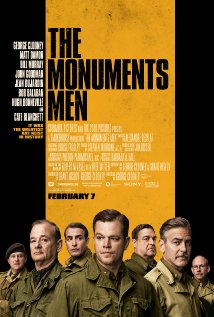
Based (rather loosely, according to all reports) on a true story, The Monuments Men is actually built around an intriguing premise, the exploits of a team of art historians, who in the final days of the 2nd World War, are charged with the task of rescuing some of the great works of art appropriated by the Nazis. Frank Stokes (George Clooney) and his veteran team undergo basic training (a piece of cake apparently) and then head off to a series of exotic locations in search of Hitler’s pilfered masterpieces, while the war rumbles on, rather half-heartedly, in the background.

Handsomely mounted and featuring a cast to die for –  Clooney, Matt Damon, Cate Blanchette, Bill Murray… (I could go on), the overwhelming mystery here is why the resulting movie is so fatally uninvolving. Perhaps the blame lies with the lukewarm script by Clooney and Grant Heslov, which barely touches upon the irony of men giving their lives to save art (one short scene in John Frankenheimer’s The Train (1964) says it more eloquently than this entire movie does) or perhaps it’s the fact that the story never manages to generate any real fire in its belly and becomes a series of ‘almost did’ events. Damon’s character for instance, almost has a romantic liaison with Blanchette’s art historian, but instead, does the decent thing and goes home. Hugh Bonneville as a disgraced historian, who given a second chance decides to be a hero, almost manages to raise a tear but, not quite. Likewise when Damon’s character stands on an unexploded land mine, an opportunity to generate some genuine suspense if ever there was one, the device turns out to be a dud.

Ultimately, this is a decent enough attempt at telling a story, yet there remains the distinct conviction that the story must surely have been grittier and more dynamic than this and consequently, The Monuments Men should be filed under L for  lost opportunities.

2.8 stars

Philip Caveney

The Drop

MV5BMTkyNjMzODUzNV5BMl5BanBnXkFtZTgwNjIxNDI1MTE@._V1_SX214_AL_

16/11/14

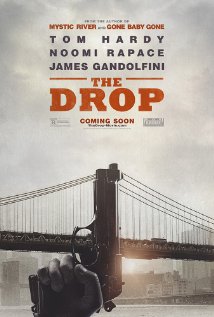
Based on a short story by Denis Lehane, The Drop is a slow-burning crime drama that revolves around a seedy bar in Brooklyn. Here, Bob Saginowski (Tom Hardy) serves the drinks, under the watchful eye of his cousin Marv (James Gandolphini in his final screen role.) The bar is a regular ‘drop’ for the Chechnyan gang lords who actually own the place, somewhere to deposit illicit money generated by drugs, prostitution, protection rackets… you name it. Over the years, Marv and Bob have learned that it’s safer to just go along with things, rather than bringing the wrath of their employers down on their heads. But when Bob chances upon a badly beaten puppy in a litter bin belonging to Nadia (Noomi Rapace) things get a little more complicated – she is the ex girlfriend of Eric Deeds (Matthias Schoenearts) the puppy’s owner and a self-professed killer. It soon becomes clear that Deeds wants his dog (and Nadia) back – he doesn’t seem to make much distinction between the two of them. Then, an armed robbery at the bar relieves the ‘owners’ of $5,000 and it’s inevitable that the Chechnyans are going to want their money back…

Hardy is terrific in the lead role. He seems to be channeling Brando’s memorable turn as boxer Terry Molloy in On The Waterfront, delivering a hugely appealing character that seems as helpless as he is vulnerable. But in Lehane’s world, still waters run deep and there are a couple of twists in the narrative that are sure to take you by surprise. Gandolphini bows out in style, depicting a man who is impelled towards crime, not because of greed but by personal circumstance. This movie shows a side of America that we rarely see on film, an unabashedly blue collar world of grime, debt and criminal corruption. Though it takes its time to reveal the whole story, there’s a constant simmering threat of violence hanging over everything that happens and the conclusion, when it finally arrives, is brutal and shattering.

While in no way a ‘big’ movie, The Drop has a confident, engrossing narrative and is yet another notch in Hardy’s chameleon-like ability to portray characters from all continents and all walks of life. And it serves as a fine farewell for James Gandolphini, to whom the film is respectfully dedicated.

3.9 stars

Philip Caveney

The Imitation Game

MV5BNDkwNTEyMzkzNl5BMl5BanBnXkFtZTgwNTAwNzk3MjE@._V1_SY317_CR0,0,214,317_AL_

15/11/14

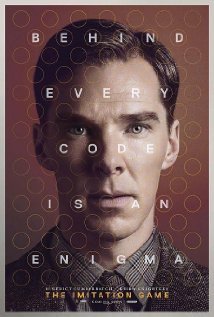
So many bottoms on seats at a Saturday afternoon showing for what is, ostensibly, an ‘art house’ movie can mainly be put down to  one thing – the Cumberbatch Effect. Seriously, this man could go on film and read his shopping lists and an eager audience would surely turn up to watch him do it. So what a good thing that The Imitation Game is a unqualified delight, a truly absorbing and compelling tale, expertly told, that, despite a running time of 114 minutes, doesn’t flag for a moment. And in the lead role of mathematician and all-round genius, Alan Turing, Cumberbatch is (it has to be said) quite extraordinary.

Of course it’s not the first time that this story has been attempted in the cinema. Some may remember Enigma (2001), where Dougray Scott was charged with playing a fictional version of Turing called Tom Jericho and where all the awkward stuff was summarily skipped. Perhaps unsurprisingly, it was a box office failure. This version of the story, however, stays closer to the facts and is all the better for it.

The film opens in 1951, where Manchester-based detective, Inspector Nock (Rory Kinnear) investigates a mysterious break in at Turing’s apartment and guesses that the man is hiding secrets, but he can have little idea of the web of intrigue that is going to be revealed as a result of his investigation. History of course has (eventually) recorded that Turing is the man who turned the tide of World War Two, by deciphering the German’s Enigma Code. In so doing, he shortened the course of the war by two years, saved millions of lives and (almost as a side-effect) pioneered the use of computers. But it’s also a tragic story. He was treated abominably for being a homosexual at a time when such a thing was illegal and suffered the almost unimaginable consequences.

Norwegian director Morten Tyldum ( Headhunters) handles the proceedings with great skill and he’s aided and abetted by a superb screenplay by Graham Moore, one that skips effortlessly back and forth in time without ever confusing the audience and manages to make the most complex material easily understandable. An ensemble cast delivers a host of note-perfect performances. Keira Knightly as Joan Clarke, Turing’s doomed would-be fiancé, is a particular delight and both Charles Dance and Mark Strong excel in their roles as, respectively, a crusty Commander and a secret service operative. Special mention should also be made for Alex Lawther, who plays Turing as a boy, a matching of two actors that, for once, absolutely convinces. But, even amidst such riches, this is undoubtedly Cumberbatch’s movie and he manages to nail Turing’s (clearly autistic) character absolutely, by turns funny, awkward and inspirational. The film’s conclusion is just heartbreaking and only the stoniest character will manage to resist tears.

The Imitation Game is filmmaking of the highest order and I cannot recommend it highly enough.

5 Stars

Philip Caveney