Stand Up For Sarah

Unknown Unknown-1 Unknown-3Unknown-4Unknown-2

The Comedy Store, Manchester

22/07/15

Smoke machines. What are they all about? The people who run the Comedy Store, Manchester own one and they’re not afraid to use it. It spills out a smelly fug of chemicals as we take our seats for tonight’s show and, as we’ve chosen positions near the front, the effect is a bit like sitting in the midst of an army of people smoking Capstan full strength. It creates no special atmosphere whatsoever. Unless you think a dodgy smell is something to savour. Just saying.

Tonight’s show if for a special cause – Thameside nurse, Sarah Swindells has terminal cancer and the entertainers are raising money to pay for some special treatment which is not available on the National Health. All the performers have donated their talents free of charge and there’s an encouraging turnout for a midweek event.

Thankfully, the smoke machine takes a break and out strolls our MC for the evening, veteran comedian Mick Ferry. He’s been around the block and knows just how to work an audience. An Australian visitor is singled out for some choice taunts (mostly the fact that he’s wearing more layers than everyone else) and a luckless tattooed  Mancunian builder called Billy is elected to start the applause but becomes the butt of several jokes, because he keeps wandering off to replenish his drinks. If an MC’s remit is to warm up the crowd, Ferry manages it expertly and introduces the first proper act of the evening.

Justin Moorhouse has also been around the block a bit. Some of his observations about his ‘other half’ feel a little over familiar. Lines like ‘you start off riding a bucking bronco, then find yourself straddling a leathery old cow,’ are clearly not intended to endear him to the feminists in the audience, but he settles into a better groove when talking about the ever-expanding universe. His impersonation of Stephen Hawking (sounding rather more like Kermit the frog) brings the house down.

Next up, Joe Lycett takes the stage, coming on like an oafish bellowing lager lout and my heart sinks; but it’s a clever bit of misdirection. He promptly starts talking in his ‘real’ voice, explaining that’s he’s just come from a stag party and that he’s simply been exhibiting learned behaviour. His camp, bitchy tone puts me in mind of the late, great Kenneth Williams, while his scattergun approach to comedy keeps taking us in unexpected directions. If there’s a prize for the most inventive comic of the evening, he wins it hands down and a joke about the chastity belts features in Mad Max: Fury Road is filthy but hilarious.

After a short break – and another unwelcome appearance by that bloody smoke machine – the event continues. The oddly named Penella Mellor wanders on and delivers a beautifully constructed routine on a somewhat controversial topic – children and how much she hates them. And, having established that there are several primary school teachers in the audience, she goes on to explain how they are responsible for making children even more annoying. Her deadpan serious expression as she delivers gems like; ‘ a margarine tub sprayed silver is not an acceptable birthday present – especially when I checked and there was a spa day on Groupon,’ has the audience (including the aforementioned teachers) in stitches.

Our final act of the evening is Daliso Chaponda. (I have to come clean at this point and admit that Daliso is a longstanding friend and he’s probably the main reason why we’re here tonight.) He hails from Malawi and much of his humour derives from canny observations where he compares the culture of his homeland to that of the UK. With Daliso, it’s all in the delivery. His distinctive voice and his range of accompanying animated expressions really help to sell the material. One lady sitting a few seats away from me is laughing so hysterically, I start to worry that she must be struggling to breathe. Daliso’s material is also somewhat ruder than I remember, but his charming air of innocence as he delivers the more risqué lines means that he can get away with murder. All in all, it’s a fine set which brings this memorable show to its conclusion.

An entertaining evening of laughter, all in aid of a really worthwhile cause. Whats not to like? (Apart from the smoke machine.)

4 stars

Philip Caveney

Hector and the Search For Happiness

MV5BNTAzNTIyNDYzNV5BMl5BanBnXkFtZTgwNDg1NjYyMjE@._V1_SX214_AL_

20/07/15

The presence of Simon Pegg in a movie can usually be relied upon as some kind of quality control, but as Hector and the Search For Happiness proves all too readily, this can’t always be relied upon. Based upon the best selling self-help book by Francis LeLord, the film tells the story of Hector (Pegg) a successful psychiatrist, happily living in London with his girlfriend Clara, (Rosamund Pike.) But talking to a succession of depressed people on a daily basis eventually has an inevitable effect on him and he undergoes a bit of a mid life crisis; whereupon he tells Clara that he needs to go off and ‘find himself’ or more accurately, to find the essence of pure happiness.

To this effect, he visits China (for no apparent reason other than Chinese people are considered to be quite happy.) He  goes to work with an old college friend in Africa, and, in the final segment, he visits Los Angeles and his old flame, Agnes (Toni Collette) now a happily married woman with two children and a third on the way. Pegg tries hard to instil the proceedings with some degree of interest but is ill served by a story that despite involving so much travel is clearly going nowhere. It’s all a bit vapid to be honest. There’s some nice scenery to enjoy along the way and several serious actors appear in minor roles – Stellan Skarsgard, Jean Reno and Christopher Plummer to name but three, but apart from a few fridge magnet bon mots, there really isn’t an awful lot to be gleaned from the story, which eventually collapses into a conclusion that is so mind-numbingly predictable, we could have saved Hector the price of all those air fares.

2 stars

Philip Caveney

Damson – Tasting Menu

Unknown-1 Unknown

Damson, Heaton Moor

17/07/15

We don’t generally review restaurants more than once and I’m more than aware that we have already waxed lyrical about Heaton Moor’s Damson a couple of times, but here’s the situation. We had something special to celebrate and it came to our attention that the restaurant now offered a six course tasting menu at £49.50 per head, served with matching wines for an extra £25. Now, I’ll grant you, this is probably not the kind off money you’d be looking to spend in an ordinary week, but for a special occasion, it’s something you might seriously consider trying. And let me ask you this. How can I not write about the best meal I have ever eaten? Seriously, it was that good. Please bear in mind, that though what I am about to describe may sound like a mountain of food, the portions are skilfully sized to ensure you can enjoy it all without feeling over faced – and the staff here are attentive, and will always accommodate you if you should ask for a short pause between courses.

We began with a tasting of seasonal soup, in this case, potato and fennel. Served in a cup, it was light, creamy and utterly delicious, just enough to whet the appetite and get those taste buds tingling for the delights to come. The soup was matched with a glass of citrusy Pino Grigiot. A very good start.

Next came grilled scallops, with compte cheese and cauliflower croquettes, accompanied by wild garlic, hazelnuts and truffle. Perfectly pitched and as light as air, this came with a glass of Circumstance Rosé, the slightly acidy tang of the wine a perfect companion for the moist and delicious scallop.

The third course was grilled fillet of plaice, served with Jersey royals, sprouting broccoli, sea aster, cockles, mussels and wild garlic pesto. If I had to choose a favourite dish from the selection, this might just take the edge. The plaice was melt-in-the mouth tender and delicately showcased by its delightful companions. The accompanying wine here was Picpoul de Pinet, a fruity zesty white. Sipped at beforehand it was okay, but tasted with the fish, it became exquisite and served as a perfect example of how intelligent wine-matching works.

Now for another standout: roasted rump of lamb with pea and mint mousseline, english asparagus, baby gem, whole grain mustard, morel mushrooms and salt and pepper sweetbreads. In a word, wow! The lamb was so tender and immersed in the mousseline, it tasted like heaven on a plate. Here, the chosen wine was a rich, robust red, Andes Peak Carmenere. Actually, on reflection, this course is neck-and-neck with the previous one as my favourite.

Time for a dessert? Oh yes, especially when it’s a chocolate cremeux with passion fruit and praline ice cream. Sometimes words fail to adequately describe just how delicious a sweet can be and this, I’m afraid, is one of those occasions. Suffice to say that the cremaux was… mmmmm. And the ice cream… aaah!

And so finally to cheese – or more accurately a generous tasting of three English and three French cheeses, served on a board and accompanied by bread, crackers, red grapes and a couple of sticks of celery. Even we struggled to finish this off completely but we were left comfortably full and ever so slightly sozzled, which is of course, the object of the exercise.

Make no mistake. This is a tasting menu to challenge the biggest names in the business and I can’t imagine how it might have been bettered. It’s customary in these reviews to focus on the meals shortcomings, but… try as I might, I couldn’t find one. I should perhaps point out that vegetarians needn’t feel left out of the game as a meat-free version is also available.

So, all of you out there who appreciate fine dining… the next time you have something special to celebrate, you know exactly where to go.

5 stars

Philip Caveney

Jurassic World

MV5BMTQ5MTE0MTk3Nl5BMl5BanBnXkFtZTgwMjczMzk2NTE@._V1_SX214_AL_ images-1 images

19/07/15

In 1993, the release of Jurassic Park was a genuine game-changer. It was the first time that CGI had been convincingly used to create realistic-looking dinosaurs (rendering the pioneering stop-motion work of people like Ray Harryhausen obsolete virtually overnight.) It was directed by Steven Speilberg at the height of his powers and even if Michael Crichton’s source novel was just anther riff on one of his earlier ideas (Westworld), it nonetheless deserved to be the blockbuster it undoubtedly was. There were a couple of underwhelming sequels in the 90s that never really capitalised on the central premise and now here we are, more than twenty years later and Jurassic World has recently become the biggest grossing film in history.

I put off watching this one for quite a while, mostly because I suspected I’d be disappointed. But after all the furore about its earnings, I had to give it a shot. What becomes clear from the outset is that despite the care and effort that has been lavished on making those dinosaurs look absolutely real, no such effort has been made with the screenplay, which features so many ridiculous ideas, it’s hard to know quite where to start.

It’s twenty two years after the events of the first film and Jurassic World on Isla Nublar is now a successful theme park. Quite how the operators obtained the licence when so many of its previous visitors had been eaten by the exhibits is never mentioned. Let’s face it, in terms of safety records, this place makes Alton Towers look like a vicarage tea party. In a sort of amped-up version of Sea World, tourists flock to watch the antics of giant dinosaurs. Well, yes, who wouldn’t? But there’s a problem. Apparently, audiences are growing tired of seeing ‘ordinary dinosaurs.’ Yeah, like that would happen. With this in mind, the island’s boffins have been doing a bit of gene splicing and have come up with a bigger, louder, toothier creature called Indominus Rex, which they’re keeping in a secret enclosure on the island. Apparently, it occurred to nobody that this might not be the most sensible move ever.

Now we’re introduced to Claire (Bryce Dallas Howard) who operates in some kind of PR capacity at the park. Just to give her something more to worry about, she’s tasked with looking after her two cuddlesome nephews who are on holiday, escaping from their parent’s marital problems. You can’t help wondering how Claire ever got her job; she’s frankly useless at PR and even more useless at looking after kids, making one bad decision after another, each one seemingly intended to plunge her luckless nephews deeper and deeper into the brown stuff. It gets worse. The woman doesn’t even have the sense to take off her high heels when running from a dinosaur! Luckily, she has hunky Owen (Chris Pratt) to fall back on. He’s an animal expert who is currently training three velociraptors to work as a team – sort of like a Dino Whisperer. But he’s somewhat hampered by the ambitions of Hoskins (Vincent D’Onofrio) a ruthless park contractor who is such a pantomime villain, he may as well have the word ‘dodgy’ tattooed on his forehead. Hoskins sees the velociraptors as potential military weapons and is clearly biding his time, waiting for the right moment to step in and take control of them.

That moment arrives when the Indominus Rex escapes (honestly, who saw that coming?) and starts gleefully chomping down on the tourists. It’s now up to Claire and Owen to sort out the situation…

Look, I get that Jurassic World is a family film, one that has to appeal to viewers from twelve to twelvety and I can’t really argue with the kind of success it’s enjoying, but honestly, how did this damp squib of a film become the runaway success of the year? There’s not an original idea in it, all the best sequences riffing on tropes that featured in the original. The lack of chemistry between Dallas Howard and Pratt is a real problem (a scene where they pause mid-carnage for a quick snog is rewarded with gales of laughter from the audience.) And perhaps most damning of all, there is no sense of peril here – remember the knockout scene in Jurassic Park where the kids were pursued into a kitchen by the velociraptors? You actually felt they could die in there. There’s nothing here to equal that – the two kids in this movie experience all kinds of dangers, but you never feel they’re being threatened by anything more lethal than a shedload of pixels. It’s by no means an awful film, it’s just a bit… meh.

I’m looking forward to the next one in the series, where Dallas Howard, Pratt and the entire board of Jurassic World end up in court, accused of causing the deaths of hundreds of innocent tourists. Now that would put a different spin on the franchise!

3.5 stars

Philip Caveney

Love and Mercy

MV5BMTk1MTkwMzU4Nl5BMl5BanBnXkFtZTgwNjY0MDE1NTE@._V1_SX214_AL_ Unknown

11/07/15

Music biopics can be perilously tricky affairs. Far too often, they come across merely as karaoke reruns of the original events and only a very few ever succeed (or even bother) to try and probe beneath the shiny surface. Happily, Love and Mercy belongs in the latter category. Bill Pohlad’s film offers two Brian Wilsons for the price of one.

In the 1960’s-set first strand, a bulked up Paul Dano does an uncanny job of portraying pop music’s most celebrated tortured genius, complete with the chubby bewildered features and the pudding basin haircut. The recreations of the band’s early concerts and TV appearances are uncannily accurate. After the Beachboys’ initial successes with their surfing songs, Brian suffers a debilitating panic attack on an airplane, and elects to stay in the studio and create music while the rest of the band head off to Japan on tour.

In the second, 1990’s-set strand, we meet another Brian Wilson, post nervous breakdown and in the clutches of bullying psychiatrist, Eugene Landy (Paul Giametti in a fright wig, looking strangely like Melvyn Bragg.) In these sequences, Brian is played by John Cusack, who is of course a very accomplished actor – but he  looks nothing like Wilson, or for that matter, Dano. The conclusion has to be that the director was trying to make a statement about his subject’s schizophrenic nature but I couldn’t help feeling that he’d have done better to stick with Dano throughout.

Once the two time frames are established the film cuts effortlessly back and forth, between two major stories. In the 60’s, Brian’s mounting confusion alienates him from his fellow band members and family – but here the film manages to nail the creative process of recording better than most other films I’ve seen. It’s wonderful to watch as a pop masterpiece like God Only Knows is assembled virtually note by note, before finally blossoming into the sublime finished product we know and love.

In the second storyline, a heavily sedated Brian, always accompanied by Landy and his henchmen, wanders into a car showroom to purchase a Cadillac and makes a connection with Melinda Ledbetter (Elizabeth Banks.) The two of them start to date and Melinda quickly begins to realise that Brian is under Landy’s control, every bit as much as he suffered under the tyranny of his abusive father, Murray. But how can she extricate him from his self-inflicted woes? And does Brian even want to be rescued?

This is by no means a perfect film, but it’s intriguing and compelling enough to keep you hooked to the end and there’s some fabulous sounds to enjoy along the way. At the film’s conclusion we get the added bonus of the real Brian Wilson performing the wistful song from which the film takes its title. You don’t have to be a Beachboys fan, but it certainly helps.

4.2 stars

Philip Caveney
The Skriker

Unknown IMG_1428

4/07/15

Royal Exchange Theatre/MIF15, Manchester

The Skriker is a screaming, hurtling explosion of a play, quite unlike anything I have seen staged at the Royal Exchange before.

I’ve never seen the Exchange like this before either; it’s been transformed to accommodate this play. From the moment we enter the beautiful old building, we know something’s different: there’s an avenue of trees casting a dappled green light, and the glass theatre-pod in the middle of the Great Hall is shrouded in black.

We’re in the first gallery; as we settle into our seats and peer down into the gloom, it takes us a while to notice that all 400 of the stage-level seats have been removed, making way for a series of rough wooden tables, laid out like the spokes of a broken wheel. It feels, somehow, like being inside a tree.

Although our seats give a us a clear overview of the performance space, the intention, clearly, is an immersive experience: there are chairs at most of the tables, and about sixty audience members thus become part of the set. They are, then, more than witnesses: they are complicit and involved. If they chose to, they could intervene…

I’ve long been a fan of Caryl Churchill’s work; she asks difficult questions without obvious answers, and seems to revel in the awkwardness of rejecting clear-cut rhetoric. Yes, she’s political, but she’s not interested in soundbites or tub-thumping. The world is more complex than that, and so are our reactions to it. This refusal to tread a familiar path is reflected in the theatrical form. Churchill’s plays do not conform to any accepted norms – and they’re not always easy to watch.

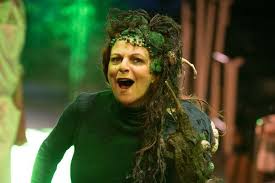
The Skriker, certainly, is a challenging piece. The eponymous role, played here with great relish and enormous talent by Maxine Peake, is a kind of ancient fairy, a damaged, polluted, angry spirit, raging at humans for destroying the earth. Josie and Lily, two troubled teenagers, become the focus of the Skriker’s fury, forced to confront the calamity that climate change has wrought.

The banquet scene, set down in Fairyland, is central to the play and it’s here that the themes are crystallised. Josie, propelled into this underworld by greed and curiosity, participates enthusiastically in the feast, even when an anguished woman reveals that the glistening platters are actually laden with parts of her body: ‘That’s my head!’ It makes no difference; the revellers continue to gorge, even as they witness her destruction, their dancing becoming ever wilder and more reckless. The woman implores Josie not to drink the wine, making clear that, if she does, she too will be destroyed. But no one heeds the warning. It’s not the subtlest of metaphors and – in a play this complicated – that’s no bad thing. Here, it seems, is a central premise we can use to inform our understanding of other, more opaque ideas; here, we have a clear allegory for mankind’s wanton destruction of the planet, continuing, as we do, to drive, fly, hunt rare animals, overfish the seas, cut down rain forests and frack our blighted earth

It’s an important play: frightening and angry and funny and weird. Maxine Peake is perfectly cast as the shape-shifting fairy; she inhabits each persona so completely, it’s a wonder to behold. It doesn’t matter, really, that she overshadows the younger, less experienced actors playing Josie and Lily (Laura Elsworthy and Juma Shorkah respectively), as this was always meant to be the Skriker’s play. The ensemble of wraiths and spirits embody freakish malevolence and anxiety, and the choir cements the savage beauty of the other-worldly air.

A full five stars for this one, then, but if you go to watch it, be prepared: this is not light-hearted entertainment. It’s hard work – but it’s worth it.

5 stars

Susan Singfield

Amy

P18290.Juliette.img2272007 MTV Movie Awards - Show

4/07/15 

Home, Manchester

We all think we know the story of Amy Winehouse – a staggeringly gifted teenage singer/songwriter makes waves on the jazz scene, rises meteorically after the recording of breakthrough album Back To Black, then plunges into a tragic downward spiral fuelled by addiction to drugs and alcohol. And yes, that’s pretty much what we get in Amy. But director Asif Kapadia allows us to see her story through fresh eyes, to fully appreciate what a tragic waste of talent was here. Kapadia’s approach (as with his much acclaimed motor racing doc, Senna) is to painstakingly assemble an intricate collage of material from every stage of his subject’s life, incorporating interviews with all the major players in her story, from those who evidently loved and cherished her to those who fed shamelessly on her rising star and hitched it to their own particular wagon. It’s a labour of love that took three years to assemble.

It’s all here, from grainy home movie footage of a young Amy, already displaying exceptional talent as she performs Happy Birthday for her best friend, a lithe fresh-faced Amy performing brilliantly in the intimate setting of a jazz club, to the tragic scene of her stumbling onstage at a massive outdoor festival, drunk and unwilling to perform a single note. Through the course of the film, heroes and villains inevitably emerge. Original manager Nick Shymansky clearly worshipped the ground she walked on, but had to step aside when she demanded that he leave his employer, Simon Fuller, to concentrate on her. Bessie mate, Juliette Ashby was clearly always there to fight her corner, no matter what she had done. Her husband Blake Fielder-Civil professes he only had her best interests at heart, but with every word reveals himself as an opportunistic freeloader – and the less said about Amy’s father, Mitch, the better. A scene where he brings a camera crew to the remote holiday island she has fled to, (mostly because of unwelcome press intrusion), is frankly one of the film’s most shocking moments. Mitch has loudly complained that the documentary has ‘stitched him up’ but the truth is right up there on the screen, for all to see. And then, of course, there’s the paparazzi. Scenes of Amy fleeing from a pack of rabid cameramen amidst a blizzard of flash photography, make the hackles rise and almost instil a sense of shame that we belong to the same species as these creatures. How can they live with themselves? Didn’t they realise they were hounding her to her own destruction?

A word about the venue. Home has taken over from the Cornerhouse as Manchester’s home for independent cinema (as well as boasting two theatres, several bars, exhibition space and a cafe) and what a fine job it’s doing! It has five state-of-the-art screens with prices far more reasonable than the multiplexes and the friendliest staff I’ve ever encountered. This special showing took place in the spacious setting of Cinema One (air conditioned – a blessing on one of the hottest days of the year) and was followed by a Q and A with co-producer George Pank. Annoyingly, a pressing engagement elsewhere precluded us from actually staying on for this, but it’s hard to know what it might have added. Any questions we may have had about the career of Amy Winehouse are answered comprehensively in this brilliant, hard-hitting and ultimately heartbreaking documentary. Don’t you dare miss it.

5 stars

Philip Caveney

London Road

Unknown-2Unknown-1

28/06/15

London Road is an extraordinary film. Although clearly indebted to its theatrical roots, this is a truly cinematic work – and quite unlike anything I have seen before.

Centred around the infamous Ipswich murders of 2006, when five prostitutes were killed over the course of a few months, London Road tells the stories of the local residents: their discomfort at their street becoming part of the red-light district; their horror at the murders; their reactions to the revelation that the killer was Steven Wright, a neighbour of theirs. Through verbatim accounts, drawn from interviews conducted with the real life residents of the street , we learn of a community torn apart – and then, ultimately, uniting to reclaim its heart.

And it’s a musical.

Actually, it’s not really a musical, as such, but it is mostly sung – and the effect is stunning. The dialogue is faithfully reproduced, with every ‘um’ and ‘ah’ included; every hesitation, interruption, exclamation rigorously documented in the lines. The language dictates the rhythms, and the score stretches and amplifies the natural cadences of speech, creating a kind of hyper-realism that is utterly compelling. Some lines are repeated to create a kind of chorus or refrain, thus reinforcing some of the more prevalent ideas (‘He could be one of us…’).

There’s no driving narrative here, no one character whose tale defines the story. It’s exactly what you might imagine a series of interviews to amount to: a collage of disparate accounts. And yet, this collage serves to create a very clear whole picture. There are conflicting emotions, as the prostitutes move away from the area to somewhere where they feel safer, and the residents begin to take a pride in where they live again. ‘I know it’s awful,’ says Julie (Olivia Colman), as she looks around the resurgent neighbourhood, ‘but I’d like to shake his hand.’ It’s an uncomfortable truth, made more so by the brooding presence of Vicky (Kate Fleetwood) walking through the street, untouched and unobserved, clutching a balloon like a hopeful child. No one can condone the murder of these troubled women, but none of us would like them working where we live.

There are some big names attached to this film: Tom Hardy makes a fleeting appearance as a taxi driver obsessed with serial killers. But it doesn’t feel right to single anyone out: this is an ensemble performance, with all parts contributing fully to the whole.

It’s a game-changer, I think.

Go see it.

5 stars

Susan Singfield

Patrick MacNee: An Appreciation

Unknown Unknown-1

26/06/15

It’s one of my earliest memories from childhood; sitting with my parents in the little living room of whichever RAF home we were in then, waiting for our favourite programme to start. A little flickering screen in the corner. And then that music, Laurie Johnson’s strident theme, the brass section blasting out four notes which seemed to quite literally trumpet the programme’s title. The Avengers! The Avengeeeeers! Then the black and white credit sequence, cutting edge cool in the 1960s. And finally the episode itself, a delicious slice of surreal cold-war spy fluff as John Steed and Emma Peel took on the villains in their own spectacular style. These days of course, the same title conjures up images of brawny superheroes clad in latex and blessed with underwhelming ‘special’ powers, but in those far off times, it meant something quite different.

There had of course been an earlier series with Honor Blackman as Cathy Gale, but I don’t really remember that as clearly. The second series is imprinted so perfectly in my memory, that even now, more than fifty years later, I can recall entire scenes, even lines of the witty dialogue. I know that I was absolutely besotted with Diana Rigg who seemed to me the very epitome of feminine mystique – lithe, pretty, intelligent and powerful enough to fell a villain with one perfectly timed karate chop (even if, in long shot, you could sometimes see that she had been cunningly substituted by a burly bloke clad in an ill-fitting leather jumpsuit.) And of course, I saw all the later incarnations. I never really warmed to Linda Thorson as Tara King, but I did like Joanna Lumley as Purdey in The New Avengers, almost as much as I despised Gareth Hunt as the perpetually smirking ‘bit-of-rough’ Mike Gambit.

Through it all, Patrick MacNee’s John Steed remained unchanged, suave, stylish, outfitted in Saville Row’s finest suiting, his trademark bowler hat in place and his deadly weapon (an umbrella) poised ready to take out the toughest opponent. (Apparently, the umbrella was McNee’s idea. He’d been a naval officer in the war and had emerged from the experience with an intense dislike of violence of any kind, so much so, that he steadfastly refused to be pictured with a gun. ‘I’ll carry an umbrella,’ he suggested at an early script meeting and everyone went along with that. It was an inspired idea.)

Of course, the problem with a successful show like The Avengers was the danger that it might typecast the stars. Rigg had no problem escaping its clutches, becoming a major star of the theatre, but McNee didn’t manage much else but some forgettable television and an occasional film cameo; a shady psychiatrist in Joe Dante’s The Howling, a delightful turn as Sir Dennis Eaton-Hogg in This Is Spinal Tap, even a decent showing in a Bond film, opposite Roger Moore in A View To A Kill. But John Steed would remain his signature role, as much a fantasy image perhaps as those created by his female co-stars. In real life, you suspected, you’d actually hate someone like John Steed. With his Gentlemen’s Clubs, his impeccable manners and his old style courtesy, he was, even in the swinging 60s, something of a dinosaur – but MacNee’s charming manner made you believe that underneath it all he was a really nice chap, that should you bump into him in real life, he’d be every bit as charming as his fictional counterpart.

It’s always a jolt when you read that one of your earliest heroes has died. MacNee was 93 years of age, which by any standards is (as Steed himself might have observed) a jolly good innings. Back in the day, we tended to sneer at television shows. It’s only recently that TV has had something of a renaissance and we wax euphoric about the likes of Breaking Bad and True Detective. But The Avengers was an example of television at its most groundbreaking. Re-watching that opening credit sequence on YouTube still gives me the same thrill I had when I was a little boy. And if Patrick MacNee will always be John Steed in the nation’s memory, well that’s no bad thing. Because in his own way, he was one of the greats.

Philip Caveney

Mr Holmes

MV5BMTg5MjE0Njk0MF5BMl5BanBnXkFtZTgwNTgwMjQ4NTE@._V1_SX214_AL_

24/06/15

There can be few fictional characters who have enjoyed as many interpretations as Sherlock Holmes – we’ve already seen him as a young man, so it was perhaps inevitable that somebody would take him in tother direction. Here, he’s played by Ian McKellan as a 93 year old, convincingly aged in state-of-the-art latex. It’s 1947 and he’s long retired to a village in Sussex, where he’s looked after by housekeeper, Mrs Munro (Laura Linney making a decent fist of an English accent). Her young son, Roger (Milo Parker) clearly idolises the old man and has a bit of an interest in detection himself. Directed by Bill Condon, the film is adapted from the short story A Short Trick of the Mind and has Holmes struggling with the onset of dementia, whilst desperately trying to piece together and write about the particulars of his last case, the one that made him retire from the detection game. In this parallel universe, Sir Arthur Conan Doyle never existed. The Holmes stories really were written by Dr Watson (who we only glimpse in flashback) and Holmes is clearly a lost soul without his old partner to back him up.

This is a slight though pleasing story, dominated by a perfectly nuanced performance from McKellan (though it has to be said, there’s more than a passing resembance to his turn as James Whale in Gods and Monsters, which Condon also directed.) He’s ably supported by the other members of the cast, particularly young Milo Parker and by Hattie Morahan as the young woman who’s tragic story causes Holmes to ditch sleuthing and take up beekeeping instead. If the tale occasionally strays into the realms of sentimentality, it’s of no great consequence; this is diverting enough but the earth doesn’t move and it makes you think that in the end, Holmes tales are a bit like buses – there’ll be another one along soon.

3.8 stars

Philip Caveney