The Broons: Maggie’s Wedding

01/11/16

The King’s Theatre, Edinburgh

The Broons are a much-loved Scottish institution. It’s hard to believe that, as a popular comic strip,  they have featured in The Sunday Post since 1936 – which makes this theatrical celebration an 80th anniversary event. Written by Rob Drummond and directed by Andrew Panton, it was originally commissioned and developed by Sell A Door Theatre Company and as you might expect, given the subject, there’s a robust cartoonish feel to the show. Maw and Paw Broon (Joyce Falconer and Paul Riley) preside over their working class family in the fictional town of Auchentogle, with real pride and plenty of love. As the title might suggest, the events of the play lead up to the marriage of Maggie (Kim Allan) to the (unseen) Cameron. But Maw doesn’t much like the idea of her little princess leaving the family home – and when she finds out that other members of the family are also planning to move away, she quickly takes steps to ensure that such a thing will never happen…

I’ll be the first to admit that having only recently moved to Scotland, I really don’t have much of a backstory with these characters and consequently, many of the ‘in’ jokes (which elicited roars of appreciative laughter from tonight’s audience) went completely over my head; but there was still much to enjoy here, particularly Laura Szalecki’s portrayal of the man-hungry Daphne and Duncan Brown as the monumentally thick Englishman, Jock Badge, who thinks the term ‘4 to 6 years’ on a jigsaw puzzle is an indication of how long it might take him to put it together.

As events scamper joyfully along,  the actors slip effortlessly from character to character and, since this is a play with music, just about everyone bashes out a tune on some kind of musical instrument at various points in the proceedings. The overall effect is charming and though I don’t really agree with the play’s ultimate message – that it’s better to stay with what you know than to seek out new experiences – it certainly chimes with a story that has remained totally unchanged for so very long. And who could fail to enjoy the rousing singalong at the conclusion that pays tribute to a whole host of Scottish talent from The Waterboys to The Bay City Rollers?

If you’re a fan of these fictional folk, you certainly won’t want to miss this; and, if you’re merely curious as to what the fuss is all about, you’ll still be in for an entertaining night.

4 stars

Philip Caveney

Train to Busan

31/10/16

Zombie movies are a bit like buses: you wait for what seems like ages for a decent one and then two crackers come along at pretty much the same time. No sooner are we over extolling the genre-busting virtues of The Girl With All The Gifts, than Train to Busan comes thundering down the track. We’ve all heard of Snakes on a Plane, but Zombies on a train? One look at the trailer was enough to convince us that this should be our Halloween movie of choice.

South Korean writer/director Sang-ho Yeon is in the driver’s seat of this adrenalin-fuelled delight, which eschews the slow-witted lumbering zombies of George Romero and substitutes them for some hot-footed, rabid berserkers that would leave the crowd from 28 Days Later standing on the platform. They are everywhere in this film – tumbling through glass doors, raining down out of the sky and, at one point, forming an inhuman chain clinging tenaciously onto the back of a locomotive. It’s fast, it’s frantic and, above all, it’s fun to watch.

Our hero is Seok Woo (Yoo Gong) a wealthy fund manager who, from the very outset, presents as a man who looks after his own best interests. When he is obliged to (very reluctantly) escort his young daughter, Soo-an (the adorable Soo-an Kim) to Busan to rendezvous with her mother – from whom Seok Woo is separated – he expects nothing more than an uneventful journey. But there’s a barely glimpsed ‘incident’ at the station where the train starts from and an injured woman stumbles aboard and locks herself in the toilet. When she emerges, she is one of the undead and she quickly sets about biting everyone she encounters. This is a disease that travels like wildfire and, within minutes, the train is full of unwelcome travellers.  Seok Woo and a band of fellow passengers will have to use every trick they can think of if they hope to survive to the end of the line…

Like most zombie movies, this is more than it might at first appear. The train is a great big metaphor for humanity and it quickly becomes apparent that the most dastardly travellers on board are the ones who care only about themselves. Chief among them is Yong-Suk (Eui-sung Kim) a man who thinks nothing of flinging a helpless teenage girl to the ravening hordes in order to cause a diversion to escape their clutches. Time and again, the nice people (the socialists) are seen sacrificing themselves in order to help others. The question is, which side will Seok Woo end up on?

Don’t worry – this doesn’t feel anything like a lecture. While you could argue that Train to Busan isn’t particularly scary, it makes up for that shortfall by ramping events up to almost unbearable levels of suspense, utilising some incredible set pieces along the way. This is quite simply a cinematic thrill ride, one that grips like a vice all the way to its (heartbreaking) conclusion.

Don’t miss out. Book your ticket to ride before this one pulls out of the platform and disappears over the horizon.

4.8 stars

Philip Caveney


Jumpy

29/10/16

Lyceum Theatre, Edinburgh

Jumpy is a cracker of a show, at once funny and appalling, familiar and uncomfortable. It’s an episodic tale, a series of vignettes that combine to give a frank and detailed examination of a middle-class family life.

Primarily, this is the tale of Hilary and Tilly, a  mother and daughter struggling with their relationship. Hilary (Pauline Knowles) has just turned fifty, her marriage is stale and she’s about to lose her job. She’s in the habit of pouring a glass of wine as soon as she sets foot inside her home, and she’s frustrated by the way her daughter dismisses her. Tilly (Molly Vevers) is a truculent young woman, happy when she’s with her friends and angry with Hilary. Her anger isn’t specific – Hilary has done nothing wrong – it’s more of a howl against the world, where a fifteen-year-old can’t quite be free. She’s tugging at the apron strings, but of course still needs her mum.

Make no mistake, at its core this is a comedy, and the teenage angst is played for laughs. The way Vevers tuts and scowls and contorts her body stays just the right side of parody: this is adolescence writ large – played for humour but with enough realism to keep us all on side. And while Knowles’ portrayal of Hilary is touchingly vulnerable – she really seems to ache with the difficulty of it all – it’s still funny, in a wry, sardonic way.

There’s a great supporting cast too, most notably Gail Watson as Frances, whose burlesque routine is as impressive as it is hilarious, and Richard Conlon as Roland, the spineless cad who can’t see beyond his own shallow needs. And Stephen McCole’s Mark makes an interesting counterpoint, straight man to the comedians, the solid centre at the heart of Hilary’s life.

It’s brutal in places; it’ll make you question and evaluate the relationships you have with other people, the world, with politics (and wine). But that’s all to the good. April De Angelis’s play is definitely one to see. So get yourself a ticket, and catch it while you can.

4.6 stars

Susan Singfield


The Gorbals Vampire

untitled-design-4-jpg-gallery

29/10/16

Citizens’ Theatre, Glasgow

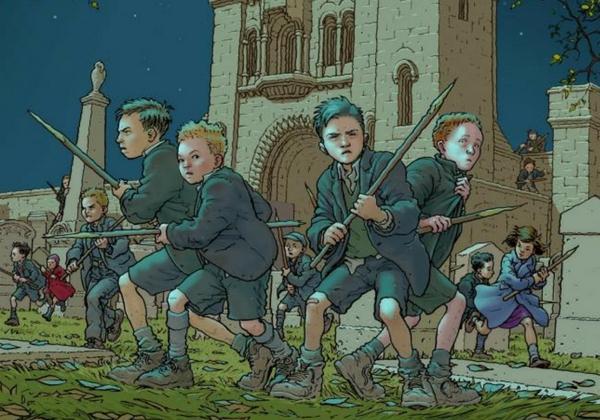
We’re often told that truth is stranger than fiction and the story of the Gorbals Vampire definitely falls into that category. It happened in September 1954. Police were summoned to attend a strange gathering in the Southern Necropolis, Glasgow’s huge cemetery, late one evening. They found bands of children, armed with improvised weapons, searching for ‘the man with metal teeth,’ a creature they claimed had already killed and devoured several children from a local school.

It appears to be a case of mass hysteria, inspired (so some people claimed at the time) by Imported American comics like Tales From the Crypt, which even resulted in them being banned for several years. Whatever the causes, the Citizens Theatre has chosen to commemorate the story with a community project including a play, specially written by Johnny McKnight, an exhibition and a short story competition (on which I was delighted to be one of the judges).

The play is an incredibly ambitious undertaking, utilising over fifty non-professional actors, original music and highly effective lighting effects. It has adult actors portraying children and perfectly illustrates the way that rumours can originate, spread and become exaggerated in the manner of ‘Chinese Whispers.’ This is fabulous stuff, deftly choreographed and often hilarious in its depictions of everyday Glasgow life – there are several performances here that belie the amateur status of the actors. Appropriately as we move towards Halloween, it’s also wonderfully atmospheric and delightfully sinister. At any rate it went down a storm with the packed audience.

It’s only showing for a couple of days, which is a pity as this is one community production that would surely appeal to a wider audience.

4 stars

Philip Caveney

The Full Monty

24/10/16

King’s Theatre, Edinburgh

The Full Monty has been through several incarnations: it started life as a Sheffield-based film starring Robert Carlyle, then evolved into an Americanised musical, this time set in Buffalo, New York. And now it’s back in a third guise that’s much closer to the original concept, with a stage adaptation currently touring the UK, and coming soon to a theatre near you.

The cast features a number of faces punters will recognise as regulars from Hollyoaks, Brookside, Coronation Street and Eastenders, and there’s a decidedly soapy feel to this slice-of-life tale, with its narrative of a working class deprived of work, of disenfranchised men searching for ways to retain a sense of identity and pride, while their families are torn apart by poverty and despair. It’s against this backdrop that Gaz (Gary Lucy) conceives of ‘Bums of Steel’ – when he finds out how much the Chippendales earn, he convinces his friends to forget the misery of Job Club and join him in a new venture, as members of a male strip-group. The money, he hopes, will allow him to pay the child support he owes, and ensure he retains access to his son, Nathan (played tonight by the aptly named Monty Poole).

At its heart, this is a story about socialism: shafted by Thatcher and her politics of individualism, Gary and his friends have a more co-operative approach to life. They unite, help each other, form a team, and show that together they can escape the trap into which they’ve been dropped. Although very firmly set in the 1980s, it speaks volumes about the present day, and the focus on unemployment and a punitive benefits system have never been more relevant.

Despite its serious political stance, it’s a lively, energetic production, with lots of laugh-out-loud moments and some exemplary performances, most notably from Andrew Dunn (as Gerald) and Louis Emerick (as Horse). The humour is broad and exaggerated, which certainly engages the audience and elicits a loud, approving response – but it does mean that some of the pathos is lost at times. Overall though, this is a strong production, and well-worth seeing. The second act, in particular, really hits the mark, and the finale – wink, wink – is definitely worth the wait.

4 stars

Susan Singfield

David Bann – Vegetarian Restaurant

images.jpegIMG_2258.JPG

St Mary’s Street, Edinburgh

23/10/16

David Bann’s reputation for vegetarian fine dining is well known around Edinburgh, offering something more refined than the usual salad and quiche cafe experience. The deceptively spacious interior is clean and contemporary and there’s a relaxed atmosphere – yet there’s something decidedly old-school about the place. There’s no wi-fi on the premises and a quick internet search reveals that it doesn’t seem to have a Twitter handle, which – in this day and age – seems almost perverse.

The staff are friendly and accommodating however, and we’re soon enjoying some decent quality wine.  For my starter, I opt for a ravioli parcel with walnut on basil tomato soup. This is nicely cooked and presented,  the pasta parcel satisfyingly al dente, packed with a delicious walnut and spinach filling and floating serenely in a bowl of smooth herb-accented soup. Susan had the salad of fennel, beetroot, raspberry and poached egg. And again, this was handsomely presented, and deliciously fresh, the sharp tang of the raspberry adding a welcome zing – although the poached egg was disappointingly firm. In this kind of dish, you really want to see the yolk spilling over the salad. A minor niggle, perhaps, but an important one.

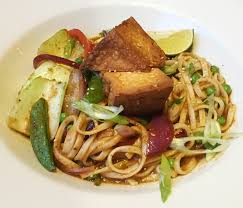
For my main course, I chose a bowl of stir fried vegetables with udon noodles and smoked tofu. Indeed, this was a popular choice with our party (four out of six of us chose it). It was nicely spiced with ginger and soy, while the smoked tofu was particularly tasty. It’s hard to get tofu just right and this was one of the best attempts I’ve tried. Susan’s baked crepe with spinach, mushroom and smoked cheese was very satisfying too, as well as being the most hearty of all the dishes we ordered, arriving, as it did, with a substantial portion of Mediterranean roasted vegetables.

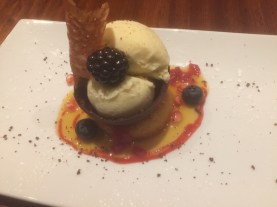
We were pretty full at this point, so Susan declined a pudding, but I felt I had to sample the ginger and lime ice cream with orange cake –  mostly because it sounded really tempting – and I have to say it was every bit as delicious as it sounded, the orange cake succulently moist, the subtly flavoured ice cream good enough to die for, and packed into a dark chocolate nest. In many ways this was the most assured element of the meal. Across the table, I could see a hot peach and raspberry tart (freshly cooked to order in fifteen minutes), which also looked very appetising but was devoured by my dinner guest before I could steal a spoonful from his plate.

David Bann’s deserves its much-trumpeted reputation. For vegetarian diners who long for something special, this is clearly Edinburgh’s go-to venue. They really should sort out that wi-fi, though – and I’d be tweeting this review to others, if I only could…

4.6 stars
Philip Caveney

I, Daniel Blake

maxresdefault

21/10/16

If everything had gone to plan, this film wouldn’t have seen the light of day. Ken Loach’s previous movie, Jimmy’s Hall, was intended to be his swan song. And though that was a decent enough film, it was hardly up there with his finest work.But clearly, a look around ‘Benefits Britain’  – as engendered by the Tory party’s heartless policies – has stirred the veteran director out of retirement. I, Daniel Blake is not so much a film as a protracted howl of anger – and it’s one of the finest polemics I’ve seen on the cinema screen.

Dan (stand-up comedian, Dave Johns) is a carpenter who has recently suffered a serious heart attack. Told by his doctor that he’s not fit to go back to work, he signs on, but soon discovers that  the ‘decision-maker’ has deemed him ‘fit for work.’ Of course, he has no income, so if he wants money, he’ll have to apply for Jobseeker’s Allowance. This obliges him to trudge around Newcastle looking for jobs that he isn’t fit enough to accept even in the unlikely event that he gets them. During one trip to the Job Centre, he encounters Katie (Hayley Squires) a young single mother with two kids to look after. She’s recently been relocated from London to Newcastle and is desperately trying to find work. Dan befriends her, and becomes a kind of surrogate grandfather to the two children.

All the familiar Loach tropes are here – non actors, giving every scene a shot of verité, semi-improvised dialogue and a story that meanders from incident to incident with little in the way of a traditional story arc. But what there is in abundance is a sense of simmering anger, an incomprehension that life in this green and pleasant land could have come to this sorry state of affairs. There are scenes here that would move the most implacable viewer to tears (a scene set in a food bank is particularly affecting). If this should prove to be Loach’s final film, it’s a hell of a leaving card.

This should be required viewing for every politician in the land.

5 stars

Philip Caveney

Walking On Walls

walking-on-walls

19/10/16

Traverse Theatre, Edinburgh

Walking On Walls by Morna Pearson is part of the Traverse’s latest ‘A Play, A Pie and A Pint’ season. There are five plays, each one shown at 1pm from Tuesday to Saturday, with one later performance on a Friday evening. It’s a successful concept and clearly very popular; today’s show is sold out. And really, what’s not to like about a £12.50 theatre ticket that also includes a savoury pie and a pint of ale (wine or soft drinks are also available)?

We’ve extolled the virtues of the Traverse and have invited friends to join us today, so we’re extra keen for this one to be good. And (quite by chance) Philip met one the actors at an event in Glasgow, last night, which adds another level of pressure; he wants to be able to offer genuine praise!

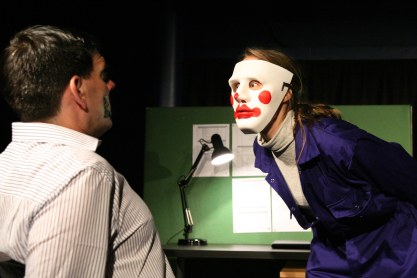
Luckily, we’re not disappointed. Morna Pearson’s script is sharp and liberally laced with dark humour. It tells the tale of Claire, a young woman still traumatised by the bullying she experienced at school. Her solution is to become a masked vigilante; after work each evening, she stalks the city’s streets, looking for people to help and reporting ‘criminals’ to the police.

As the lights go up, she is keeping an eye on her latest project: a man, bound and gagged, sits listening to her, growing more and more agitated. She’s called the police, she says; they’ll be here soon. But we quickly learn more about Fraser and how his past interconnects with Claire’s.

It’s a simple two-hander in a black box studio, with minimal props and a basic set (two desks, two  chairs, a scattering of stationery). But the simplicity absolutely suits the piece.  Both actors (Helen Mackay and Andy Clark) inhabit their characters convincingly. Their relationship – with all its tensions and revelations – is deliciously  uncomfortable, but there are plenty of laughs amid the heartache and despair.

It might be tough to get a ticket for this, but I do urge you to try. It’s a cracking little play – and the pies are pretty good too.

4.3 stars

Susan Singfield

The Mousetrap

unknown

17/10/16

King’s Theatre, Edinburgh

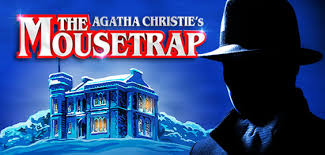
It’s hard to believe that I’ve been on this planet for sixty-four years and I’ve never seen a stage production of Agatha Christies’s The Mousetrap beforeIronically, the play has been around for exactly the same length of time as I have. It was first performed  in 1952 and has been running in the West End ever since. This touring production, directed by Ian Watt-Smith, is at the King’s Theatre until the 22nd of October.

It’s a single-room drama and the events take place in an extraordinarily naturalistic set, which looks as though it was tailor-made to fit the stage of the King’s (although, of course, it wasn’t, and will shortly move on).  The detail is meticulous – even the smattering of snow on the characters’ coats melts as they warm up by the fire. We are in Monkswell Manor, an old country pile, where Mollie Ralston (Ann Anderson) and her husband Giles (Nick Barclay) are attempting to set up a guest house. As the play opens, a terrible snowstorm is in progress and we learn very quickly that there has been a brutal murder nearby. As the first clutch of guests begin to arrive, it is apparent that each of them can be considered a suspect – especially the histrionic ‘Christopher Wren’ (a deliciously revved-up performance by Oliver Gully), whose ill-considered utterances make him look more suspicious by the moment, and the mysterious Mr Paravicini (Gregory Cox), who wears makeup to appear older than he really is – why? The first half closes with the murder of one of the guests and, in the second act, it is up to Sergeant Trotter, who has arrived on skis in the middle of the storm, to attempt to unravel which of the Manor’s inhabitants is guilty of murder most foul.

This is unashamedly old-fashioned in its style and ambitions (how could it not be?) and fans of Agatha Christie will revel in the avalanche of red herrings unleashed here. At times, it’s like being caught up in a game of Cluedo, with characters conveniently slipping away to a variety of locations throughout the house, just as something important happens. Of course, the play is famous for it’s ‘twist’ ending and it’s impossible not to play armchair detective as you try to unravel the possibilities of who might be hiding something. The play’s revelation (which audiences are always entreated not to reveal) must have seemed pretty incredible back in the day, but those well-versed in detective stories may find themselves guessing the eventual outcome early in the proceedings.

It doesn’t matter. This is an enjoyable slice of classic theatre and it’s easy to see why it has remained in the public gaze for so long. Why not drop in and see if you can work it out for yourself?

4 stars

Philip Caveney


A Bench On The Road

c64_eventimage-a877

15/10/16

Assembly Roxy, Edinburgh

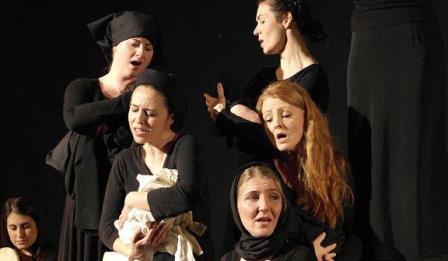
A Bench On The Road, is quite clearly a passion project for writer/director Laura Passetti – and how gratifying it must have be for her to see the Assembly Roxy packed (almost literally) to the rafters with tonight’s eager and appreciative audience. This is a slice of verbatim theatre, based on the testimonies of female immigrants who travelled from Italy to Scotland to begin new lives. Here are their stories plucked from different points in one hundred years of history – twenty five million Italians left their homeland between 1850 and 1950 and thousands of them chose to settle in Scotland – and yet, with what’s currently happening in the Mediterranean, this really could not be a more prescient production, examining exactly what it means to be a migrant, how it feels  to leave the land of your birth in search of a new life. As Passetti (an Italian immigrant herself) told me during the brief chat we had earlier this month, history has a habit of repeating itself.

Perhaps the play’s most effective sequences are those set during the Second World War when the rise of fascism under Mussolini impacted on those Italians who had already relocated to Scotland, where parents were forcibly separated from those children who had been born in their new homeland.

Simply but effectively staged, by Charioteer Theatre, the play features three Italian and three Scottish actors with accordian player, Caroline Anderson Hussey. Jaunty Italian dance songs are counterpointed by plaintive Scottish airs, cleverly underlining the clash of cultures. The performances are all exemplary and the harmonies as the six actors join together in song are sometimes exquisite. If there’s an occasional problem with catching lines of dialogue, it’s more to do with being perched right at the back of the sizable theatre space than with any shortcomings on the actor’s part. This is powerful stuff and my only regret is that we caught it at the very end of its short tour, instead of at the beginning, where we could have urged more people to see it..

The performance concludes to an ecstatic standing ovation and I can’t help feeling that this is a production that deserves a wider audience. Looking around at the delighted faces of tonight’s crowd, there’s every reason to believe that A Bench On The Road could just find it.

4 stars

Philip Caveney