Denial

02/02/17

You’d be hard put to find a worthier subject than that depicted in Denial. It’s based around the true story of American historian, Deborah Lipstadt (Rachel Weisz), who, in the late 90s, was sued for defamation by author, David Irving (a slimmed-down and eerily repellant, Timothy Spall), after she dismissed his ramblings in print as the work of  a ‘holocaust denier.’ An admitted lifelong Hitler obsessive, Irving repeatedly maintained that there was no real proof that the Nazis carried out genocide on the Jewish people during the Second World War, and that Jews had simply fabricated the idea in order to obtain reparation from the Germans after the conflict was over.

The trial is played out in London and Lipstadt is horrified to discover that, because of the peculiarities of British law, it is not for her to prove that Irving is wrong, but rather that she is correct in insisting that the Holocaust actually took place. To lose the case would be unthinkable. Her solicitor, Anthony Julius (Andrew Scott), is insistent that Lipstadt will not be allowed to take the stand, and neither, for that matter, will any Jewish survivors, who will run the risk of being publicly humiliated by Irving. Just to make things even more difficult, Julius decides that the case  should be deliberated not by a jury, but by a single high court Judge.

This is, of course, what actually happened, so we can hardly take umbrage with the particulars of the case – but, in terms of a screenplay, it makes it very hard for playwright David Hare to generate any sense of the actual drama. Lipstadt is forced to sit throughout the proceedings in frustrated silence while barrister Richard Rampton (Tom Wilkinson) conducts the case on her behalf. The result is, I’m afraid, a curiously unaffecting film, one that fails to engage an audience as much as it needs to. Even the scenes shot in modern day Auschwitz seem somehow perfunctory and lacking in emotional depth. And of course, since we all know the outcome of the case, there’s no real suspense here, either.

This is a shame because on nearly every other level the film is nicely done. There are strong performances from an excellent cast, it is decently shot and Irving’s famous interview with Jeremy Paxman is cleverly reenacted. But I have to say, worthy though the subject undoubtedly is, this doesn’t have the kind of impact it could.

3.6 stars 

Philip Caveney

Prevenge

31/01/17

Prevenge belongs to Alice Lowe. She’s the writer, director and the star – and the resultant singularity of vision gives this film a rare clarity. Truly, it’s a pleasure to watch this darkly funny tale, even if there are moments of such gruesomeness that I have to hide my eyes.

Ruth is a young widow, pregnant and enraged. Spurred on (she believes) by her unborn baby, she embarks on a killing spree, murdering her victims with ruthless determination. They include odious 70s music DJ, Dan (Tom Davis), workaholic CEO, Ella (Kate Dickie), and likeable climbing instructor, Tom (Kayvan Novak). Interspersed with visits to the midwife, these homicidal incidents grow ever more violent, yet – despite her obvious moral deficiencies – we remain firmly on Ruth’s side. She’s not likeable exactly – and why should she be? But her humanity is writ large; she’s an ordinary woman, with the same flaws and over-reactions that affect all of us. She just takes things to extremes, that’s all.

Lowe uses the obviously low-budget to her advantage: the film has a claustrophobic feel as we’re stuck with Ruth in cheap hotel rooms, the corner of a bar, another victim’s living room. The episodic structure means that it’s essentially a series of two-handers, but this plays to the story, and helps to underline Ruth’s isolation. The only constant in her life is the midwife. It’s a tragedy, I suppose – but a very funny one.

This screening is part of a Q and A tour, so we have the added pleasure of hearing Lowe speak about her project. Her enthusiasm is infectious, and it’s fascinating to hear how the idea for the film emerged: “A funding opportunity came up, and I thought, ‘Oh, but I’m pregnant, so I can’t…’ And  then I started to think about what I could do that would include my pregnancy.” Like all the best creative pieces, then, this is a mixture of talent, experience and happenstance. You won’t see another film quite like it. It’s well worth a visit to your local cinema.

4.6 stars

Susan Singfield

Norton House Hotel & Spa

Ingliston, Edinburgh

30/01/17

Ah, afternoon tea! Could there be a more quintessentially British concept? I seriously doubt it. This kind of experience has been bringing smiles to the faces of the beleaguered citizens of the UK for a very long time indeed. And now, more than ever, we really need those smiles!

Actually, I have to confess that the prospect of cakes and coffee isn’t one that particularly floats my gastronomic boat, but on this occasion I am outnumbered three-to-one, and since this is a belated Christmas treat for members of the family, I can hardly suggest a plate of cheeky noodles instead – so along we go and even I have to admit that there can be few settings quite as perfect for the occasion as Norton House. Situated ten miles or so outside of Edinburgh, it sits amidst fifty-five acres of impeccably tended gardens and on this sunny, late January day, it all looks absolutely splendid. I have to reflect that life can be hard sometimes, but hey, today really isn’t so bad.

The dining room is delightfully quaint and I’m happy to note, well-attended, so there’s a convivial bustle about the place (the last time we tried one of these things, we were the only people in the dining room, which tends to dampen the spirits somewhat). We get off to an excellent start with the perfect appetiser, a glass of chilled champagne, which gives us that delightfully muzzy feeling (luckily neither of us is the designated driver!). There are unlimited quantities of tea or coffee and it’s elegantly served in proper china cups and saucers. And then the food arrives. Wow. What you can see in the picture serves two people, so we certainly weren’t complaining about the portions.

There are four kinds of finger sandwiches – smoked salmon, cream cheese and capers; honey roast ham with English mustard; egg and cress mayonnaise; and cucumber and mint – all freshly prepared and quite delicious. Of course there are scones and (nice touch this), for those of us who greet the presence of dried fruit with the same enthusiasm we might reserve for a portion of freshly grilled bluebottles, there are also some plain ones on offer, with lashings of clotted cream and raspberry jam. The latter is a little on the runny side, but frankly, if this is the only criticism we can find, it’s not so bad. The scones are brilliant examples of their kind: light, fluffy and hard to resist – but you need to try because there are still the puds.

Ah, the puds! Each one is more delightful than the last, but in amongst the feeding frenzy I manage to note that there’s a passion fruit tart that melts in the mouth, a lemon polenta cake that has a delightful coconut texture, a vanilla panna cotta that’s to die for, a chocolate cake that really ought to be stodgy but is as light as you like, and even some little bright green macarons for those who adore that kind of thing.

Now, don’t get me wrong, we can eat like nobody’s business, but even we have to admit defeat before we’ve quite cleared everything off the display; but it’s no bother. The friendly waitress points out that whatever we can’t finish can be packaged up in a cardboard box, so we can take it home and have another run at it once we’ve recovered our appetites – which, to be honest, isn’t till the following day.

Look, let’s be clear. Afternoon tea still isn’t my favourite thing, but I’d be a very hard man to please if I didn’t acknowledge that, if this kind of thing is your pleasure (as it is my companions’), then you should make a beeline for Norton House at your earliest opportunity. Because, when it comes to the great British cream tea, this is pretty much as good as it gets.

4.8 stars

Philip Caveney

The Pompadour by Galvin

Princes Street, Edinburgh

29/01/17

Situated in Edinburgh’s famous Caledonian hotel, the Galvin brothers’ Pompadour restaurant is a real delight. We’re here because… well,  because, why not? We have family visiting, and we want to give them a treat. And a jolly lovely treat it turns out to be.

We’re eating from the seasonal menu, which is £45 for three courses – and well worth every penny. To start, I opt for the salad of poached winter fruits, speck and toasted macadamia nuts. It’s a triumph: sweet and salty and bursting with flavour. Philip has the lasagne of North Berwick crab with beurre nantaise, which is the chef’s signature dish. It’s wonderfully aromatic and so light it virtually melts in the mouth.

Next up, the main courses. I have the corn fed chicken breast, with pommes mouuseline, roast chervil root and purple sprouting broccoli. This is quite simply the best chicken dish I’ve ever tasted; it’s almost ridiculously delicious. I didn’t know chicken could be quite so… chickeny. And the accompaniments are perfect too. Philip has the haunch and faggot of venison, with wild mushrooms, pommes Anna, red cabbage and charred onion, which, served pink, is as rich and tender as can be. He’s a very happy man. One of our guests samples the roast fillet of Peterhead sea bream, with pearl barley kedgeree and a confit egg yolk; she pronounces it ‘delicious’ too.

Thankfully, this isn’t one of those restaurants where they try to get us through quickly, so that they can offer our table to the next set of  diners in the queue. We’re allowed to progress slowly, which means that we can take a breather before pudding, and enjoy the rather pleasant New Zealand sauvignon blanc we’ve chosen to accompany our meal. And I’m glad of this, because the puddings are lovely. I have the salted Valrhona dulce chocolate crémeaux, with almonds, prunes and rum ice cream, and it’s gorgeously reminiscent of my starter, with its salty-sweet flavours and lightness of touch. Philip goes for the classic apple tarte tatin with vanilla ice cream, which is perfectly executed too.

Would we come back again? Of course we would. The food is faultless, and the service impeccable.

5 stars

Susan Singfield

T2: Trainspotting

449395d0

29/01/17

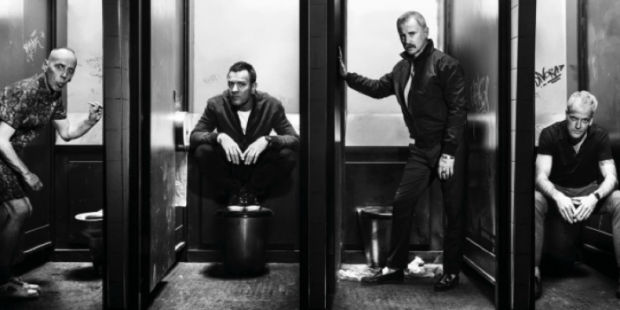
It’s twenty years after the events of Trainspotting and the only running feet in evidence belong to a stranger, pounding a treadmill in a busy gym. But as we quickly discover, mortality waits in the wings, ready to claim the lives of the unwary.

Following the death of his mother, Renton (Ewan McGregor) returns to his home city to pay his respects and to look up his old cronies. Spud (Ewen Bremner) is still a hopeless junkie and just about ready to end his own life when Renton comes (quite literally) to his rescue. Sick Boy (Jonny Lee Miller) is running his auntie’s dilapidated pub and attempting to make a dishonest living by blackmailing a series of victims with the help of his Bulgarian girlfriend Veronika (Angela Nedyalkova). Begbie (Robert Carlyle) is still languishing in prison, but with the help of another inmate and a well-aimed shiv, manages to effect an escape. Time has not mellowed him in the slightest and he is still intent on avenging himself on the man who double-crossed him all those years ago. It’s strangely satisfying to note that Carlyle still excels at playing the consummate psychopath and it’s all too easy to understand Renton’s terror of his old adversary.

With T2, director Danny Boyle has crafted a sequel that more than pays lip service to its iconic predecessor. In fact, in certain respects, it betters the original. As a study of the city of Edinburgh, for instance, it’s a massive step up – Trainspotting was largely filmed in and around Glasgow, but T2 takes advantage of many of its home city’s most screenworthy locations. The cinematography of Anthony Dodd Mantle looks absolutely stunning and, as you would hope, there’s an energetic and propulsive soundtrack, a mixture of new material and golden oldies.

John Hodge’s screenplay is particularly astute, taking time to pay homage to many of the original film’s most iconic scenes and in many cases, subverting them. Renton’s ‘choose life’ speech is given a contemporary reboot, (spoken in of all places, in the fourth floor brasserie at Harvey Nicks) while Spud takes on the mantle of novelist Irvine Welsh as he starts to write down the foursome’s youthful adventures as a kind of prototype novel. (Keen-eyed viewers will spot the real Welsh in a cameo, reprising the role of wheeler-dealer Mikey). Occasional flashbacks to the first film and to the childhoods of the four main characters lend a bitter-sweet air of melancholy to the proceedings.

Not everything is perfect. It would have been nice to see Kelly McDonald and Shirley Henderson given a little more to do here and I would have liked to hear more from Renton’s widowed father (James Cosmo), but I suppose you can’t have everything. These shortcomings aside, T2 ranks as one of the most satisfying sequels ever, largely because it has the intelligence to honour its origins without being allowed to turn into a pale imitation. The packed Sunday afternoon screening we attended paid eloquent testimony to the fact that Danny Boyle has a palpable, and well deserved hit on his hands.

T2 also features one of the most memorable final sequences of recent years as Renton, back in his childhood bedroom, finally rocks out to a new version of Lust For Life.

Don’t miss this one, it’s a keeper.

4.6 stars

Philip Caveney

Lysistrata

27/01/17

King’s Theatre, Edinburgh

The Attic Collective’s adaptation of Lysistrata is certainly true to the spirit of Aristophanes’ original play, though it takes the story to extremes I’ve never witnessed before: bawdy, rambunctious and featuring even more inflatable phalluses than you’re likely to see on the average rowdy hen night, it’s also liberally sprinkled with acerbic comments about contemporay political developments (including the inevitable Trump reference).

First performed in Athens in 411 BC, the play is a wry condemnation of the patriarchal society that held sway at the time. Lysistrata (Cait Irvine), tired of watching her husband trotting off to take part in the latest battle of the Peloponnesian war (a conflict which raged on for thirty years), enlists her female friends to join her in a sex strike – the women of Athens, she insists, will not agree to pleasure their husbands until a peace deal can be struck with their adversaries in Sparta. Aristophanes’ point is that sex can be a powerful weapon and that, when men are deprived of it, they will do pretty much anything to earn the right to enjoy it once again.

This is a spirited ensemble production from this emerging new company, brash and clamorous, incorporating music, movement and vocalisation. For a while there, I didn’t really think this was going to be for me , but it gradually exerted its considerable strengths and, by the conclusion, I had been won over. Mind you, this isn’t going to work for everybody. If you’re at all prudish, this may not be your cup of bromide, but as a gutsy interpretation of a classic text, it certainly achieves its aims.

3.8 stars

Philip Caveney

Jackie

24/01/17

Jackie Kennedy was a celebrated style icon when I was growing up but, I must confess, she’s somebody I haven’t given a great deal of thought to… until now.

Pablo Larrain’s somber and affecting film looks at her experiences during and just after the assassination of JFK. Framed by an interview with a journalist (Billy Crudup) it shows how her life was transformed and marginalised by her husband’s death. Indeed, within minutes of his demise, as his successor Lyndon B. Johnson is sworn in, she suddenly, shockingly finds herself an outcast, a woman totally defined by her husband’s former role. Without him she is an encumbrance, an embarrassment, somebody deemed to be without value.

The film concentrates on her stubborn attempts to ensure that the memory of Jack Kennedy lives on. She insists that he is given a state funeral and that she be allowed to walk alongside her children behind his coffin in an elaborate funeral cortege – and she ruthlessly manipulates everything that is written about him and her.

In the lead role, Natalie Portman delivers an eerie impersonation, capturing Jackie’s style and her weird drawling voice with uncanny precision. It’s a barnstorming performance, one that is likely to win her a well-deserved lead actress Oscar next month. If the film itself does not quite measure up to that stellar performance, it’s nonetheless pretty assured, uncannily cutting between genuine historical footage and skilful recreations without putting a foot wrong. Just look, for instance, at the recreation of Jackie’s famous ‘tour of the White house’ television programme, which is chillingly accurate in every last detail. Most of the other actors have to be content with cameo roles but Peter Sarsgaard shines as Bobby Kennedy and there are winning turns from Greta Gerwig, Richard E. Grant and from John Hurt as the elderly catholic priest that Jackie pours her heart out to in a couple of key scenes.

But make no mistake, this is Portman’s film and she absolutely relishes the opportunity to inhabit a role that allows her to stretch herself as an actor. If she does get to lift that Oscar statuette, it won’t be the night’s biggest surprise.

4.4 stars

Philip Caveney

Au Revoir Les Enfants

23/01/17

January 27th 2017 is Holocaust Memorial Day – and as a thematic tie-in with this important occasion, the Cameo Cinema, Edinburgh arranged a showing of Louis Malle’s 1987 film, Au Revoir Les Enfants. This moving, semi-autobiographical story is a powerful yet unsensational reminder of the horrors of the German occupation of France.

It’s 1944 and, with Paris under constant bombardment by allied planes, young Julien Quentin (Gaspard Manesse) is sent to a boarding school in the French countryside. Run by a society of monks (or ‘Monkeys’, as the boys prefer to call them), the school is a retreat from the realities of the real world. But one day, a new student arrives at the school. Jean Bonnet (Raphael Fejto) seems to receive preferential treatment from the monks. something which makes him a target to the more established children. He is, it turns out,  a talented musician and is addicted to reading fiction. At first he and Julien are adversaries but as Julien begins to learn more about the new arrival, so a deepening friendship develops. But it is a friendship that is doomed from the very beginning. Julien discovers that Jean is really called Jean Finkelstein – and that the monks are hiding him from their German occupiers. As the Nazis begin to exert an increasingly powerful grip on France, it’s only a matter of time before the truth reaches the attention of others…

Malle’s film is a little marvel – frank, unflinching but never overstated, it looks at the subject of the persecution of the Jewish race through the eyes of childhood and exposes it for the shameless horror that it really is. It also highlights the bravery of those who try to help their Jewish neighbours. There are affecting performances from the two young leads and the film’s searing conclusion will have you thinking about it long after the  credits have rolled.

The showing was followed by a short talk from Henry Wuga, a 91 year old German Jew who travelled to Glasgow in 1938, courtesy of the Kindertransport initiative and who has subsequently devoted his life to talking about his experiences as a refugee (a subject which really could not be more prescient in these troubled times). Henry is a fascinating man, who seems to possess an energy that belies his years – if you get the chance to hear him speak, I strongly recommend that you take it up. There are many who will tell you that the kind of events depicted in Au Revoir Les Enfants belong firmly in the past; but there are others (myself included) who look at what’s happening in the world right now and tremble to think that unless people wake up to the truth, they could all too easily be allowed to happen again. To find out how you can play your part in ‘learning lessons from the past,’ visit hmd.org.uk, phone 0207785 7029 or email enquiries@hmd.org.uk

And, if you can arrange it, watch the film, which is readily available on DVD and through streaming services.

4.6 stars

Philip Caveney


Split

21/01/17

It’s time to ask some important questions. Why do film companies keep giving M. Night Shymalan the money to make more films? Why do major actors still think it’s worth taking a punt on appearing in one of them? And perhaps most vexing of all, why do I keep giving the man another chance? To be fair, I’ve managed to resist seeing his last few efforts, alerted by terrible advance reviews, but the word on Split is that it represents a major return to form (something he hasn’t really had, in my opinion, since The Sixth Sense, way back in 1999). So off I dutifully trot to my local multiplex and, perhaps inevitably, I am disappointed once again.

Split is all about Kevin (James McAvoy), a man who suffers from Dissociative Identity Disorder and who, according to his therapist, Doctor Karen Fletcher (Betty Buckley), has twenty-three separate identities. At the film’s opening, he abducts three young women who are leaving a birthday party and imprisons them in his labyrinthine underground lair. One of them, Casey (Anya Taylor-Joy), seems more resourceful than her companions, mostly because of trauma she suffered in her childhood (and to which the film intermittently flashes back). Casey learns very quickly that one of Kevin’s personalities, a nine year old boy called Hedwig, is more approachable than the others and starts to investigate this as a possible way out of her predicament… but all of Kevin’s characters talk about the imminent arrival of a new and very frightening twenty-fourth identity…

It’s an intriguing premise but one which falls short on just about every level. Given that it’s about an abduction, the film fails to generate any real tension or sense of threat. Its risible treatment of a genuine psychological disorder, will, I have no doubt, offend anybody who knows anything about the reality of the situation, as will the actions of Doctor Fletcher, a supposed professional who surely breaks every rule in the book in her approach to her patient(s). McAvoy makes a decent fist of his eight roles (thankfully he isn’t called upon to show us the other fifteen!), which essentially means he changes his voice and expressions, so we’re never in any doubt as to which personality we’re seeing at any given time, but it’s hardly the grandstanding tour de force I’d been led to expect. Perhaps if the script (as ever, also by Shymalan) had been more skilful, I’d have been more convinced by what I was hearing.

All the usual Shymalan tropes are in evidence. Cameo performance by the director? Check. Twist ending that you can see coming a mile off? Check. Weird Twilight Zone-style payoff? Check. And oddly, we’re also offered a coda that absolutely relies on you having a working knowledge of the director’s early output. Inevitably, a lot of people left feeling baffled.

Shymalan has always had a very singular approach to his cinematic ‘vision’ but I’m sorry to say that, try as I might, it’s a vision that I am unable to share. Well, at least it was better than Lady In The Water.

2.2 stars

Philip Caveney


Lion

20/01/17

Lion is the true-life story of Saroo Brierley, a young man on a quest to find his family. The opening sequences depict a home life that, while far from idyllic – they are desperately poor: Saroo’s mother is a manual labourer, collecting rocks from dawn till dusk; Saroo and his brother steal coal to sell for milk; none of them can read or write – is nevertheless loving and nurturing.

What follows is startling and devastating: at the train station, five-year-old Saroo, told to wait for his brother, seeks a place to sleep on a decommissioned train. When he awakes, the train is on the move, and it doesn’t stop until it reaches Kolkata – 1000 miles away from Saroo’s home town. Saroo doesn’t speak Bengali, and he doesn’t know the proper name of his village, so he can’t tell anyone who he really is. It’s utterly heartbreaking to see the plight of the street kids he joins: the dangers they face, and the sheer numbers of them. (And Sunny Pawar, who plays young Saroo, is just delightful, all big eyes and vulnerability. He’s definitely one to watch.) Eventually, Saroo is placed in an orphanage and, from there, adopted by a kindly couple from Tasmania.

The second half of the film has a more sombre feel; it’s less immediately engaging, but compelling nonetheless. Adult Saroo, played by Dev Patel with customary aplomb, is an all-Aussie guy, a surfer with long hair and a promising career ahead. He has a girlfriend, a good relationship with his adoptive parents; things have worked out well for him. (Sadly, life has not been so kind to Mantosh (Divian Ladwa), the second boy adopted by the Brierleys, whose past demons won’t let him rest, and see him seeking solace in heroin.) But when Saroo spends an evening with Indian friends, buried memories are evoked, and he embarks on a lonely mission to find his long-lost family – using Google Earth to assist his search.

It’s a deceptively gentle tale of love and loss, offering insight into the moral and social complexities of adopting children from poorer lands. The film is not overtly political, and it doesn’t dwell on the causes of the poverty that lead to Saroo’s suffering. But neither does it shy away from showing us grim realities: this is one man’s story, a microcosm of a larger problem. It’s impossible not to feel moved and humbled. And very thankful that, for Saroo at least, it has a happy ending.

4.2 stars

Susan Singfield