Theatre

Hedda Gabler

images images-1

10/04/15

Lyceum, Edinburgh

Edinburgh’s Lyceum is a beautiful Victorian theatre, and a delightful place to visit in its own right; it’s hard to imagine anyone could be unimpressed by the perfectly preserved intricacies of its decor; the sumptuous blues, golds and reds, redolent of old-fashioned luxury. It’s lovely.

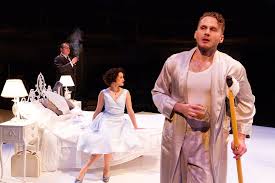
If this, along with the choice of an Ibsen piece, suggests a staid, old-fashioned production, then nothing could be further from the truth. This version of Hedda Gabler (adapted by Richard Eyre and directed by Amanda Gaughan) is vivacious and sprightly; as fast and funny as it is heartbreaking and tragic. Nicola Daley, as Hedda, is never less than utterly engaging; she clearly revels in the role, and captures perfectly the awful attractiveness of Hedda’s reckless malevolence. By the end, we feel sorry for Hedda, but we never lose sight of how dangerous she is.

The supporting cast is strong too: I love Sally Edwards’ Aunt Juju – a real Miss Bates of a character – as irritating and vapid as she is charming and kind; Benny Young, as Judge Brack, oozes sly debauchery concealed beneath a layer of respectability so thin that only Juju is taken in. Jade Williams convinces as the outwardly naive – but ultimately hard-headed – Thea, and Jack Tarlton’s swaggering energy makes Loevborg’s wild dissolution a physical, menacing thing.

The set is marvellous too: the light, fresh, open design makes for a queasy juxtaposition with the suffocation Hedda feels in her home, her marriage, her social class. It underscores the point for us that poor George will never be able to give her what she needs; no open window will ever offer enough air.

I loved this play. I can’t fault it. I’m still thinking about the characters twenty-four hours later, contemplating their behaviours and their fates. A fabulous piece of theatre.

5 stars

Susan Singfield
Anna Karenina

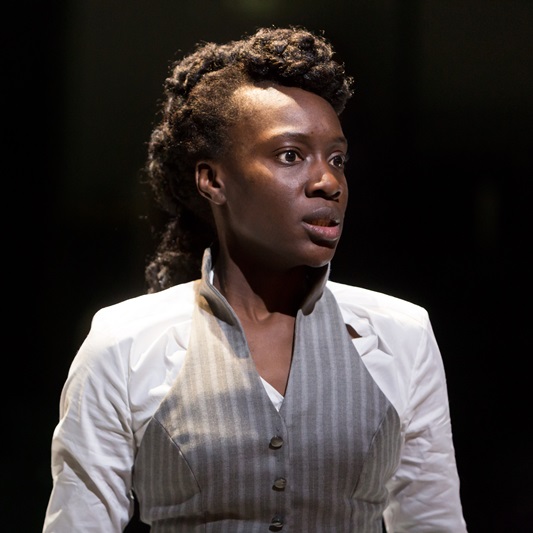
OnyUhiaraAsAnnaKarenina

24/03/15

Royal Exchange, Manchester

Tolstoy’s classic tale of blighted love gets a stripped-down, eclectic interpretation at the Exchange, replete with multi-ethnic casting and a selection of accents that range from deepest cockney to broad Scottish. Adapted by Jo Clifford, this co-production with the West Yorkshire Playhouse casts Oblonsky (Ryan Early) as the play’s occasional narrator. Rakish and dissolute though he may be, (Early’s playful performance is one of the production’s strongest cards) he’s also the only character here who actually seems to be enjoying himself. Elsewhere all is woe and misery.

Anna (Ony Uhiara) is a faithful and dutiful wife, happy with her marriage to the older Karenin (Jonathan Keeble) until she sets eyes upon the dashing Count Vronsky (Robert Gilbert), the moment accentuated by the use of a dazzling spotlight beamed in from outside the performing area. She embarks on an affair which will have catastrophic consequences for her and those around her. Production designer Joanna Scotcher has chosen a minimalistic set, through which run a set of train tracks along which a pair of tables are pushed backwards and forwards across a central pit of earth. Through the course of the action, the latter is used to represent the earthy attributes of the likeable but muddled Levin (John Cummins), the grubby stigma attached to a married woman carrying on so brazenly and it even provides the opportunity for Karenin to (quite literally) sling some mud at his unfaithful wife. It could be argued that this symbolism is somewhat overused (and it must have been a nightmare for the play’s costume department!) but it would have been nice to see a couple of bigger set-pieces along the way – the death by train that kicks proceedings off is criminally understated and the famous horse race that is the story’s centrepiece requires all our powers of imagination to envisage.

That said, this is an accessible production of what can, in the wrong hands, be a rather ponderous story. Clifford’s skilful script clearly delineates the various strands of the tale and over the space of nearly three hours, proceedings never lose pace. It’s interesting to note that six members of the same cast will be taking on the Bruntwood Prize-winning play The Rolling Stone from Tuesday 21st of April.

4 stars

Philip Caveney

Beating McEnroe

beating_mcEnroe_5_460_689_95_s

27/03/15

The Traverse Theatre, Edinburgh

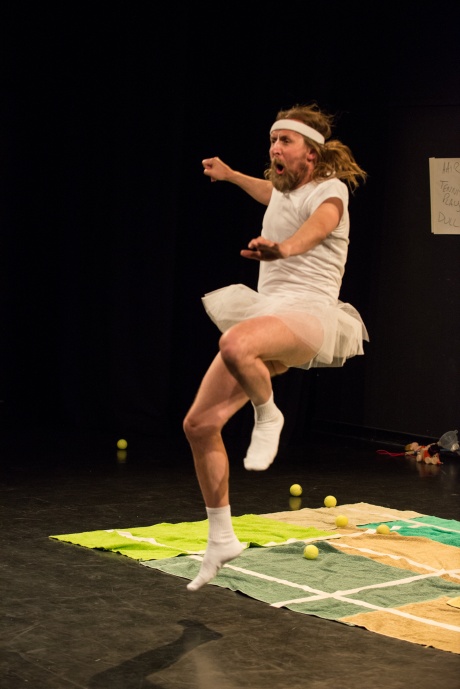
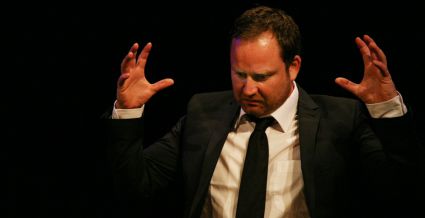
We enter the theatre to find a bearded man dressed in a tennis headband and a towelling bathrobe. He’s sitting cross-legged on the floor silently contemplating a pile of tennis balls. As the crowd continues to shuffle to their seats, he starts to throw the balls to people and urges them to throw them back. Then, once everyone is assembled, he gets us all to chant some kind of repetitive mantra.The man is Jamie Wood and the show is Beating McEnroe, a monologue about the infamous Wimbledon showdown between Bjorn Borg and John McEnroe in 1980. It’s also about how the young Jamie came to terms with always being whupped at tennis by his older brother. It’s about hero worship and the awful realisation that one day, all heroes must inevitably be bested, often by people who don’t seem to deserve the acclaim. Along the way there’s some slapstick, some dancing and some very funny visual jokes. Wood’s charming persona allows him to effortlessly manipulate the audience into helping him out, acting as his umpires, his ball boys and girls even at one point impersonating him (nice one Susan!) and his big brother. This is interactive theatre at its best and while it’s undeniably a piece of fluff, it’s fluff that’s performed with great skill and a disarming lightness of touch – enough to earn it a nomination for a Total Theatre Award at this year’s Edinburgh Fringe.

I had the task of tying a carton of table salt to Jamie’s head, which might sound decidedly odd, but which resulted in the funniest visual gag of the night. I felt as though somehow I had contributed to the evening and left feeling rather pleased with myself. We caught this performance at the end of it’s run at the Traverse, but those seeking a genuinely entertaining night at the theatre could do a lot worse than booking to see this at the Lowry in Salford where it plays for just one night on Saturday 28th of March. You’ll believe a man can become a human tennis ball!

4 stars

Philip Caveney

The Caucasian Chalk Circle

The-Caucasian-Chalk-Circle-at-the-Royal-Lyceum-Theatre-250x165

Lyceum Theatre, Edinburgh 17/02/15

This is one of those productions that makes me want to bottle its essence, and use it when – in my day job as a drama teacher – I am introducing a class of students to Brecht and his ideas. There’s a danger, sometimes, of presenting him as too difficult or serious (he is, of course, both – it’s the ‘too’ that’s the problem), and of the alienation effect coming to mean something quite different within the confines of the classroom.

But this production was so enchanting and funny and lively and, yes, engaging (sorry) that no one in the audience could fail to feel its impact. From the moment we entered the theatre, we were made witness to events. The stage was huge and cluttered, with all curtains removed and the wings exposed; costumes hung on rails, and actors moved around the stage, gossiping, going over lines, checking their props. After a while, a couple of actors came down into the audience and chatted. ‘D’youse know much about Brecht?’ one of them asked the woman next to me. ‘Nothing at all,’ she replied, and the actor hunched down on the floor beside her, and gave a quick précis of the ideas behind epic theatre. This deliberate negation of any notion of naturalism or realism was only made more stark by the opulent beauty of the late 19th century Lyceum theatre, with its proscenium arch and ornate boxes. This was no black box of a space, where experimental theatre is par for the course; it was a studied and deliberate clash of theatrical styles, and it worked – big time.

The production was overtly musical, with a glorious performance by Sarah Swire as the singer/narrator, acting as a kind of rock-chick Greek chorus to keep up the momentum. The pace never flagged: this was an energetic ensemble piece, whose fourteen actors contrived to create the sense that they were many more. John Kielty was another standout, in a variety of roles, but most notably as the Governer’s snobbish wife; he clearly revelled in the drag and campery. Christopher Fairbank (as Adzak, among others) also made his mark, not least for his impressive rendition of a wide variety of accents.

The direction (by Mark Thomson) was stunning. It’s hard to single out particular moments in such a seamless production, but I did love the depiction of the rickety bridge, with an enormous fan blowing a paper blizzard, while three wooden planks were moved in front of Grusha (Amy Manson), their wobbling placement creating a real sense of the crevasse she was crossing and the danger she faced. The puppet used to represent Michael was another delight, skillfully manipulated by Adam Bennett, who breathed life into the (polystyrene?) head, forcing us to confront the very real dilemmas Grusha had to resolve.

All in all, this was a fabulous and celebratory piece of theatre: dazzling, spectacular, and – above all – thought-provoking. It’s on until the 14th March. Go and see it if you can.

5 stars

Susan Singfield


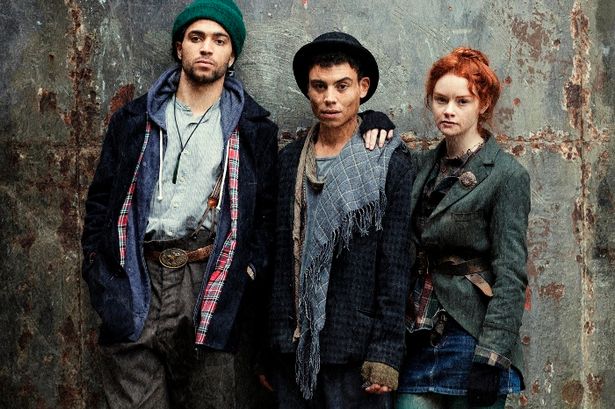
Scuttlers

JS55497410

10/02/15

Royal Exchange Theatre, Manchester

A brand new play that explores the origins of Manchester’s original street gangs, Scuttlers by Rona Munro, is set in the year 1885, but incorporates echoes of the city’s more recent riots. It’s a big, urgent production, stunningly choreographed by Eddie Kay of Frantic Assembly and featuring a cast of over 40 young actors, who race restlessly back and forth across the Exchange’s circular set, propelled along by Denis Jones’ pulsing, electronic score, which incorporates the clanks and rattles of  machinery.

In the heat of summer, two street gangs are edging closer and closer to violent confrontation. The Bengal Street Tigers, led by Sean (Bryan Parry) are preparing to take on their sworn enemies, the Prussia Street gang. Former Tiger, Joe (Tachia Newall) is now a respectable soldier and the father of a baby with local nurse Susan (Anna Krippa), but he has changed his allegiance and now supports Prussia Street. Meanwhile, ‘Tiger cubs’ Margaret, Polly and new girl Theresa, are every bit as committed to their gang as any of their male counterparts. Then along comes Thomas (David Judge) a seemingly mild-mannered lad, but one who is determined to emulate his dead father and be the ‘King’ of Bengal Street. When the cotton mill that employs virtually everyone in Ancoats closes for a three day break, it’s clear that a final showdown is long overdue…

Scuttlers has much to recommend it, though the story itself has an overly familiar feel and the tragic conclusion isn’t really the shocking surprise it ought to have been. It also doesn’t help that some of the dialogue is occasionally swamped by the score, but that’s doubtless something that will improve as the production settles into its stride. Production wise, there are some real delights here. I loved the central ‘loom’ design that could be adapted to provide suggestions of other locations and the unexpected appearance of a rain storm with real water, definitely had the ‘wow’ factor. I also loved the play’s conclusion as a stream of restless walking characters segued into the present, period clothing giving way to hoodies, trainers and mobile phones.

This is strident exciting theatre, well-suited to a younger audience, which I hope it manages to connect with. I only wish the storyline was as innovative as the wonderful choreography and theatrical effects.

3.7 stars

Philip Caveney

Little Shop of Horrors

LSOHPosterWebsiteNoText

Royal Exchange Manchester

9/12/14

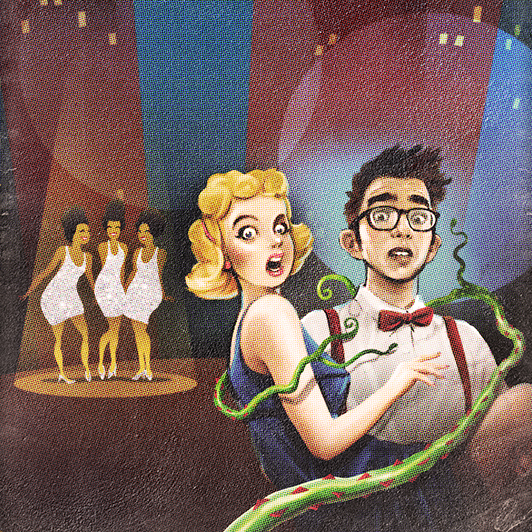
As guilty theatrical pleasures go, Little Shop of Horrors is right up there with the very best of them. I first saw Howard Ashman and Alan Menken’s musical in the early 80s at Manchester’s Library Theatre and I’ve been a devout fan ever since. To my mind, it’s the perfect blend of great songs, weird humour and 50s-style science fiction (and let’s face it, you don’t find many of those!) While it might seem an unusual choice for a Christmas Production – where’s the tinsel, where’s the saccharine? – the Royal Exchange are on to a winner with this superlative show and if the idea of a Christmas musical is to create joy, then this does so in spades. It had the audience securely wrapped in its tendrils from the opening bars onwards and never let go.

Seymour Krelborn (Gunnar Cauthery) is an orphan, working at Mushmik’s Florists on New York’s notorious Skid Row. Shy, much put-upon by the florist’s scheming owner, Mr Mushnik (Sevan Stephan) Seymour quietly carries a flame for his co-worker, Audrey (Kelly Price), but she, unfortunately, is going out with sadistic dentist, Orin Scrivello (Ako Mitchell) who treats her as his personal punchbag. As a business, Mushnik’s isn’t exactly flowering; indeed, it’s on the verge of withering up completely. That’s when Seymour reveals his secret project, a strange and unusual plant which he chanced upon (as you do) during a total eclipse of the sun. He’s named it Audrey Two, in honour of his beloved and he soon realises that the plant only thrives on one kind of food. Human blood. However, despite this inconvenience, the arrival of Audrey Two has an unexpected effect on business. Things at Mushnik’s are on the up and up. But, as with any Faustian pact, there is always a terrible price to be paid somewhere down the line…

LSOH is, of course, ubiquitous, beloved of school drama and amateur dramatic societies alike. There’s a reason for that. Most musicals have one or two memorable songs, but in this, every song is memorable. It’s so expertly put together that it’s hard to make a really bad version of it (little wonder that Ashman and Menken were soon snapped up by Disney.) The Royal Exchange have come up with a note-perfect production, cleverly staged and directed with brio by Derek Bond. The role of Audrey is pivotal and Kelly Price makes this her own, her superb voice ranging from delicate and plaintive in ‘Somewhere That’s Green,’ to strident and soaring in the show-stopping, ‘Suddenly Seymour.’ There’s wonderful support from the 10-strong role-swapping cast (at times, it seemed that there must be thrice that number.) The fact that the musical is played ‘in the round’ means that the various manifestations of Audrey Two require onstage puppeteers, but it matters not a jot – in fact, special mention must go to head puppeteer Nuno Silva, who as well as manipulating the (eerily convincing) ‘mean green mother from outer space’ also provides him with a voice that would do Levi Stubbs proud.

Of course, there has to be a big ending and trust me, this production has one. It would be unfair to reveal any more than that but suffice to say that the usually austere Royal Exchange crowd made their feelings known, leaping to their feet to deliver an enthusiastic standing ovation to a clearly delighted cast. The musical’s run has been extended by two weeks and I’m told there are still a few tickets available, so if you can get hold of some, I would urge you to do so. This is unadulterated theatrical joy and like most of the audience, I came out singing. Simply the best Christmas production involving a man-eating plant from outer space that I have ever witnessed. Miss it and weep.

5 stars

Philip Caveney

The Crucible

Unknown

4/12/14

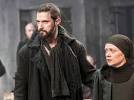
The Old Vic theatre company, as directed by Yoel Farber, takes on Arthur Miller’s near legendary play and arranges to have it beamed to a cinema screen near you. What’s not to like? Particularly when the interpretation is as compelling as this version, which stars Richard Armitage as a brooding, macho John Proctor and Anna Madely as his much put-upon wife, Elizabeth. The play of course, centres on the Salem witch trials, a device that Miller originally employed as an allegory about the McCarthy witch hunts of the 1950’s. Here the characters are compelled to talk in strong Lancastrian accents – possibly to evoke comparisons with the fate of the Pendle witches, or perhaps to point out that witch hunts can happen just about anywhere? I’m not entirely sure of the reasons behind the decision, but the fact is that it works brilliantly, making Miller’s ageless dialogue sing in a way I’ve never heard it before.

In a note perfect cast, it’s hard to single out highlights but Adrian Schiller’s take on the difficult role of beleaguered cleric, Reverend John Hale,  is a particular delight; and how amazing to see William Gaunt as the white-haired and irascible Giles Corey, evoking fond childhood memories of watching him play a young superhero spy in The Champions; what a decade-spanning career that has been! The standout scenes are the ones in which the ‘possessed’ girls, under the tutelage of Abigail Williams (Samantha Colley) crank the volume up to eleven. It’s powerful stuff this, and time has not dulled its cutting edge. Proctor’s final ‘confession’ is frankly the stuff of heartbreak and a demonstration of the way in which religion can be turned to support the forces of evil. A superb production and a rare opportunity to see the Old Vic in all its glory without paying for train tickets to London and a night in a hotel.

4.6 stars

Philip Caveney

Cat on a Hot Tin Roof

Unknown

Royal Exchange Theatre, Manchester

14/11/14

James Dacre’s production of Cat on a Hot Tin Roof is assured and confident, aided not inconsiderably by Mike Britton’s simultaneously stark and sumptuous set. The oppressive heat of the American Deep South is almost palpable, despite the cold reality of a November evening in Manchester. The lazy whirring of the inevitable ceiling fans and the glare of imagined sunshine from the gloss-white floor combine to create a drunken, languorous atmosphere seething with repressed emotion: the calm that comes before the storm.

Last night’s performances were solid: if Marian Gale (as Maggie) took a while to settle into the rhythm of her desperate stream of words, she made up for it in later scenes, where the raw emotion of unrequited love was beautifully expressed. Big Mama (Kim Cresswell) was a suitably unpleasant recipient for Big Daddy (Daragh O’Malley)’s crass indifference; Matthew Douglas and Victoria Elliott, as Mae and Gooper, provided a welcome respite from the play’s essential brutality, with their obnoxious brood of no-neck singing brats (think Sound of Music without the heartwarming stuff). The scenes where Brick (Charles Aitkin) was lying on the floor at Big Daddy’s feet, helpless without either his literal or his alcoholic crutch, brought home the importance of Williams’s theme: if Brick’s love for Jack Skipper had been allowed to thrive in the open, how much less destructive for all concerned.

Cat on a Hot Tin Roof is undoubtedly a miserable play, with little in the way of relief, and this production was certainly not to everybody’s taste last night. Three people sitting behind us left during Act 1 (one of them actually exiting through the set) to go for a cigarette, although they (unlike the couple sitting next to us) did at least return for the second act. Still, somebody in the audience clearly liked it enough to start taking photographs towards the end; the flash was distracting for us in the audience; goodness knows how irritating it was for the actors trying to focus on their lines.

All in all, this was an interesting – if ultimately unexciting – production. A faithful representation of a strange and turbulent play.

3.2 stars

Susan Singfield

Jeeves and Wooster in Perfect Nonsense

character-artwork-1

8/11/14

The Lowry, Salford

A perfect antidote for the November ‘glums’, Jeeves and Wooster in Perfect Nonsense offered what amounted to a large helping of theatrical fluff. But what accomplished fluff! This superb three-hander, already a substantial hit in the West End, finished it’s run at the Lowry in great style. I’d love to tell you something about the plot but it’s pretty unfathomable – something to do with a silver plated cream jug, a marriage proposal and some hilarious shenanigans concerning a nine foot tall Hitler lookalike. (I think that about covers it). Needless to say, Wooster blunders throughout proceedings in the time-honoured tradition, Jeeves manages to say so much with the merest raising of an eyebrow and I think it’s fair to say that PG Wodehouse would have approved of this interpretation of his work.

The conceit here is that Bertie (James Lance in triumphantly oafish mode) elects to act out one of his recent japes for the audience’s delectation, aided and abetted by Jeeves (John Gordon Sinclair) who in his usual capable manner has arranged for certain ‘props’ to be available. All the other roles (and they are numerous) are enacted by Seppings (Robert Goodale) an elderly retainer charged with a series of lightning fast costume changes. Special mention must go to set and costume designer, Alice Power, who has created a proscenium set that incorporates a multitude of tricky concealed entrances and exits, which enable the action to scamper along at breakneck pace. Some of the reveals are so surprising that the audience couldn’t conceal their gasps of amazement!

The three players handled the piece with consummate panache and during one extended set piece, where Jeeves had to enact two separate characters simultaneously (one male, one female) my laughter threatened to turn to sheer hysteria. Suffice to say, this was triumphant clowning of the highest order. The hearty ovation from a delighted audience was well and truly earned.

4.6 stars

Philip Caveney

Crash

Crash.preview

Traverse Theatre, Edinburgh

29/10/14

Offered in the great value, A Play, A Pie and A Pint slot, Crash by Andy Duffy is a brilliantly understated monologue that plays with our emotions and never loses momentum from start to finish. Monologues can be tricky. It’s crucial that an audience is brought into the actor’s confidence from the word go and Jamie Michie as ‘The Man’ manages to do just that.

He begins by telling us about an actual crash in which he was the driver and his wife, a passenger. But it also transpires that he is a stock market trader, who in 2007 strikes out on his own, just as the financial world is about to go into meltdown. The Man finds a new partner, experiments with meditation and tries to carve out a new future in the trading business, but deep inside, there is something festering…

Michie plays the role with great aplomb, making us care about a character who we eventually come to realise, we probably shouldn’t invest too much sympathy in. He is in effect, an unreliable narrator and at certain points through the play, the rug is pulled rather sharply out from under our feet as we realise he has led us astray. It’s a measured but powerful performance; when tears are called for, they are provided.

At just £12 for the performance and the lunch, this is a superb matinee that delivers in every sense of the word.

4.2 stars

Philip Caveney