Theatre

Kafka’s Monkey

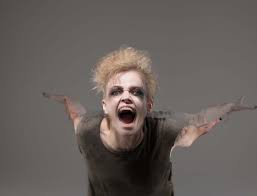
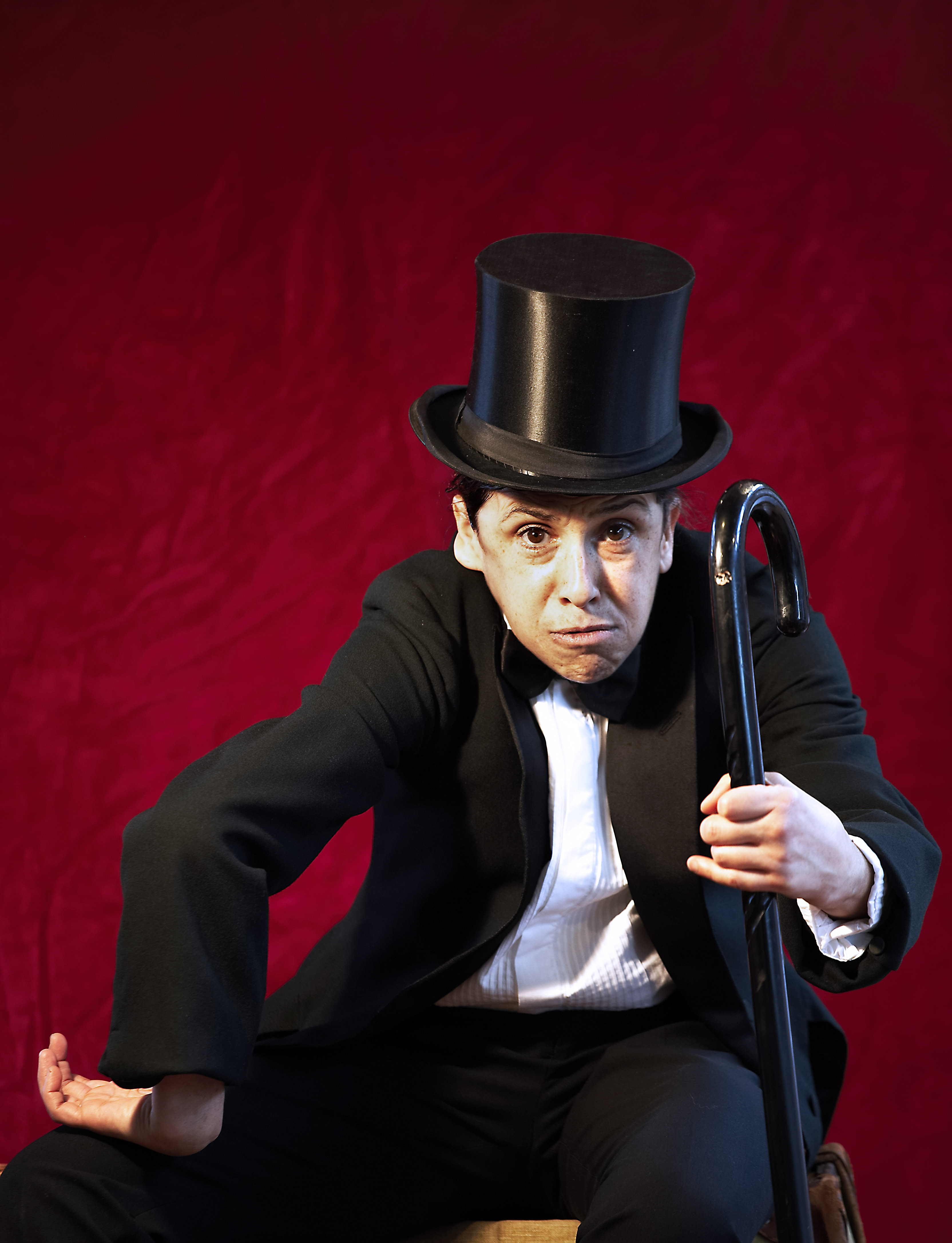
Kathryn Hunter in Kafka's Monkey at the Young Vic (photo by Tristram Kenton) Kafka's Monkey - pic 1

17/06/15

Home, Manchester

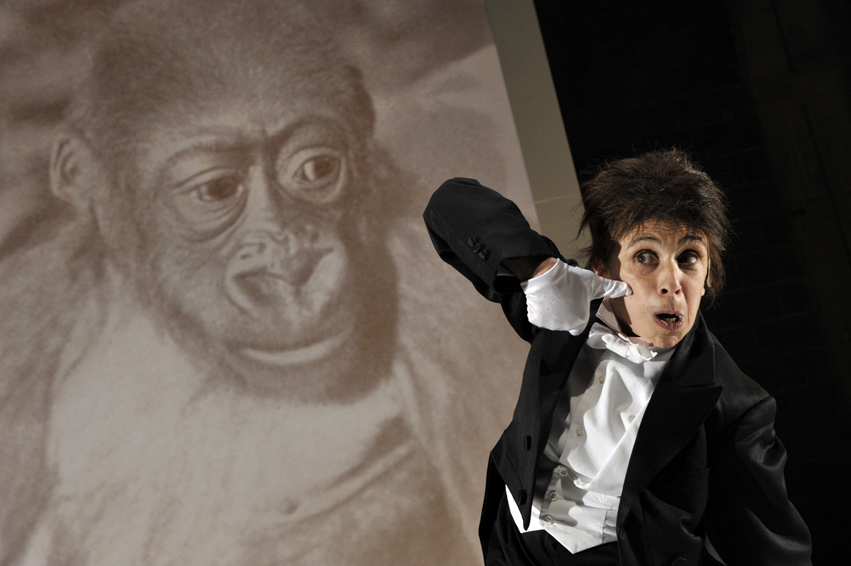
Based on Kafka’s short story, A Report To An Academy, and adapted for the Young Vic by Colin Teevan, (though it follows the original text pretty much word-for-word) Kafka’s Monkey is a fascinating monologue by Kathryn Hunter. It tells the story of Red Peter, an ape, captured in Africa and taught by his human masters to walk, talk and behave as a ‘human,’ mostly by aping the very worst aspects of humanity. Over a taut 50 minutes, we follow Peter’s progress from helpless captive to celebrated music hall performer and are left to speculate about the question of identity. Peter ultimately emerges as a misfit, a creature neither ape nor human but somewhere in between, and consequently a tragic figure. The play is completely dominated by Hunter’s extraordinary performance. Make no mistake, this is a tour de force of the actor’s art. She shuffles onstage, her body stooped and twisted and brilliantly embodies her simian character, eerily conveying Peter’s eccentric moves and his stylised way of speaking.

Sadly, the production’s other aspects aren’t quite in the same league. Teevan’s script attempts a form of iambic pentameter for Peter’s ‘human’ utterings and free verse form for his ‘monkey’ self – but the story is short on anecdotal material. The presentation is after all supposed to be taking place in a scientific establishment, which may go some way to explain its curious sense of detachment, but a more intimate approach would surely have elicited more empathy with Peter’s plight. A central screen seems somewhat underused, displaying as it does just one image, that of a chimpanzee. It’s left blank for most of the running time and might perhaps have been used to indicate different scenes – the hold of a ship, perhaps or a music hall. There’s a sparse electronic score, which again seems perfunctory, particularly when set against Hunter’s bravura performance.

There are a couple of welcome touches of humour scattered throughout the proceedings as ‘Peter’ interacts with people in the front row, hugging them, offering them bananas, coaxing them to join him onstage. Hunter also performs some contortions that elicit gasps of amazement from the audience. She’s worth the price of admission on her own, but I can’t help feeling that more supportive staging would have lifted this production to another level entirely.

3.8 stars

Philip Caveney

Funfair

GC_Home_Funfair_Wide-056 GC_Home_Funfair_DressR-491

2/6/15

Home, Manchester

We were (ironically) away from home for the launch of Home – Manchester’s brand-spanking new arts centre, which takes over from two legendary local institutions, The Cornerhouse and The Library Theatre. Home is housed in a great big serious-looking building at the end of First Street, replete with cinema screens, theatres, exhibition spaces, a cavernous bar and a restaurant. What’s not to like?

There’s certainly plenty to like about its inaugural theatre presentation, The Funfair. This is Simon Stephens’ astute adaptation of Odon Von Harvath’s late 20s play Kasimir and Karoline. Stephens must be the hardest working person in theatre right now and if Von Harvath’s play seems a wilfully obscure choice as the opening gambit for a brand new venue, its certainly a prescient one – the original play was set in austerity-stricken Munich just a few years before the rise of the Nazi party. It’s surely no coincidence that the story strikes a whole series of ironic chords with what’s happening in the UK right now. The action takes place in and around a seedy fairground and Ti Green’s design captures perfectly the tawdry splendour of such settings. Neon lights flicker, carousels whirl and you can almost smell the fried onions.

Cash (Ben Batt) is a former chauffeur, himself a victim of the stricken economy. Out of luck and now out of work, he worries that his already turbulent relationship with fiancé Caroline (Katie Moore) is doomed to failure by his lack of employment – and there are certainly plenty of temptations lying in wait for her when, after a row with Cash, she decides to visit the fair, with the professed intention of going on ‘all the rides’. She soon elicits the attentions of John Chase (Rhodri Meilir) a dorky but ambitious salesman with a liking for ice cream. When John’s rich boss, Billy Smoke (a superbly lascivious Ian Bartholomew) turns up accompanied by his equally venal companion, David Spear (Christopher Wright) their combined gaze falls upon Caroline… and the stage is set for a deliciously dark allegory about the human condition and its propensity for excess.

The Funfair is a dazzling box of delights, a real multi-media event that employs lights, shadows, live rock music, back and front projection, masks, movement and a central turntable that’s used to stunning visual effect, but none of this is ever allowed to overwhelm the splendid performances from the ensemble cast. Stephens’ canny script flips us back and forth like a well-oiled rollercoaster between the various intertwining stories and the events culminate in a bitter-sweet scene that will stay with you long after you’ve stumbled out of the building.

Home really couldn’t have asked for a better opening salvo than this. It’s on until the 13th of June and it’s an unqualified delight. Miss it and weep.

5 stars

 Philip Caveney

Scotland Short Play Award 2015

Unknown-1 Unknown

Traverse Theatre, Edinburgh

28/05/15

The Traverse is a writers’ theatre, its commitment to new writing intrinsic to its existence. This makes it an exciting place to visit; one thing here is always certain: you won’t be watching a tired old revival or an over-exposed crowd-pleaser.

Last night’s showcase of the four finalists in the Scotland Short Play Award 2015 was a case in point: a genuinely compelling selection of pieces, all simply staged but powerfully performed, with all the wit, vigour and contention you could hope for from a group of emerging young playwrights.

First up was Morven by Emily Ashton. This was a disturbing howl of a play, with Nicola Roy superb as the anguished mother, who may or may not have murdered her child. Hounded by both press and social workers, at once devastated and furious, the eponymous Morven forced the audience to confront the idea that we can never really know the truth about some stories, no matter how clear cut they appear in the tabloids. The play’s structure was simple, and the director (Tony Cownie) utilised this to advantage, employing some nice techniques, e.g. the disembodied voice of the invisible questioner filling the theatre; the headline-like questions projected onto the wall; the Katie Mitchell-esque ‘live’ projections emphasising the minutiae of Morven’s movements and expression (not least, in fact, at the end, when the projection ceased to mirror Morven, showing how dissociated even she had become). A cracking start.

The second play was Romance by Ross Dunsmore, and this was our favourite of the night. A two-hander, performed with charm and gusto by Joanne Thompson and Cristian Ortega, it explored the complexities of a teenage relationship in the social media age, laying bare the insecurity and vulnerability that leads young girls to share explicit images of themselves. If that sounds bleak, it does the play a disservice, as this was laugh-out-loud funny, depicting the sweetest of boys remaining doggedly  loyal to the girl he likes. It even had a hopeful, warm-hearted ending. In some ways, it made a mockery of the media hysteria around sexting. ‘Yeah ok,’ it seemed to say, ‘people do stupid stuff, and there can be ugly consequences, but – you know – this too will pass. It doesn’t have to be the end of the world.’ A poignant, endearing and humorous play. Lovely stuff.

Next was Cameron Forbes’ It Never Ends, another two-hander about a modern relationship, this time focused on the slightly older demographic of the undergraduate. This was perhaps the most controversial piece of the night, dealing as it did with two young people heading out to a club, both keen to let loose: get drunk, get high and get laid. Their intentions were clear and stated, and the first half of the play was full of hope and hedonism, dancing and fun. The following morning, however, waking up in a stranger’s bed, the young woman had no recollection of their sexual encounter, and crept away, bereft and violated. There was no redemption here, and no easy ‘answer’ for the audience. The young man was not a rapist (he was as inchoate as she) but she certainly felt raped. Neither of them found the joy they were seeking. It’s a sad and complex issue, and the tragedy was made clear here.

The final play of the night was Potterrow by Martin McCormick. This was the most ambitious piece by far, and perhaps the least suited to the fifteen-minute time-frame. Nevertheless, it was a fascinating monologue, charting a man’s breakdown: a new parent’s sleep deprivation leading to paranoia and obsession, and – eventually – to the murder of an old woman whose dog fouls The Meadows. We were never quite sure if he was a policeman or not, or if the uniform he wore was just another symptom of his ailing mind. The footprints laid out on sheets across the stage mapped out the man’s demise, and also emphasised how often he became derailed, his intentions thwarted along the way. The performance, by Gavin Jon Wright, was both nuanced and convincing. This playwright is certainly one to watch.

All in all, then, this was a fascinating night, and bodes well for the future of theatre. With these young playwrights at the helm, things look very promising indeed.

4 stars

Susan Singfield
The King’s Speech

Unknown001562_regular

King’s Theatre, Edinburgh

23/05/15

The King’s Theatre, Edinburgh, has a reputation for being beautiful. “If you like the Lyceum,” several friends have told us, “just wait until you see the King’s.” And, to be fair, the building is gorgeous: all perfectly preserved Art Deco woodwork, and a frankly overgenerous serving of boxes, with a staggering eighteen ornate (and empty) loges dominating the auditorium. So, yes, the theatre is lovely to look at.

Unfortunately, I didn’t love the play. The story was too familiar from the over-praised film (I enjoyed the film, I really did, but it felt more like a decent TV drama than the Oscar-winning heavyweight it was lauded as), and the subject too unsympathetic. It’s hard to empathise too much with such a vastly over-privileged man.

The performances were good: Jason Donovan made an appealingly irreverent Lionel; Claire Lams a wonderfully acerbic Queen. But the dialogue was plodding, and the direction lacked the lightness of touch that elevated the film. Set changes, for example, were more complex than necessary, interrupting the flow and slowing the pace. The simplicity of the wooden wall panels was negated by the constant shifting of superfluous props: the location was clear as soon as a door slid open; I didn’t need three desks, a bookshelf and a couple of armchairs to tell me where we were.

I liked the way the political machinations were writ large in this play, and how Lionel Logue’s refreshing lack of agenda was shown to contrast so heavily with the naked, ugly self-interest of the clergy, the government and the royal family itself. But, overall, this was not for me.

2.3 stars

Susan Singfield
The Ghost Train

Unknown-1 Unknown-3

Royal Exchange Theatre, Manchester

19/05/15

The Royal Exchange are billing The Ghost Train as a comedy thriller, and there are certainly elements of both within Dad’s Army favourite Arnold Ridley’s 1920s play. It’s a lively production, performed with zeal by the ever-peppy Told By an Idiot, and there’s plenty to commend.

The premise is simple: six passengers are stranded at an isolated railway station, purportedly haunted by a ghost train. The play follows the development of their relationships, and unravels the mystery of the phantom. It’s hardly challenging stuff, but then, it isn’t meant to be, or at least not in this incarnation. Here, it’s clearly supposed to be fun – a riotous, silly, galumphing escapade – and it certainly had the audience laughing throughout.

There were a lot of clever moments: I love a bit of overt theatricality, so I was tickled by the narration-and-sound-effects idea at the start of the play (although I did feel it went on too long), and impressed by some of the set pieces, such as the initial (interrupted) train journey, and the prolonged parrot-chase. The cast revelled in the performance, and their enthusiasm was – at times – infectious.

However, despite (or because of) all the playfulness and witty ideas, the play just didn’t hang together. It was uneven and incoherent at times, with techniques shoehorned in as if it were an A level piece (where students need to demonstrate everything they know, all at once, even if it doesn’t really fit).

And, while some ideas were stretched to their limits – the ludicrous woman-in-a-parrot-suit, for example – other, more promising notions just weren’t taken far enough (the clowning was half-hearted; the drag act criminally understated), which was a real shame.

In all honesty, this play just didn’t work for me or my companions, but this certainly wasn’t a universal view. The house was raucous with laughter, and the applause was enthusiastic. Why not see it and decide for yourself? You certainly won’t be bored.

2.4 stars

Susan Singfield

The Venetian Twins

Unknown

02/05/15

Lyceum Theatre, Edinburgh

Carlo Goldoni is, of course, the playwright whose earlier work, A Servant of Two Masters was so fruitfully adapted by the National Theatre to create One Man, Two Guvnors. The Venetian Twins is cut from the same bolt of gaudy cloth (indeed, can it really be a coincidence that lead actor Grant O Rourke is a dead ringer for James Corden?) At any rate, it matters not. This is a farce majeure, beautifully played, timed to precision and rib ticklingly funny from start to finish.

The action takes place in Verona. Rich and somewhat dim country boy, Zanetto (O Rourke) comes in search of a bride, specifically the nice but equally dim Columbina (Angela Darcy) whose gold-digging father, The Provost senses an opportunity to refill the family’s depleted coffers. But Zanetto has an identical twin brother, Tonino (also played by O Rourke) from whom he was separated as a child. When Tonino flees his native Venice for Verona along with his sweetheart, prototype feminist Beatrice (Jessica Hardwick), the scene is set for a bewildering series of ‘mistaken identity’ disasters. It’s a cliche to say that much hilarity ensues but in this case, that’s exactly right.

In the wrong hands, farce can be toe-curling, but there’s not a foot put wrong here (unless you count the hilariously drunken old landlady who falls repeatedly through an open trapdoor.) This owes much to Commedia Dell Arte, but this is no ‘off-the-peg plot. Much of the wittily updated script by Tony Cownie is delivered in broad Scots accents, which work brilliantly, and there’s a wonderfully foppish performance by John Kielty as the effete (and inevitably English-accented) Florindo. There’s some wonderfully fruity innuendo, a fistful of malapropisms from Columbina and a stomach-churning scene involving a blocked toilet that modesty forbids me to describe in detail. Meanwhile, O Rourke slips effortlessly between the two roles simply by doing up the top button on his jacket and adopting a different expression. The two acts galloped by while the audience, myself included, were convulsed with laughter from start to finish. If laughter is something you relish, then you really should see this before it moves on. It’s a Venetian blinder.

5 stars

Philip Caveney

The Rolling Stone

Unknown

24/04/15

Royal Exchange, Manchester

Receiving its World Premiere at the Exchange, The Rolling Stone by Chris Urch has a short run here before transferring to the West Yorkshire Playhouse. It’s a story torn straight from the headlines. In the opening scene, two young men recline beside a lake on their first date – they chat, flirt and eventually kiss. Nothing at all out of the ordinary – except this is Uganda where homosexuality is expressly forbidden and transgressors face life imprisonment and ostracisation. Dembe (Sule Rimi) has fallen in love with young doctor, Sam (Robert Gilbert) who has an Irish father and a Ugandan mother. They both know that their relationship must be kept under wraps – particularly since Dembe’s older brother, Joe has recently been ordained as a church minister for their small community. But the local newspaper, ‘The Rolling Stone’ is always on the lookout for those people it likes to tag as ‘deviants’… and there’s a terrible price to pay if your name appears on their list…

There’s a great play to be written about this subject, but sadly, The Rolling Stone isn’t quite it. Despite excellent acting from the six-strong cast and some rousing acapella singing, the play’s characters are rarely allowed to rise above the two-dimensional; it’s hard to believe that they have another life outside of the story and everything we learn about them, seems designed merely to power the narrative. There are, however, some good scenes along the way. The playful opening hints at depths hidden beneath the surface, even if it never actually uncovers them; Joe’s vitriolic sermon condemning homosexuality makes for uncomfortable viewing and the play ends on a moment of high tension, where we realise the full implications of Dembe’s situation – but I wanted to know so much more about his family relationships and that didn’t really come across.

The Rolling Stone tells an important story, one that deserves to be heard by the widest possible audience and I’m glad that it has been written, (glad too that The Exchange deemed it worthy of production) but this must count only as a partial success. It continues here until the 1st of May.

3 stars

Philip Caveney

Shooting With Light

Unknown-1

22/03/15

Lowry Theatre, Salford

At the Edinburgh Fringe 2013, one of our happiest discoveries was the physical theatre group, Idle Motion. We saw two productions – Borges and I (based around the life of writer and librarian, Jorge Borges) and That Is All You Need To Know (inspired by the story of Bletchley Park and the breaking of the Enigma Code.) Both pieces were extraordinary and we were disappointed to discover that they weren’t back at the Fringe in 2014.

Now here’s a touring production of their latest offering, Shooting With Light, which we caught at the beginning of it’s short tour. It’s the story of famous war photographer, Robert Capa (or to give him his real name, Andre Friedman) and his partner, Gerda Taro, who shared his passion for such dangerous work and in many cases, actually took some of the photographs with which he was credited. What I love about this group is their simplicity. A basic set of centrally placed translucent white boxes becomes a whole variety of locations – doors, windows, a cinema screen (presciently showing Frank Capra’s It Happened One Night), wardrobes, phone booths, you name it. As always with Idle Motion, this is an ensemble piece with just five performers taking on a multiplicity of roles. In a mixture of acting and movement they lead us into the dark heart of the Spanish Civil War and, intriguingly, place  a mystery at the centre of the story – the search for a box of lost negatives that includes the picture that Capa considered the most important of all.

If I have a minor criticism with the piece, it’s simply that, so early in the tour, the movement isn’t quite as slickly choreographed as it will be as it settles in. There were a couple of clumsy missteps tonight and a slightly shonky moment where a rug was flung out of a window for Capa and Tarot to ‘lie’ on – the resulting effect, beneath a starry sky, was magical, mind you, but the transition, rather less so. I’m quibbling here. This is a splendid performance piece, engaging, atmospheric and ultimately rather emotional – both Capa and Taro paid the ultimate price for their undoubted courage and I’m not embarrassed to say that at one point I was watching through tear-filled eyes.

Shooting With Light continues at the Lowry until the 24th of April and then heads out to a series of locations around the UK until the 9th of May. (You’ll find full details on the group’s website.) If you love physical theatre and want to see it brilliantly performed, then I urge you to catch this show. It really is worth the effort.

4.4 stars

Philip Caveney

Cuckooed

Unknown

18/04/15

Cuckooed was one of the hot tickets at last year’s Fringe – so hot, in fact, that we failed to procure tickets for it. So it was great to see it repeated at the Traverse Theatre and to note, that once again, it was absolutely sold out. Luckily we booked early.

Tonight’s show is divided into two halves. Before the titular ‘comedy of betrayal,’ we are treated to forty minutes of chat by writer and star Mark Thomas, focusing mostly on the ‘105 Acts of Minor Dissent’ that he recently set himself. It’s hard to describe Thomas’s act. He’s not exactly a standup, in the sense that there are no real jokes or punchlines here – and yet he has people roaring with laughter, pretty much from the get go. He’s actually an activist, a ‘domestic terrorist’ as the police like to label him, a man who entered the Guinness Book of records for holding 20 protests in 24 hours. Thomas has devoted his life to confronting senseless authority and he manages to make me feel ashamed for not doing more. He’s also a man who doesn’t hold back when talking about those who he feels fall short of being decent human beings. A recent competition he held, to come up with a definition of the word ‘Farage,’ resulted in the following: Farage: the puddle of smelly liquid at the bottom of a rubbish bin. 

Cuckooed is a more complex animal, a blend of theatre, witness-recollections, video and reconstruction. Instead of a programme, we get a paperback copy of the script, which is always a bonus. It tells the story of when Mark was a member of the Campaign Against the Arms Trade and carried out protests alongside his dearest friend, referred to here only as ‘Martin.’ When it becomes apparent that members of the group are being spied on by the arms company, BAE Systems, it soon transpires that there has to be a mole working within CAAT, and, after much digging, suspicion falls upon Martin. Thomas is at first incensed. How could just a hardworking, devoted activist be thought capable of performing such a horrible deception? But, as he begins to probe the evidence himself, a terrible truth is uncovered…

Thomas is a mesmerising performer. This is essentially a monologue (with interjections from witnesses recorded on video screens, cleverly contained within the sliding drawers of filing cabinets), but he carries the show expertly, using all the techniques of a gifted actor. A key scene where his emotion builds to the point where his eyes fill with tears of regret is incredibly moving, and, I believe, impossible to fake. It raises some incredibly cogent questions about the right to privacy and touches on other deceptions – notably the case of undercover policeman John Dines, who conducted a three year relationship with a woman, a member of an anti-capitalist group, simply in order to spy on her and the other members.

It’s a brilliant show, not the angry diatribe it might have been, but thoughtful and measured. At its conclusion, the audience rise to their feet to deliver a well-deserved standing ovation. You can bet that we’ll be booking tickets early for his next show, Trespass, when it comes to Edinburgh in August.

5 stars

Philip Caveney

Broth

Unknown-1 Unknown

Traverse, Edinburgh

The Traverse Theatre’s A Play, A Pie and A Pint is a fabulous idea: for a mere £12, punters can treat themselves to a warm lunch, a convivial drink, and – of course – some entertainment. It’s a clear attempt to thwart theatre’s (often unfair) elitist reputation; to render play-going a simple, unpretentious event.

Let’s begin with the play. This one (the last in PPP’s Spring season), Broth by Tim Primrose, starts very well indeed: three women, a kitchen and a blood-soaked man. The man is Jimmy, a terrifying patriarch, husband, father and grandfather – respectively – to Mary, Sheena and Ally. It seems that Mary has, for once, fought back: Jimmy is unconscious, maybe even dead, and his blood is everywhere – all over the table cloth, the kettle, his clothes and his face. The three women unite as they try to work out what to do.

The premise is strong, and the characters convince. Their voices are appealingly authentic, the Scots dialect employed with knowing wit and a lightness of touch. The performances rarely falter, and the relationships are beautifully flawed. It’s funny too: that raw, black humour that epitomises domestic tragedies such as this. It’s hard to single out an individual actor for praise; this is a real ensemble piece, and they work together to create a fully-realised world.

Unfortunately, the plotting doesn’t seem as strong as the other elements: after a tight forty minutes, the story starts to waver, becoming repetitive and unfocused. It’s still enjoyable, but there’s no peril left, and the half-hinted at idea of the metaphysical (‘It hurt when you killed me’) is never really developed, so that it feels like a wasted concept – a strange red herring that adds nothing to the play.

Still, it’s well worth seeing, and would work well away from a traditional theatre setting too: this is a play that would translate effectively to a school hall or a community centre or a working men’s club. It’s a welcome slice of kitchen-sink – and at its best when its not trying to be anything else.

Oh – and the pie was lovely.

3.2 stars

Susan Singfield