Film

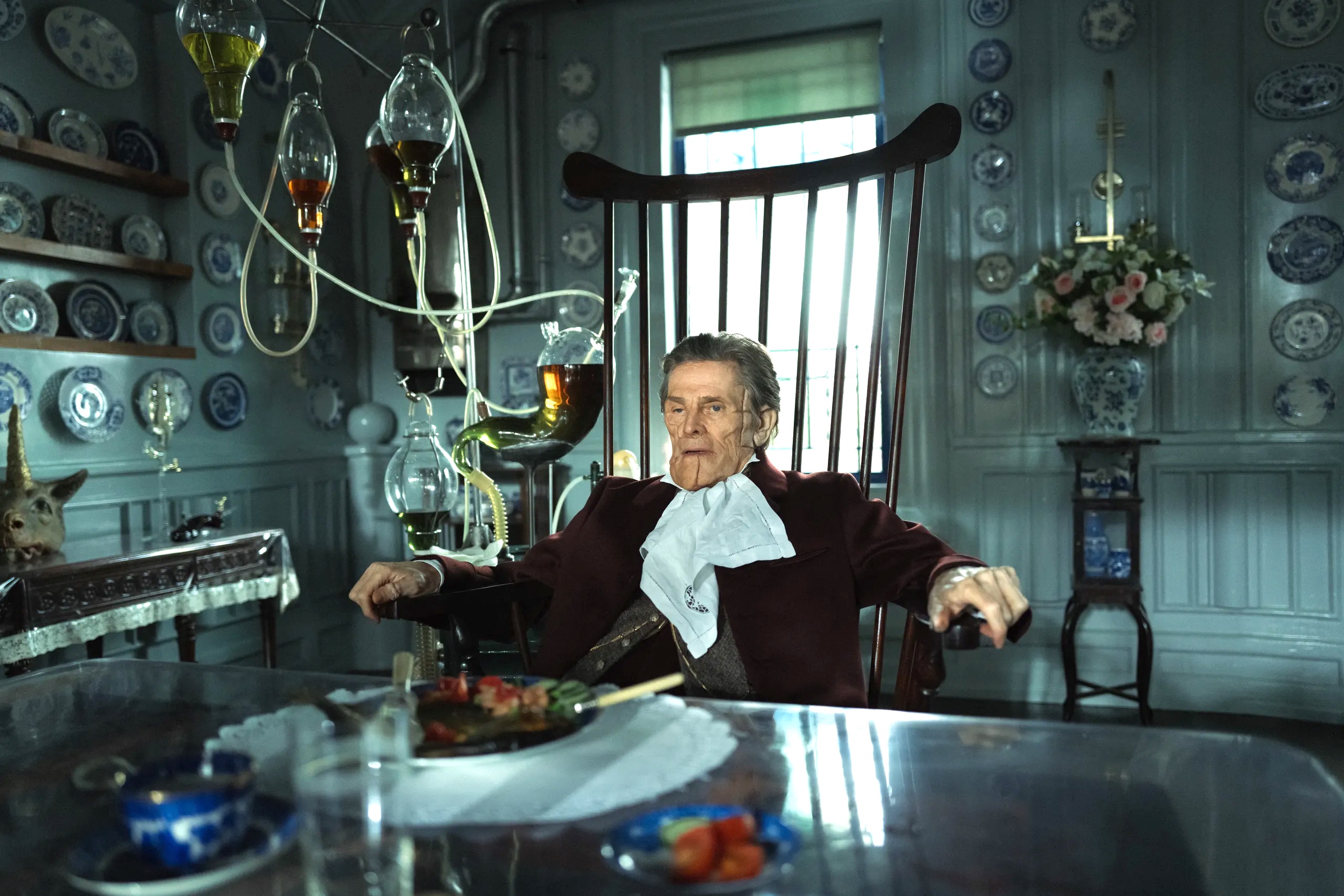
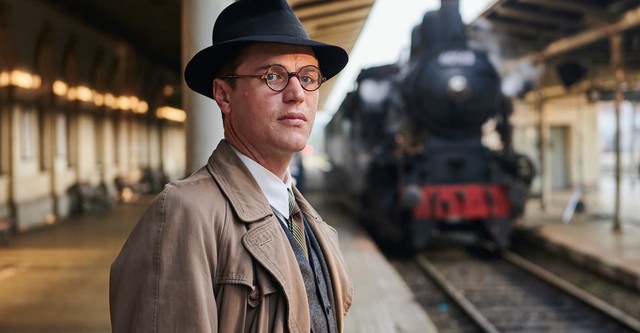
A Haunting in Venice

15/09/23

Cineworld, Edinburgh

Kenneth Branagh’s third attempt to bring Agatha Christie’s most celebrated detective back to cinema stardom initially feels like every James Wan movie you’ve ever seen: a series of elaborate jump scares designed to unnerve viewers and open them up to the possibility of supernatural goings on.

But it isn’t long before we encounter Poirot, recently retired to – well, the clue’s in the title – and apparently finished with the world of sleuthing, happier to fill his spare time with gardening. He’s even hired ex-police officer, Vitale Portfoglio (Riccardo Scarmacio), to act as his bodyguard, ensuring that anybody who comes looking for the services of a sleuth is treated to a quick push off the edge of a canal. But one person does manage to get through. She’s author Ariadne Oliver (Tina Fey), who thinks she’s responsible for Poirot’s fame in the first place by featuring a thinly-disguised version of him in one of her early novels. Now she wants to enlist him to investigate the notorious medium, Mrs Reynolds (Michelle Yeoh), who – Oliver claims – seems to be ‘the real McCoy’.

Staunch non-believer Poirot agrees to go along to a Hallowe’en event in a crumbling palazzo, said to be haunted by the ghosts of many lost children. The current owner, Rowena Drake (Kelly Reilly), is keen to contact the ghost of her daughter, Alicia (Rowan Robinson), who committed suicide. Rowena has hired Mrs Reynolds to contact her and find out exactly why she did it.

Poirot is soon happily exposing Mrs Reynolds as a fraud but things take a nasty turn when the medium falls to her death from a high window (bet she didn’t see that coming). And naturally, the killings are not going to end there. A large group of mid-listers find themselves marooned by a violent storm in a building that – conveniently – can only be accessed by boat.

The main problem with A Haunting in Venice is that it’s neither fish nor fowl. The ghost story/horror elements fail to convince, while the plot (if I can call it that) is so risible and convoluted that it’s hard to take any of it seriously. Amidst a sea of familiar faces, the only ones that really connect are a re-teaming of Belfast father and son duo, Jamie Dornan, as a doctor haunted by his experiences in the Second World War and Jude Hill as his somewhat creepy son (who, unfortunately, is a dead ringer for a young Michael Gove). But sadly, they’re not enough to make this turkey fly.

In the latter reaches of the film, some of the sequences are so murky and labyrinthine that I’m occasionally left wondering what is happening to who and where. Screenwriter Michael Green (who has based this farrago on a 60s Christie novel entitled Hallowe’en Party), somehow manages to have his cake and eat it by suggesting that not every supernatural element has been faked. But the intellectual flexing required to solve the case suggests that, by its conclusion, Poirot is back in the game.

After suffering through A Haunting in Venice, I seriously doubt I’ll be back to see the next in the series.

2.4 stars

Philip Caveney

Past Lives

10/09/2

Cineworld, Edinburgh

It’s hard to believe that Past Lives is only the debut film of Korean-Canadian playwright, Celine Song. Here she has created a narrative so assured, so brilliantly handled, it’s little wonder that critics around the world have fallen for its charms. And I am swooning along with them.

When we first see the three main protagonists, they are chatting together in a bar, while a couple of unidentified voices speculate about what their relationship might be. We learn further down the line that they are playwright, Nora (Greta Lee), her novelist husband, Arthur (John Magaro), and Korean engineer, Jung Hae (Teo Yoo). Their relationship is complicated to say the very least, and the film takes its time unravelling an explanation. But relax, there’s no great hurry.

First we must backtrack twenty-six years to see young Nora (or Na-Young, as she was called then) and Jung Hae, at school together in Korea. They are already inseparable, so much so that their respective mothers take the two of them out on a first ‘date’. But huge changes are looming. Nora’s parents are keen to emigrate to Canada, so that their respective artistic careers can prosper. To help her adapt to her new home, Na-Young adopts the name ‘Nora,’ and is obliged to say goodbye to Jung Hae, but twelve years later, the two of them reconnect online and begin a series of soulful conversations.

Jung Hae tells Nora that he still thinks about her all the time. Sadly, work commitments get in the way and once again the two of them drift apart.

Then, at a writer’s retreat in Montauk, Nora meets Arthur and, almost before they know what’s happening, a decade or so has slipped by and the two of them are happily married and living in a tiny apartment in New York.

And then, Jung Hae travels thousands of miles to visit them…

In clumsier hands the stakes at this point. Nora and Jung-Hae would doubtless realise that they’ve always been meant for each other and Arthur merely an obstacle to be overcome, by force if necessary. But Song’s beautiful and lyrical approach to the story displays a generosity of spirit that takes in all those conflicting emotions and accepts that it’s okay for them to exist – that the three protagonists are all on the same journey through life and can co-exist, without recourse to anger or brutality. Song’s perceptive screenplay makes her characters act and talk like real people actually do.

Shabier Kirchner’s cinematography captures the cities of Seoul and New York in vivid detail and the plaintive music by Christopher Bear and Daniel Rossen is perfectly matched to the film’s languorous, sedate pacing. By the third act I am, quite frankly, spellbound by the story, which is sweet and yearning and deeply affecting, particularly when Jung Hae confesses to Nora that he didn’t realise that liking Arthur would cause him so much pain. The conclusion is so adeptly handled I want to applaud.

If this is Song’s debut, I can only wonder about what she might achieve further down the line. Meanwhile, Past Lives is truly impressive. Miss it and weep… or see it and weep. The choice is yours.

5 stars

Philip Caveney

The Equalizer 3

03/09/23

Cineworld, Edinburgh

Denzel Washington famously resists doing sequels, but this is his third outing as everybody’s favourite vigilante, Robert McCall, and his fifth film with Antoine Fuqua, with whom he won his second Oscar for 2001’s Training Day. (If you’re wondering, the duo’s other collaboration is the much underrated remake of The Magnificent Seven. You’re welcome.)

TE3 takes McCall away from his familiar beat and sets him down in Italy, where he’s exacting his usual unflinching version of comeuppance to an elderly farmer, who is not quite the innocent he appears to be – though what he’s actually done to deserve such retribution is kept a secret until the end. On first appearance, McCall has an almost sepulchral look, as though his endless diet of shooting and punching bad people has taken a terrible toll on him.

On his way out, McCall makes an uncharacteristic mistake and winds up with a bullet in his back, but luck is with him and he winds up being taken care of by Enzo (Remo Girone), a charming small-town doctor who doesn’t ask too many questions and who offers McCall a place to lay his head. Filmed in the impossibly picturesque town of Amalfi, it’s hardly surprising that McCall soon starts thinking that he’s finally found himself a home.

But even impossibly picturesque Italian towns have their crosses to bear and here it’s in the form of Mafia thug Vincent Quaranta (Andrea Scarducio), who has his own heinous plans to transform the sleepy little harbour into a convenient place for shipping off regular consignments of illegal drugs. It soon becomes clear that McCall has some more trash to take out before he can happily retire…

Washington is a fabulous actor, with enough gravitas to elevate material like this and take it to another level – and Fuqua too is a skilled director, who never makes the mistake of allowing the violence in his films to look ‘cool’. The physical exchanges between McCall and those who are foolish enough to underestimate him are unflinchingly visceral and (quite literally) pull no punches.

You could argue that the people McCall comes up against are almost cartoonishly evil and that much of the pleasure in watching these films comes from seeing such creatures given the same rough treatment they’re happy to hand out. But I’d be the first to admit that I enjoy TE3 enormously and, on a giant IMAX screen, Washington’s performance looks even more towering than usual.

There’s also a labyrinthine quality to the plotting here, including a through-line that brings in Dakota Fanning as CIA operative Emma Collins as a key part of the story – and there are brief glimpses (blink and you’ll miss ’em) of characters from the previous instalments. Stay in your seat till the end and all will become clear.

Will there be a TE4? Probably not. It’s unusual for a franchise to make it to a third outing without jumping the shark, so maybe Washington and Fuqua should quit now, while they’re still ahead. Then again, Robert McCall does seem to have an uncanny knack of moving to locations that need his unequivocal style of rough justice. If one arrives, I’ll be there for it.

4 stars

Philip Caveney

Scrapper

29/08/23

Cineworld, Edinburgh

Georgie (Lola Campbell) is just thirteen years old and, since the recent death of her mother, she’s managing to fend for herself in a council flat somewhere in London, all on her own. The neighbours know of her situation but turn a blind eye to it, not wanting to see her engulfed and spat out by the system. Meanwhile, with her best friend, Ali (Alin Uzan), Georgie is making ends meet by stealing second-hand bikes and selling them on to local shopkeeper, Zeph (Ambreen Razia).

Georgie is determinedly self-sufficient and precocious beyond her years, even able to smoothly talk her way out of trouble when a woman finds her trying to remove her bike-lock. But then one day, Jason (Harris Dickinson) climbs over the garden fence and introduces himself to Georgie as the father she’s never met. He’s been over in Spain working as a ticket tout, but has returned with the intention of getting to know his daughter. Georgie is initially suspicious of him, not allowing him to sweet-talk her, the way he’s already doing with Ali – but, bit by bit, her defences begin to crumble…

This is the feature debut of young writer/director Charlotte Regan and it’s been compared to Aftersun, with which it does perhaps share some DNA – though that’s perhaps unfair, because Scrapper is its own beast.

Steadfastly refusing to play to the usual poverty porn clichés, Scrapper depicts the estate where Georgie lives in bright, primal colours and offers us short, direct-to-camera comments from some of the other local inhabitants – even the spiders in Geogie’s house manage to have their say! Campbell’s performance is extraordinary, while Dickinson is totally convincing as Jason, a man who has never really matured but is doing the best he can to meet the demands of fatherhood.

I like too the scenes that are shown from Georgie’s own POV – the weird assemblage of bicycle parts she has constructed in the spare room, which in her mind’s eye assumes gigantic proportions: a dizzy ladder climbing to heaven, where she hopes her mother is waiting for her.

Sweetly sad and often affecting, Scrapper is a delightful low-budget gem from a young director with plenty of potential.

4 stars

Philip Caveney

Luck

16/07/23

Apple TV

After experiencing some er… issues at his old outfit, former head honcho of Pixar John Lasseter has formed his own studio, Skydance Animation, along with a whole bunch of other producers. Their first release, Luck, an Apple original, has all the visual hallmarks of a Pixar production, though directors Peggy Holmes and Javier Abad – and writers Kiel Murray and Jonathan Aibel – don’t seem able to negotiate the fine line between emotion and mawkishness quite as skilfully as Pixar do.

The film starts confidently enough with orphan Sam (Eva Noblezada) turning eighteen and accepting that the ‘forever family’ she’s always longed for simply isn’t going to happen. She must strike out on her own, find a job and learn to fend for herself. It’s refreshing to see an older protagonist at the centre of an animated story and, when we learn that Sam’s always been cursed with bad luck, the point is skilfully demonstrated by a series of beautifully-timed slapstick routines.

But Sam’s luck changes dramatically for the better when she shares a snack with a talking black cat called Bob (entertainingly voiced by Simon Pegg in a dodgy Scottish accent. Don’t worry, it’s explained later…). Bob leaves behind a lucky penny, which Sam picks up – whereupon, her own luck changes for the better. If she drops a slice of toast now, it lands jam side up! But Sam vows to give that penny to a little girl at the orphanage, who Sam knows is hoping to be adopted.

When she inadvertently drops the penny down a toilet, Bob comes back in search of it – and, before she quite knows what’s happening, Sam is accompanying Bob to the legendary ‘Land of Luck’ in search of a replacement…

Luck is a bit of a mixed bag. The early sections, set in the real world, work just fine and hit the chuckle buttons, promising a thoroughly enjoyable experience – but, once in the fantasy world, everything becomes a bit too complicated for its own good and, as a result, it feels less assured. The story galumphs along at full steam expecting us to take a lot in our stride: a tribe of penny-polishing leprechauns with awful accents (no excuses offered this time); a Queen dragon voiced by Jane Fonda; a leprechaun captain (Whoopi Goldberg); and a camp moustachioed unicorn called Geoff (Flula Borg), who is fond of a workout down the gym.

But then it turns out there’s also a Land of Bad Luck and, when Geoff’s complicated machinery (it keeps the two opposing forces balanced) goes a bit haywire, we’re told there’s a danger of all the good luck in the world disappearing, a possibility that unfortunately generates no jeopardy whatsoever.

Not awful then, by any stretch of the imagination, but frankly not in the same league as some of Pixar’s big-hitters – though, truth be told, even they are struggling to reach their former heights. Why would that be I wonder? Bad stories? Bad management decisions ? Or just bad luck?

You decide.

3.4 stars

Philip Caveney

My Imaginary Country

11/07/23

The Cameo, Edinburgh

The young people at the heart of this documentary are genuinely awe-inspiring. Prior to watching this, I’ll admit that I was almost entirely ignorant of the situation in Chile, and certainly unaware of what this impressive grass-roots protest had achieved.

Sparked by – of all things – an increase in the price of subway tickets, the ensuing estallido soon expanded into a general call for equality and justice, a demand for a new way of living. Hundreds of thousands of people – primarily young women – stood up for the cause, persisting in the face of tear gas and military oppression. And they won, eventually forcing a change of government.

Patricio Guzmán is a seasoned documentary maker, and it shows. My Imaginary Country offers us a tentative celebration, combining a justifiable sense of pride and triumph with a note of caution about what could still go wrong. After all, Chileans are all too aware that their hard-won democracy can be plucked from them in an instant.

Nonetheless, the footage captured here is mesmerising. Drones reveal an apparently endless sea of people, the scope of their demands seemingly as inexhaustible as their number. They don’t confine themselves to a single issue. Instead, they want it all: increased pensions for the old, equal rights for LGBTQ+, better job prospects, free education, decent health care for all. In short, they want society to function properly, the way it’s meant to. They want politicians to live up to their promises.

Governments around the world should take note. Today’s youth knows how to mobilise; they know how to take matters into their own capable hands. And they’re tired of being ignored.

4 stars

Susan Singfield

Mission Impossible: Dead Reckoning Part One

10/07/23

Cineworld, Edinburgh

Most long-running movie franchises start strong and steadily run out of steam. The Mission Impossible series, however, seems to be running in reverse. It kicked off way back in 1996 (inspired by Bruce Gellar’s groundbreaking 1960s TV series). Even with seasoned director Brian De Palma at the helm, the results were sort of so-so. Each successive film tried a new director with similar results and it wasn’t until Christopher McQuarrie came aboard for 2015’s Rogue Nation that the gears finally began to mesh. Indeed, 2018’s Fallout was an adrenalin-fuelled, five-star smash and I really didn’t see how McQuarrie and everybody’s favourite Sandi Toksvig-lookalike, Tom Cruise, could ever hope to reach such stratospheric heights again.

My doubts are reinforced when it’s revealed that Dead Reckoning is only Part One of a story. While I understand that films continually strive for ‘bigger’, if a tale cannot be fully encapsulated within the confines of a 163 minute running-time, then surely something is amiss?

But I’m happy to report that I’m wrong on this score. The latest instalment might not be the perfectly-crafted beast that was its predecessor, but it nonetheless runs a pretty close second.

This time around, the antagonist is not a person so much as a thing: an AI creation known as The Entity. (Brilliant timing on this, I have to say, with everyone and his dog looking at ChatGPT and predicting imminent doom.) When we first witness The Entity’s powers, it is taking out a Soviet nuclear submarine and pushing the world to the brink of destruction, so it’s pretty clear that Ethan Hunt and his merry crew are going to have their work cut out to bring this mission to a satisfactory conclusion.

Said merry crew includes old hands, Luther (Ving James), Benji (Simon Pegg) and Ilsa (Rebecca Ferguson), and there’s also new recruit, Grace (Hayley Atwell), a talented pickpocket but – as it transpires – a pretty average driver. The boo-hiss brigade features the return of The White Witch (Vanessa Kirby), who is as smirkingly horrible as ever. The McGuffin this time around is a pair of interlocking keys, which have somehow become separated from each other. When combined, they will grant the possessor access to the sunken submarine where The Entity is currently housed. But the AI has a human ambassador called Gabriel (Esai Morales), who is accompanied everywhere by his enigmatic hit-woman, Paris (Pom Klementieff, without her Guardians of the Galaxy antennae). This formidable duo will go to any lengths to thwart Ethan.

Meanwhile, Hunt’s employer, Kittridge (Henry Czerny), continues to be as fiendish and unpredictable as the villains he’s supposedly trying to defeat. Which side is he on, anyway? I’m still not entirely sure.

As ever, the extremely complex plot is mostly an excuse to link together a whole smorgasbord of action set-pieces, which somehow manage to feel fresh and innovative, no matter how mundane they sound when listed: car chases and countdowns, punch-ups and explosions, mix-ups and murders – and, of course, Tom Cruise running across a variety of landscapes like Mo Farrah on poppers. All the usual suspects are here for your delectation and, it must be said, they are brilliantly executed. A final confrontation aboard an out-of-control Orient Express racks up the tension to such an unbearable degree, I’m virtually chewing my own fingers off.

And then…. Lalo Schifrin’s immortal theme music kicks in, the credits roll and, against all expectations, I find I’m still up for another instalment. Honestly, I can’t wait. Except I’ll have to. Dead Reckoning Part Two is currently scheduled for June 2024 and I’ll be one of the first in the queue – assuming AI hasn’t taken over mankind by then and turned us all into human kitty litter.

Just saying.

4.8 stars

Philip Caveney

Smoking Causes Coughing (Fumer Fait Tousser)

09/07/23

Cineworld, Edinburgh

French writer/director/cinematographer Quentin Dupieux is a singular filmmaker, with an offbeat style that defies definition. This latest offering, for example, is about a superhero task force – except it isn’t, because they’re never called upon to perform any actual heroics and, in any case, it’s hard to know what their particular skillset (harnessing the negative energy from cigarettes, obviously) could achieve. Apart from making people cough.

But if saving the world isn’t on the agenda, Chef Didier – a revolting, slimy-mouthed puppet-rat, voiced by Alain Chabat – still has plans for his Tobacco Force (Gilles Lellouche, Vincent Lacoste, Anaïs Demoustier, Jean-Pascal Zadi and Oulaya Amamra). Noticing a little friction in the group, he decides that what they need is some team-building. Ignoring their protests, he packs them off to a country retreat, where they are ordered to focus on re-establishing their bond. This complex set-up is, in fact, just a framing device for what is essentially a whimsical portmanteau movie, as our heroes try to impress each other by telling fantastical tales around a campfire. But even this is far from straightforward, as a wandering child, Josette (Thémis Terrier-Thiebaux), and – ahem – a grilled fish (voiced by Franck Lascombes) also get in on the act…

The bleached-out colour palette, shonky robots and scruffy puppets all add to the sense of unreality that pervades this film. It looks suspiciously like something from 70s children’s TV, and yet it’s oddly polished too, as if it’s been sprinkled with magic movie dust.

Yep – it’s as weird and wonderful as it sounds. In an era of Marvel-saturation and double-digit sequels, it’s refreshing to see an oddity like this on offer in a mainstream cinema. Dupieux lets his imagination roam free and – although the inside of his head must be a strange place indeed – it makes for a very entertaining output. Highlights here include the gross-but-sweet story of a man caught in a wood-chipper, and the superheroes’ matter-of-fact acceptance that their accommodation boasts ‘a supermarket fridge’, complete with shopkeeper. Of course it does.

Don’t ask. Just do yourself a favour and book a ticket to see this in a cinema near you.

4 stars

Susan Singfield
Joy Ride

08/07/23

Cineworld, Edinburgh

Viewed via an Unlimited ‘Secret Screening,’ Joy Ride is a film we probably wouldn’t bother to book in normal circumstances – but I’m all for stepping out of my comfort zone now and then. This is a rumbustious comedy, a sort of Asian-American Bridesmaids.

Audrey (Ashley Park) is working in a Seattle law firm and jumps at the chance of going to China to oversee an important business deal. She has no memories of her birthplace because she was adopted as a baby by a white American couple, but she’s still besties with Lolo (Sherry Cola), her friend and protector ever since her arrival in the USA. Lolo is an artist, who specialises in objects inspired by human genitalia – something that writer/director Adele Lim seems to think is hilarious, and something on which we’ll have to agree to differ.

Would it be a good idea for Audrey to take Lolo to China with her? Clearly it wouldn’t, but of course she does anyway. Along for the ride comes Lolo’s hapless pal, ‘Deadeye’ (Sabrina Wu), a non-binary computer nerd obsessed with K Pop. Deadeye is a strangely adorable character and one of the best things about this patchy tale.

Once in Beijing, the trio meet up with mutual friend, Kat (Stephanie Hsu), an actor currently filming a popular television series, with a Hollywood deal in the pipeline. Kat and Lolo have an adversarial relationship, which is intensified when Kat introduces her hunky fiancee, Clarence (Desmond Chiam), a devout Christian who has no knowledge of Kat’s sexually active past, nor of the fact that she sports a memorable tattoo in an intimate place.

When Audrey meets the Chinese businessman with whom she needs to broker a deal, he’s clearly unimpressed when she admits to knowing nothing of her origins. When Lolo suggests it might be a good idea for Audrey to reconnect with her birth mother, in order to save the deal, the four friends promptly set off on an odyssey to the place where Audrey was born…

On paper, it sounds like a complicated scenario, but essentially, it’s an excuse for a breathless romp that meanders through a variety of locations, occasionally managing to be genuinely funny. More often than not, however, it confuses the lead characters’ insatiable appetites for sex and cocaine with humour. You could argue that there have been lots of films in which male characters follow similar trajectories, but if I’m honest, I don’t care much for them either. I’d also be more impressed if Joy Ride‘s ultimate message wasn’t one of those fridge magnet statements about friendship and forgiveness. And the problem is, you can see it coming from miles away.

The best bits here are the observations about different cultures, the way that a person’s upbringing influences the decisions they make throughout life. Trying to find a train carriage, for instance, Audrey shies away from sharing with Chinese people and instead assumes the lone white female on the train is more trustworthy. Big mistake.

Ultimately, Joy Ride delivers pretty much what it says in the title: a silly, frenetic chase through a series of unlikely situations, sometimes hitting the jackpot, but mostly missing by miles. A potentially funny sequence where the foursome try to impersonate a K Pop band (in order to get through an airport checkout without passports) is full of promise, but is squandered when they can only manage to deliver a truly forgettable few lines. Still, I’m hardly in the demographic for this. If Hsu’s recent success in Everything Everywhere All at Once is anything to go by, this could do serious business.

2.9 stars

Philip Caveney

Run Rabbit Run

29/06/23

Netflix

Run Rabbit Run is an unsettling psychodrama, set in an Australia that’s a lot darker and less sun-kissed than we usually see on screen. Woman of the moment, Sarah Snook, stars as single mother Sarah, whose orderly life disintegrates when her young daughter, Mia (Lily LaTorre), begins to exhibit some disturbing behaviours.

On the surface, Sarah seems to have it all: a good job, a nice house, a sweet kid and a civilised relationship with her ex (Damon Herriman). But underneath, she’s struggling. Her dad has just died, and her garage is full of his things, forcing her to confront a childhood trauma she’d rather forget. On Mia’s seventh birthday, a white rabbit appears from nowhere and the little girl adopts him as her pet. And then she starts to talk about things from Sarah’s past, things that she can’t possibly know…

It’s a simple enough story, but director Daina Read manages to generate real tension, despite what is obviously a low-budget, proving that you don’t need expensive gimmicks to make a scary, unnerving film. Sarah’s unravelling is slowly and meticulously examined, so that I’m holding my breath for much of the running time, genuinely fearful, wondering what is going to happen next.

I do suspect that much of the movie is on the cutting room floor. Early press releases (back when Elisabeth Moss was attached, before ‘scheduling conflicts’ meant she had to pull out) make much of the fact that Sarah is a fertility doctor, forced to confront her beliefs about life and death, but there’s not a lot of that in the version before me. True, we see Sarah wearing scrubs, and there’s one scene where she scans a pregnant woman, locating her foetus’s heartbeat, but beyond that and a solitary reference to her as ‘Doctor’, her job isn’t mentioned at all. In fact, when the rabbit bites her, she doesn’t seem to know how to treat the cut, so it’s hard to believe she’s even got a first aid certificate, let alone a medical degree. In addition – and I’m being deliberately vague here so as to avoid a spoiler – there’s quite a big event at the end that isn’t flagged up at all, so that I have to rewind to check if it really happened.

Despite these niggles, Run Rabbit Run is an enjoyably thrilling watch, and Sarah Snook and Lily LaTorre both carry it really well. Mia’s rabbit mask and the oblique Alice in Wonderland imagery are horribly spooky, and I find myself still thinking about this film when I wake up the next day.

3.8 stars

Susan Singfield